Daniel Drezner once wrote about how international relations scholars would react to a zombie epidemic. Aside from the sheer fun of talking about something as silly as zombies, it had much the same illuminating satiric purpose as “how many X does it take to screw in a lightbulb” jokes. If you have even a cursory familiarity with the field, it is well worth reading.

Here’s my humble attempt to do the same for several schools within sociology.

Public Opinion. Consider the statement that “Zombies are a growing problem in society.” Would you:

  1. Strongly disagree
  2. Somewhat disagree
  3. Neither agree nor disagree
  4. Somewhat agree
  5. Strongly agree
  6. Um, how do I know you’re really with NORC and not just here to eat my brain?

Criminology. In some areas (e.g., Pittsburgh, Raccoon City), zombification is now more common that attending college or serving in the military and must be understood as a modal life course event. Furthermore, as seen in audit studies employers are unwilling to hire zombies and so the mark of zombification has persistent and reverberating effects throughout undeath (at least until complete decomposition and putrefecation). However, race trumps humanity as most employers prefer to hire a white zombie over a black human.

Cultural toolkit. Being mindless, zombies have no cultural toolkit. Rather the great interest is understanding how the cultural toolkits of the living develop and are invoked during unsettled times of uncertainty, such as an onslaught of walking corpses. The human being besieged by zombies is not constrained by culture, but draws upon it. Actors can draw upon such culturally-informed tools as boarding up the windows of a farmhouse, shotgunning the undead, or simply falling into panicked blubbering.

Categorization. There’s a kind of categorical legitimacy problem to zombies. Initially zombies were supernaturally animated dead, they were sluggish but relentlessness, and they sought to eat human brains. In contrast, more recent zombies tend to be infected with a virus that leaves them still living in a biological sense but alters their behavior so as to be savage, oblivious to pain, and nimble. Furthermore, even supernatural zombies are not a homogenous set but encompass varying degrees of decomposition. Thus the first issue with zombies is defining what is a zombie and if it is commensurable with similar categories (like an inferius in Harry Potter). This categorical uncertainty has effects in that insurance underwriters systematically undervalue life insurance policies against monsters that are ambiguous to categorize (zombies) as compared to those that fall into a clearly delineated category (vampires).

Neo-institutionalism. Saving humanity from the hordes of the undead is a broad goal that is easily decoupled from the means used to achieve it. Especially given that human survivors need legitimacy in order to command access to scarce resources (e.g., shotgun shells, gasoline), it is more important to use strategies that are perceived as legitimate by trading partners (i.e., other terrified humans you’re trying to recruit into your improvised human survival cooperative) than to develop technically efficient means of dispatching the living dead. Although early on strategies for dealing with the undead (panic, “hole up here until help arrives,” “we have to get out of the city,” developing a vaccine, etc) are practiced where they are most technically efficient, once a strategy achieves legitimacy it spreads via isomorphism to technically inappropriate contexts.

Population ecology. Improvised human survival cooperatives (IHSC) demonstrate the liability of newness in that many are overwhelmed and devoured immediately after formation. Furthermore, IHSC demonstrate the essentially fixed nature of organizations as those IHSC that attempt to change core strategy (eg, from “let’s hole up here until help arrives” to “we have to get out of the city”) show a greatly increased hazard for being overwhelmed and devoured.

Diffusion. Viral zombieism (e.g. Resident Evil, 28 Days Later) tends to start with a single patient zero whereas supernatural zombieism (e.g. Night of the Living Dead, the “Thriller” video) tends to start with all recently deceased bodies rising from the grave. By seeing whether the diffusion curve for zombieism more closely approximates a Bass mixed-influence model or a classic s-curve we can estimate whether zombieism is supernatural or viral, and therefore whether policy-makers should direct grants towards biomedical labs to develop a zombie vaccine or the Catholic Church to give priests a crash course in the neglected art of exorcism. Furthermore, marketers can plug plausible assumptions into the Bass model so as to make projections of the size of the zombie market over time, and thus how quickly to start manufacturing such products as brain-flavored Doritos.

Social movements. The dominant debate is the extent to which anti-zombie mobilization represents changes in the political opportunity structure brought on by complete societal collapse as compared to an essentially expressive act related to cultural dislocation and contested space. Supporting the latter interpretation is that zombie hunting militias are especially likely to form in counties that have seen recent increases in immigration. (The finding holds even when controlling for such variables as gun registrations, log distance to the nearest army administered “safe zone,” etc.).

Family. Zombieism doesn’t just affect individuals, but families. Having a zombie in the family involves an average of 25 hours of care work per week, including such tasks as going to the butcher to buy pig brains, repairing the boarding that keeps the zombie securely in the basement and away from the rest of the family, and washing a variety of stains out of the zombie’s tattered clothing. Almost all of this care work is performed by women and very little of it is done by paid care workers as no care worker in her right mind is willing to be in a house with a zombie.

Applied micro-economics. We combine two unique datasets, the first being military satellite imagery of zombie mobs and the second records salvaged from the wreckage of Exxon/Mobil headquarters showing which gas stations were due to be refueled just before the start of the zombie epidemic. Since humans can use salvaged gasoline either to set the undead on fire or to power vehicles, chainsaws, etc., we have a source of plausibly exogenous heterogeneity in showing which neighborhoods were more or less hospitable environments for zombies. We show that zombies tended to shuffle towards neighborhoods with low stocks of gasoline. Hence, we find that zombies respond to incentives (just like school teachers, and sumo wrestlers, and crack dealers, and realtors, and hookers, …).

Grounded theory. One cannot fully appreciate zombies by imposing a pre-existing theoretical framework on zombies. Only participant observation can allow one to provide a thick description of the mindless zombie perspective. Unfortunately scientistic institutions tend to be unsupportive of this kind of research. Major research funders reject as “too vague and insufficiently theory-driven” proposals that describe the intention to see what findings emerge from roaming about feasting on the living. Likewise IRB panels raise issues about whether a zombie can give informed consent and whether it is ethical to kill the living and eat their brains.

Ethnomethodology. Zombieism is not so much a state of being as a set of practices and cultural scripts. It is not that one is a zombie but that one does being a zombie such that zombieism is created and enacted through interaction. Even if one is “objectively” a mindless animated corpse, one cannot really be said to be fulfilling one’s cultural role as a zombie unless one shuffles across the landscape in search of brains.

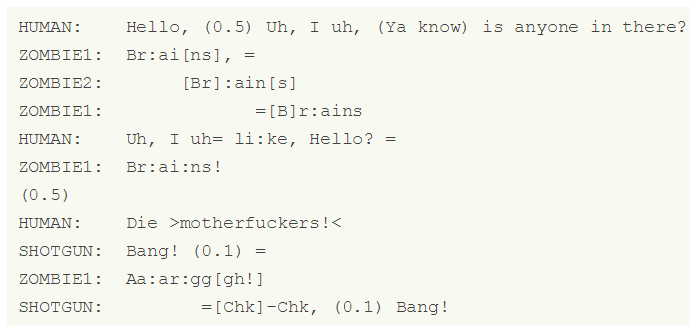
Conversation Analysis.2 (1)
Cross-posted at Code and Culture.

Gabriel Rossman is a professor of sociology at UCLA. His research addresses culture and mass media, especially pop music radio and Hollywood films, with the aim of understanding diffusion processes. You can follow him at Code and Culture.

Sometimes the sexy goes too far. These are some of those times.

Sexy pizza rat (Yandy):

21

Sexy Cecil the Lion (Yandy):

19

Sexy Donald Trump (Yandy):

18

Sexy Rosie the Riveter (Party City):

20

Sexy Frankenstein (Yandy):

10

Sexy infant (Yandy):
11

Sexy Charlie Brown (Yandy):

14

For more Sexy What!?, see our past posts featuring Sexy Chinese Take-Out, Sexy Yoda, and Sexy Chuckie.

Lisa Wade, PhD is an Associate Professor at Tulane University. She is the author of American Hookup, a book about college sexual culture; a textbook about gender; and a forthcoming introductory text: Terrible Magnificent Sociology. You can follow her on Twitter and Instagram.

It’s that time of year again!  Enjoy our collection of Halloween posts from years past or visit our Halloween-themed Pinterest page.

Just For Fun

History

Politics and Culture

Race and Ethnicity

Sexual Orientation

Gender

Gender and Kids

The intersection of Race, Class, and Gender

And, for no conceivable reason…

Lisa Wade, PhD is an Associate Professor at Tulane University. She is the author of American Hookup, a book about college sexual culture; a textbook about gender; and a forthcoming introductory text: Terrible Magnificent Sociology. You can follow her on Twitter and Instagram.

In the 2.5 minute Atlantic video below, sociologist Bruce Western discusses the problem of mass incarceration. The practice, he says, isn’t just about locking up lots of people — almost 700/100,000; more than any other nation on earth — but incarcerating groups of people in concentrated ways, namely Latino and especially Black men. This devastating to communities, relationships, and children.

2 3

Mass incarceration is a choice, Western points out. “We’ve chosen prison as a way to respond to crime.” There are lots of other things we could do, other than the deprivation of liberty: restorative justice, house arrest, mental health or substance abuse treatment, community service, parole and probation, fines, halfway houses, and more.

Watch it here:

At Family Inequality, sociologist Phil Cohen argues that it would be relatively easy for Americans to raise the funds to end child poverty. All it would take is an average of $578 per non-poor family per year. Taxed on a sliding scale, the rich would pay more and the middle and working class less. This is what the tax would look like (more rich on the left, less rich on the right):

eliminate child poverty.xlsx

Thinking that ending poverty for children is “hard” is part of the problem, he argues.

Americans tend to think of poverty as a giant, intractable problem, combining intergenerational dynamics, complex policy tradeoffs, conflicting cultural values, and “personal responsibility” (not to mention genetics).

Ideas like these are a resource for conservatives who don’t want to help poor families or don’t want to help badly enough to let it come out of their pockets. They can argue complexity and shrug. But Cohen wants us to recognize that it would be easy.

And, if it’s so easy, then the persistence of child poverty means that we just don’t want to do it.

He concludes:

Some people say the Pope should stick to religious matters, and not speak about politics. Some people also say a social scientist should stick to scientific analysis, and not make moral demands. You can ignore my moralizing, as long as you understand the fact that child poverty is a choice we make with our policies. Eliminating child poverty does not require restructuring American families, mass contraception campaigns, or a new ethos of shame. It just costs a little money.

Lisa Wade, PhD is an Associate Professor at Tulane University. She is the author of American Hookup, a book about college sexual culture; a textbook about gender; and a forthcoming introductory text: Terrible Magnificent Sociology. You can follow her on Twitter and Instagram.

In 2010, Hasbro launched the fourth generation of the long lived My Little Pony© TV programs and toys.  What would happen in the next five years shocked not only Hasbro, but the world.  A new type of fan emerged: Bronies, originally dedicated men aged 16 to 25, but now both men and women from 14 to 35, primarily. Members of all branches of the military love My Little Pony, but there is a perception among them that Marines are the majority.

I’ve been analyzing social media and observing presentations on Military Bronies at Brony conventions in an attempt to understand how they experience and negotiate their fandom within the military.

You don’t have to go very far on the net to find them.  This is no trolling of middle aged men in the dark basements from the blackhole of the net. These are proud men and women in the service, coming together on pages like FOBEquestria.com or Military Bronies on Facebook (with over 10,000 members).

4

8

They have created not only their own niche in the fandom, but their own art, music, and even military paraphernalia. Here’s an example of fan art by Sir-Croco:

9

Interestingly, they have had an influence in the progression of the show. It is believed, for example, that the development of the show’s Wonderbolts Academy and characters was a response to military fans. The show’s creators acknowledge that they mirror the Navy and Air Force flight demonstration teams.  And a former US Navy fan became so “horse famous” (the act of gaining notoriety as a fan icon), that he has now joined the cast.

Military Bronies are quick to defend their love for My Little Pony and point out the positive lessons taught by the show. For instance, the US Army’s Values statement includes the following: Loyalty, Duty, Respect, Selfless Service, Honor, Integrity, and Personal Courage, while the elements of Harmony in My Little Pony are Loyalty, Honesty, Generosity, Laughter, Kindness, and Magic. With a bit of creativity, one can easily see similarity between the two.

Because My Little Pony is made by Hasbro for young girls and features females as their “mane” characters, some consider it to be deviant for teen and adult men to like the show. As one Brony said, they’re sold on “the pink aisle!” Male Military Bronies at times suffer from the kind of stigma and bullying reserved for feminine men and, because they are also often assumed to be gay, homophobia. One Brony, for example, discussed how his platoon sergeant refuses to inspect his room because it is plastered with My Little Pony paraphernalia that the sergeant does not want to see or be near.

But it’s okay to be gay in the military now, at least policy wise. It may be that the repeal of “Don’t Ask, Don’t Tell” actually opened up space for Military Bronies. Before the repeal, love of My Little Pony might have been interpreted as a “tell” and punished accordingly, but today there can be no institutional response to soldiers’ sexual orientation, so stigmatization when it occurs seems to remain informal.

Male Military Bronies are a fascinating site of negotiations of masculinity in one of its strongest bastions. Along with their female counterparts they also represent an interesting new form of fan. I hope that my research will teach us a lot about how men negotiate gendered expectations and will check back in as my project develops.

Cross-posted at Pacific Standard.

Kevin W. Martin, MA is a doctoral candidate at the University of Missouri, specializing in queer theory, identity, and deviance. You can follow him in Linkedin, Facebook, and Twitter.

There is a light bulb in a fire station in Livermore, CA that has been burning since 1901. It was manufactured in the late 1890s. And, yes, there is a BulbCam.

13

According to Hunter Oatman-Stanford, writing for Collectors Weekly, the first homes that had electricity were serviced entirely by electric companies. He explained:

Generally, customers would purchase entire electrical systems manufactured by a regional supplier who would handle installation and upkeep. If a bulb “burned out,” meaning the filament had deteriorated from repeated heating, someone would come and replace it for you [for free].

Given this business model, it made sense to try to develop bulbs that would burn out as infrequently as possible, and the goal was to make ones that would last forever. The one in Livermore was made by the Shelby Electric Company and, interestingly, no one remembers what they did to make their time-defying bulbs. For now, at least, their secrets are a mystery.

Only later, when electric companies turned over the job of replacing lightbulbs to homeowners, did they decide that it would be more profitable to make cheap bulbs that burned out frequently. As of around 1910, companies were charging the equivalent of $33 for a 1,500 hour lamp (which is about the same life of an incandescent bulb today). Yikes. At least the price has gone down.

We call this planned obsolescence: the practice of designing products with a predetermined expiration date aimed at forcing consumers into repeat purchases. Since the mid-1900s, more and more products have been literally designed to fail. In some cases, we seem to have fully accepted cyclic purchasing (think, for example, of the constant replacing of our electronic devices) or we are embarrassed into doing so (think fashion and the stigma of driving an old car). Other times, like with the lightbulb, we just assume that this is the best engineers can do.

Planned obsolescence is criticized for being wasteful. How many light bulbs sit in landfills today? How many natural resources have we extracted or burned up to make their replacements? How many cargo ships and semis have been filled with lightbulbs and taken around the world?

The little lightbulb in Livermore is a great reminder that just because we live in technologically advanced societies doesn’t mean we always have access to the most advanced technology. Other forces are at work.

Lisa Wade, PhD is an Associate Professor at Tulane University. She is the author of American Hookup, a book about college sexual culture; a textbook about gender; and a forthcoming introductory text: Terrible Magnificent Sociology. You can follow her on Twitter and Instagram.

Flashback Friday.

Two of my favorite podcasts, Radio Lab and Quirks and Quarks, have stories bout how inertia and reliance on technology can inhibit our ability to find easy, cheap solutions to problems.

Story One

The first story, at Radio Lab, was about a nursing home in Düsseldorf, Germany.  As patients age, nursing homes risk that they will become disoriented and “escape” the nursing home.  Often, they are trying to return to homes in which they lived previously, desperate that their children, partners, or even parents are worried and waiting for them.

When they catch the escapee in time, the patient is often extremely upset and an altercation ensues.  If they don’t catch them in time, the patient often hops onto public transportation and is eventually discovered by police.  The first outcome is unpleasant for everyone involved and the second outcome is very dangerous for the patient.  Most nursing homes fix this problem by confining patients who’ve began to wander off to a locked ward.

An employee at the Benrath Senior Center came up with an alternative solution: a fake bus stop placed right outside of the front doors of the nursing home.  The fake bus stop does two wonderful things:

(1)  The first thing a potential escapee does when they decide to “go home” is find a bus stop.  So, patients who take off usually get no further than the first bus stop that they see.  “Where did Mrs. Schmidt go?”  “Oh, she’s at the bus stop.”  In practice, it worked tremendously.  This meant that many disoriented patients no longer needed to be kept in locked wards.

(2)  The bus stop diffuses the sense of panic.  If a delusional patient decided that she needed to go home immediately because her children were all alone and waiting for her, the attendant didn’t need to restrain her or talk her out of it, she simply said, “Oh, well… there’s the bus stop.”  The patient would go sit and wait.  Knowing that she was on her way home, she would relax and, given her diminished cognition, she would eventually forget why she was there.  A little while later the attendant could go out and ask her if she wanted to come in for tea.  And she would say, “Ok.”

Listening to this, I thought it was just about the most brilliant thing I’d ever heard.

Story Two

The second story, from Quirks and Quarks, was regarding whether it is true that dogs can smell cancer.  It turns out that they can.  It appears that dogs can smell lots of types of cancer, but people have been working specifically with training them to detect melanomas, or skin cancers.  It turns out that a dog can be trained, in about three to six weeks, to detect melanomas (even some invisible to the naked eye) with an 80-90% accuracy rate.   If we could build a machine that was able to detect the same chemical that dogs are reacting to (and we don’t know, at this time, what that is) it would have to be the size of a refrigerator to match the sensitivity of a dog’s nose.  When it comes to detecting melanomas, dogs are better diagnosticians than our best humans and our most advanced machines.

Doggy doctors offer some really wonderful possibilities, such as delivering low cost cancer detection to communities who may not have access to clinical care.  A mobile cancer detection puppy bus, anyone?

Both these stories — about these talented animals and the pretend bus stop — are fantastic examples of what we can do without advanced technology. I fear that we fetishize the latter, turning first to technology and forgetting to be creative about how to solve problems without them.

This post originally appeared in 2010.

Lisa Wade, PhD is an Associate Professor at Tulane University. She is the author of American Hookup, a book about college sexual culture; a textbook about gender; and a forthcoming introductory text: Terrible Magnificent Sociology. You can follow her on Twitter and Instagram.