This November, a wave of student activism drew attention to the problem of racism at colleges and universities in the US.  Sparked by protests at the University of Missouri, nicknamed Mizzou, we saw actions at dozens of colleges. It was a spectacular show of strength and solidarity and activists have won many concessions, including new funding, resignations, and promises to rename buildings.

Activists’ grievances are structural — aimed at how colleges are organized and who is in charge, what colleges teach and who does the teaching, and what values are centered and where they come from — but they are also interpersonal. Student activists of color talked about being subject to overtly racist behavior from others and being on the receiving end of microaggressions, seemingly innocuous commentary from others that remind them that they do not, as a Claremont McKenna dean so poorly put it, “fit the mold.” That dean lost her job after that comment. Many student activists seem to embrace the policing of offensive speech, both the hateful and the ignorant kind.

Negative reactions to this activism was immediate and widespread. Much of it served only to affirm the students’ claims: that we are still a racist society and that we, at best, tolerate our young people of color only if they stay “in their place.” Other times, it was confusion about the kind of world these young people seemed to want to live in. Why, some people asked, would anyone — especially a member of a marginalized population — want to shut down free speech?

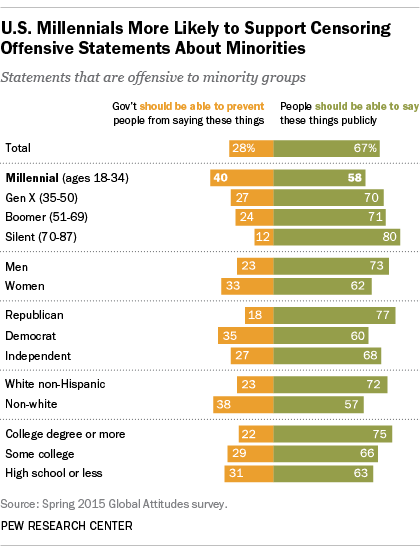
Well, it may be that the American love of free speech is waning. The Pew Research Center released data measuring attitudes about censorship. They asked Americans whether they thought the government should be able to prevent people from saying things that are “offensive to minorities.” Millennials — that is, today’s college students — are significantly more likely than any other generation to say that they should.

In fact, the data show a steady decrease in the proportion of Americans who are eager to defend speech that is offensive to minorities. Only 12% of the Silent generation is in favor of censorship, compared to 24% of the Baby Boomers, 27% of Gen X, and 40% of Millennials. Notably, women, Democrats, and non-whites are all more likely than their counterparts to be willing to tolerate government control of speech.
4

Americans still stand out among their national peers. Among European Union countries, 49% of citizens are in favor of censorship, compared to 28% of Americans. If the Millennials have anything to say about it, though, that might be changing. Assuming this is a cohort effect and not an age effect (that is, assuming they won’t change their minds as they age), and with the demographic changes this country will see in the next few decades, we may  very soon look more like Europe on this issue than we do now.

Re-posted at Pacific Standard.

Lisa Wade, PhD is an Associate Professor at Tulane University. She is the author of American Hookup, a book about college sexual culture; a textbook about gender; and a forthcoming introductory text: Terrible Magnificent Sociology. You can follow her on Twitter and Instagram.

The police do not shoot people. Not any more. Apparently, the word shoot has been deleted from the cop-speak dictionary.

A recently released video shows a Chicago cop doing what most people would describe as shooting a kid. Sixteen times. That’s not the way the Chicago Police Department puts it.

Chicago Tribune: A “preliminary statement” from the police News Affairs division, sent to the media early the next morning, said that after he had refused orders to drop the knife, McDonald “continued to approach the officers” and that as a result “the officer discharged his weapon, striking the offender.”

In Minneapolis, Black Lives Matter is protesting what they think is the shooting of Jamar Clark by a police officer. How wrong they are. The police did not shoot Clark. Instead, according to the Minnesota Bureau of Criminal Apprehension.

MPR News: At some point during an altercation that ensued between the officers and the individual, an officer discharged his weapon, striking the individual.

The police don’t shoot people. They discharge their weapons striking individuals, usually suspects or offenders. A Google search for “officer discharge weapon striking” returns 3.6 million hits.

Worse, the press often doesn’t even bother to translate but instead prints the insipid bureaucratic language of the police department verbatim.

Fearing for their safety and the safety of the public, they fired their guns, striking the suspect.

(Other sources on these stories do put the press-release prose in quotes. Also, in California, officers who discharge their weapons also usually “fear for their safety and the safety of the public.” I would guess that the phrase is part of some statute about police discharging their weapons)

Here’s another example from the Wilkes Barre area:2 (1)The writer nailed the lede: a police officer shot a suspect. But whoever wrote the headline had majored in Technical Language and Obfuscation rather than Journalism.

Does the language make a difference? I don’t know. Suppose the headlines two weeks ago had said, “In Paris, some people discharged their weapons striking individuals.”

Originally posted at Montclair SocioBlog; re-posted at Pacific Standard.

Jay Livingston is the chair of the Sociology Department at Montclair State University. You can follow him at Montclair SocioBlog or on Twitter.

SocImages News:

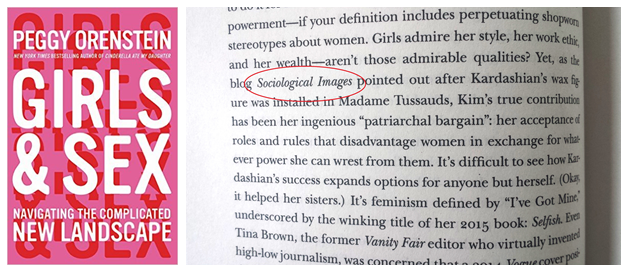
Sociological Images’ post on Kim Kardashian and the patriarchal bargain is mentioned in Peggy Orenstein’s forthcoming book, Girls and Sex: Navigating the Complicated New Landscape. What a wonderful surprise!

7

Also this month, we featured a guest post by sociology graduate student Nicole Bedera. Her criticism of the latest viral Barbie ad prompted NPR to do a story. Listen to hear Nicole and Barbie-scholar Ann DuCille comment on about how far the doll has, or hasn’t, come.

Finally, I had the opportunity to contribute to a smart analysis of energy drink marketing at the New Yorker and a really nice discussion of “love your body”-type marketing at The Establishment.

You like!  Here are our most appreciated posts this month:

Thanks everybody!

Editor’s pick:

Top post on Tumblr this month:

Upcoming Lectures and Appearances:

Hey folks, I’m all booked up for February and March, but might be able to squeeze something in later in the semester. Happy to talk about hookup culture (that’s the favorite) or to offer some of the other talks I’ve worked up on American thinking about genital cutting, the science of sex differences, feminism and friendship, public sociology, and more!

Social Media ‘n’ Stuff:

Finally, this is your monthly reminder that SocImages is on Twitter, Facebook, Tumblr, Google+, and Pinterest.  I’m on Facebook and Instagram and most of the team is on Twitter: @lisawade, @gwensharpnv, @familyunequal, and @jaylivingston.

Lisa Wade, PhD is an Associate Professor at Tulane University. She is the author of American Hookup, a book about college sexual culture; a textbook about gender; and a forthcoming introductory text: Terrible Magnificent Sociology. You can follow her on Twitter and Instagram.
The Economy of Christmas

Lisa Wade, PhD is an Associate Professor at Tulane University. She is the author of American Hookup, a book about college sexual culture; a textbook about gender; and a forthcoming introductory text: Terrible Magnificent Sociology. You can follow her on Twitter and Instagram.

 

Thanksgiving Mythology

Theorizing Thanksgiving:

Some Fun History:

Cigarette Advertising, on this Holiday:

Thanksgiving, Race, and Gender:

Five minutes for fun facts on this almost-Thanksgiving day in the US. Some of my favorites:

  • Stuffing goes back to at least the 4th century CE.
  • Potatoes are truly an American tuber; it’s grown in every 50 states.
  • Corn is a flower.
  • Meat pies preceded desert pies and they were called “coffins.”
  • In case you need a 15th century aphrodisiac recipe: boiled peas and onions sprinkled with cinnamon, ginger, and cardamon.
  • The average American eats between 3,000 and 5,000 calories at Thanksgiving dinner.

Thanks Mental Floss!

Enjoy!

I don’t know for sure what holidays are like at your house, but if they resemble holidays at my house, and most houses in the US, women do almost all of the holiday preparation: decorating, gift buying and wrapping, invitations, neighborhood and church activities, cooking, cooking, more cooking, and cleaning.

Holidays are moments in the year when women, specifically, have extra responsibilities. I distinctly remember my own beloved stepmother telling me — stress making her voice taut — that she just wanted everyone to have a nice Thanksgiving. She would work herself silly to do and have all the right things so that everyone else would have a good time. Multiple this by 10 at Christmas.

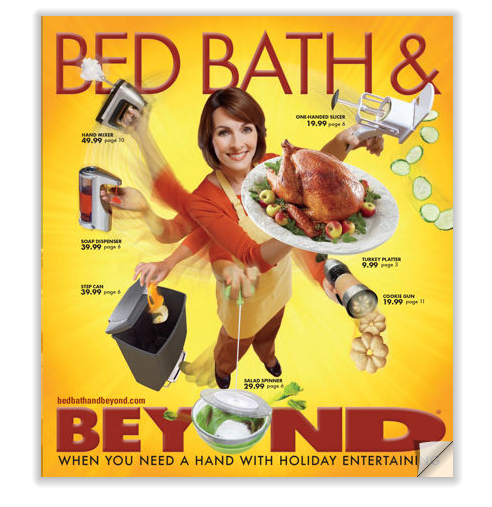
This Bed, Bath, & Beyond ad, sent in by Jessica E. and Jessica S., reminded me of the crazy workload that accompanies holidays for women:

Picture_1Alone with the responsibility of making a holiday for everyone else, the woman manages to mobilize technology and goods from BB&B to make it happen. Ironically, the text reads: “When you need a hand with holiday entertaining,” but actual human help in the form of hands is absent. Apparently it’s easier for women to grow five extra arms than it is to get kids and adult men to pitch in.

Anyhoo, be a peach and give your mom a hand this holiday season.

Originally published in 2009.

Lisa Wade, PhD is an Associate Professor at Tulane University. She is the author of American Hookup, a book about college sexual culture; a textbook about gender; and a forthcoming introductory text: Terrible Magnificent Sociology. You can follow her on Twitter and Instagram.
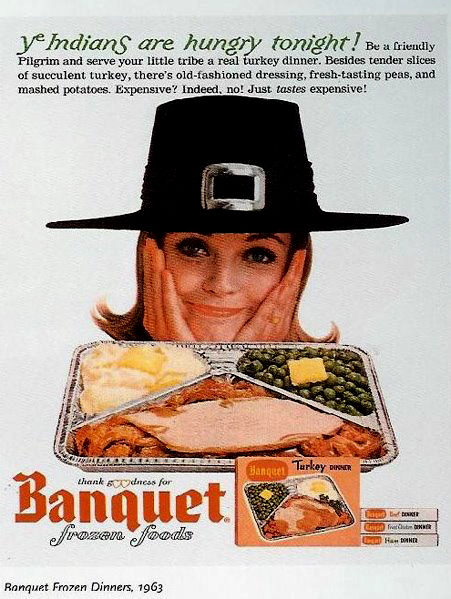
6a00d83451ccbc69e2010536215b89970bPre-prepared frozen meals pre-dated the Swanson “TV dinner,” but it was Swanson who brought the aluminum tray — previously only seen in taverns and airplanes — into the home.

They were motivated by opportunity and necessity. The necessity went something like this, or so the story goes: After the 1953 Thanksgiving holiday, Swanson found themselves up to their ears in turkey. They had overestimated demand, and there they were, with 260 tons of frozen turkey and the next bird holiday 364 days away. So, they slapped together a frozen turkey dinner, with peas and mashed potatoes, and held their breath.

3

The opportunity was the meteoric rise of living room television sets. In 1950, only 9% of American households had TVs. By 1953, 45% of households had one. The next year, that number would rise to 56%. Swanson’s overstock of turkeys occurred at exactly the same moment that owning a television became the new hot thing. So, Swanson tied their advertising directly to TV watching, inventing the phrase “TV dinner.”

2

Rumor is that Swanson wasn’t optimistic, but the dinners outsold their expectations. They planned to sell 5,000 turkey TV dinners that first year, in 1954, but they ended up selling 10 million.

So, if you celebrate Thanksgiving and are eating a TV dinner tonight instead of a whole bird, know that you, too, are part of a true American tradition.

Lisa Wade, PhD is an Associate Professor at Tulane University. She is the author of American Hookup, a book about college sexual culture; a textbook about gender; and a forthcoming introductory text: Terrible Magnificent Sociology. You can follow her on Twitter and Instagram.