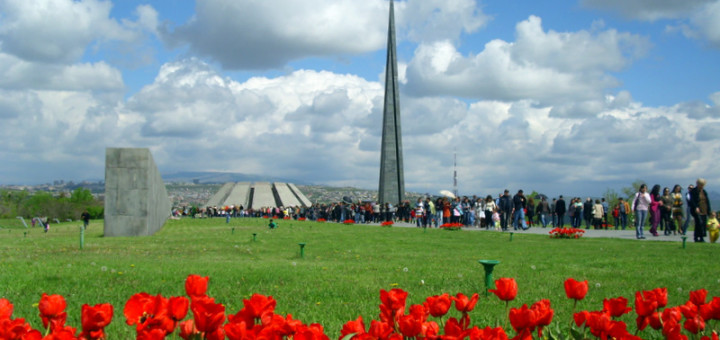
Today marks the 103rd anniversary of the beginning of the Armenian Genocide. As is customary, the Armenian communities around the world and in the Republic of Armenia gather to commemorate the extermination of their kin and kith in the Ottoman Empire in which an estimated 1.5 million Armenian Christians perished as the result of the state organized mass murder. Despite the growing body of incontrovertible evidence about this horror, the government of Turkey still continues to deny the fact of the Armenian Genocide, finding refuge in “the sanctuary of steadfast denial,” to borrow from Truman Capote. Denial then takes many shapes, ranging from the minimization of the number of victims to victim blaming. The survivors of the Armenian Genocide and their descendants have had to confront an entire universe of state produced alternative facts before Kelyanne Conway made alternative facts a thing. As the great French philosopher and essayist Michel de Montaigne has put it, “If a lie, like truth, had only one face we could be on better terms, for certainty would be the reverse of what the liar said. But the reverse side of truth has a hundred thousand shapes and no defined limits.”

Armenian Genocide Monument in Yerevan, Armenia

On April 24 in 1915, hundreds of the Ottoman Empire’s Armenian intellectuals—the leading luminaries of Armenian culture, including professors, doctors, poets, playwrights, composers, and members of the Ottoman parliament—were rounded up and executed shortly thereafter. After these leading voices had been murderously silenced, the Ottoman government of Turkey moved to annihilate its Armenian citizens through a sadistic repertoire of violence that included rape, starvation, death marches, beheadings, public hangings, and mass killings by means and methods so crass and brutal that the butchers of the ISIS would find entirely unobjectionable. Those fortunate enough to survive, like my late grandparents, never fully recovered from the personal damage wrought by the atrocities, which would be later compounded by their own survivors’ guilt. Alongside the destruction of human life, eliminated were also hundreds of Armenian churches, schools, and monasteries – razed to the ground in a carnival of wanton destruction.

Yet Turkey continues to embrace the hydra-headed denial of the Armenian Genocide by funding scholars to rewrite the history of this horrible episode, as well as blackmailing Western governments, and the US government in particular, from officially recognizing the Armenian Genocide. Time and again Turkey has threatened to disengage from lucrative business dealings if these governments make an official recognition of the Genocide. It is a method that has worked in the past. It is time to render it ineffective. It has been wisely observed that the denial of genocide is in fact the final stage of genocide. It can also become the first stage of the next genocide in the making if left unaddressed and without proper redress. Turkey’s current treatment of its Kurdish minority is in a sense connected to the non-punishment of its original crime – the Armenian Genocide. The cycle of crime and non-punishment can be broken if genocides are properly condemned by being properly recognized. This year’s anniversary of the Armenian Genocide, if nothing else, provides the US government the perfect opportunity to break tradition with the usage of “inoffensive” euphemisms and to reclaim, if only partially, the much-squandered moral capital of previous administrations and its own.


Artyom Tonoyan (Ph.D., Baylor University) is Education Program Specialist at the Center for Holocaust and Genocide Studies. He is also a visiting Research Fellow at the Institute of Archaeology and Ethnography, National Academy of Sciences of Armenia. His research interests include sociology of religion, religion and politics in the Caucasus, and the contemporary effects of the Armenian Genocide.

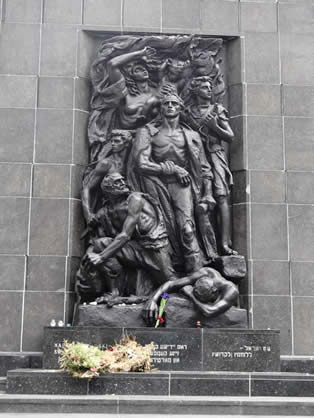
If you have visited Warsaw, Poland, you have seen it majestically rising up from the square, between a Soviet era style apartment complex and the POLIN Museum of the History of Polish Jews. On a sunny afternoon in Warsaw, people sit on benches, read papers, converse and eat lunch; others walk their dogs, or simply stroll along Mordechai Anielewicz Street. The Warsaw Ghetto monument a backdrop to their daily existence, barely noticed.

Politicians and dignitaries lay wreaths, and Jewish visitors leave stones and light Yahrzeit candles. For them, it is a memorial, a way to remember those who fought from April 19-May 16, 1943; who chose how they would die when death was the only option.

For 70 years, Nathan Rapoport’s Warsaw Ghetto Monument has marked the Uprising, first bursting out from the rubble of the ghetto on the spot linked to leader of the resistance Mordechai Anielewicz’s death. From the rubble, a neighborhood has grown around the monument which now faces the new museum dedicated to educating visitors about the thousand years of Jewish life in Poland.

Rapoport, who was Jewish, was born in Warsaw in 1911. He fled in the early days of the German attack on Poland in September 1939, ending up in Soviet territory. He conceived the monument in the immediate aftermath of the Uprising, and was given the commission in 1946 on the basis that he could complete it by 1948 for the fifth anniversary of the uprising, which he did.

The sculpture acts as both monument and memorial. Its duality worked out with the heroic figures of the front embedded into a large stone edifice symbolizing both the wall that segregated the Jews during German occupation, as well as a reference to the Kotel. On the back, a bas relief in the style of Greek processionals, invokes the loss of Jewish lives as they were deported to the death camps in the East.

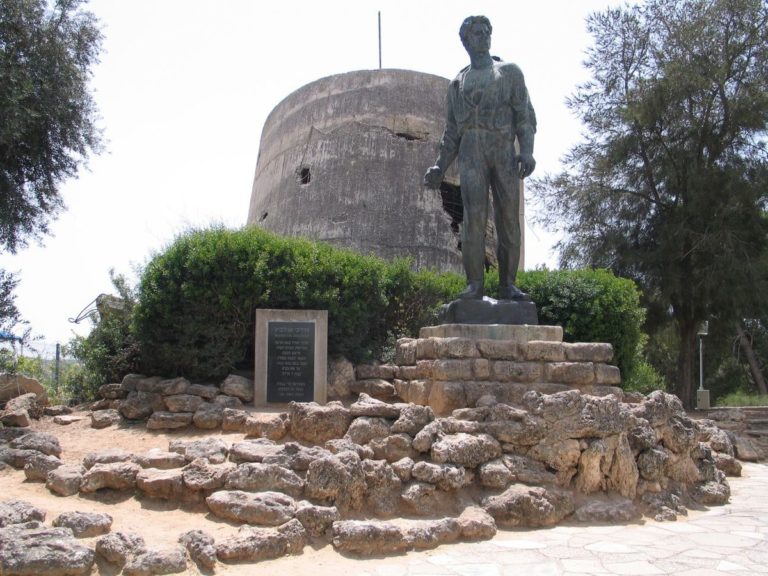
The mix of styles enhances the narrative of heroism and sacrifice linking both to the Uprising and Israel’s statehood. So much so, a version of the monument was also erected in Israel in 1976. The figures in the sculpture are symbolic references to other revolutionary artworks such as Delacroix’s Liberty Leading the People (1830), frame Mordechai Anielewicz clutching a grenade like a modern day David, a theme Rapoport would repeat when he built a statue to Anielewicz at Kibbutz Yad Mordechai in 1951. Influenced by Rodin and Michelangelo, Anielewicz rises up in both works as the champion of the Jewish people, both in Warsaw and in Israel to mark the efforts of the members of the kibbutz (named for him) who fought the Egyptians in the battle for independence.

Anielewicz may not have been herculean in stature as Rapoport portrays him, but he certainly loomed large in his commitment to the resistance in Warsaw, and to giving meaning to Jewish deaths at the hands of the Nazis. Anielewicz, born outside of Warsaw in 1919, was a Zionist who led several movements during the War prior to his time in the ghetto. In 1941, he began to encourage and organize an armed resistance movement, which he led until his death during the Uprising on May 8, 1943. His last words written, “The dream of my life has risen to become fact. Self-defense in the ghetto will have been a reality. Jewish armed resistance and revenge are facts. I have been a witness to the magnificent, heroic fighting of Jewish men in battle.”

As we commemorate the 75th anniversary of the Warsaw Ghetto Uprising, we must also recognize Rapoport’s sculpture for it has forever solidified the event in our collective memories, and reinforced the importance and significance the Uprising has played in Jewish history.


This article first appeared on the Holocaust and Humanity Center blog.

Jodi Elowitz is the director of education at the Center for Holocaust and Humanity.

Kentucky recently became the eighth state in the nation (joining a small but growing list of states) to mandate Holocaust and genocide education for all middle and secondary students. The Ann Klein and Fred Gross Holocaust Education Act recently passed the Kentucky General Assembly and was signed into law on April 2nd, 2018. The law states: “Every public middle and high school’s curriculum shall include instruction on the Holocaust and other cases of genocide, as defined by the United Nations Convention on the Prevention and Punishment of the Crime of Genocide, that a court of competent jurisdiction, whether a court in the United States or the International Court of Justice, has determined to have been committed by applying rigorous standards of due process.” While such well-intentioned legislation aims at countering increasing anti-Semitism in the United States and around the world, the bill may well fall short of lawmaker’s intentions in its implementation in classrooms. The legislation makes no provision for supporting the state’s teachers in complying with the law. Further, the law’s language may curb teachers from robust explorations of genocide by limiting permissible case studies.

The impetus for such legislation often rests on the widespread assumption that schools and individual educators are not teaching students about the Holocaust and other genocides. These assumptions are often reinforced by efforts such as Rhonda Fink-Whitman’s popular YouTube video highlighting Pennsylvania students’ lack of knowledge about the Holocaust. The fact remains that no comprehensive studies exist examining Holocaust and genocide education in the United States. The decentralized nature of American schooling, unlike countries such as Germany and Israel, has led to a patchwork of Holocaust and genocide education efforts. Most states include the Holocaust in their state educational standards for social studies or English language arts, yet critics claim that these standards rarely prove sufficient to ensure students learn about the Holocaust. Ironically teachers, who will ultimately be charged with fulfilling Kentucky’s mandate, are absent from the legislation and the conversations around the law.

Ultimately, the Kentucky law, which is being widely praised by legislators and Jewish community organizations, does little to address the gap between such legislative mandates and their implementation in schools. State Representative Lynn Bechler (R) expressed concerns about this gap: “I believe that everybody should know what happened in the Holocaust, the horrors of the Holocaust. I continue to have problems, however, as the session goes on, that we require more, and more and more from our teachers and our schools.” In 2008, the Kentucky legislature passed a bill, which empaneled a commission to create a state Holocaust curriculum. Unfortunately, the results of the commission’s work, little more than a list of resources (some with costs associated), provides few supports for educators as the state moves forward with its mandate. Kentucky, unlike New Jersey (with a robust cache of Holocaust curricula and teacher trainings) or Florida (with a network of Holocaust museums and educational institutions), has few available resources to support schools and individual educators. At issue, isn’t, as Bechler suggests, requiring more from teachers, but requiring more from teachers while failing to make provisions for adequate support.

Further, the Kentucky law, while seeking to expand instruction on the Holocaust and other genocides, might ultimately limit genocide education efforts. The bill restricts instruction to those instances of mass atrocity that meet the provisions of the 1948 United Nations Convention for the Punishment and Prevention of the Crime of Genocide or other national and international court proceedings. Surely such language is intended to sidestep controversies over the use of the term genocide. However, under such guidelines, educators might well be restricted from using a genocide framework to explore the destruction of Armenians during World War I (acknowledged as a genocide by Kentucky, but not by the United States or the United Nations), current atrocities against the Rohingya, or such efforts to recognize the genocide of Indigenous peoples. The Kentucky law raises serious questions of teacher autonomy to construct lessons to challenge students around such complex issues as genocide.

As a teacher and Ph.D. student in social studies education interested in Holocaust, genocide, and human rights education in U.S. schools, I laud efforts to ensure access to Holocaust and genocide education for students. However, I question the efficacy of the Kentucky legislation without simultaneously attending to increased Holocaust and genocide education in teacher licensure programs, as well as immediate and continuing support for existing teachers via curricular support and robust professional development. Although no such Holocaust education mandate exists within Minnesota, organizations have mounted campaigns to push for mandates in all 50 states. As similar legislation is introduced across the country, I urge lawmakers to avail themselves of the models set forth by states like Michigan and Illinois and carefully consider the implications of narrowly defining genocide. Teachers need adequate support and the freedom to construct lessons to help students grapple the complexities of the Holocaust and other genocides.


George Dalbo is a Ph.D. student in Social Studies Education at the University of Minnesota with research interests in Holocaust, comparative genocide, and human rights education in secondary schools. Previously, he was a middle and high school social studies teacher, having taught every grade from 5th-12th in public, charter, and independent schools in Minnesota, as well as two years at an international school in Vienna, Austria.

Thursday marks the start of the 37th annual Minneapolis-St. Paul International Film Festival, a two plus week celebration of cinema from across the globe. This year’s events feature more than 250 films spread across six theaters throughout the Twin Cities.

Here are a few selections that may pique your interest:

Dodging Bullets

Dodging Bullets examines the contemporary issues affecting the lives of Native people through the lense of intergenerational trauma. Going beyond the history of Native peoples’ first encounters with Europeans, the films highlights the continued racism and disenfranchisement communities continue to face to this day.

Hitler’s Hollywood

Hitler’s Hollywood examines the Third Reich’s infatuation with Hollywood cinema and its deliberate attempts to emulate it. Rüdiger Suchsland’s film looks at the Nazi era’s lasting influence on German film and its impact on today’s work.

Indian Horse

Indian Horse’s titular character is an eight year old Ojibwe-Anishinabe boy who is sent to one of Canada’s Catholic residential schools. Barred from using his language and expressing his culture, Indian Horse finds solace through playing hockey. The film is based on the novel by one of Canada’s most famous indigenous authors, Richard Wagamese.

Ohiyesa: The Soul of an Indian

Ohiyesa is the the story of George Eastman, a renowned lecturer, physician and Native American rights activist. In this film, Eastman’s descendents, including MN alum Kate Beane, document his life and the impressive legacy he leaves today.

Risking Light

Risking Light is filmmaker Dawn Mikkelson’s in-depth exploration of forgiveness. From Cambodia to Australia, the film examines how people can forgive the seeming unforgivable, including two survivors of Australia’s lost generation.

With hundreds of films to choose from, the next two weeks are sure to be a cinephile’s dream. Happy watching!

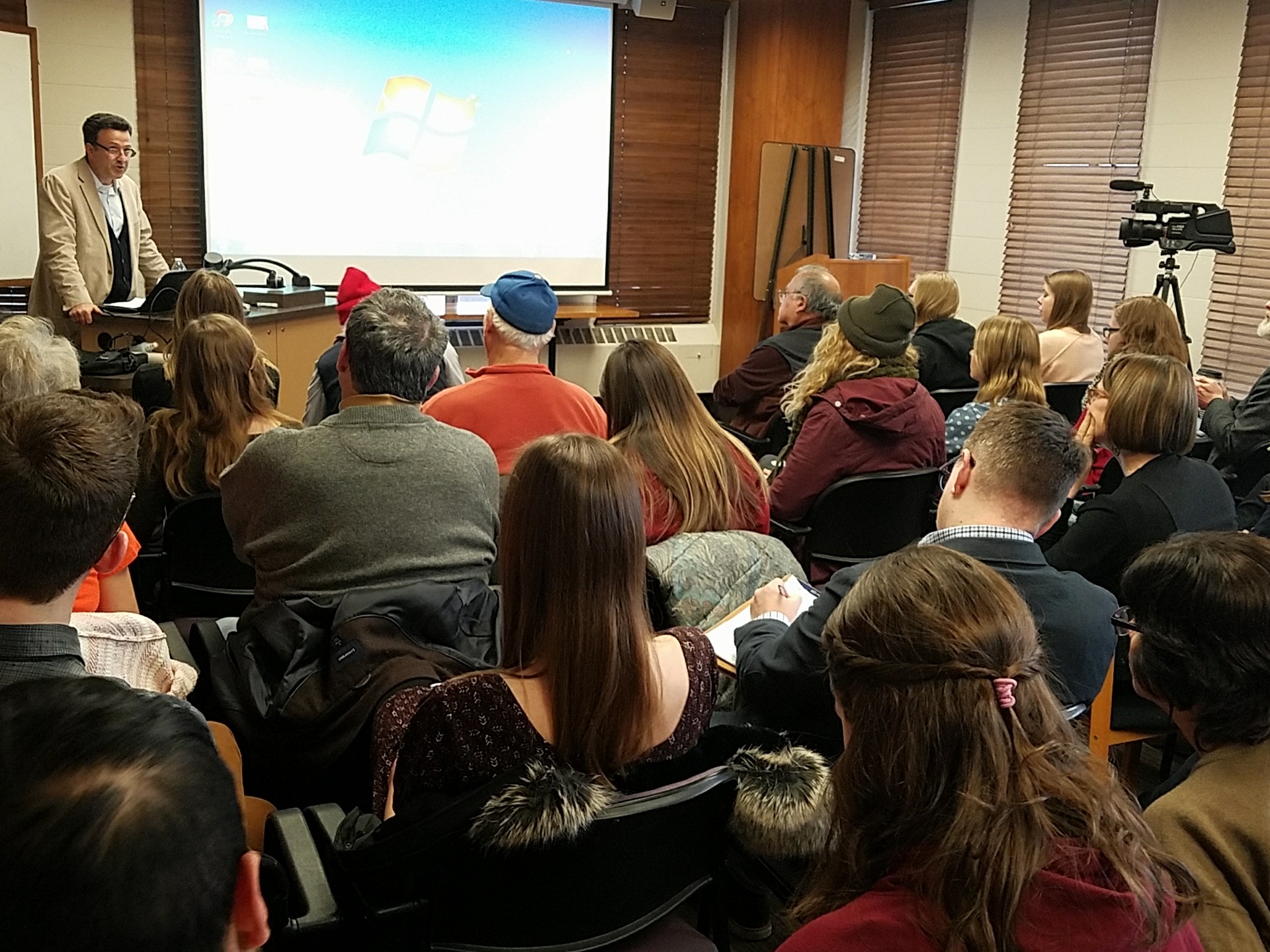
Professor Carlo Tognato gave a lecture titled, “Narrating the ‘Righteous in the Colombian Armed Conflict’: A civil pedagogy of solidarity for highly polarized and deeply divided societies” at the Holocaust, Genocide and Mass Violence Interdisciplinary Graduate Group. You can watch the lecture here. After his lecture, Tognato shared more insights with Michael Soto (UMN Graduate Student, Sociology).

Carlo Tognato is Associate Professor at the Department of Sociology at the Universidad Nacional in Colombia. He is also Director of the Nicanor Restrepo Santamaría Center for Civil Reconstruction in Bogotá and Faculty Fellow at the Center for Cultural Sociology at Yale University. For over a decade, he worked on cultural economic sociology. Since 2014, though, his research has almost exclusively concentrated on civil reconstruction in postconflict society, thereby taking a more interventive and public turn.
 

In your presentation on “Narrating the ‘Righteous’ in the Colombian Armed Conflict,” you highlighted that post conflict narratives tend to have a binary focus on victims and perpetrators. You introduced a third category, that of the ‘Righteous.’  What does this mean and why is it important?

The big problem with the victims-perpetrators binary is that it ends up feeding into extreme polarization and deep socio-political divisions. When you are under these circumstances, and you want to solidarize with a person who belongs to another group, then the people within your own group will see the act of solidarity towards people from other groups as an act of betrayal of in-group solidarity.  

This has some major implications. If in your own group you have some perpetrators, and you refrain from solidarizing with the victims that belong to other groups, then you are stuck with the perpetrators you have in your own backyard, and with the moral responsibility that comes from accepting it and not doing anything about it.  

If, on the other hand, you solidarize with members of other groups that might deserve your solidarity and hence you do the right moral thing, then you have to count on the possibility that people from your own group will start to withdraw their solidarity with you. And this may be quite problematic. After all, as a result of deep divisions and extreme polarization, solidarizing with the victims of other groups will not necessarily translate into receiving the protections granted by that group to its members. As a result, as groups are trapped into their own tribal solidarities, once you cut your solidarity ties with people from your own group, you are left alone. And that is socially a very dangerous place to be.

The category of the ‘Righteous’ in a conflict like the Colombian, extends that of the “Righteous Among Nations” which was born within the experience of the Holocaust. The “Righteous Among the Nations” were non-Jews who, during the Holocaust, were willing to take some risks, and pay even a high price to perform acts of solidarity and generosity. People who were non-Jews were willing to engage in acts of solidarity towards Jews in order to save them from extermination.  

Now, such behavior can be found at other times and within other contexts of violence. However, almost regularly the story of these people who do engage in such acts of generosity, against all odds, towards people from the other side are not being told systematically. If we only focus on the victim-perpetrator binary in pursuit mostly of recognition of the suffering of the victims, a step that is necessarily at the core of the cultural work on collective memory in post conflict societies, then we lose sight of the need for integration and for the restoration of the cement of society. In short, we lose sight of the imperative of restoring cross-group solidarity across society.

By analogically applying the category of the ‘Righteous’ outside the Holocaust, the idea of the “Righteous Among the Nations,” we may be in a better position to address the reconstruction of solidarity ties across groups when socio-political differences have been essentialized to the point of being similar to the way racial differences were coded between Jews and non-Jews in Germany in the ‘30s and ‘40s.


Can you tell me a little more about how this narrative might impact different individuals based on their social position, say bystanders, or if they are on opposite sides of the conflict?

The category of the ‘Righteous’ provides an analytical lens to distinguish between different kinds of bystanders. The category of the bystander provides a very broad umbrella, under which many kinds of behavior can sit. Some are an expression of civil indifference, while others resist or reject it.  

The category of the ‘Righteous’ performs a direct interpellation on bystanders that are indifferent to the suffering of the victims or turn a blind eye on them. Generally, when we observe a group of people, it is hard to recognize who are prone to civil indifference and who are capable and willing to activate themselves to mitigate the suffering of others. Game theoretically, we need to  generate a separating equilibrium that allows the latter to come out from every single group of society, mutually recognize themselves and hopefully come together and collaborate. The narrative of the ‘Righteous’ contributed to that. By identifying with the ‘Righteous,’ this latter type bystanders may indirectly signal to each other their willingness to face and resist evil and not to back the perpetrators that their own social group might have produced. At the same time they will not sacrifice their social ties with members of their own groups by identifying with the ‘Righteous’ within their own. Such separating equilibrium, in turn words, comes at lower social costs and hence becomes more feasible.

This, in turn, paves the way to undermining the social base that in post-conflict societies still sustains perpetrators, not because bystanders want to support them, but rather because they are stuck in a prisoner’s dilemma. The story of the ‘Righteous’ gives bystanders from all social and political groups the chance to identify with the positive example set by the ‘Righteous’ at no or low social costs instead of withholding solidarity with victims from other groups and hence being stuck with the perpetrators within their own.

One of the typical defenses that perpetrators deploy, in a war or conflict, or in its aftermath, is to claim that the very nature of war is that horrible things happen. The example of the ‘Righteous’ debunks that. They chose to do and ultimately did otherwise. In other words, people face options. This is extremely powerful, and may inspire other bystanders to overcome their own civil indifference.


This reminds me of a phrase from your talk, “To act in solidarity we need to imagine it.”

Yes, when after a long, internal armed conflict, people have lost the capability of imagining solidarity with members on the opposite front, because they are trapped in the vicious circle of mutual hatreds and recriminations, we need to restore that capability. Telling the stories of those who did engage in those acts of solidarity tells people that the very possibility for that solidarity is not dead. To imagine that possibility, we don’t need a representative sample. The issue is not a quantitative one. The appearance on one’s own horizon of the stories of the ‘Righteous’ who bear witness to that possibility is per se sufficient.

What’s more, it raises questions for the people who are around them, and for those who might not need to run great risks or pay high prices for their solidarity for members of other groups and still they decide to turn a blind eye on their suffering. That is where the category of the ‘Righteous’ is productive.  

My sense, though, is that to move bystanders from their indifference by virtue of the example of the ‘Righteous’, we may need to simultaneously tell the story of the ‘Righteous’ who stand on polar opposite of a societal spectrum, either political or social, that is, people on the extreme left and extreme right, people from the opposite ends of the social pyramid, hence from popular strata and elites, or even from the middle class, people from civil society and State, or from the armed forces and the trade unions. We need to weave their stories of solidarity towards the other side together in a criss-crossing pattern for the purpose of showing that zipping the fragments of society together after a war is possible by tapping on to the example of such ‘Righteous’.  


You described your project as a “pedagogy for civil courage.” Could you expand upon it and explain more what you mean?

The stories of the ‘Righteous’ set an example and face people with a powerful interpellation: “What did I do in a given situation? What could I have done? What should I have done?”  

For instance, German students in 1968 turned on their parents and asked: “Wo warst du?,” “Where were you? Where were you when Hitler and the Nazis did all that?”  

The stories of the ‘Righteous’ face bystanders with a similar question, and also provide them with an option to emancipate themselves from the moral weight of past indifference to the suffering of others by identifying with the ‘Righteous’ and by committing to their example at least for the future. That interpellation from the ‘Righteous’ must resonate across schools and universities, in the media, in fiction on TV and cinema: “Wo warst du?,”  “Where were you?  Why were you indifferent when others were not and engaged in acts of solidarity? This can be pedagogically powerful.


Could you expand upon the role of collective memory? You mentioned that it is sometimes seen as a source of division and sometimes of coming together.

If we look at postconflict societies in Latin America or elsewhere, the process of construction of a postconflict collective memory almost regularly focused on the victim-perpetrator binary, thereby feeding into polarization.

This is worrying because postconflict societies must build some common horizon of the future if their people are to live side by side peacefully. Such construction, however, must pass through the construction of a common horizon of interpretation of what happened in the past.

In societies where it is more difficult to distinguish between victims and perpetrators, this latter process becomes a daunting task. The stories of the ‘Righteous’ provide a base to converge on a common horizon of interpretation of that past. People can come to identify with the common ground of civil decency in the face of violence and suffering that the stories of the ‘Righteous’ make it possible to bring into focus.


Lastly, you mention that part of your hope that people would be inspired to come onto the project. Could you highlight some specific ways that people could come onboard?

In my talk at CHGS I laid out five lines of intervention that this project on the ‘Righteous’ is currently pursuing. We must lodge narratives about the ‘Righteous’ in journalistic practices, in the aesthetic realm, in the State apparatus, particularly among the public security forces, in education and in memorial museums.

Students and colleagues may contribute by thinking ways of achieving that more effectively or they may join the actual delivery of the interventions from academia along the above-mentioned lines. On both fronts, this provides opportunities for scholars and students who are keen on practicing a more interventive as well as public social science.

Also, you don’t need to be a Colombia specialist to come onboard.

It would be very important to open a line of comparative work addressing the challenge of restoring cross-group solidarity after internal armed conflicts or in the course of dramatic political transitions in other places across Latin America, Africa and Asia, from El Salvador, Guatemala, Chile, Argentina, Peru, and Venezuela to Rwanda, Lebanon, Cyprus, Syria, Iraq, Sri Lanka, Myanmar, just to name a few contexts.

Deploying the category of the ‘Righteous’ may enable us to better bring into focus its potential as well as its limits, and hence it may provide new opportunities to calibrate it, extend it and ultimately adapt it. Every single societal context will inevitably produce its native category of ‘Righteous’. This will enable us to give shape to a global research agenda about civil courage, what feeds it, and how we may cultivate across very different societal contexts. I would think that this could provide useful insights for civil society organizations, foundations, governments, and multilateral agencies around the world that are in the business of democratic consolidation as well as peace-building.


Michael Soto is a PhD student in Sociology and fellow at the Interdisciplinary Center for the Study of Globalization Change (ICGC). His dissertation research is on the transition to peace in Colombia, with a focus on reintegration and reconciliation processes.
“A Holocaust video game!” exclaimed the man sitting to my left with an alarmed look on his face. Professor Wulf Kansteiner, in a keynote address, had just suggested both the inevitability and the necessity of such a video game in his argument for expanded tolerance towards the shifting nature of Holocaust narratives in societal consciousness and education. Indeed, half the audience gathered at the three-day Holocaust education conference, “Near but Far: Holocaust Education Revisited,” in Munich, Germany seemed incensed by the idea of a video game about the Holocaust. The other half – a mix of professors, teachers, and site educators – nodded their heads, if not in approval, perhaps knowing that the future of Holocaust education, as outlined by Kansteiner, is already emerging. Indeed, such games are making a tentative foray into an industry whose revenues have surpassed those of the movie industry for more than a decade.

The conference, part of a larger project exploring contemporary trends in Holocaust education in Germany and beyond, hosted researchers and practitioners from all over the world at Ludwig-Maximilians University. Throughout the conference, familiar tensions emerged between the particularity and sanctity versus the universality and normalization of the Holocaust in public consciousness and education. By and large, the German academics and teachers seemed more conservative in their approaches to Holocaust education, resisting trends towards de-contextualization and dehistoricization, while American colleagues seemed more willing to embrace shifting Holocaust narratives, which, on more than one occasion, were described as part of the “Americanization” of the Holocaust.

Perhaps most provocative were the sessions exploring how technology is changing how students learn about the Nazi atrocities. With a note of caution, treading a middle ground between his German and U.S. colleagues, Canadian Professor Scott Murray reviewed current practices in Holocaust testimony. Murray challenged participants to think about the ethical and moral questions raised by the Shoah Foundation’s New Dimensions in Testimony Project. The program creates interactive avatars of Holocaust survivors, which are capable of responding to students’ questions. Many attendees wondered if the Shoah Foundation’s interactive avatars would soon replace practices of bringing survivors to visit classrooms or taking students to sites like the Dachau Concentration Camp Memorial Site and the  Munich Documentation Center for the History of National Socialism.

Highlighting the power of survivor testimony, Abba Naor, a Holocaust survivor living between Israel and Germany, spoke to a rapt audience, including many students from the university’s pedagogy department. Following his moving talk, German students in the audience pressed Naor about his relationship with Germany and the Germans. Noar spoke neither of animosity nor goodwill, but rather of a complicated relationship and an overwhelming compulsion to share his personal story with students. After attending many sessions over the three days of the conference that effectively explored the nuances of Germany and Germans’ complicated relationships with the Holocaust, Naor’s story and comments on his own relationship to Germany seemed to ground such research. Naor, who will soon turn 90 years old, further highlighted the nearing moment when survivors will have all passed away.

As a new Ph.D. student just beginning my studies, Near but Far: Holocaust Education Revisited, helped highlight the tensions and directions within the growing field of Holocaust education. Colleagues from Spain, Israel, Brazil, and India demonstrated the differences in national approaches to Holocaust education, but also the increasing number of similarities as the effects of globalization assert themselves on the field. Despite much talk of the collapse of the Eastern Bloc and the developments within Holocaust studies in the ensuing almost 30 years since the end of the Cold War, interestingly, yet perhaps unsurprisingly, few sessions made any mention of the Holocaust in the East, the so-called “Holocaust by bullets.” Poland’s recent Holocaust legislation, criminalizing any speech that implicates Poles in the murder of Jews, further highlights the need for research into the Holocaust and Holocaust education in Eastern Europe.


George Dalbo is a Ph.D. student in Social Studies Education at the University of Minnesota with research interests in Holocaust, comparative genocide, and human rights education in secondary schools. Previously, he was a middle and high school social studies teacher, having taught every grade from 5th-12th in public, charter, and independent schools in Minnesota, as well as two years at an international school in Vienna, Austria.

On March 24, 85 year old Vel d’Hiv roundup survivor Mireille Knoll was murdered and her body partially burned in her Paris apartment by a Muslim neighbor. Pundits speculate that the neighbor may have been radicalized in jail, although we are still at the very beginning of the investigation. The neighbor knew her since age 7. During the past twenty years her humble apartment remained open to him and to neighbors of all faiths. No one could have anticipated the horrific crime, worthy of Dostoyevsky’s Crime and Punishment–the murder of an old, vulnerable woman, just because it is possible, because after the death of God, man is all powerful. In front of such barbarity, one falls speechless, aware that wording will never do justice to such evil. Language, indeed, and forgive the cliché, is inadequate.

The failure of words comes from the failure of theodicy, a word which in Greek means “divine justice.” Man-made atrocities, past a certain degree, can no longer be thought in terms of hidden providence, in terms of making sense of suffering. While Job was tested by God, it would be indecent to explain the torture of Mireille Knoll as God’s and Satan’s plan. French Jewish philosopher Emmanuel Levinas, in an essay written in the wake of the totalitarianisms of the last century, used the phrase “useless suffering.” He meant that after Auschwitz, Hiroshima, and Cambodia, it is no longer possible to believe that suffering has a purpose, that it is God’s plan, or that, if one does not believe in God, it is a necessary evil that will result in historical progress (think of the millions of victims of Stalinism, in the name of a better humanity and of hastening the end of history.) It is no longer possible to believe that negativity, death, and suffering have a hidden purpose.

With the murder of Mireille Knoll a week before Passover, after the murder of Sarah Halimi in uncannily similar circumstances in 2017, after the cold blooded murder of Jewish children in their schoolyard in Toulouse in 2012, language fails because no meaning is commensurable with the deed. The Ancient Gnostics, Christian heretics, believed that there was such a thing as pure evil–an evil that is not just the “absence of the good” (Augustine) but that is a creative/destructive force in the world. As an agnostic, I have a hard time endorsing this narrative, although I find tempting to see the murderer of Mireille Knoll as the devil’s arm.

The scholar of anti-Semitism must nonetheless respond, as rationally as possible. It’s her job, so to speak, to find words and concepts to explain the monstrous. I believe that what we have witnessed has neither a social nor a political explanation. Since we are faced with a pattern, this atrocity is not the effect of an individual mental pathology either. To try to understand this event, it is my contention that we need the help of psychoanalysis and philosophy.

In an essay entitled “Excluded the Jew Within Oneself” (L’Esprit Créateur, Winter 2017) French philosopher Jean-Luc Nancy argues first that the Jews constitute an internal outside, or an external inside, if you prefer, of Europe. In the European unconscious, Jews are an affect, or a principle, that destabilizes the European psyche. That psyche is always already split between a striving for autonomy (to wit, modernity) and the remainder of heteronomy—to wit, an archaic attachment to the call from God. Nancy further suggests a psycho-anthropological theory of sibling rivalry. Built on Judaism, Christianity is yearning for a self-foundation. It strives to be its own origin. The younger does not forgive the elder. In the most compelling part of his argument, Nancy identifies antisemitism as a case of European self-loathing, a phenomenon that pertains to the DNA of European civilization. Nancy argues that European civilization is split between a striving for autonomy and rationality, on the one hand, and, on the other hand, a longing for an ideal and spiritual accomplishment—the sacrifice of power, materiality and wealth to something higher. Nancy is right to see this split at work in the history of the Christian Church (after all, the Catholic Church has built its mundane empire by preaching its rejection of mundane affairs and of worldly considerations). As a result European antisemitism appears as a case of projection. The Jew comes to embody everything that modern Europe hates about itself—money, power, democracy and technique. In fact Nancy’s analysis both in terms of sibling rivalry and in terms of a projection onto the Jews of an anxiety about oneself would apply very well to Islamic anti-Semitism, aka “new anti-Semitism.” Nancy concludes his argument with the metaphor of paranoia—a paranoia at the level of a whole civilization—a threat that originates in oneself is turned into a threat that originates from the other. This remarkable analysis of European anti-Semitism should be extended to the paranoid structure of Islamic anti-Semitism. Indeed, as Avishai Margalit and Ian Buruma have shown, Islamic hatred of the West recycles European self-hatred and the projection on an enemy (the Jew, America) of its anxiety vis-à-vis modernity. Understanding a problem is not solving it. It is, however, our duty as scholars of anti-Semitism to try to shed light with all the theoretical tools at our disposal.


Bruno Chaouat is a professor in the Department of French and Italian, and is also affiliated with the Center for Jewish Studies and the Center for Holocaust and Genocide Studies. He is interested in 19th and 20th century French literature and thought, and has recently published, Is Theory Good for the Jews? French Thought and the Challenge of the New Antisemitism.

Film, since its inception, has played a significant role in capturing history. It has given us ways to explore events in the past while contemplating the present. Art (it would seem) is ahead of politics, especially in matters of examining the painful realities of World War II in Eastern Europe. In recent years there has been a dangerous trend in Poland and Hungary in revising history to fit a political narrative.

Both Poland and Hungary have been trying to balance Democracy and the rise of right wing political parties, who are determined to use the Holocaust to rewrite historical narratives to create nationalistic pride, directly contradicting their past and present. Poland and Hungary along with Ukraine, Lithuania and Latvia, are all experiencing revisionist movements. Historian John Paul Himka believes part of the problem is how these once double occupied countries (by Germany and the Soviet Union) dealt with false historical narratives or “myths” they were told under post-war Soviet occupation, once they were free of Communism. Himka states in their hurry to join the West, they did not take the necessary time and care to explore their wartime roles, allowing for a division between memory and fact.

Poland has been making news after Polish President Andrzej Duda signed controversial legislation which criminalizes any mention of Poles “being responsible or complicit in the Nazi crimes committed by the Third German Reich.” The legislation is very strong on reserving the harshest penalties (of up to 3-year prison sentence) for those who refer to Nazi-era concentration camps as “Polish death camps.” The only exemptions from the law is scientific research and artistic work about the war.

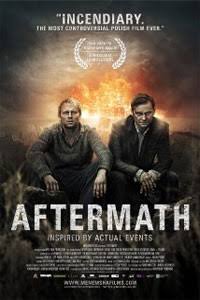
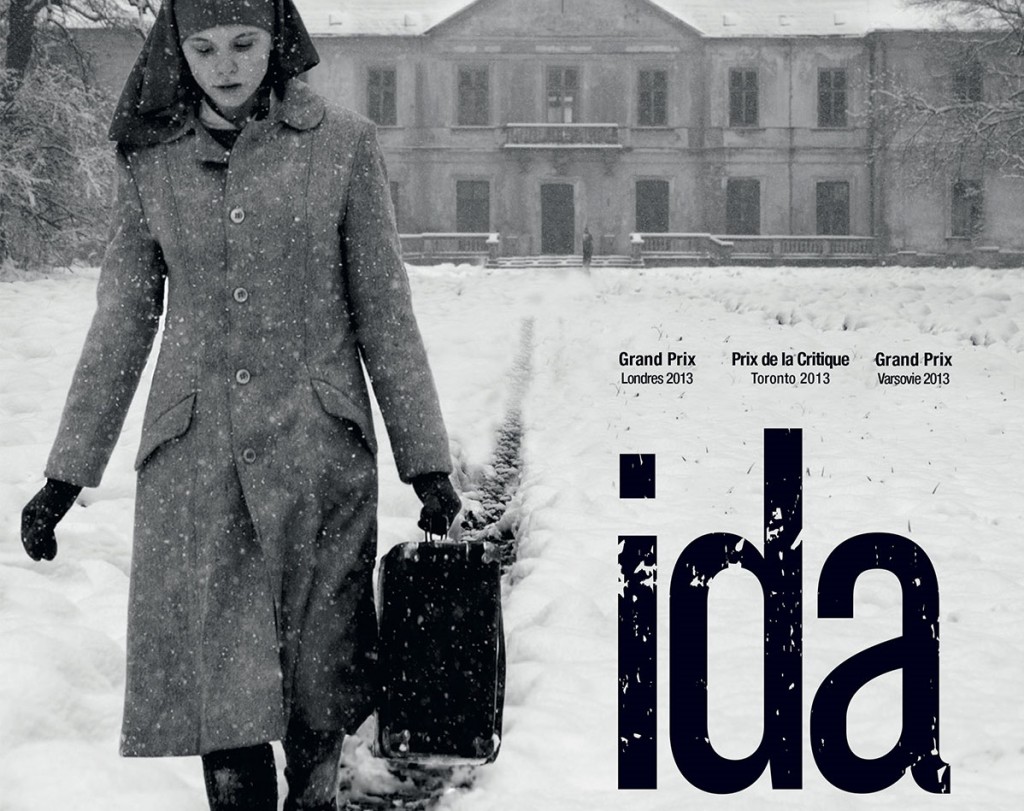
It is interesting that art is exempted, but one must wonder who will determine what is or is not art, or what will be acceptable to the Polish government. The right factions of the government have already shown their hand in how they received the two critically acclaimed films Aftermath and Ida, which deal with the controversial issue of the complicity of Poles in the destruction of their Jewish populations. Both films were labeled anti-Polish, with claims that they inaccurately portrayed Polish actions during WWII.

Aftermath was controversial because it was based on historian Jan Gross’ work Neighbors, which explores the murder of the Jews of Jedwabne by the town’s Poles in July of 1941. The films deal with the myth that it was the Germans who had killed the Jews. The massacre has always been a controversial topic since the release of the book in 2001, and Gross has been the subject of ongoing outrage as he has been repeatedly denounced by Polish right-wing scholars and politicians for defaming the Polish people. Ida, originally less controversial, became targeted after it won an Academy Award for best foreign film in 2015. In 2016, it was televised on Polish TV with a 12-minute government sanctioned documentary defaming the film.

The two films have lead the way to a new movement in Eastern European Holocaust cinema, which examines the actions of the bystanders and the benefactors of the crimes against Jews. Both Aftermath and Ida dig up the past by recovering the secrets buried in unmarked graves across Eastern Europe, exposing the living more so than the dead for as the graves yield their secrets. Those who hoped to bury their crimes in the past must now deal with them in the present, with tragic results.

The latest film to tackle this theme is 1945, a Hungarian film released in 2017, directed by Ferenc Török, based on the short story “Homecoming” by Gábor T. Szántó. The film definitely takes its cues from Aftermath and Ida, sharing both films’ quest for the truth through the lens of 1930’s Hollywood horror and art house film. In 1945, two unknown Jewish men visit a small Hungarian town in the aftermath of World War II. The appearance of the two men sends the town immediately into panic as they reflect on their guilt while rationalizing their behavior towards the missing Jews of the town, whose belongings, homes and businesses they have possessed. Like, Aftermath and Ida, the townspeople are haunted by their actions, but in 1945, burial has a much different meaning. Filmed in black and white, the film also feels like an old western, with tensions that build towards a showdown between the strangers and the townspeople.

It would not hurt for Eastern Europe to look to modern Germany, who after decades of self-reflection and dealing with their past, have accepted responsibility for their actions during World War II. Certainly, this is not easily done, and of course the ghosts of Hitler and the Third Reich will always loom over Germany. Nevertheless, if a country is to thrive, it must examine and learn from its past, admit its wrongs, and accept responsibility before they become the thing they valiantly claim to have fought against. Until then, we will have to hope that more filmmakers in these countries will continue to dig up the past and reveal the truth so that people can remember and honor the dead, as well as truly be able to bury the past in a way that allows them to move forward.


Jodi Elowitz is the director of education at the Center for Holocaust and Humanity.

Part I: Man’s Inhumanity to Women

Mid-semester, in our high school genocide studies course, my students and I were about to begin class by turning to the assigned readings on the Bosnian War and the question of genocide in former Yugoslavia. I had prepared slides for the day’s discussion that included numerous photographs, which, in retrospect, showed mostly Muslim boys and men behind barbed-wire fences. As students were coming into the classroom, one student, Elise (a pseudonym), began describing a performance of Eve Ensler’s Vagina Monologues she had seen the previous weekend. One monologue in particular resonated with the week’s readings: “My Vagina was My Village.” The monologue describes the intimate, excruciating story of a woman being brutally raped during the course of the war, as well as the physical and emotional aftermath of living with the trauma. As Elise described the monologue in careful detail, the class grew increasingly quiet, students’ eyes trained on their desks. I too sat motionless not wanting to interrupt Elise but wondering if the topic of rape was too difficult, inappropriate for high schoolers. Elise ended her comments with a question that reverberated around our classroom: “Why don’t we talk about rape and the stuff that happens to women?” After a long pause, she continued: “It’s almost like…the way it’s talked about…genocide…I mean…it’s almost like it’s something that men do to other men.”

My students and I began to cautiously explore examples of, and the issues around, sexual violence in genocide. Because such topics are not widely discussed in secondary classrooms, I knew that communication with my students, their families, and the school administration were important to ensuring everyone was aware of the classroom discussions. Given the statistics about rape and sexual violence in the United States, it seemed likely that some of my students would have had first-hand experiences with sexual violence, making a safe and supportive classroom environment essential. Although, given recent attention around sexual violence on college campuses, an open conversation about the subject seemed appropriate, if not necessary. After all, these students would be leaving for college in a short few months. In addition to exploring rape and sexual violence, our class discussions also afforded students the opportunity to examine the shame and stigmatization attached to these crimes by societies more broadly. Students soon pushed me and each other to dig deeper, exploring LGBTQ experiences and rape and sexual violence committed against men and boys, an area of even greater societal taboo and stigma.

Part II: “Other Victims”

Over the lunch hour at an educator conference, I walked from the convention center to the Castro neighborhood of San Francisco. I wanted to visit the Pink Triangle memorial, a series of 15 granite pillars topped with pink triangles memorializing the roughly 15,000 gay men imprisoned by the Nazis. As I approached the memorial, with the intention of taking a few photographs to share with my high school students, I notice that the memorial park was abuzz with activity. Unlike many other urban Holocaust memorials that seem largely forgotten after their dedication, this memorial was lovingly tended. Striking up a conversation with some of the people working in the gardens, I shared my and my students’ interest in expanding our knowledge of who our textbook casually refers to as “other victims” of Nazi genocide (only Jews and Roma and Sinti are specifically named). As I talked with the gardeners, I became increasingly interested in the connections these community members had to the memorial. “I watched as so many of my friends died of AIDS,” said one older man. “I wonder,” another asked, “do your students know about AIDS or the ways LGBTQ peoples are still stigmatized and treated unfairly in this country?” I paused, taken aback, where I had expected to visit a memorial to the victims of Nazis persecution, I found a memorial that spoke most powerfully about the AIDS epidemic and the continuing prejudice against LGBTQ communities.

Year after year, my students are always shocked to discover that the infamous Paragraph 175 dates not from the 1930s, but from 1871. The Nazis, however, strengthened the law and increased prison sentences for those targeted under the law from months to years in 1935. Perhaps most alarming for students is to learn of the reimprisonment, even after the Allied liberation of the camps, of many gay men who had not served their full sentence. Indeed, an estimated 50,000 men were prosecuted under the law following the war. The law ultimately remained in effect until 1994. Broader discussions of Paragraph 175, not only help to provide a voice to the “other victims” of Nazi genocide, but also provide ways for students to think about the stigmatization and discrimination of LGBTQ communities over a longer span of time. In recent class discussions, after sharing the above story from San Francisco with my students, we tend to include some discussion of the AIDS epidemic and the bridging between the genocides of WWII and other topics in contemporary discourse.

K-16 educators interested in exploring issues surrounding gender and sexual orientation in genocide are invited to enroll in a weeklong summer educator workshop at the University of Minnesota: Gender and Genocide: Uncovering Absent Narrative in Mass Violence and Human Rights Education


George Dalbo is a Ph.D. student in Social Studies Education at the University of Minnesota with research interests in Holocaust, comparative genocide, and human rights education in secondary schools. Previously, he was a middle and high school social studies teacher, having taught every grade from 5th-12th in public, charter, and independent schools in Minnesota, as well as two years at an international school in Vienna, Austria.

From now until March 24, the Guthrie Theater is presenting Paula Vogel’s Indecent. Surely, this is the 21st century’s greatest play about the Jewish experience in 20th century Europe and America.

It’s a play about a play—Polish (later American) author Solomon Asch’s The God of Vengeance, one of Yiddish theatre’s most famous plays (along with The Golem and The Dybbuk)—but don’t let that put you off. In the hands of Vogel, the history of this work raises many issues relevant to our current times. Plus, the lively staging by Wendy Goldberg includes a good deal of Klezmer music and Jewish dance (choreography by Yehuda Hyman), so the heartbreaking story is thoroughly entertaining.

Asch’s play, The God of Vengeance, tells the story of a hypocritical brothel owner who lives with his wife and daughter above the bordello. His dream is to keep his own daughter “pure” and a perfect candidate for marriage to a young scholar. But the daughter, Rivkele, falls in love with Manke, one of the prostitutes. One of the highlights of the play is a beautiful love scene between the two women in the rain.

The play premiered in Berlin and played all over Europe (in the original Yiddish) in the first two decades of the 20th century to full houses and great acclaim. It was translated into English and presented in America. What happened in our country and after is the crux of Indecent, Vogel’s stunning, theatrical, and moving play. (Like all historical plays and novels, Indecent is a mixture of actual history and invented scenes.)

There is, of course, a Holocaust connection in this play. It’s a play about European Jews in the first half of the 20th century, so how could there not be? I won’t spoil the plot, but at the end of the play, Asch says, “I have lost my audience. Six million of them have left the theatre.” In addition, the creative staff of Indecent includes artists who lost relatives in the Holocaust.

A cast of seven actors performs multiple roles. Most of them are superb local actors, including Miriam Schwartz, Hugh Kennedy, Robert Dorfman, Steven Epp, and Sally Wingert. Only Ben Cherry, from the original Broadway production and Gisela Chípe have been imported. Musicians Lisa Gutkin, Spencer Chandler, and Pat O’Keefe also add color and atmosphere to the production, playing throughout almost all the show.

I can’t recommend this show highly enough to anyone and everyone. You don’t have to be Jewish to be enthralled by it. Within its history of Yiddish culture, the play explores themes of tolerance, the clash between established and new immigrants, censorship and self-censorship, and finds the universal by paying attention to the particular. Rush tickets can be obtained for a very reasonable price. You can also obtain tickets by calling 612-377-2224, or going online to www.guthrietheater.org.


Daniel Pinkerton is a playwright and lyricist. He is co-artistic director of Fortune’s Fool Theatre in Minneapolis. For 27 years, he was an editor at the Center for Austrian Studies at the University of Minnesota.