On October 14, 2017, one of the worst truck bombs ever experienced in Africa ripped the capital of Somalia, Mogadisho. On a global scale, this blast was only second to the 2016 attack in Iraq that killed 341 people in Karrada. This particular attack was so horrific that even a former Al-Shabaab leader was pictured donating much needed blood. As of October 16th, almost 276 people had been declared dead with 300 hundred injured. This number is likely to increase in the coming hours as the rubble is sifted through. Due to the intensity of the blast, there is a very real chance a large number of the dead will never be identified. One of the victims of the attack is Dr. Maryama Abdullahi who was to graduate from the medical school this week and whose parents’ joy and anticipation has now become unbearable grief. Another was Ahmed AbdiKarin Eyow, a Minnesota man who prayed at the Dar-Al-Farooq Islamic Center in Bloomington. I’m not sure if you saw this in your regular news outlets or if it even crossed your social media platforms.
If you haven’t heard this news there are a couple of things I would like to point out. The first is that mainstream news outlets were incredibly slow to cover this story. It would appear that coverage of the attack lagged behind public outcry over the silence of mainstream western news organizations and also by most social media users and platforms. Of the traditional news organizations that did cover the attack, only The Guardian had it as a cover story, a leading online story, and has provided continual updates during the after-math. The second is that our social media views are curated using algorithms which play a large part in affecting what we see on our chosen platform in ways that we as consumers do not understand. Thus, if you do not ‘like’ news stories or follow journalists that cover international events, your chances of seeing this attack on your feed were minimal. The third important factor to consider is essentially how we empathize. As social beings, we are often much likely to empathize with those that we share affinity with the most. We are wired to show empathy to those that look like us, speak like us, could be our siblings, friends and other family members i.e. those in our ingroup. Lest we forget, journalists are as much a product of their society as they are trained professionals. Thus, an explosion in Mogadisho is likely to be interpreted as just ‘another day’ in the Somalia, a country that has been continuously ravaged by al-Shabaab in the recent past. As such, its victims are not part of the ingroup in the same way a victim from France, Belgium or Canada would be. It is probably due to a confluence of these factors that you did not see the news about the worst truck bomb in Somalia and the continent in general.
I would like to pose a few questions: In today’s hyper connected world, how many international news organizations do you follow on your platform of choice? How many non-American news organizations, such as al Jazeera, do you read? These are some of the practical choices we can make to diversify our news consumption habits. To this end, I implore you to be more adventurous in your news consumption. This, I believe, would be the first step towards learning about events such as the attack in Somalia.
j. Siguru Wahutu is a 2017-2018 visiting fellow at the Berkman Klein Center for Internet and Society at Harvard University and a Ph.D. candidate in the Sociology Department of the University of Minnesota. He previously was the 2013-2014 and the 2015 Bernard and Fern Badzin Graduate Fellow in Holocaust and Genocide Studies at the Center for Holocaust and Genocide Studies (University of Minnesota).
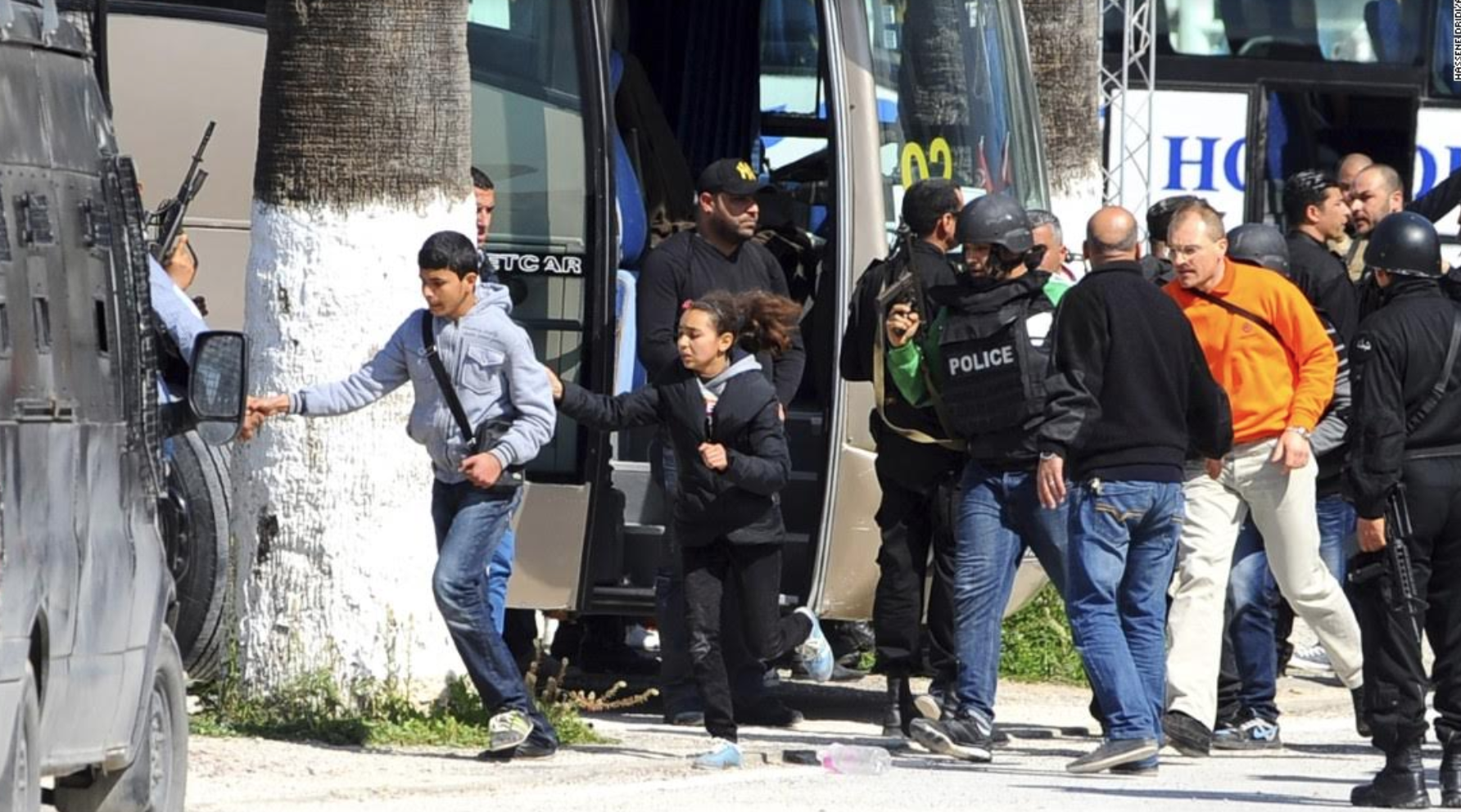
On March 19, 2015, two armed men entered a museum in Tunis, the capital of Tunisia, and opened fire, killing 19 people. The assailants specifically targeted a popular tourist destination with the alleged goal of generating maximum impact on behalf of the Islamic State (IS). This example is hardly unique. Between mid-2015 and mid-2016, numerous large-scale attacks against civilians occurred in the capitals of France, Indonesia, Turkey, the UK, and Belgium, to name only a few. Why do insurgents choose to target capital cities? Are these attacks evidence of a global trend? Are there specific circumstances in which attacks on capital cities are more likely?
Insurgent Attack in Tunisia, 2015 (PC: CNN)
In a forthcoming paper in the journal Political Geography I provide answers to these questions. Using high-resolution geographic data on insurgent atrocities, this study establishes that the increasing frequency of civilian killings in capitals is part of a specific strategy on the part of the perpetrators. These data also allow me to identify specific symbolic capital city features that explain these patterns.
Firstly, insurgents who commit large-scale violence generally seek to inflict harm on regime functionaries and elites – the people who tend to populate capital cities. Attacking those cities, therefore, makes accomplishing their goal more likely, even compared to other large cities that are not the capital. Moreover, attacks can cause financial harm to these elites, coercing them to negotiate with, or at least recognize, the insurgents.
Secondly, attacking the capital generates strong fears among the civilians by demonstrating that the insurgents can hurt them even if they live at the epicenter of political power, in a city that is itself a symbol of the state’s authority. In doing so, they intimidate the civilians into pressuring the regime to settle with the insurgents. This is true not only for suicide bombings and mass shooting sprees, but also more organized campaigns of violence. For instance, in the few days following their 1999 assault on Freetown in Sierra Leone, Revolutionary United Front (RUF) and military junta troops executed approximately 5,000 civilians blamed for being government “collaborators.” This is arguably unprecedented number of noncombatant casualties for a single campaign in almost eight years of civil war.
Thirdly, insurgents might target the capital to hurt, or at least threaten, the citizens of other countries. Diplomatic envoys, non-government organizations, foreign investors, embassies, and tourists are all highly likely to be present in the capital. By harming foreign citizens, insurgents can generate international impact, which might persuade the governments of their victims to pressure the targeted regime to settle with these groups.
Importantly, these attacks do not happen uniformly. While every insurgent group has some incentives to commit atrocities in the capital, some groups might be more likely to do so.
Groups that fight ethnic wars, for instance, target capitals more frequently, because these cities encapsulate the institutional power of the ruling ethnic group and its control of the security apparatus. Ethnic insurgents also have fewer incentives to use violence selectively against regime supporters, because members of the ruling ethnicity are unlikely to view the insurgents’ cause as just. Therefore, the incentives to both coerce elites and intimidate civilians become even more important in these contexts.
A second type of insurgent group with greater incentive to kill in the capital is secessionists. Secessionist campaigns are frequently the result of true or perceived economic injustice, especially if the region offers valuable natural resources such as oil, or the group represents an ethnic majority. Such groups also frequently have limited military strength, and thus choose to kill civilians in the capital to compensate for their military weakness. By attacking civilians in the capital, secessionist insurgents can “persuade” international investors to withdraw their investment from the regime, and seek alternative routes to obtain any lucrative resources the region might possess.
These findings have policy implications. Most importantly, they strongly suggest that governments, international coalitions, and nongovernmental organizations focus resources on devising new strategies to strengthen security at the gateways to capital cities, particularly in countries and regions where ethic or secessionist insurgents have shown a penchant for mass killing.
Ore Koren is a PhD candidate at the University of Minnesota in Political Science, a pre-doctoral fellow at Dartmouth College, and a former Jennings Randolph Peace Scholar at the United States Institute of Peace, specializing in international relations and methodology. Within international relations, his research has involved innovative approaches to studying the causes of civil conflict and political violence. His methodological interests include limited dependent variable models and applied Bayesian statistics, mixed and combined methods approaches, and event data. His work has appeared or is forthcoming in Journal of Politics, International Studies Quarterly, Political Geography, Journal of Peace Research, Food Security, Conflict Management and Peace Science, and Terrorism & Political Violence, as well as policy outlets such as The Monkey Cage (Washington Post), The United States Institute of Peace Policy Briefs, and Political Violence @ A Glance. He also has a contract with Oxford University Press for a coauthored book about the role of paramilitary groups in post-civil-war situations, and a forthcoming coauthored book at Palgrave Macmillan about the politics of mass killing in authoritarian regimes.
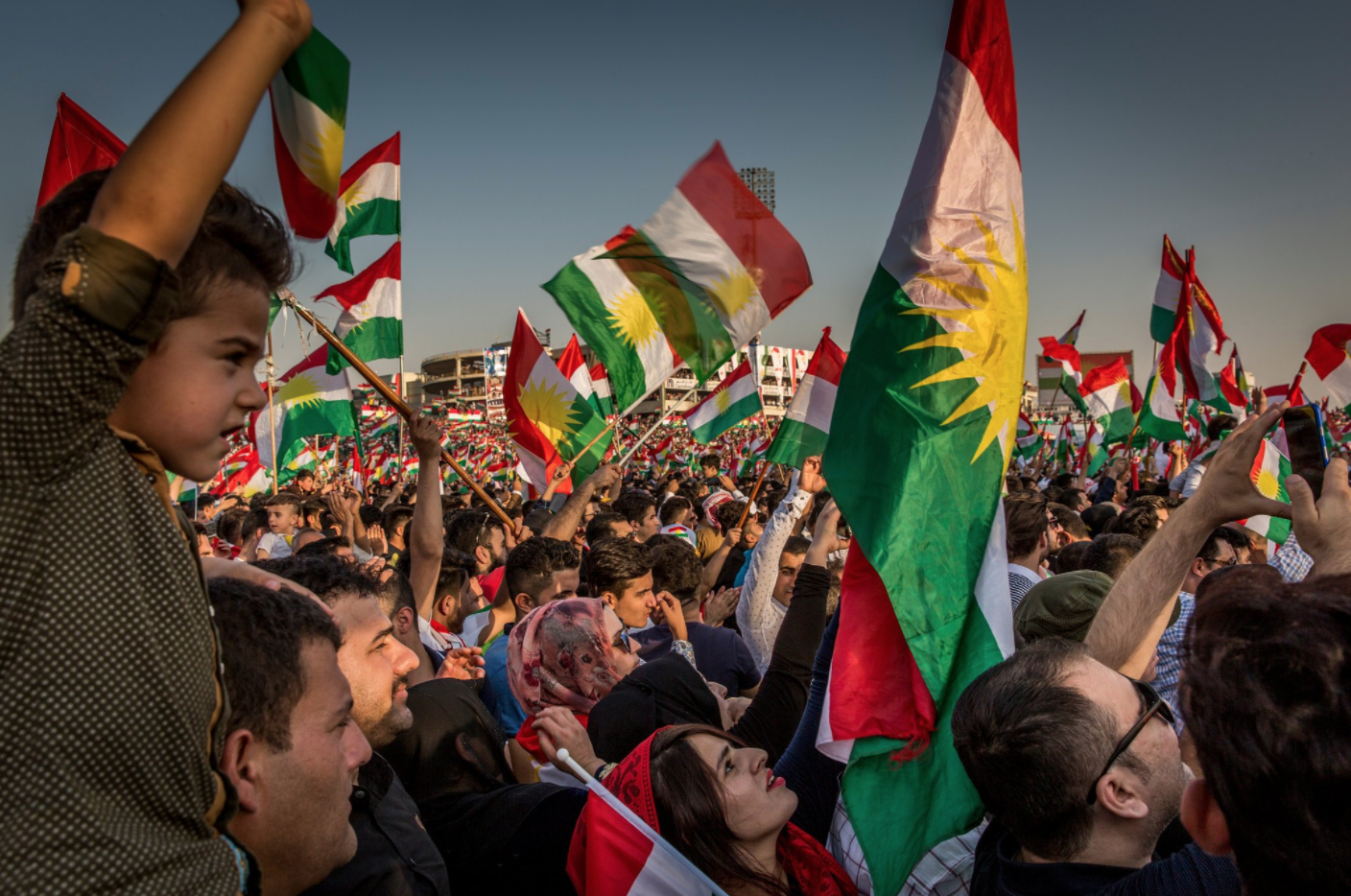
On Sept. 25th, 2017, the electorate of the Kurdistan Region of Iraq (henceforth called ‘Başûr,’ the Kurdish name for Iraqi, or Southern, Kurdistan) participated in a historic referendum for independent statehood. Kurds in Iraq carried the decision to an overwhelming 93% vote in favor of secession, with 72% of all eligible voters participating. Having had de facto autonomy in most of Başûr since 1991—which today includes its own sitting president, international diplomacy missions, a military wing (Peshmerga), and foreign trade negotiations independent from Baghdad—the Kurdistan Regional Government (KRG) now appears intent on honoring the results of the referendum and striving toward full independence.
Kurds Gather at Pro-Independence Rally (PC: Ivor Prickett for The New York Times)
But the path toward statehood seems less clear now than ever. As Kurds across the region celebrated the decision of their compatriots, the governmental bodies which dissimulate Kurdistan’s boundaries (Iran, Iraq, Syria, and Turkey) all sharply rejected the results of the referendum. The risk of military action is growing quickly. Baghdad has sent troops to secure oil fields in Kirkuk, a city which has been under Peshmerga control ever since Daesh’s major offensive into nearby Mosul (2014), and the subsequent abandonment of Kirkuk by Iraqi military forces. Iraqi and Turkish troops are also now coordinating joint exercises in Habur (Turkey) near Iraq’s northern border. Additionally, the Iranian Chief of Staff, Major General Mohammad Bagheri, confirmed on Wednesday, September 27th, that Tehran will allow Iraqi forces to be stationed on the Iranian border with Başûr. Lastly, Ankara’s post-referendum provocation against the KRG’s referendum is especially alarming. “It will be over when we close the oil taps, all [their] revenues will vanish, and they will not be able to find food when our trucks stop going to northern Iraq,” Turkish President Recep Erdoğan said.
Despite such frightening uncertainty, me might find solace in revisiting the concept of nation and trying to understand its perhaps unexpected importance in the early 21st century. Addressing a conference at the Sorbonne in 1882, Ernest Renan famously defined the nation as a “daily plebiscite.” Neither a right of ‘race’, i.e. biological descent, nor that of kingly dynasty, Renan argued that the nation is predicated upon a dual-facing “spiritual principle”: a common legacy of “memories” on the one hand, and, on the other, “present-day consent, the desire to live together, the will to perpetuate the value of the heritage that one has received in an undivided form.” The nation is never something laid to rest or immutably proven; rather, it is a collective will to remember, and to keep remembering. Even further, as Bhabha reminds us, the “nation-space” is never unquestionably reified through this repetition of memory but renegotiated in every reiteration. The nation hence becomes the liminal site and struggle of cultural difference, betraying its enclosure and purification by nationalist discourse.
In the face of so many state-sanctioned obligations to forget, and alongside so many competing Kurdish nationalisms, Kurdistan persists in precisely this undecided, daily remembrance. No external attempt has yet succeeded in silencing it: not the violent repression of Kurds in the Republic of Turkey, nor the numerous brutal interventions led by the Pahlavi dynasty and the Islamic Republic of Iran, nor the denaturalization and forced displacement of Kurdish citizens under Ba’athist rule in Syria, nor the genocidal al-Anfal campaign (1986-1989) against Iraq’s Kurdish population. And neither has Kurdistan been killed off by the intense periods of conflict between Kurds—whether it is PKK guerrillas against Peshmerga (and each other), Iraqi Kurdish betrayals against Iranian Kurdish comrades, the horrible civil war in Başûr in the 1990s, or the recent power struggles between Başûr and Kurdish fighters in Turkey over influence in Rojava. Indeed, Kurdistan does not exist despite its tumultuous, fracturing histories but directly because of them. More than anything, Kurds have shown that it is not their abandonment of but their belonging to Kurdistan—as an ambiguous, pluralized nation-space—which provides them refuge against domination, which grants them the freedom to narrate Kurdistan as an unsettled question. It is unclear if or when Kurds will reach independence, but the September 25th referendum in Başûr reveals once again that the memory of Kurdistan, and hence the memory of nation, is far from forgotten.
*In memory of Mam Jalal Talabani (1933-2017), founder of the Patriotic Union of Kurdistan (PUK) and former President of Iraq (2005-2014).
John Kendall is an MA student in Geography at the University of Minnesota. His thesis research focuses on Christian missionary work in Kurdistan during the 19th and early 20th century. His broader interests include political geography, postcolonialism, and Kurdish national identity
For the first time since 1933, an extreme-right party has been voted into German parliament. Going by the name of the Alternative für Deutschland (AfD), this newcomer made substantial gains from the last federal election (+7.9%) while centrist parties were dealt (to use a German soccer colloquialism) a massive “Klatsche.” Now Germany must ponder its political future. But what does this mean about the country’s collective memory?
This is unprecedented in Germany. For the past 70 years, German public figures have hardly ever called German WWII soldiers “brave.” Instead, Germany’s coming to terms with its Nazi history, better known as Vergangenheitsbewältigung, has been legislated in forms of integration policy, reparations, education, memorialization of Holocaust victims in public space and media, etc. so that Germany demonstrates a continual reconciliation with its past atrocities.
Examples of contemporary literature rooted in the ideology of the German far-right. Here we see intersecting concepts of guilt, multiculturalism, and migration presented as “problem topics” contradictory to AfD’s notion of German cultural identity.
So, where are Gauland’s comments coming from? A good place to start is with a book: DerKult mit der Schuld, which roughly translates to the “Cult of Guilt.” The book decries “political correctness” as having evolved from Germany’s collective memory of the Holocaust, lamenting that “no other people like the Germans are so ashamed of themselves.” From the back cover description:
What is often overlooked is that the “cult of guilt” has a highly destructive potential; indeed, the modern interpretation of collective guilt hovers over us like a radioactive cloud on all areas of public life—contaminating slowly but surely not only our politics and culture, but also our democratic and moral values. And in certain leftist and politically correct circles, this amounts to classic psychological symptoms of self-hatred.
Before the election, AfD politician Wilhelm von Gottberg spoke out against this so-called “cult of guilt” to say that the Nazi era had been “worked through” – and that today, the Holocaust has been twisted into an “effective instrument to criminalize the Germans and their history.”
If von Gottberg is trying to absolve today’s Germany of its guilt, then Gauland’s wants to reassert Germany’s innocence—and neither attempt legitimately produces an end result of “working through” the Holocaust. Nonetheless, the party continues its normalizing message. AfD politician Bjorn Höcke called for Germany to adopt “a memory culture which brings us first and foremost into contact with the great achievements of our ancestors.” He has also said that the Holocaust memorial in Berlin was “a monument of disgrace.” Earlier this year, AfD insisted that school curricula emphasize “positive, identity-uplifting” events in German history. The AfD wants to contest how Germans remember. We should remember that “pulling the curtain” fails at disturbing depths to extract innocence from guilt.
Christopher Levesque is a doctoral student in Sociology at the University of Minnesota, Twin Cities. His research interests include institutions/patterns of migration, collective memory, and refugee political participation in Germany and the United States.
The Twin Cities Arab Film Festival is finally here! This year, the festival covers a wide range of pertinent and urgent issues, especially in light of ongoing islamophobia and xenophobia targeting immigrants and refugees globally. Here, we have compiled a list of films that highlight the stories of people who grapple with, resist and remember conflicts and tragedies in Palestine, Lebanon, Syria, Iraq and Egypt. Below are the blurbs featured on the official festival website. The 2017 Arab Film Festival will go on from September 27th-October 1st.
Directed by Philip Gnadt and Mickey Yamine | Palestine/Germany | 2016 | 87 minutes
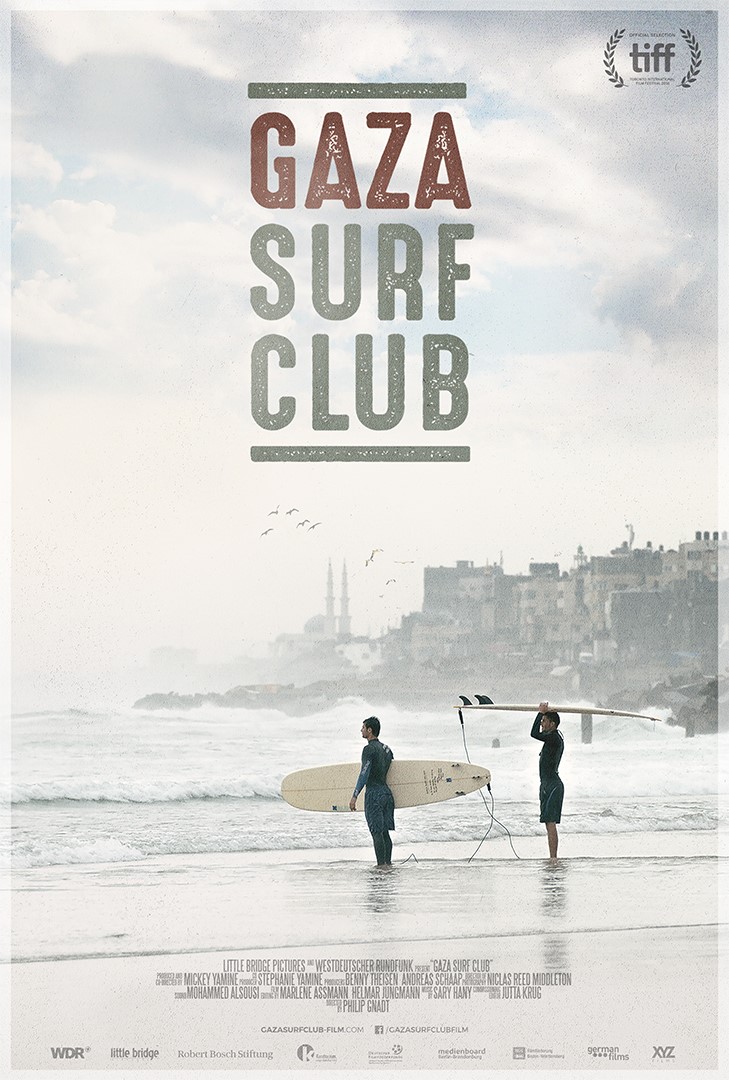
Gaza is a small strip of land with a population of 1.7 million. Wedged between Israel and Egypt, it is isolated from the outside world and, as a result of Israel’s ongoing occupation, the area’s 26 miles of coastline no longer services ships. Hardly anything gets in and even less gets out. While the young people of Gaza lack job prospects and suffer the indignities of life under occupation, this doesn’t stop them from surfing. Gaza Surf Club follows the dedicated members of the surf community in Gaza City, who must use smuggled surfboards to pursue their passion. Juxtaposing experiences of oppression and escape, the film captures brief and beautiful moments of freedom for Gaza’s youth.
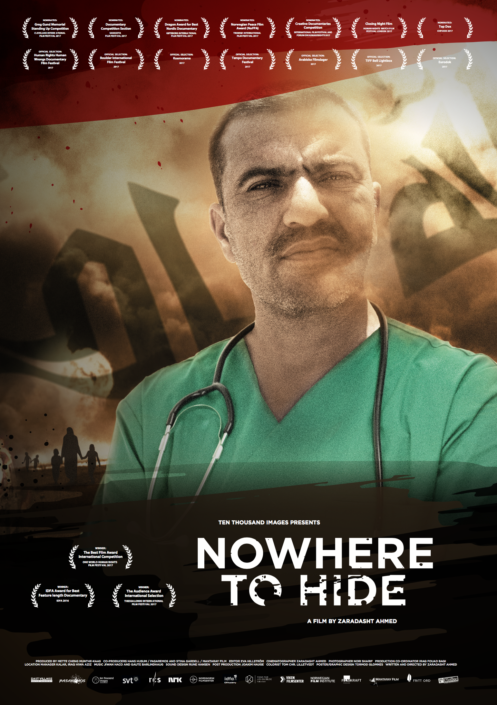
Directed by Zaradasht Ahmed | Iraq/Sweden/Norway | 2016 | 86 minute
This is the story of one man’s struggle in Iraq, where war has become the norm. The enemy is invisible and there are no safe places to hide. Nori Sharif, a 36-year-old nurse, husband, and father of four, takes up a camera and begins documenting life in one of Iraq’s most dangerous provinces, Diyala. As the Americans retreat in 2011 and the war erupts anew, Nori records the destruction without choosing sides. The film covers a period of five years and a series of dramatic events, beginning with hope for a better future, through witnessing the growth of ISIS, and eventually documenting the fall of Nori’s home town. As Nori films, he begins to turn the camera on himself.
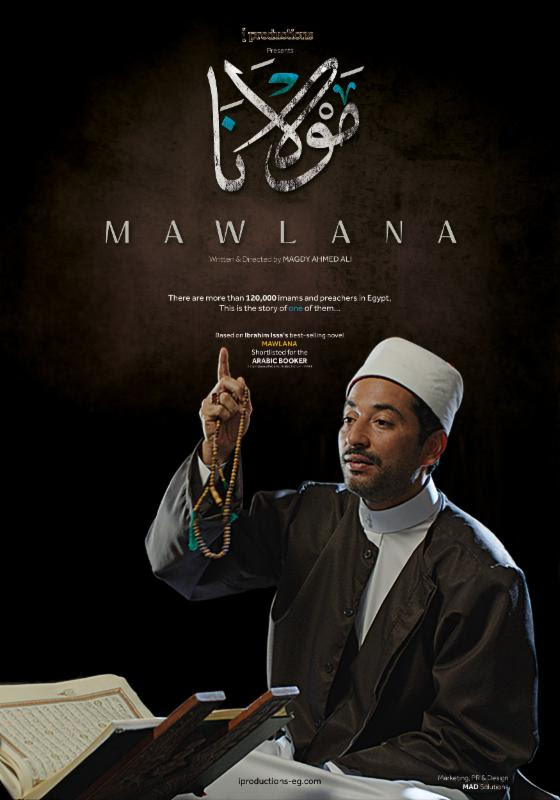
Directed by Magdy Ahmed Ali | Egypt | 2016 | 130 minutes
Hatem (Amr Saad), a moderate young preacher in Cairo, becomes a television celebrity with millions of fans. This makes him a perfect tool for government manipulation on a mass scale, as his eloquence and wit are employed by key figures in the Egyptian state to influence policy and religious practice. However, when the cameras are off, bloody struggles for state power rage, and as Hatem tries to stay out of political and sectarian disputes, his personal and professional life become increasingly consumed by the complex tapestry of Egyptian politics. Based on a novel by the same name, Mawlana by Ibirahim Issa, the story offers a critique of power, corruption, and fundamentalism in Egyptian society. In addition, this dark and convincing film highlights the importance of media in the production of political and religious agendas.
Shambouk is a historically complicated area in Northern Lebanon just a few kilometers away from Syria where borders, religious doctrines, and communities intersect. Haykal, a 60 year-old Christian farmer, lives there and runs a restaurant and is in the process of building a house. Those Who Remain follows Haykal’s struggle to stay on his land amidst sectarian tensions, fear, and hopelessness.
Directed by Obaidah Zytoon and Andreas Møl Dalsgaard | Syria/Denmark/Sweden/Finland | 2016 | 100 minutes
The War Show tracks the experiences of radio host Obaidah Zytoon and her friends after they join the street protests against Syrian President Bashar al-Assad’s regime in March 2011. This group of artists and activists filmed their perspective on this pivotal moment, even as the regime’s violent response spiraled into a bloody civil war and their hopes for a better future were tested by imprisonment and death. While making the film, Zytoon journeyed throughout the country, from her hometown Zabadani to the center of the rebellion in Homs and to northern Syria. A deeply personal road movie, The War Show captures the fate of Syria through the intimate story of a small circle of friends as their lives intersect with war.
Directed by Amjad Al-Rasheed and Darin Sallam | Jordan/Germany | 2016 | 18 minutes
A Mizrahi Jewish family from Tunisia settles into their new life and their new home in Haifa, Palestine in 1948. The house is lovely, but it contains the memories of its previous Arab residents and the pet they left behind: a large and chatty parrot.
A number of years ago I read an article by Hyman Berman, now deceased, who was a long time member of the U of M Department of History, on political antisemitism. His focus was the 1938 Gubernatorial election in Minnesota between Farmer Labor governor Elmer Benson and Republican, Harold Stassen. Berman looked at the “whisper campaign” run by a Republican operative Ray P Chase, who had been state auditor, a congress person, and candidate for governor. Berman wrote that Chase received information from the Dean of Student Affairs of the period Edward Nicholson about students and faculty, their political beliefs and activities. In Chase’s dossiers about these people, he labeled many “Jew communist.” I was especially interested in that because the Center for Jewish Studies is in Nicholson Hall, and I have taught there. I was curious to know more about Nicholson and this secretive relationship of two anticommunist, antisemitic men.
Ray P. Chases’ papers are at the Minnesota Historical Society, where Berman worked with them. In 2016 I was able, with research funding, to hire Sarah Atwood, an advanced graduate student in American Studies, to spend a summer doing research. She worked first with the Chase files, and then in the University archives with the papers of the presidents, dean of student affairs and others. We also looked at the African American and the Jewish press. Patrick Wiltz, a graduate student in History, worked extensively with the Minnesota Daily.
I had the idea for the exhibition quite a while ago. At that point, Brown University was the first to begin a process to address its history of founders and trustees who were slave holders. Some of those issues were of interest to me about Dean Edward Nicholson. But the project grew in scope as we learned so much about the University’s history of racial segregation in housing, and found a dissertation by Mark Soderstrom on the 1930s at the U of M.
This exhibit is as much about political surveillance on campus as it is about racism and antisemitism, all in the 1930s. The project began with understanding surveillance, and yes, the current political climate was crucial. The intense period of research and curation all took place throughout the 2016 presidential campaign, and its relevance actually grew.
What was the most surprising finding in your research for the exhibit?
There were many, many surprises. Remember, the idea began with learning there was collusion between the Dean of Student Affairs and a Republican politician for more than half of the 1930s. Then, the revelation that from 1931-1942 there was segregated, taxpayer funded student housing. President Guy Stanton Ford forbade that as soon as he became president in 1937, but it began again as soon as he retired. Jewish students could be excluded from boarding houses, with the consent of the U of M from the 1920s until the 1950s.
But there were positive surprises too, and that included how powerful activism was on the campus, and how deeply involved students were with segregation, anti-war activism, and student rights.
What lessons does this exhibit teach for the present?
“A Campus Divided” is both a deeply disturbing story and a truly uplifting one for me. I would like visitors to understand how effective student activists were in almost all of the issues that they addressed, which included segregated housing, required military drills for male students, and opening campus life to competing ideas.
They succeeded when they forged alliances. The issue of segregated housing was led by African American students, but they partnered with white activists. The antiwar groups created umbrella organizations that included a variety of perspectives on whether the US should enter the war in Europe. Students also formed alliances with the NAACP. The American Jewish World and the Spokesman, an African American newspaper, were both involved in campus issues, which were communicated to their communities. Some students worked with the Farmer-Labor Party as well. All of these groups were powerless, but together they accomplished a great deal.
The exhibit shows that in the 30s there were alliances forged across political, religious, and racial lines, specifically between Jewish and Black student groups. How much of such alliances do you see happening today?
Your question is not precisely accurate. The Menorah Society existed during this period, but there were not many specifically political Jewish groups. Individual Jews were very active in all of the struggles I have described. Our most recent politics in the United States have now put white supremacists and neo-Nazis at the forefront of activism. Those groups most threatened and targeted by these groups are working together in productive ways. Neither Jews nor African Americans are monolithic groups. There is great variability within each community. In the progressive groups of American Jewish life there is tremendous support for and commitment to issues around immigration, including of course, DACA and deportations, and racial justice.
Should the UMN consider renaming Nicholson Hall and other spaces named after figures whose worldview and actions this exhibit critiques?
On September 13 President Kaler announced that he was appointing “The President’s and Provost’s Advisory Committee on University History” to guide our thinking about appropriate modern responses to historical issues on our campuses. Its membership will be drawn from students, administrators, faculty, alumni, and the University of Minnesota Foundation. I believe that this process is ideal for considering how to address the history of the University of Minnesota and the legacy it will bring into the 21st century. I hope that the members of this commission that will be headed by Dean John Coleman will be good listeners and will take their responsibility seriously.
How will UMN students and the community engage with the content of this exhibit (classes, visits, etc.)?
A course is being offered in the 2018 spring semester in the history department on historical memory that will look at the events in Charlottesville as well as the materials from the exhibit. Students in a number of classes in the Departments of German, Scandinavian and Dutch, History, and Journalism thus far, during the 2017 fall semester will be seeing the exhibit as part of their courses. Additionally, student leaders in the Student Senate, in Coffman Union and other programs are viewing the exhibit.
Riv-Ellen Prell, an anthropologist, is Professor Emerita of the Department of American Studies. She is the author of many books and articles about American Jewish culture, and the ways in which gender, class and race have shaped it. Her books include: Prayer and Community: the Havurah in American Judaism (winner of a National Jewish Book Award), Fighting to Become Americans: Jews, Gender, and the Anxiety of Assimilation, and Women Remaking American Judaism. She was awarded the Marshal Sklare Award of the Association for the Social Scientific Study of Jewry for her contributions to scholarship in the field.
What makes someone an effective leader? Arguably, one vital component is being a capable and willing protector of one’s people. Aung San Suu Kyi, the State Counselor of Myanmar and also a Nobel Laureate, is currently failing in this role. She continually chooses to “protect” only the Buddhist majority of Myanmar by supporting the government of Myanmar’s stance that the Rohingya, long time inhabitants of the Rakhine region of Myanmar, are not citizens. Their lack of legal citizenship has been used as justification by the state to perpetrate atrocities against the Rohingya, who are denied civil rights. These atrocities escalated this August when Rohingya militants attacked Burmese security forces. In retaliation, the Burmese military launched a violent crackdown against the Rohingya, killing hundreds of people, and forcing hundreds of thousands to flee into Bangladesh. There is little doubt left that Myanmar has begun a state sanctioned ethnic cleansing of the Rohingya, using the violence perpetrated by a few Rohingya militants to justify the mass slaughter of an ethnic population.
Rohingya Protestors (PC: Hindustan Times)
Aung San Suu Kyi has been sung as an icon of democracy by many humanitarian figures. Many people view her as having ushered in a new era for her country after a militarized Burma transitioned into a democratic Myanmar. But when one takes into consideration the politics weighing on Suu Kyi, as well as her unwavering support of the Rakhine Buddhist’s interests over the Rohingya, the truth of Suu Kyi’s leadership becomes clear: Suu Kyi is nothing more than a figurehead who is incapable and unwilling to protect the lives of all peoples residing within Myanmar. Her only purpose is to provide the façade of a “democracy” in what is still a predominantly military state.
When Burma transitioned into Myanmar, those previously in power drafted into the new constitution a guarantee that the military would always have at least twenty-five percent of the seats in Myanmar’s parliament. As a result, the military still holds significant power within the country, impeding the democratic process by removing the Burmese people’s ability to fully participate. Furthermore, Suu Kyi’s title of State Chancellor is a legally powerless one as there is no mention of the position in Myanmar’s constitution since it was created by Suu Kyi after the constitution’s inception. If the military decided Suu Kyi no longer served their interests she could be driven from her position. Thus, it would be no surprise that Suu Kyi feels extensive pressure to continue to support these discriminatory policies because of her relatively precarious position in the Myanmar government.
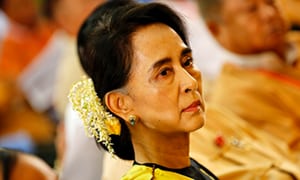
Aung San Suu Kyi (PC: The Guardian)
If we regard only domestic political pressures, we are presented with an image of Suu Kyi as an unwilling actor of the Rohingya genocide. But is she unwilling? It was only very recently that she acknowledged the violence after having previously denied it. She has even laughed at the allegations, which further illustrates contempt for the Rohingya. In a recent phone call with the Turkish President Recep Tayyip Erdogan, Suu Kyi said that she is determined to deal with the “terrorist problem” and that reports of genocide are merely fake news propagated by terrorist sympathizers.
Myanmar is attempting to present itself as a legitimate democracy to the world, using state sovereignty as a defense against international inquiry and obscuring the primary power of the state, the Myanmar military. Suu Kyi’s actions reveal the true nature of her position, a figurehead beholden to the military’s will. But she has also shown herself to be simply unwilling to aid the persecuted Rohingya through her continued vilification of them. These factors combine into, at the very least, a damning complicity by Suu Kyi to the unfolding genocide of the Rohingya people.
Rebecca Dekker is an undergraduate student at the University of Minnesota, Twin Cities. She is majoring in the Sociology of Law, Criminology, and Deviance, and minoring in Global Studies. Her academic interests include the roles of moral panic and the bystander effect during atrocities, as well as the various applications of restorative and retributive justice post-atrocity.
My official title during my Spring 2017 teaching appointment at the Global Studies program – Visiting Professor – was in some ways misleading. The University of MN campus was not in any form new to me. I trod its paths as a graduate student back in the seventies, and later as a faculty member in the Classical and Near Eastern Department in the nineties. I was glad to be invited to revisit a familiar turf, not as a momentary visitor, but as a staff member. Embraced by Chair of CHGS, Professor Alejandro Baer, and ever-accommodating Program Coordinator, Jennifer Hammer, I plunged into the University’s old and new teaching routines with a little side splash. Challenges were encountered on unexpected fronts such as the likes of decoding the mechanics of discourse between computers whose compatibility was unnatural – a “Hebrew Speaking” PC and the campus’ Apple lingo. Or the ever-astonishing fact of a May 1st snow storm. Even as a veteran of a dozen winters I was caught by surprise. Perhaps the twenty warm years since I left the campus, and the Israeli scorching sun must have affected my brain’s memory cells. I was also surprised by the sign over the entrance door to Classroom 1-111 on the first floor of Hanson Hall, which read: The Dairy Queen Class. Quite ironic, I thought to myself, for a course on the history of the Holocaust. Evidently no prank, just one coincidence of what life is made of.
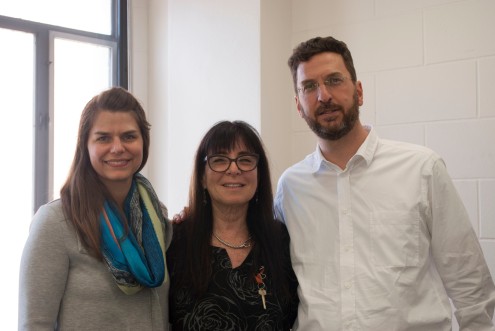
Jennifer Hammer, Yehudit Shendar, and Alejandro Baer
At the beginning of last spring, as I was trying to overcome these initial hurdles, I stood in front of some 30 students, who enrolled for a two and a half hour long class on the history of the Holocaust through works of art created by Jewish artists living under Nazi occupation. The course was scheduled in the late evening. Will I be able to keep their attention? Will I be able to entice and challenge their past knowledge, perspectives, and presuppositions as to what the term Holocaust entails? The faces observing me, as much as I did them, were to my great satisfaction mostly young, and to my great delight of versatile ethnic and racial backgrounds. I was not going to preach to the choir, but rather confront fresh young unchartered minds.
The task was ambitious, and class sessions were often packed to the brim with information and images. At times, the visual brutality of the reality of the Holocaust peered from the screen – shocking and disturbing. The message of art as valid historical evidence was slowly making its presence. The students’ inquisitive eyes, sometimes veiled with tears, conveyed all that I aspired for. I was reaffirmed of the power of the artistic expression to tell the perspective of the individual victim, and to bear witness to a historic event of an unmeasurable impact on the annals of humanity.
I am thankful for the opportunity given to me to share my perspective with University of MN students, as well as the wider public in the many lectures scheduled during my short tenure. The strong reactions by the listeners’ body is my true reward. It affords me the ability and desire to continue addressing audiences, specifically by making mute art speak for those who were persecuted and murdered during the Shoah. A worthy calling.
Yehudit Shendar is retired Deputy Director and Senior Art Curator at Yad Vashem (Israel), and a current member of the Schwabinger Kunstfund, the international taskforce of experts researching the Cornelius Gurlitt cache of Nazi looted art, unveiled in Munich in 2013.
Moritz has been recently awarded the 2017-2018 Bernard and Fern Badzin Fellowship in Genocide and Holocaust Studies! Congratulations, Moritz!
Moritz was born and raised in Berlin, Germany and moved to Minneapolis in 2013 to pursue his graduate studies. He received his M.A in Germanic Studies from the University of Minnesota in 2015. Before moving to the United States, Moritz had a vocational career in theater, stage lighting, and intercultural communication. He studied Cultural Studies (cultural history major, linguistics minor) at the European University Viadrina Frankfurt (Oder), where he received his B.A. in 2012. Moritz’s teaching and research interests are modern European literary and intellectual history, German-Jewish history and modern Ottoman/Turkish history. Moritz is interested in the representation of the Holocaust and experience of exile in literature and the arts and focuses on the encounters of Holocaust representation with other forms of twentieth-century violence, specifically for the case of Turkey and the Middle East.
Moritz is currently working on his dissertation project on the history of German and German-Jewish exile in Turkey during the 1930/40s. Focusing on the case of the literary critic Erich Auerbach (1892-1957), who wrote his most influential works on European literature while in Turkish exile and later in the U.S., Moritz examines the relationship of German-Jewish émigré culture to Turkish intellectual history. During the 2017/18 academic year, Moritz will conduct research abroad and begin writing his dissertation (prospective defense: Spring 2019).
Between 1975 and 1979, the Communist Party of Kampuchea (CPK), also known as the Khmer Rouge, fundamentally transformed the social, economic, political, and natural landscape of Cambodia. During this time as many as two million Cambodians died from exposure to disease, starvation, or were executed at the hands of the state.
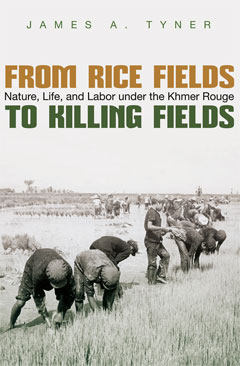
The dominant interpretation of Cambodian history during this period, known as the Standard Total View (STV), presents the CPK as a totalitarian, communist, and autarkic regime seeking to reorganize Cambodian society around a primitive, agrarian political economy. Under the STV, the victims of the regime died as a result of misguided economic policies, a draconian security apparatus, and the central leadership’s fanatical belief in the creation of a utopian, communist society. In short, according to the STV, Democratic Kampuchea, as Cambodia was renamed, constituted an isolated, completely self-reliant prison state. My publication From Rice Fields to Killing Fields: Nature, Life, and Labor under the Khmer Rouge (Syracuse University Press, 2017) challenges the standard narrative and provides a documentary-based Marxist interpretation of the political economy of Democratic Kampuchea.
Communism, according to Marx, was necessary to overcome the alienated life that typified capitalism. This, I argue, was a central concern of the CPK. However, what the CPK actually brought about was anything but a socialist or communist society, but not for lack of trying. I do not doubt that many members of the CPK were committed to what they believed Marxism entails; that there was a concerted effort to bring about a socialist revolution in preparation for an eventual communist society. However, I also maintain that notwithstanding their attempts to establish and defend socialism and to move toward communism, they could not and did not install a communist structure as the prevailing social organization of production. Rather than erecting a non-exploitative system, the CPK merely replaced one form of exploitation with another. Indeed, the CPK reaffirmed a system of production for exchange, thereby negating its own philosophical premise. Quite simply, I argue that the CPK—similar to the former Soviet Union and other so-called ‘communist’ or ‘socialist’ governments—installed a variant of state capitalism.
State capitalism provides the theoretical foundation on which subsequent interpretations of Democratic Kampuchea must be built. Consequently, From Rice Fields to Killing Fields sits alongside previous scholarship that has reinterpreted other so-called ‘socialist’ or ‘communist’ forms of government. In Democratic Kampuchea, I find that a variant of state capitalism similarly emerged in practice while rhetorically CPK cadre spoke incessantly of their own, unique form of Marxism. Workers under the Khmer Rouge remained waged-workers—albeit with a twist. Likewise, the fundamental social relationship between those who owned the means of production (i.e. the CPK as ruling elite) and those denied access to the means of production (i.e. the workers) remained intact.
Ultimately, From Rice Fields to Killing Fields contributes in two principle ways. First, I contribute specifically to our understanding of the Cambodian genocide, namely by providing insight into the material practices that contributed to large-scale violence. For it is my contention that Cambodia’s genocide was the consequence not of the deranged attitudes of a few tyrannical leaders nor of a pervasive hatred toward certain groups. Instead, the violence was structural, the direct result of a series of ill-fated political and economic reforms that were designed to accumulate capital rapidly: the dispossession of hundreds of thousands of people, the imposition of starvation wages, the promotion of import-substitution policies, and the intensification of agricultural production through forced labor.
Second, I contribute to those literatures that have addressed forms of ‘actually existing’ socialism. Here, my concerns extend beyond the specific study of Democratic Kampuchea to address more broadly the dialectics of political philosophy and state form within the context of genocide. Employing an historical-materialist approach, my analysis of Khmer Rouge political economy speaks to deeper questions of ‘Third World’ development, communist revolutions, social movements, and anti-colonialism. It is a mistake, therefore, to view the Cambodian genocide in isolation, as an aberration or something unique. Rather, the policies and practices initiated by the CPK must be seen in a larger, historical-geographical context. Throughout the decades of the Cold War, numerous colonies achieved independence and attempted to remake their political economies. In turn, many of these embryonic countries would be typified by heavy-handed state intervention, state-led industrialization, the nationalization of resources, and anti-imperialist and nationalist fervor. As a former colony and newly independent state, Democratic Kampuchea embarked on a path that was well trod by its Asian and African colleagues, including the aforementioned policies of import-substitution, dispossession, and agricultural-led industrialization. Crucial therefore is to consider why, in Democratic Kampuchea, these economic reforms led to genocide, for satisfactory answers will remain elusive if we fail to position the Cambodian genocide within its proper historical and geographical context.
James A. Tyner is currently Professor of Geography at Kent State University. He received his PhD in Geography from the University of Southern California. Professor Tyner’s research interests include genocide, mass violence, political economy, and Marxism. He is the author of 15 scholarly monographs and over 100 articles and book chapters.
About Center for Holocaust & Genocide Studies
The Center for Holocaust and Genocide Studies at the University of Minnesota-Twin Cities promotes academic research, education and public awareness on the Holocaust, other genocides and current forms of mass violence. It was established in 1997 by Dr. Stephen Feinstein as an interdisciplinary research center. Read more…


 Gaza is a small strip of land with a population of 1.7 million. Wedged between Israel and Egypt, it is isolated from the outside world and, as a result of Israel’s ongoing occupation, the area’s 26 miles of coastline no longer services ships. Hardly anything gets in and even less gets out. While the young people of Gaza lack job prospects and suffer the indignities of life under occupation, this doesn’t stop them from surfing. Gaza Surf Club follows the dedicated members of the surf community in Gaza City, who must use smuggled surfboards to pursue their passion. Juxtaposing experiences of oppression and escape, the film captures brief and beautiful moments of freedom for Gaza’s youth.