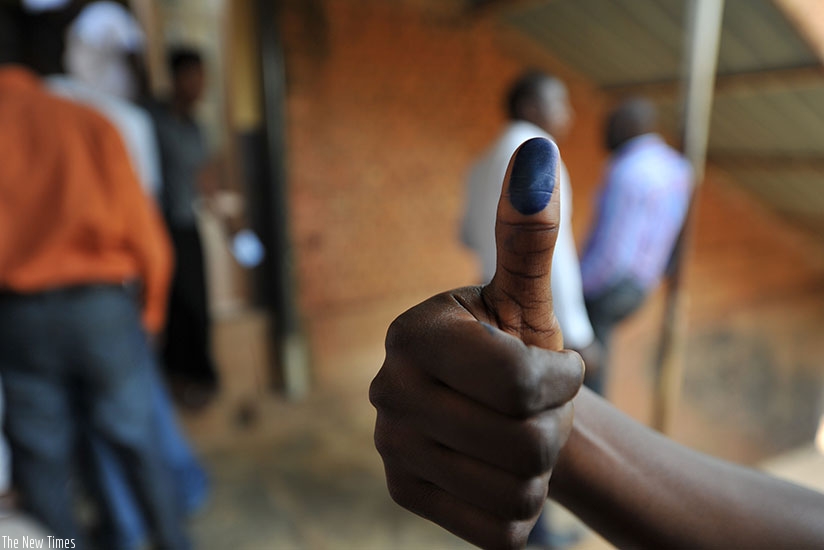
Twenty-three years have passed since the 1994 Rwandan genocide, and the decades since have shaped Rwanda into a nearly unrecognizable country. The genocide seems, at first glance, to be a distant and painful memory. The capital of Kigali has transformed into a vibrant urban hub, complete with five star hotels and immaculate streets. Educational initiatives and a skyrocketing tourism industry are reshaping the nation. For many, especially those living outside of Rwanda, the genocide seems to be a historical event, locked firmly in the past. But while decades have passed since the 100 days during which at least 800,000 Tutsi and moderate Hutu were killed, the past doesn’t seem so far away to many Rwandans. The personal tolls, be they loss of family members or lasting emotional scars, still remain.
Photo Credit: The New Times
These dynamics between a painful past and a push for progress often come to the forefront at moments of transition, and this has held true during the 2017 presidential election which took place on August 4th. The months leading up to the election were marked by domestic and international attention, with a particular focus on the effects of a 2015 constitutional referendum. This referendum allowed President Paul Kagame to run for office again, despite previously instated term limits. Kagame has led Rwanda since the waning days of the genocide; as the leader of the Rwandan Patriotic Front, Kagame took power after ousting the genocidal government, and officially becoming president in 2000. Kagame’s win was all but guaranteed.
This election has been a topic of heavy critique, particularly from many journalists and scholars outside of Rwanda. Along with questionable polls, many critics present concerns about press freedom, free speech, and political dissent. Perhaps most controversial in this election cycle was the candidacy of Diane Rwigara, an outspoken opponent of the current government. The day after she officially announced her candidacy, nude photos of Rwigara appeared online, which her campaign asserted were fraudulent. Her name was kept off of the ballot after the election board claimed that she did not reach the required 600 valid signatures, although her campaign said she had submitted over 1,000. This is not the first time such concerns have been risen; such controversies often take place regarding notable political contenders, as severe as allegations of assassination. These criticisms paint a troubling picture, with many fearful that corruption or a lack of a democratic transition may lead Rwanda, once again, down a dark path.
However, there is more to the story that these critiques often do not address. On a recent trip to Kigali, I was able to speak to young Rwandans about their views on the future of the nation and the path the country has taken post-genocide. Many spoke about the pride they felt in Rwanda’s progress and the stark contrast to their childhoods, where any semblance of peace seemed nearly impossible. One university student I spoke with summed it up well, “We still have a long journey… this is continuous… We have the task to teach continuously and endlessly.” Students I spoke with often echoed his sentiments: Rwanda is imperfect, and the path to true stability is a long one, but there is hope in the direction the nation was headed. This understanding is not universal for Rwandans, but for many, the calls for unity and reconciliation, paired with the promise of stability and hope in the aftermath of such destruction, are worthwhile pursuits, even in the face of problems.
Rwanda is not a perfect nation and not a perfect democracy – no country in this world is either. And while many have brought up worthwhile criticisms that shall continue to be central challenges for the nation for generations to come, many Rwandans continue to express optimism in the face of these concerns. This election represents another moment for reflection, both within Rwanda, as well as in the international community.
Brooke Chambers is a PhD student in the University of Minnesota’s Sociology Department. She is broadly interested in the 1994 genocide in Rwanda, bystander dynamics, and understandings of policy and transitional justice in response to genocide and mass atrocity.
In 2016, Michigan became the newest state to enact legislation to mandate the instruction of genocides for secondary students, specifically citing the Holocaust and Armenian genocide. Michigan joined seven states that have legislative mandates to teach about the Holocaust and genocide in public middle and high schools. Currently, several projects are calling for directives to teach about the Holocaust from all 50 states (e.g. New York’s Anne Frank Center for Mutual Respect and The Butterfly Project).
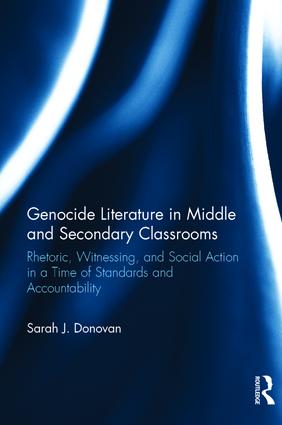
Sarah Donovan’s 2016 book, Genocide Literature in Middle and Secondary Classrooms: Rhetoric, Witnessing, and Social Action in a Time of Standards and Accountability, is a timely look at her personal journey as a middle school English teacher as she develops curricular units and pedagogy to comply with the expanded 2005 Illinois mandate to teach about 20th and 21st century genocides, in addition to the Holocaust (already mandated in 1987). In her work, Donovan pushes back on the standards-based education of the No Child Left Behind Act (NCLB) and Every Student Succeeds Act (ESSA), challenging middle school English teachers to help students explore not just the rhetoric of texts (often seen as the “right” reading of texts in preparation for standardized testing), but the rhetoricality of texts, or to “move away from identifying rhetorical moves and towards noticing texts as enacting a condition of the human experience” (Chapter 3). Teachers, and English teachers specifically, have a responsibility to help a student understand “what words can do” and how to “understand herself as a subject with agency and responsibility” (Chapter 3).
Donovan’s work asks what better way there is to do this than through a study of genocides, especially using literature, such as memoirs or novels? Allaying all doubts that 12 and 13-year-olds are too young for such weighty topics, Donovan describes and encourages classrooms to “nurture and support an ethical practice of witnessing” (Chapter 4). Drawing generously from her experience as a teacher and teacher-researcher, and including additional teacher testimonies, the work provides a balance of rationale, strategy, and suggestions for content, as well as examples and reflection. Especially useful for educators, including in my own practice as a middle and high school teacher and teacher-educator, is the diversity of examples and invaluable resource lists covering adolescent-appropriate literature about the genocides in Armenia, Cambodia, Guatemala, Ukraine, Bosnia, Rwanda, Sudan, Iraq, as well as the genocide of the Indigenous peoples of the Americas. Precious few resources exist on teaching about genocides, especially beyond the Holocaust, for middle school students.
Donovan has found, as have I in my own practice, that students are, “not only curious about the violence in the world but have a deep desire to understand how crimes against humanity are possible in our modern world” (Chapter 13). Hers is a poignant reminder that the objectives for, and the civic and moral lessons derived from, a study of genocides, although they often defy measurability, are of vital importance for the individual and society.
George Dalbo is a Ph.D. student in Social Studies Education at the University of Minnesota with research interests in Holocaust, comparative genocide, and human rights education in secondary schools. Previously, he was a middle and high school social studies teacher, having taught every grade from 5th-12th in public, charter, and independent schools in Minnesota, as well as two years at an international school in Vienna, Austria.
Demetrios Vital, J. Siguru Wahutu, and Alexandra Tiger on July 24, 2017
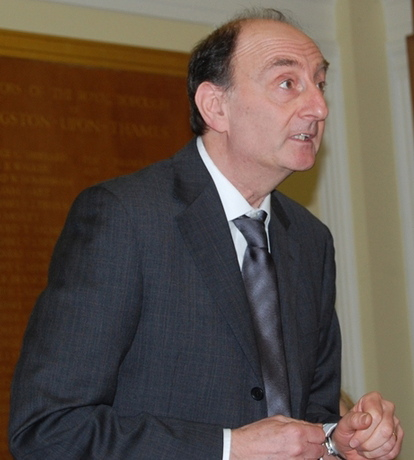
Philip Spencer
Philip Spencer gave a keynote introductory address at CHGS’ International Symposium on April, 2017 entitled Comparative Genocide Studies and the Holocaust: Conflict and Convergence. Following the symposium, he and Bruno Chaouat (UMN, French and Italian) gave a book talk (recorded in full here), where Spencer introduced the book he co-authored with sociologist Robert Fine, Antisemitism and the Left. On the return of the Jewish question. After his talk, Spencer sat with Wahutu Siguru (UMN PhD Candidate, Sociology), Alexandra Tiger (UMN undergrad in Sociology), and Demetrios Vital (CHGS Outreach Coordinator), and offered thoughtful, warm, and inspiring answers to a range of questions on topics in his book and talks. What follows are three of those questions and answers.
In your talk, you made reference to the idea that antisemitism was more of an “eternal temptation.” Would you expand on that?
When I say “eternal,” I don’t mean it’s going to go on forever. I mean “repetitive.” There are times when antisemitism is less tempting and times when it’s more tempting, for sure, so one does have to contextualize it.
People have asked me to explain antisemitism in terms of a general overarching theory, which I haven’t tried to develop […] except to talk about the recurrence of antisemitism, the attack on Jews, as revealing something about the society around it.
As I said, I don’t have a wholly developed theory on antisemitism in all its incarnations. In this work I look at people who identify with the left, with a progressive point of view, who perceive something wrong in society, to find a superficial explanation for it and to attribute those evils to a particular group. That’s not the same, by the way, as scapegoat theory, which I think is a misleading way to put it, because it suggests that people are doing this consciously. They’re not saying, “Well, we don’t like something, so let’s blame somebody for it.” It doesn’t operate at that level.
The temptation to identify this group as the source of all evils – not the same as scapegoats – is a recurring temptation that we can discern. Whatever the evils are, whether they’re problems with the stability or homogeneity of the nation, health of the nation, vitality of the economy, and so forth. These can all be attributed to the Jews.
And now, in its latest incarnation, which I say more about in the book.
We live in an unjust and unequal world.
In Europe – as goes a version of this argument – since the Holocaust, we’ve constructed a post-national European community. This post-national society shows that we can understand how to build a community in a more diverse way, not based on ethnicity, particularity, and so forth. Israel, by contrast, is – in this line of argument – a uniquely backward society because it hasn’t learned the lessons of the Holocaust. We Europeans (who committed the Holocaust) have understood the lessons of it, but you Jews, you haven’t understood it. So it’s tempting to think this way of the problems of the world. And so on: the problems of the Middle East? It’s the Jews. It leads to the idea of Israel being the greatest threat to world peace, which is preposterous and empirically impossible.
Now, why the Jews should be picked out is a very difficult question to answer, and there are various versions of this, some more persuasive than others. But all I’ll say about it is this, and you can see it in Arendt, in the beginning of The Origins of Totalitarianism, she tells a joke about antisemitism (it’s an old joke):
Hitler is giving a speech and says, “All the problems go back to the Jews!”
And a man in the back yells, “And the cyclists!”
Hitler continues, “…all the problems in our political system go back to the Jews!”
The man in the back yells, “And the cyclists!”
Hitler continues, “…Germany’s weak, falling apart. Whose fault is it? The Jews!”
“And the cyclists!”
“Look,” Hitler says, “every time I say it’s the Jews, you say, ‘And the cyclists.’ Why the cyclists?”
“Well, why the Jews?”
[Laughter] … But it’s a question that we have to answer.
In your talk, you addressed the difficulty in defining antisemitism. I’m curious if there’s a more specific way of defining antisemitism in the left as opposed to the right, and if those are the same thing?
Right-wing and left-wing antisemitism do differ in profound ways. What I am looking at in this book is a left-wing version. Or rather a failure to respond to it, a tolerance of it, a collusion with it, and at times a use of it. Which is troubling to me. It seems to me that that derives not from a consciously racist stance, in its beginning – because it comes from people who think of themselves as anti-racists, egalitarian, progressives interested in social justice. One wouldn’t find that on the right. And they are derived from an earlier, deeper view, among people who think of themselves as universalists. One doesn’t find those on the right.
What one finds on the left is an antisemitism that emerges within a very different frame of reference, and therefore gets accounted for initially in very different ways. But the effect on the targeted group, even if the group isn’t consciously targeted, is very serious. That doesn’t exclude the possibility that people who begin as universalists might end up as racists, and there are lots of cases… Bruno Bauer is a good example: Bauer began as left-wing universalist and ended as a straightforward right-wing antisemite.
So I don’t see them as the same. Which one poses a danger? I do not in any way minimize the danger of right-wing antisemitism. Antisemitism is a complex phenomenon and takes different forms in different societies. It’s quite mobile and can be picked up by lots of different groups in different ways in different times. Nor is left-wing antisemitism the greatest danger faced by Jews globally at any given time, but it’s very serious right now.
Left-wing antisemitism is dangerous because it denies its own existence.
Right-wing antisemites, generally speaking, say they are antisemites. The problem is taking them seriously. I think the mistake many people on the left make is to not take overt antisemites seriously. When people say they hate Jews, my inclination is to believe them. They do. If they say they hate Jews and want to kill them, they’re going to take measures to do it, then red alert. Overt antisemites often then get ridiculed, and overt antisemitism gets written off, on the left.
Left-wing antisemites tolerate or occlude, and absolutely deny that they’re antisemitic. That’s a different kind of problem. They often reverse the charge and use it as a counter-argument: “You’re only raising the idea of antisemitism to deflect from criticism of Israel.” Well, then you know you’re in trouble.
On universalism, what kind of universalism / universalist society should the left embrace to tackle antisemitism?
I take as a starting point the premise that humanity is diverse. Humanity is an extraordinarily rich and diverse species. There are dangers in thinking of diversity as group-based, for sure, and there are lots of ways one can think of “groups.” But my view is that if people wish to identify themselves as a group, and value and want to continue traditions, etc, there is something wonderful about this, provided that it’s premised on the recognition of others. And that one does not see a group as hermetically sealed.
I’m interested in diversity and hybridity, as opposed to a universalism which preaches one form of identity and society.
There are various ways of managing this politically, of establishing a legal basis for encouragement of diversity, while allowing that diversity to be freely chosen, and for people to move across unrestricted boundaries. In favor of recognition of groups, but not reification of groups. Multiculturalism and hybridity are all values to me, but they depend upon groups being able to celebrate values and traditions, and to be able to add to them.
It’s the reverse of antisemitism – which is also for some people a tradition, which people add to. This is the reverse. It’s a dynamic and open multicultural society that celebrates the presence of different groups, and the mobility within the society. It’s a universalism grounded in enrichment and celebration of diversity, tolerance, respect, and equal treatment.
Wahutu is a PhD Candidate in the Sociology Department at the University of Minnesota. Wahutu’s research interests are in the Sociology of Media, Genocide, Mass Violence and Atrocities (specifically on issues of representation of conflicts in Africa such as Darfur and Rwanda), Collective Memory, and perhaps somewhat tangentially Democracy and Development in Africa.
Demetrios Vital is Outreach Coordinator for the Center for Holocaust and Genocide Studies. In this role he is responsible for the care and promotion of CHGS art and object collections, as well as working with the community in the development of programs, activities, and events.
Alexandra Tiger is a volunteer with CHGS aiding in the promotion of events. She is an undergraduate student pursuing a degree in Sociology of Law, Criminology and Deviance with a minor in Family Social Science. Alexandra has interests in the legal response to domestic violence perpetrated in the Native American community and the concepts of collective memory and remembrance following atrocities.
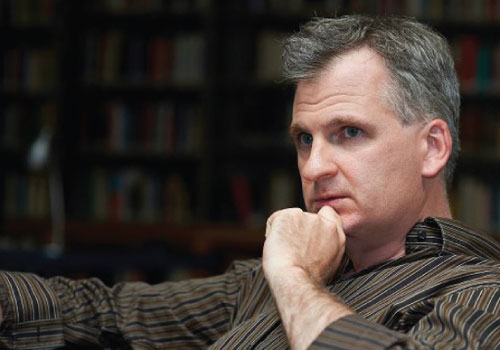
On April 6-8, 2017, CHGS held a symposium in celebration of its 20th anniversary, entitled, “Comparative Genocide Studies and the Holocaust: Conflict and Convergence.” Timothy Snyder, a professor of History at Yale University gave the keynote on “The Politics of Mass Killing: Past and Present.” Joe Eggers was able to sit down and talk with him.
Dr. Timothy Snyder
CHGS: What drew you to studying the Holocaust?
I became an eastern European historian because I was interested in intellectual history, and I was interested in the history of diplomacy, and the history of power. The late 80’s, early 90’s were a time when suddenly one could see those two sets of interests coming together, which is eastern Europe. It was only becoming an east European historian that I realized that the Holocaust and other mass crimes, German and Soviet alike, were the responsibility of east European historians. The problem with the Holocaust, or one of them at least historiographically, is that it’s not quite Jewish history because the Jews are of course the victims, but the perpetrators are from many other places. It’s not quite German history either, because although it was a German policy, more than half the perpetrators are not German and it takes place almost entirely beyond the borders of pre-war Germany. So it has to be both Jewish and German history but it also has to be east European history because that’s where it happened.
What I tried to do was write about the Holocaust that brought together these various historiographies. It was out of a sense of responsibility and then out of a sense of trying to make different things make sense together. How can we make sense of the fact that the Germans and Soviets were present in the same territories, juxtaposed or overlapping? How can we bring these things that we know are important – nationalist history, German history, Soviet history, Jewish history together? That was Blood Lands. Blood Lands was a kind of clearing of the deck, saying that these things happened at the same place and the same time. As I was talking about Blood Lands I thought ‘Okay, can I actually develop the arguments that I made in there about the Holocaust and not just say, as I do in Blood Lands, that if we know that all these events happened in the same place and time, are contemporary events that only bring so much sense.’ That led to Black Earth.
I think of myself as a historian, and not as a historian of the Holocaust. That is to say I wrote about other things and I intend to write about other things.
You talked about the differences of living in and recognizing the memory of the Holocaust in Eastern Europe versus Western Europe, especially in terms of the reluctance of some Eastern European countries to acknowledge their role in it. Could you expand on that?
In terms of East European memory, there’s an inherent plurality that we don’t necessarily see in the West because the average person living in Warsaw or Kiev is going to be thinking of not just a single German crime. An American memory of German crimes is going to be mostly limited to the Holocaust, but no one in Eastern Europe will be thinking of it that way because there was a plurality. The Germans also executed the intelligentsia, they also deported people, and they also had millions of forced laborers, so it’s not possible from an East European perspective to see the Holocaust as the only crime. Then the Soviet Union is also present, which we don’t like in the West. We would like for it to be like France, where the Germans came and people righteously rose up; something like that – we like that. We want for it to be sort of simple and dramatic. As Americans, we want for the Americans to provide the muscle.
The whole Eastern Europe story where the Soviets commit some of the crimes and the Soviets are some of the liberators is very hard for us to handle. From an East European point of view, you can’t just come in with the idea that the Holocaust is the only thing that happened, which is a bit more like where our memory is.
You’ve talked about your reluctance to use the word ‘genocide.’ Why do you feel like it is a problematic term?
In the East European context, the idea of genocide becomes very problematic. On the one side, you have people who understand that genocide is the coin of the realm morally. They therefore say the execution of the Poles at Katyn was genocidal, which legally speaking I think it was, but I fear the reason they say it is that it will be compared to the Holocaust. Or people say the Holodomor, the famine in Ukraine, was genocide, which I also believe that legally it was but I’m also afraid that the reason they say it is so people see it as equal to the Holocaust.
Then the response is that you have many more people who are in Eastern Europe who say they’re defending the memory of the Holocaust by saying the Holocaust is the only genocide. Which is legally speaking totally wrong, but in some political sense they are playing the same game as the other side, because the other side say genocide when they mean Holocaust, and so when this side says Holocaust they’re trying to say genocide. It ends up going around and around and around. The only way that I’ve been able to find some way of building out some kind of historical understanding of the various crimes in Eastern Europe is to just not use the word [genocide] because the word is like a roadblock in every chapter and you cannot write a sentence without people saying “what about this?” or “what about that?” and genocide becomes the only thing you can talk about, and so in my own work I don’t use the term.
Joe Eggers is a 2016 graduate of the University of Minnesota. His master’s thesis explored the cultural genocide of indigenous people through the boarding school system.
Your passing on June 30, 2017 barely made a ripple in the American news media; and yet even far away, there is so much we can celebrate and learn from you. Your many gifts and accomplishments do not inspire envy or a competitive spirit. You are one of the most beloved public figures in France. You never made me say in the usual resigned manner: of course, she is just a politician.
Simone Veil
Even if one disagreed with some of your stands – your last public appearance was against gay marriage in France – much of the time you were right on. During the Algerian War, as a senior French civil servant, you fought to protect Algerian women prisoners from rape and torture. As minister for health, you defended the government proposal making abortion legal in 1974 successfully, not because you liked abortion, but to protect women from life-threatening procedures.
Your most significant legacy, however, may be your stand for peace. You were born in the well to do, highly educated and thoroughly secular Jewish family Jacob, which had been French for centuries. Very early on you were exposed to your parents’ divergent views on the Germans. Your father who was held prisoner of war in 1914 hated them; your mother to the contrary, thought that peacemakers on both sides, such as Gustav Stresemann and Aristide Briand, should have been listened to. You wrote that upon your return from Auschwitz you chose to follow your mother’s lesson.
Although you did not like Hannah Arendt’s thesis on the ‘banality’ of evil’ in Eichmann in Jerusalem, your life journey is emblematic of another of Arendt’s central theses. This other survivor of the Holocaust knew that harm done could not be undone. How then could people interact with one another ‘after the deluge’? She proposed two palliatives to the potentially deadly consequences of human action. First, she advocated forgiveness, so that the past would not dictate the present. Forgiving is not a feeling of abandoning hate, but an action based on the willingness to re-engage with former enemies for the sake of the shared world. Arendt’s second palliative is promising, i.e. endorsing laws and constitutions in politics, which would bound actors to certain courses of action.
In spite of failing to protect you from deportation and half of your closest relatives from extinction, France gave you opportunities after your return. You studied law at the prestigious institute Science Po, met Antoine Veil, married and had three sons by the age of 23. You seemed destined to have the comfortable life of a stay at home upper class bourgeois wife and mother, and had to fight to obtain permission from your reluctant husband to work. For 20 years you did so in relative obscurity.
One day, your five-year-old son came back in tears from school. He had just learned about the 1572 St Barthélémy massacre when Catholics massacred Protestants. “Fortunately I am not Protestant”, he told you. Thus you had to start the long process of explaining that he was a Jew. You did not enjoy talking about unbearable suffering, but it had to be done. All your life you wore your camp tattoo on your left arm; during the summer it was especially visible under sleeveless dresses.
You were the honorary president of the Fondation pour la mémoire de la Shoah and a close friend of Serge and Beate Klarsfeld who dedicated their lives to hold Nazis accountable. Memory is a must and the foundation for reconciliation, you said. You became an ardent supporter of European integration and the first president of the popularly elected European Parliament in 1979. You wrote in your autobiography Une vie (2007, Stock): The fact that I helped make Europe has reconciled me with the twentieth century.
According to your son, Jean, your last word, pronounced softly but distinctly was: Merci (thank you). Simone Veil, may we do more than love you; may we, in our flawed and limited ways, act out your legacy of courageous involvement in public issues, non-violent conflict resolution, and faithfulness to family and friends. Your life demands no less from its admirers than this, Merci.
Catherine Guisan is Visiting Associate Professor at the UMN Department of Political Science. Her research interests focus on Democratic Theory; European Integration Politics; Transnational Ethics; and Citizens’ Participation in International Relations. She is the author of two books, A Political Theory of Identity in European Integration, Oxford: Routledge, 2011, and Un sens à l’Europe: Gagner la paix (1950-2003), Paris: Editions Odile Jacob, 2003.
When I first saw Fritz Hirschberger’s paintings in art storage, I was struck with cognitive dissonance. In the time that I’ve worked for CHGS, I looked at Hirschberger’s paintings and read about the artist quite a bit, but only in print or online in CHGS’ digital collection.
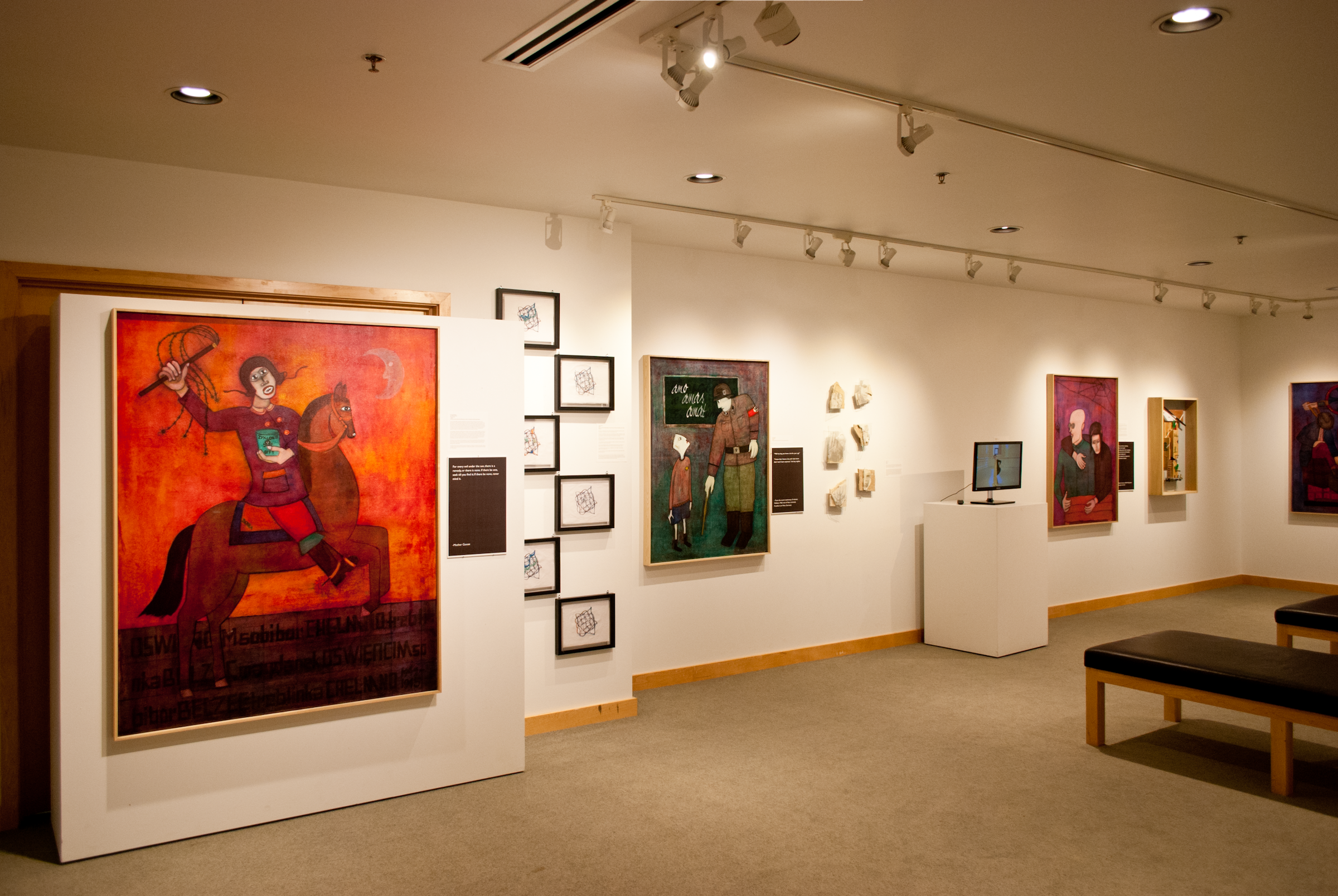
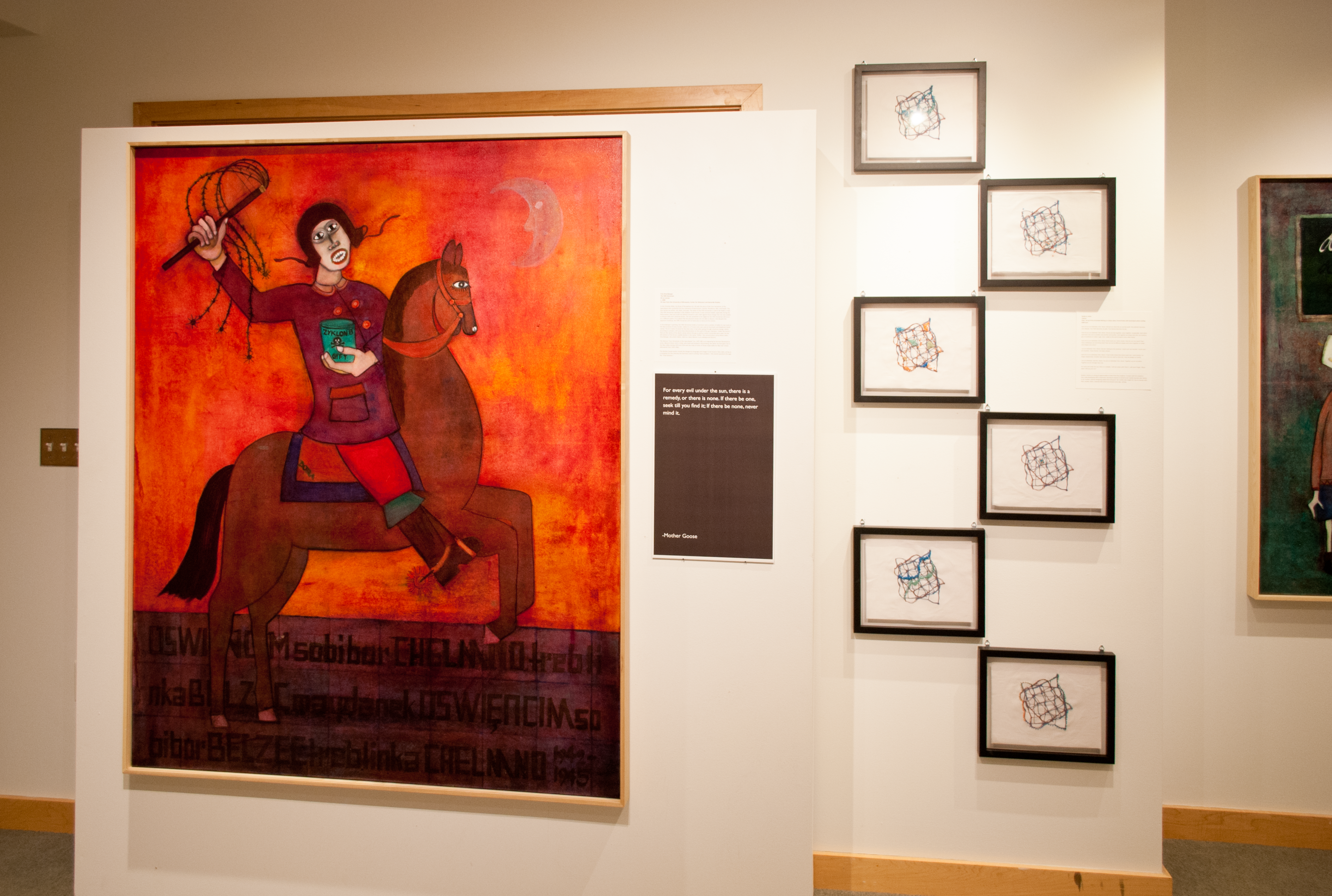
This was my first encounter with a Hirschberger painting in its physicality. Five feet tall, painted in translucent layers of bright oils, there, before me, stretched a saturated orange and purple canvas filled with the a war horseman brandishing deadly weapons. Hirschberger chose the Fifth Horseman precisely because it could not be discerned through physical senses,* yet here in my first encounter seeing this piece in person, it was arresting precisely because of its physical nature.
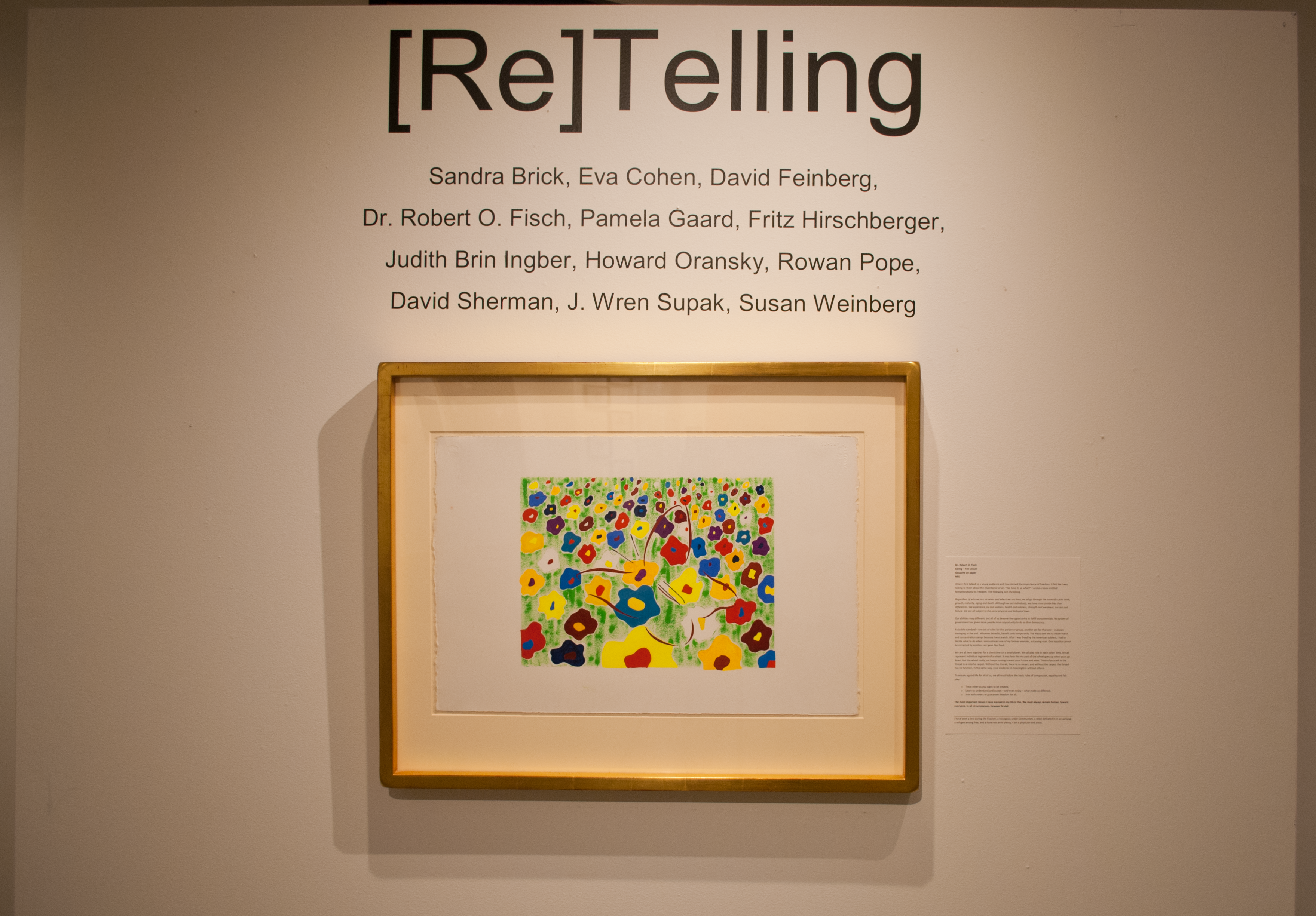
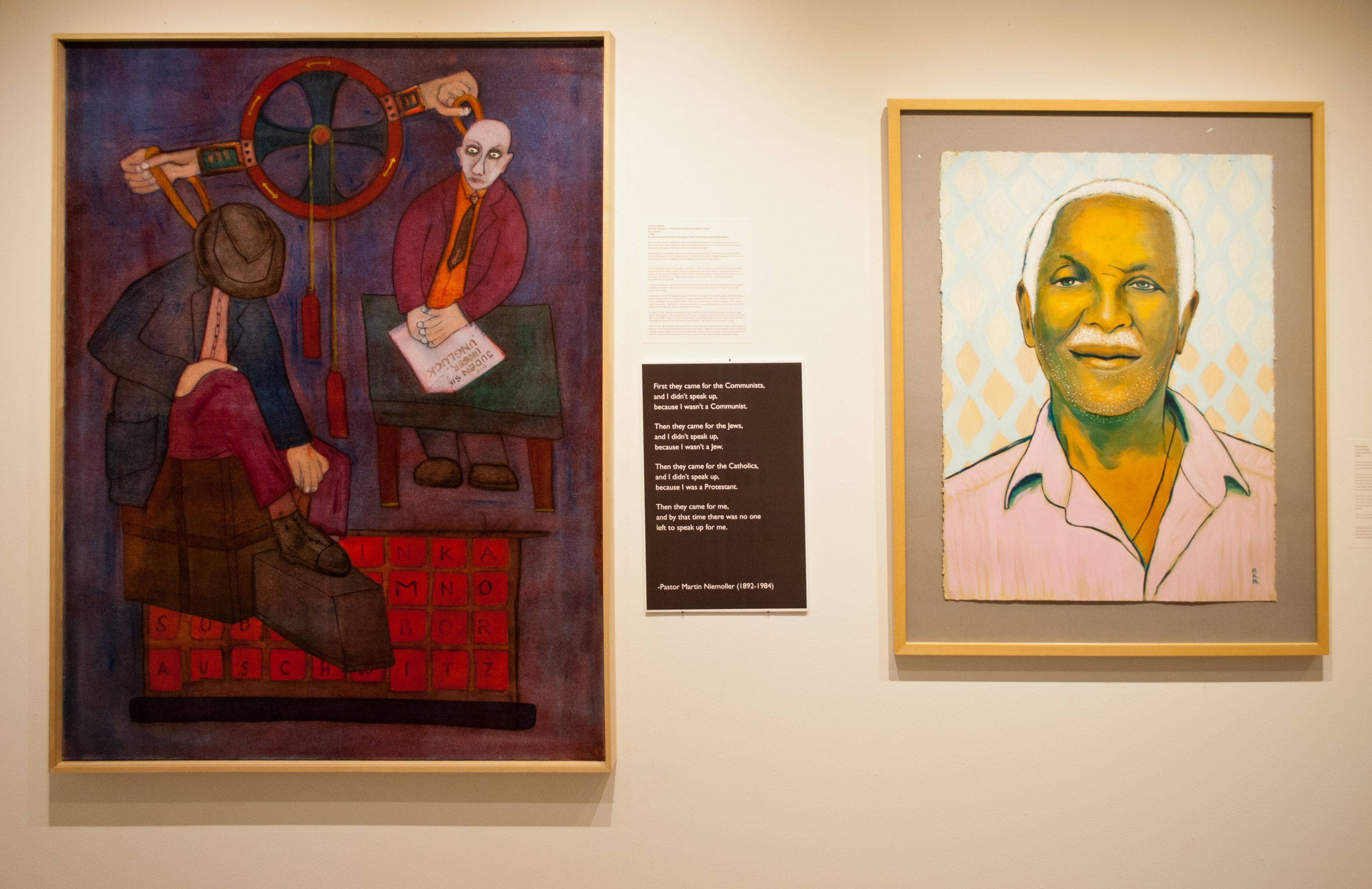
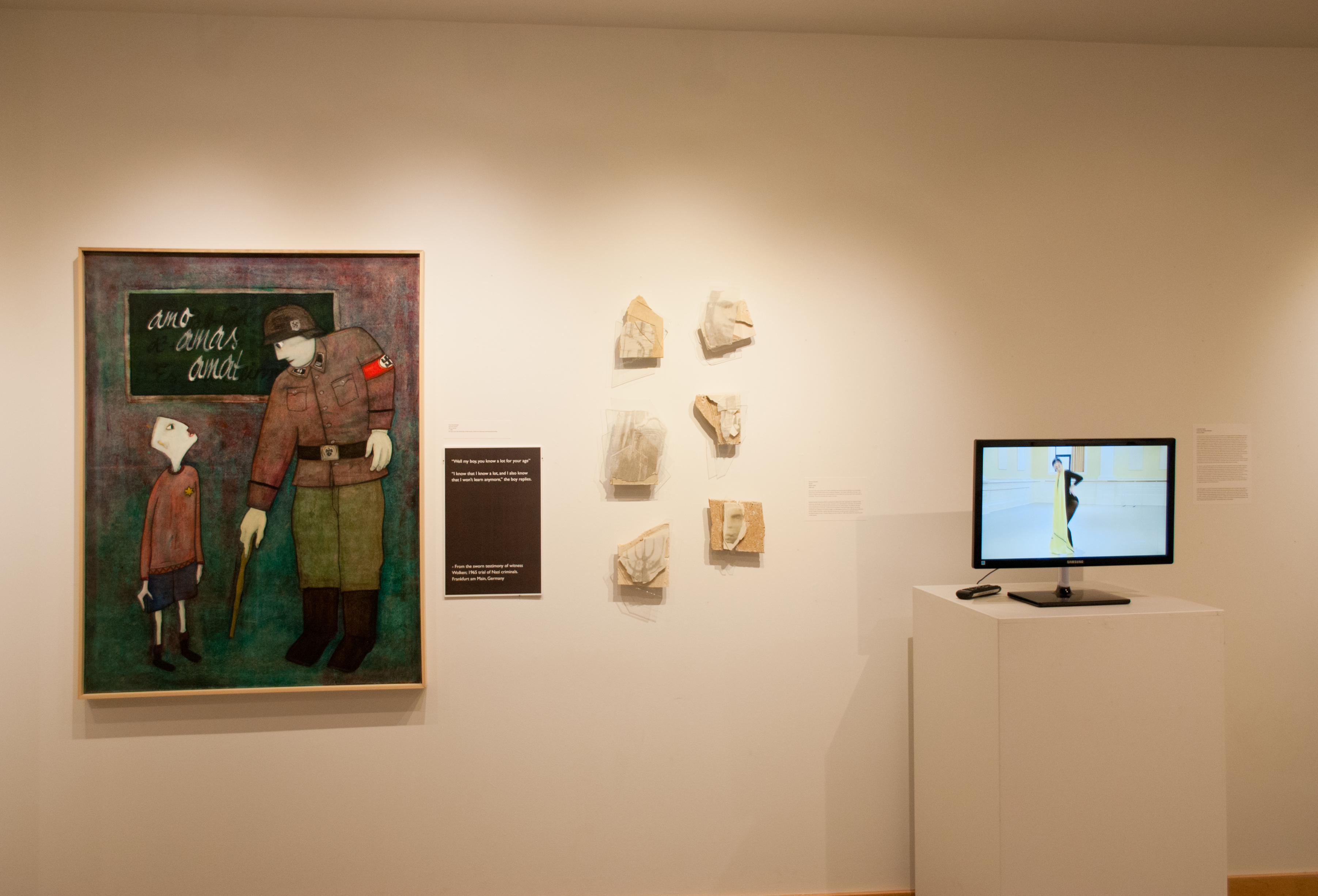
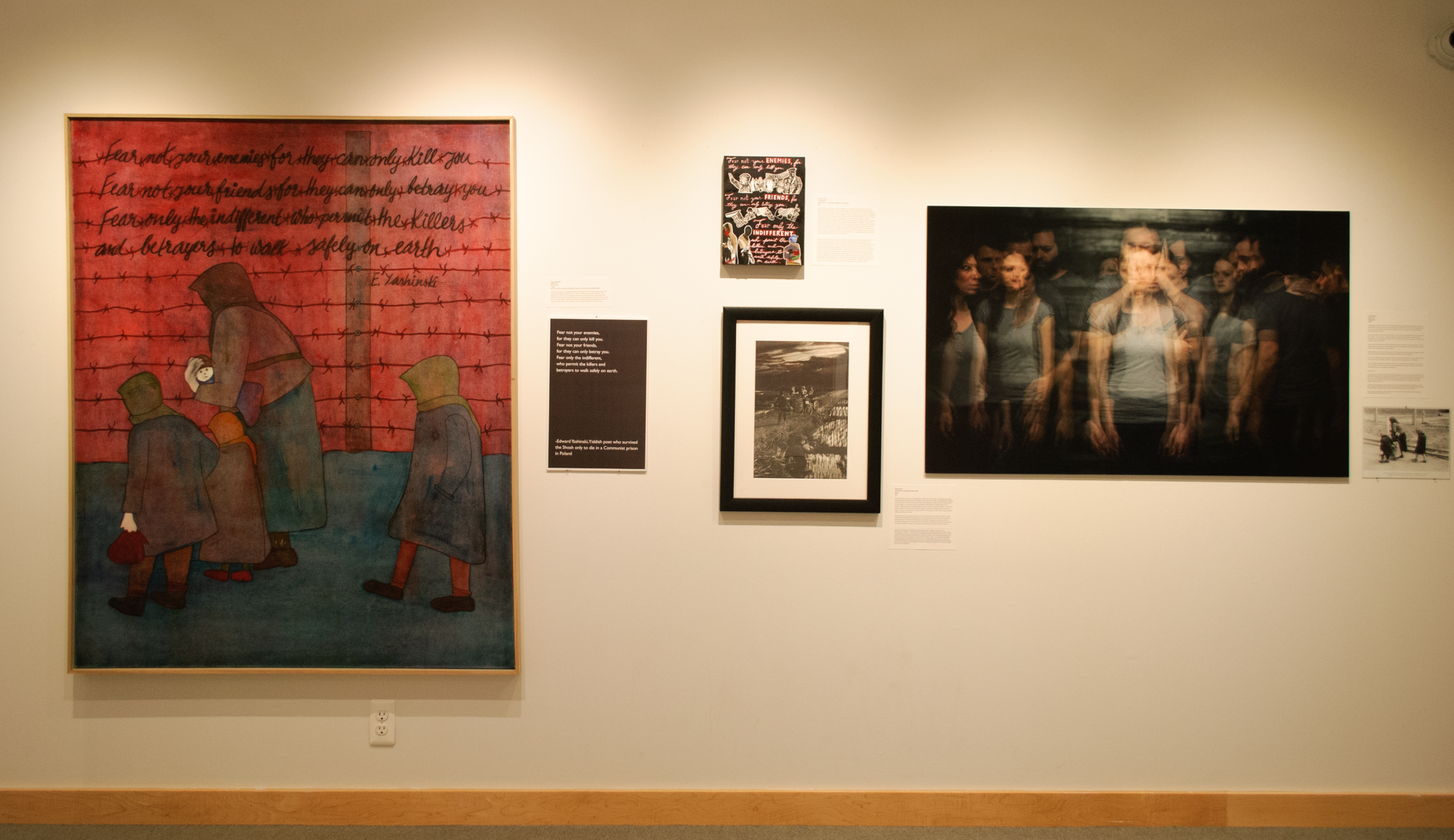
Weeks later, the paintings were installed and ready as part of [Re]Telling, an exhibition of Holocaust art, narrative, and contemporary response, held in the Tychman Shapiro Gallery at the Sabes JCC. Yehudit Shendar, retired Deputy Director and Senior Art Curator of Yad VaShem, Israel’s Holocaust memorial and museum, gave remarks at the opening reception of [Re]Telling featuring seven paintings by survivor Fritz Hirschberger selected from the CHGS permanent collection.
“[Re]Telling” participating artists and artwork by Robert O. Fisch
Shendar described Hirschberger as an artist of strong conviction, who painted in response to his experiences and his later historical research into the events of the Holocaust. Hirschberger was a Jew born to Jewish parents in Dresden, whose personal narrative during the Holocaust included forced expulsion, imprisonment in the Soviet Gulag, and military service fighting against the Nazi army. Hirschberger’s personal tragedies and losses led to further historical research, all of which played a role in painting on the subject.
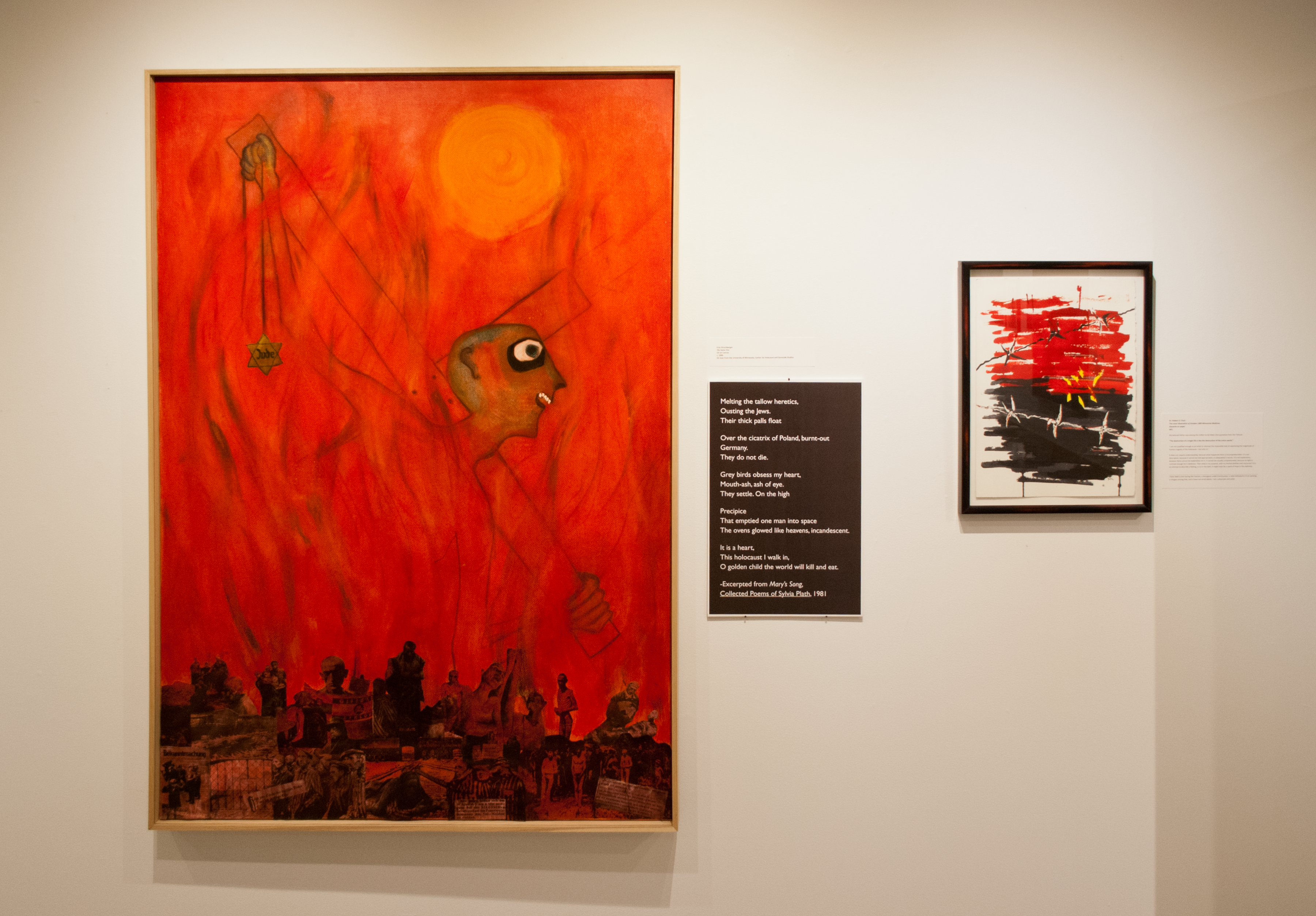
His first Holocaust series is called “Sur-Rational,” precisely because the magnitude of the events of the Holocaust seemed to exist outside of rational explanation. Like many artists responding to the Holocaust, Hirschberger uses religious imagery to further provoke the idea that the Holocaust, a human atrocity, transcends what a human can understand (such as in the “Fifth Horseman,” and “The Same Fire”). This is the cognitive dissonance of Hirschberger’s paintings: they attempt to convey something that evades rational comprehension, and are objects that display the physical crime of the Holocaust. In the corner of the Horseman’s saddle, Hirschberger painted the clearly legible word “Dora,” the name of the labor camp in which his father died.
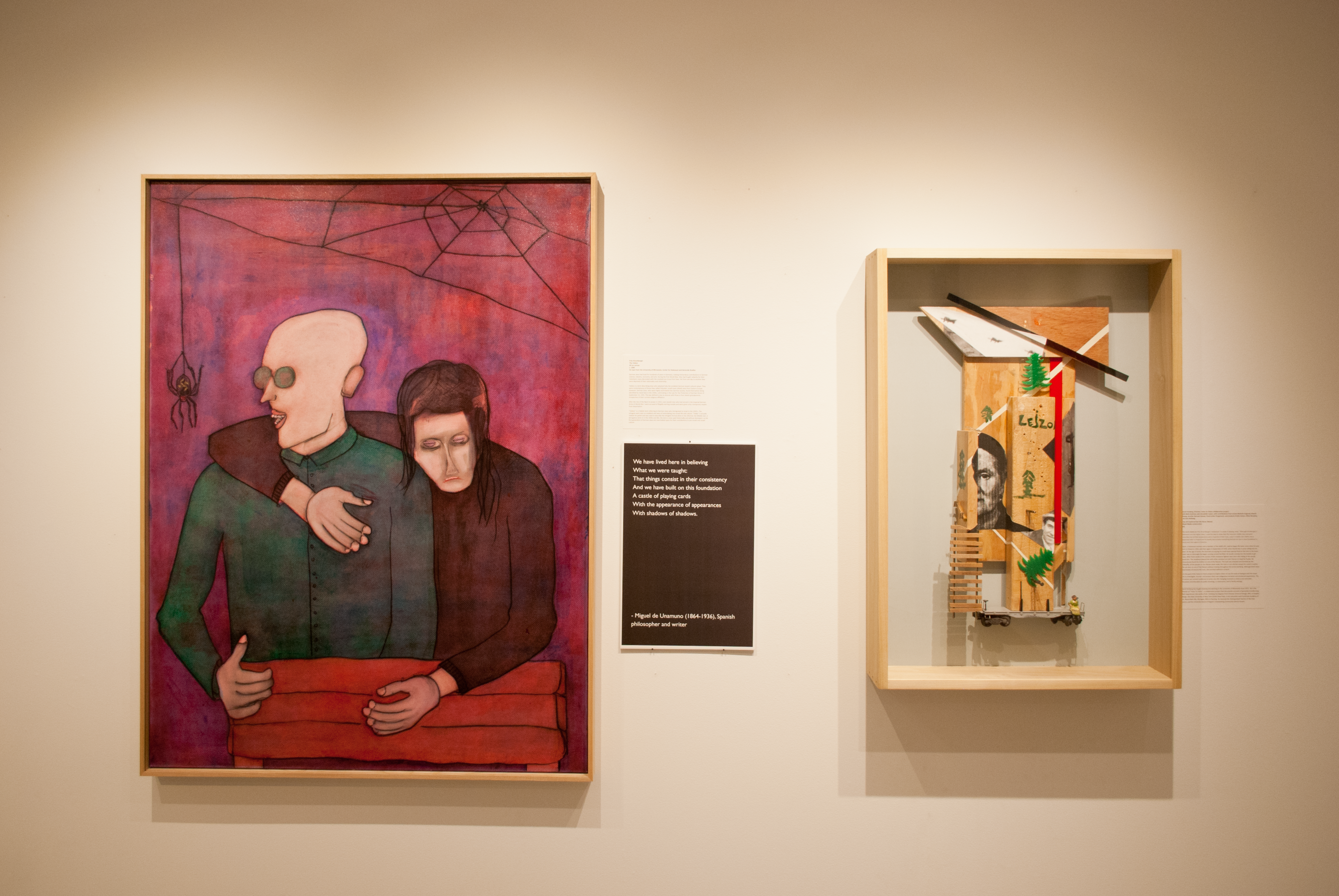
In the words of Stephen Feinstein, Hirschberger’s work attempts to “bequeath [this] knowledge and visual representation to another generation.” Hirschberger uses concrete historical references to strike an uneasy balance between the incomprehensible magnitude of the Holocaust and the real need to explain, communicate, and teach a historical event. Besides occasional words painted on the canvas, many of his paintings directly reference poetry or other texts that drive lessons and morals home to the viewer (such as “Indifference”). Some of these texts are well-known, but when juxtaposed against the disjointed and naive figures in Hirschberger’s canvases, contribute to a sense of alienation from history.
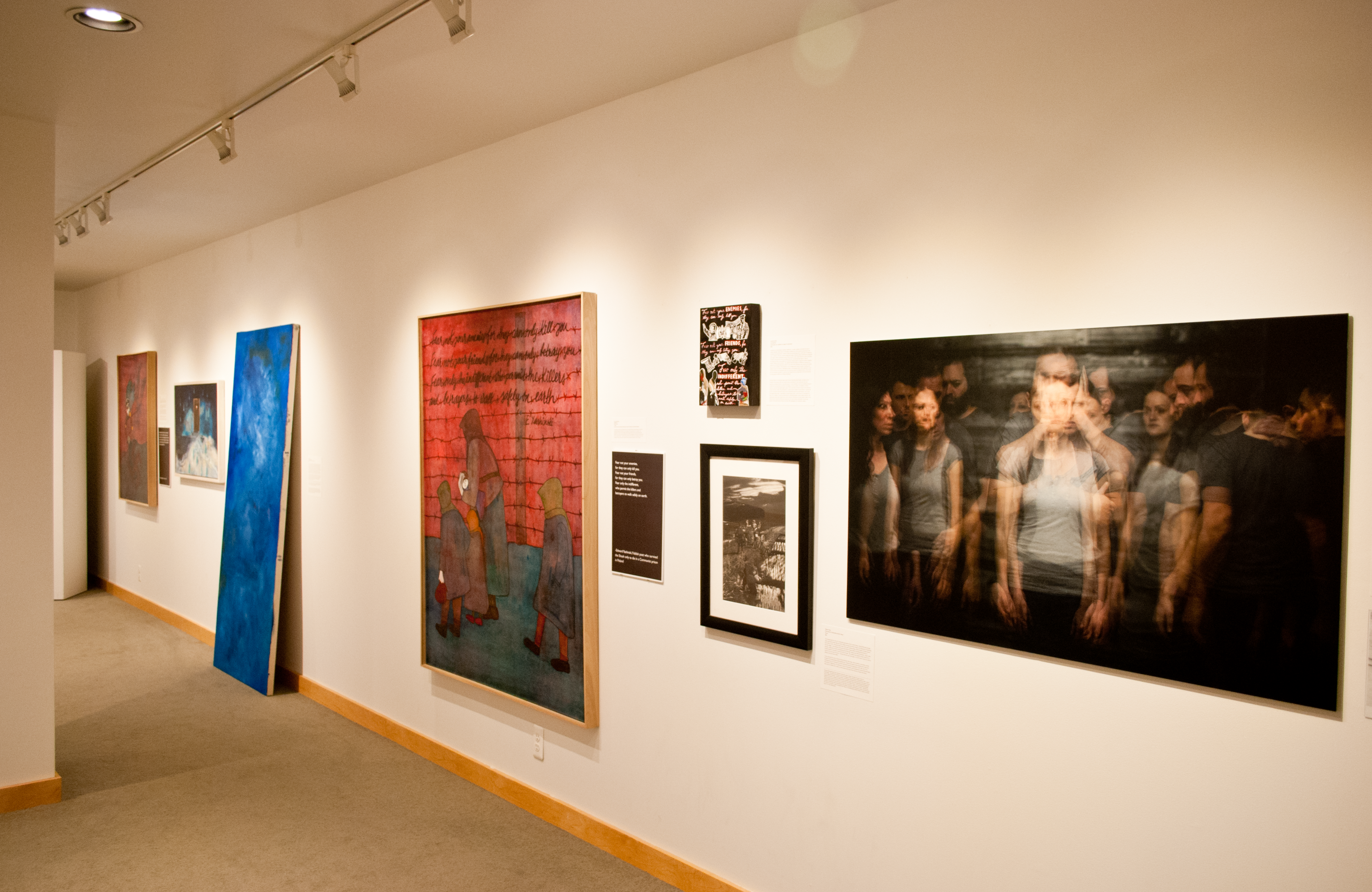
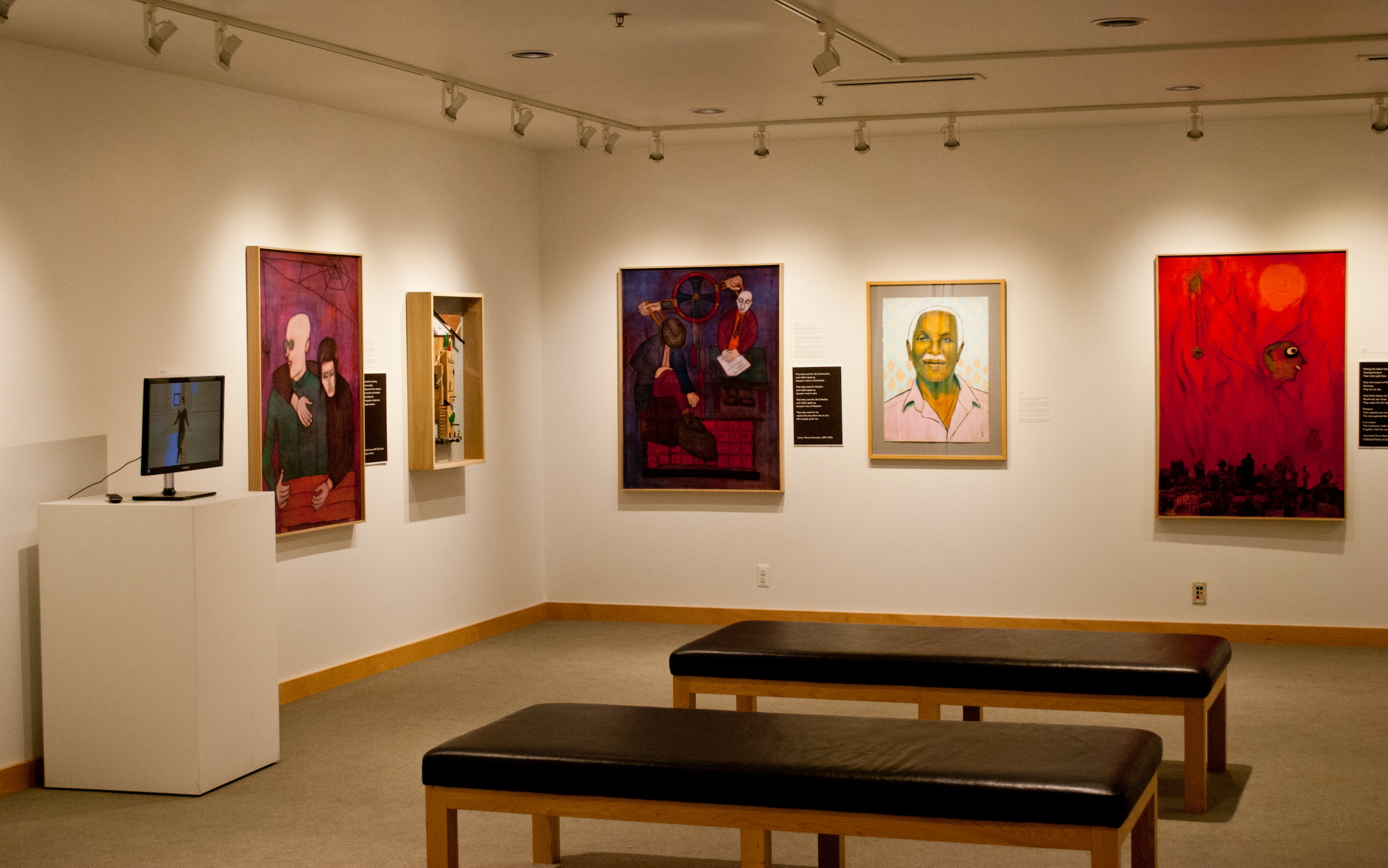
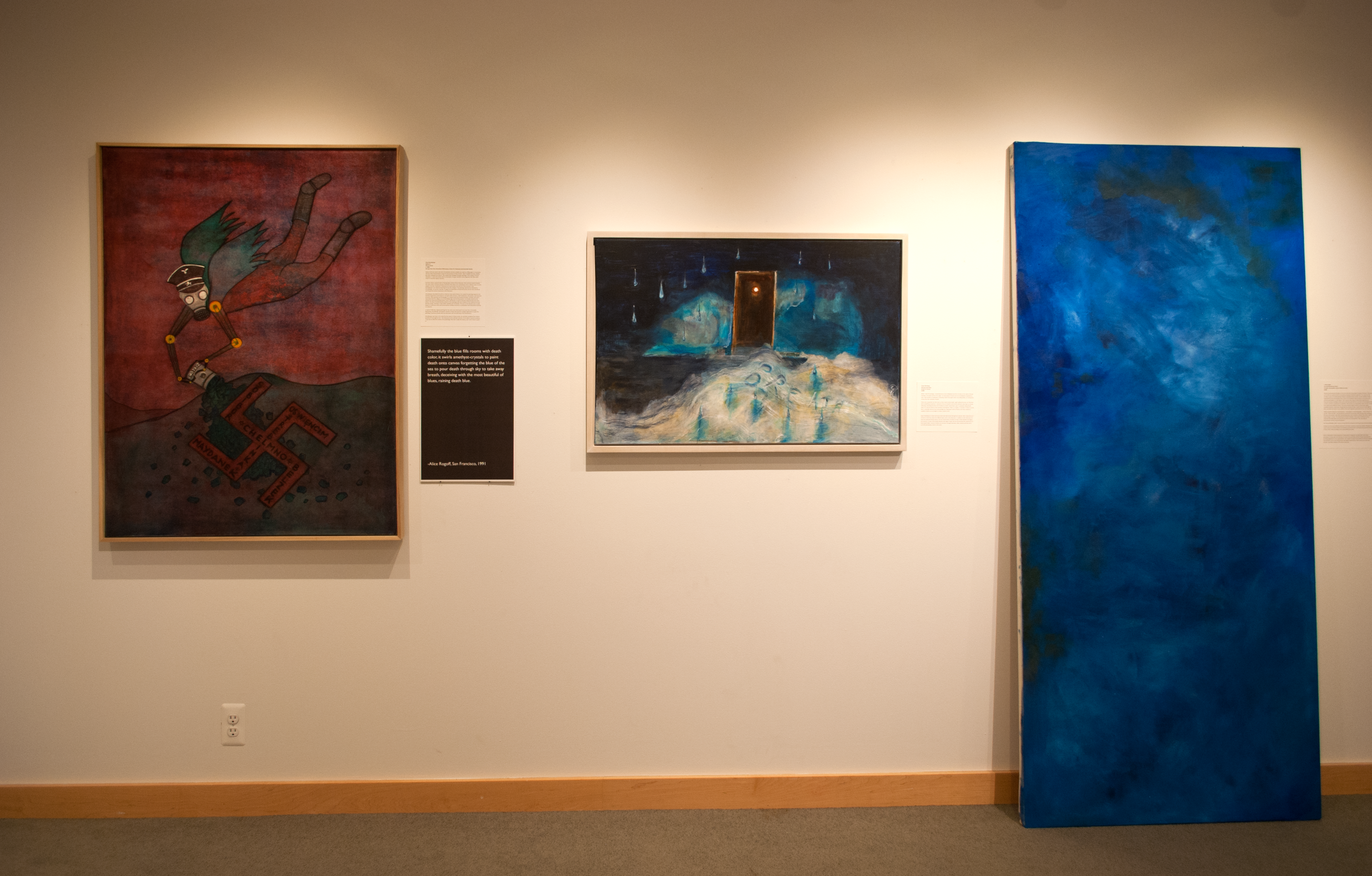
[Re]Telling showcases this process of handing-down visual representation to another generation by asking local artists and teens to create work in response to his chosen poetry or visuals. In the Tychman Shapiro Gallery, each Hirschberger painting is installed with the works of eleven local artists. Some of the artists made art in response to the literature that Hirschberger himself selected, or were directly inspired by his paintings or their themes and subject matter. In a later post, we will look at these artists’ work in juxtaposition with Hirschberger’s own.
This reflective artistic transmission represented the process of carrying personal narratives forward through generations. No artist replicated Hirschberger’s work, but each valued his testimony through the lens of their own expression. Shendar referred to this reflective process in her remarks, asserting that the past has meaning only when carried forward into the future. At its core, [Re]Telling shows how we give the past meaning, in this case in an artistic process.
In CHGS’ 20th year, this is an appropriate recognition of CHGS’ legacy, and a visible reminder of our mission to further the study of genocide through remembrance, responsibility, and progress.
[Re]Telling was presented by CHGS and the Sabes Jewish Community Center, made possible with support from the Arsham and Charlotte Ohanessian Endowment Fund for Justice and Peace Studies of the Minneapolis Foundation, and the Howard B. & Ruth F. Brin Jewish Arts Endowment, a fund of the Minneapolis Jewish Federation’s Foundation. Please explore these images of the exhibition that continue the life of this art beyond the physical exhibition, and check out CHGS’ entire collection, including past exhibitions.
* Stephen Feinstein further explained Hirschberger’s use of the symbol: “…The four horses are white, red, black, and pale. The name of the Fifth Horseman is said to be Hades or Hell. The Fifth Horseman operates in the shadow of the Fourth. It was common belief, especially during the Reformation, that one could not defend oneself or one’s faith against those things that one was unable to discern with one’s physical senses. The war predicted to be waged by the Fifth Horseman will occur on a different plane. It is a plane that the physical senses are not able to discern.”
Demetrios Vital is Outreach Coordinator for the Center for Holocaust and Genocide Studies. In this role he is responsible for the care and promotion of CHGS art and object collections, as well as working with the community in the development of programs, activities, and events.
“[Re]Telling” in the Tychman Shapiro gallery
“[Re]Telling” in the Tychman Shapiro gallery
“[Re]Telling” in the Tychman Shapiro gallery
“[Re]Telling” in the Tychman Shapiro gallery
Artwork by Fritz Hirschberger, Susan Weinberg, and J. Wren Supak
Artwork by Fritz Hirschberger and Robert O. Fisch
Artwork by Fritz Hirschberger and David Feinberg
Artwork by Fritz Hirschberger and Pamela Gaard
Artwork by Fritz Hirschberger, Howard Oransky, and dance choreographed by Judith Brin Ingber and performed by Megan McClellan
Artwork by Fritz Hirschberger, Eva Cohen, Rowan Pope, and David Sherman
Artwork by Fritz Hirschberger and Sandra Brick
Artwork from “Six Chairs” produced by middle-school students in the Breck School with their teacher, artist Rowan Pope. This project was published in a book of the same name.
The exhibition included a video of Judith Brin Ingber’s choreography for “I Never Saw Another Butterfly” (the poem by Pavel Friedman) performed by Megan McClellan:
What follows is a statement given by CHGS Outreach Coordinator, Demetrios Vital at the 2017 Twin Cities Jewish Community Yom HaShoah Commemoration, coordinated by the Jewish Community Relations Council, and hosted at Beth El Synagogue in St. Louis Park.
Demetrios spoke as a son of a survivor on the process of transferring memory across generations. Following his statements, he read the text of his father’s testimony as published in the 25th anniversary edition of Witnesses to the Holocaust, a book containing the testimony of Minnesota Holocaust survivors and liberators produced by the JCRC. That text is included below.
*****
I am deeply honored to be here with you all tonight. Thank you for having me and my father here.
I am the youngest son of Victor Vital. I am one of three children along with Rachel Vital Davis and Joseph Vital, and stand generationally between Victor and three grandchildren.
Victor Vital survived the Holocaust.
I’m one of many here who are children of survivors, or have family who survived, or who didn’t, and indeed even if we’re not directly related to those who experienced the Holocaust, we might all find access to stories and truly feel the impact of this history.
I’m not unique, but I am privileged to be here as a participant in transferring memory. I remember that my father came to my eighth grade geography class to tell his story, my first clear memory of his public speaking as a survivor. Even then, and to this day, my father’s educational testimony that he presents to students takes exactly 55 minutes, and it has three components to it. First, he addresses the history of the Holocaust on a larger level. Then, he details the history of the Holocaust in Greece. Finally, after that context, Victor shares aspects of his and his family’s experience as Greek Jews in their flight from the Nazi military. Following that, he invites questions.
This order is of explicit importance to Victor. His story is always last, preceded by very large numbers, including how many Jews were killed or survived in various countries (60-70,000 were killed in Greece, with maybe 4,000 surviving, and with variability in those estimates). Victor is intentional in placing his Holocaust experience as a Greek Jew last and within a much larger context.
Fortunately, his testimony, along with others’, is accessible through the “Transfer of Memory” exhibit, and is included in the JCRC’s publication Witnesses to the Holocaust. Those are Victor’s words, and I will read them shortly.
As one of his children, we hope his story will be accessible through us, as well. That story looms in my family, influences our behavior, and it’s there in my psyche, and work, and thoughts. But I am not driven to weigh its magnitude relative to its worth, because I don’t share my father’s survivor’s guilt. I didn’t survive. I don’t stare down at the millions who didn’t make it, or feel, nightly, those experiences, like others who survived, in camps, or as partisans, or however. But I’ve known that I’m only here because Victor survived. I have learned from my father the imperative of educating about the Holocaust, and to me that’s a vocation, and not a need that comes from starving in a forest in 1944.
I didn’t live through the Holocaust, but Victor’s story lives in me.
The experience of the Holocaust as the child of a survivor isn’t the last third of my testimony. It’s the beginning of my own life. Inheriting that experience happens in subtle ways . . . For example, at the dinner table: as a kid, I didn’t know that it wasn’t completely normal to regularly talk about genocide at Shabbat dinner.
Or in experiencing behaviors and fears and guilt and empathy manifested at any moment, often by surprise. When I heard the news of the devastating earthquake in Haiti, I was on the phone with my father. He said, “It’s terrible what happened. They have cholera, because they have no plumbing now. I had to live for two years with no bathrooms. It’s not a human life.” To go from deep suffering and trauma to an empathy manifested off-handedly like that is something beyond my comprehension.
I can not really tell Victor’s story. His story is big, and sudden, and lived in. I can try to tell the story of being my father’s son, of being a kid in Minnesota with the Holocaust on his mind. What I can transfer isn’t his story in its magnitude, framed against what he lost, but I can share what he told me, and maybe tell some of the lessons that came unplanned.
Yehudit Shendar, former Deputy Director at Yad Vashem, spoke recently at the Sabes JCC about the importance of memory working forward, rather than only reflecting backwards. That’s what we’re all here for: to move memory forward, hopefully for good. I hope to someday live up to that, and to be a part of that, with my family, and community, and with as many as will move forward with us to remembering for good. Only a few of us are Victor’s children, but even the story of one survivor is too big for any of us to transfer it alone.
*****
Victor Vital – Born: February 6, 1932 in Patra, Greece
“When I first came into the United States, I did not consider myself a survivor because I was not from the concentration camps but for two years we had very difficult times.” Victor’s family story of survival by hiding in the mountains of southern Greece began when he was twelve years old. “I’m a survivor in hiding. I was lucky not to be in the concentration camps and I owe that to my father who said when the Nazis came, ’We have to leave immediately.’”
Victor was born in Patra, a port city in southern Greece. It was an area held by the Italians and not directly threatened by German invasion until the pact between Italy and Germany collapsed and the Germans occupied the entire county. “At that time my mother’s relatives with their families, about 90 people who lived in Salonika were taken by the Germans to the concentration camps – none came out, none of these 90 people.” Word of the Salonika deportations quickly spread to the Vital family. “They sent us a notice to go away from the city and hide outside in the mountains, as far away as we could get, where no one (would) know us.”
Victor’s father, Joseph, was president of the local Jewish community and well known in the town. It was through his friend the police chief that the family got new identification papers and began preparations to go into hiding. “We took whatever we could carry in our hands and in a small car and left. There were eight people in our group: myself, my father Joseph Vital, my mother Rachel Vital, my brother Marco Vital, my sister Emily Asher and her husband Nathan and his parents Samuel and Regina Asher.”
They left Patra in the early morning and spent the night in a small bombed-out church away from the city. From there they followed a path that would lead to the village of Vallatune. The trip took three days and nights. “At night we slept on the ground in fields, always fearful of snakes and wolves.” They eventually settled in the cellars of two small houses where they kept a couple of goats. “We slept on the dirt floor of the cellars and we were infested with lice. This is (a) terrible thing – lice. We had to go into the forest to relieve our bowls – another terrible thing.” Food for the families was extremely scarce. “We went out in the field to gather greening. We bought cheese scrapings from the villagers. We bought wheat and ground it by hand to make bread. Our only beverage was water. We were always cold and hungry.
In November the family got word that Germans were in the mountain villages looking for Jews. “So we had to go deeper in the mountains to another village… It took us two days and nights to travel there. Again we slept on the ground under the trees in the forest. We huddled together to try to stay warm but it was November and very cold. We would not even make a fire to warm ourselves or to cook what little food we had. We had to protect ourselves from the wolves and if the Germans were close by, they would find out about us.” The situation became so desperate that Victor’s father and brother-in-law decided to take a chance and go into the nearby village to seek help. When they reached a bombed out church they met a Christian friend from their city who was also trying to find food for his family because it was a time of hunger and desperation for the entire Greek populace.
“He recognized my father and said, ‘what are you doing here? Go back in the mountains… the Germans are looking for you and have put a reward out for you and your families.’” As the two men turned back to rejoin their families in hiding the friend handed them a small bag of wheat. It was all he had. “I want to tell you that, if I am here today, alive, it’s because of the people (who) protected me.
“We could not have survived much longer under these conditions. Finally when the Nazis were defeated and left Greece we returned to Patra. We were sick and hungry and we found that our home had been entirely destroyed. We had no furniture, dishes, cooking utensils or even running water. Our neighbors gave us what they could spare until my father found a job.”
Victor Vital was twelve years old when his family went into hiding. They returned to their home two years later when Victor was fourteen. “The bad circumstances and the terrible life of those times are always in my mind. The suffering was beyond belief.”
“I feel obligated that I have to let the other Jews and generally all the people know about (the) Holocaust… we have to remember and as long as we remember we might avoid another.” Demetrios Vital is Outreach Coordinator for the Center for Holocaust and Genocide Studies. In this role he is responsible for the care and promotion of CHGS art and object collections, as well as working with the community in the development of programs, activities, and events.
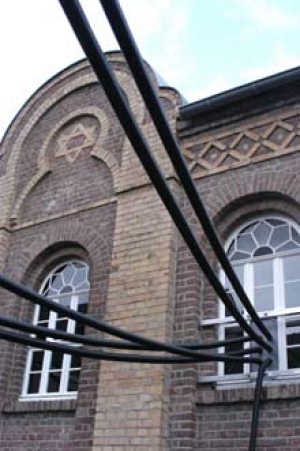
In March 2006, performance artist Santiago Serra constructed a homemade gas chamber inside a former synagogue in the Cologne area and invited Germans to be symbolically gassed. Exhaust pipes from six cars were hooked to the building, which was then filled with deadly carbon monoxide and visitors entered the space wearing protective masks. What was the artist’s intention? Serra said his aim was to give people a sense of the Holocaust. The Jewish community was furious. It was considered a provocation at the expense of Holocaust victims, an insult to survivors and the whole community. “What’s artistic about attaching poisonous car exhaust into a former synagogue?” said writer and Holocaust survivor Ralph Giordano (1923-2014), “and who gave permission for this?”
The understandable outcry from Serra’s exhibit was very similar to the one we are witnessing today from the Dakota community in response to the gallows-like artwork recently installed for the refurbished Walker Art Center’s Sculpture Garden. While “Scaffold” artist Sam Durant and Serra draw inspiration from acts of extreme violence that are different in nature and scope, the lessons to be learned from both cases are the same: art that addresses mass atrocity is always demarcated by limits. It’s unfortunate that this lesson was blatantly ignored by the Walker’s curators.
The Holocaust has prompted a long history of ethical and aesthetic debates regarding the appropriate ways to represent unspeakable events whose reverberations we are still surrounded by. Filmmaker Claude Lanzmann, the brilliant creator of Shoah (Holocaust), said once in an interview that it is impossible to convey a certain absolute horror and that claiming to do so is to be guilty of the gravest transgression. The Holocaust, he argued, “erects a ring of fire around itself, a boundary that you cannot cross.” Lanzmann’s aesthetic approach was to give voice to the victims through survivor testimony, producing a filmic work of art that purposefully avoided using images of gas chambers or any documentary footage of the annihilation. By doing so he drew the boundaries of what could and what should under no circumstances be shown.
Today, can we conceive of art on atrocity without acknowledging its representational challenges? Unlike other subjects of artistic creation, here dubious approaches or failed experiments will not just be deemed of poor quality or taste, but an insult to the memory of surviving victims. The damage that such transgressions cause, both for those who carry the burden of historical trauma and for the relations among communities torn by divisive pasts, should never be underestimated.
The Walker controversy points to a broader problem: that the art industry is at constant risk of becoming no more than voyeuristic elitism. Too often art appropriates and exploits extreme experiences and turns them into a consumer product. Certainly, artists and curators will always claim an enlightening goal. Durant and the Walker Art Center have issued statements where they side with the plea of Dakota Indians for justice and acknowledgement. “Build awareness,” “start a conversation,” “it warns against forgetting the past,” in Durant’s words. Their purpose was candid and benign. But as an old saying goes, the road to hell is paved with good intentions.
If “Scaffold” was meant to start a conversation about past atrocities, but doesn’t engage the Dakota, in the end not much has changed. It’s still perpetuating a one-sided narrative.
Alejandro Baer is Associate Professor of Sociology and Director of the Center for Holocaust and Genocide Studies at the University of Minnesota.
Joe Eggers, is a 2016 graduate of the University of Minnesota. His MA thesis explored the cultural genocide of indigenous people through the boarding school system. He currently works as a research associate at the Center for Holocaust and Genocide Studies.
The following is an open letter to the organizers of an African Trade Forum event, who have announced that Maowia Osman Khalid, Ambassador of Sudan to the US, will be on campus for a panel co-hosted by the Carlson School of Management.
Dear organizers and sponsors of “Words change Worlds” and of the African Trade Forum:
As scholars of genocide and human rights at the University of Minnesota, we are gravely concerned by the participation of the Ambassador of Sudan to the United States, Maowia Osman Khalid, at the 2017 luncheon of Books for Africa (“Words change Worlds”) and the “African Trade Forum” on Thursday, May 18th, 2017, in which you are involved as a co-organizer or co-sponsor.
Ambassador Khalid will be representing Sudan’s President Omar-al-Bashir, against whom the International Criminal Court has taken action. On March 4, 2009, the Court issued an arrest warrant against President al-Bashir for war crimes and crimes against humanity. On July 12, 2010, the Court also filed charges against President al-Bashir for the crime of genocide.
The United States is not neutral to these events. On July 22, 2004, the U.S. Senate and House of Representatives passed resolutions recognizing the mass violence in the Darfur region of Sudan as genocide, and on December 31, 2007, President George W. Bush signed into law the Sudan Accountability and Divestment Act.
In light of these facts, your involvement in organizing or sponsoring an event in which the Ambassador of Sudan participates is, in our judgment, highly problematic. We ask that you reconsider your involvement and draw the appropriate consequences.
Yours sincerely,
Alejandro Baer
Associate Professor, Department of Sociology
Stephen C. Feinstein Chair & Director, Center for Holocaust and Genocide Studies
University of Minnesota
Joachim Savelsberg
Professor of Sociology and Law
Arsham and Charlotte Ohanessian Chair
University of Minnesota
Barbara Frey
Director, Human Rights Program
University of Minnesota
Screenshot of the invitation from the Books for Africa organization.
USC Shoah Foundation Center for Advanced Genocide Research has decided to endorse the initiative of a group of seven scholars from different Latin American countries to study Holocaust Survivors in Latin America as part of its Interdisciplinary Research Week. Not an alien in the context of terrorscapes and transitional justice, Latin America has been a space of contested narratives regarding mass violence.
In countries like Colombia, realities of forced displacement, illegal prosecution, and war narratives have been ongoing historically, which has been widely documented and studied. However, there is still much to be discovered, especially as these narratives coexist with narratives of survival from the Holocaust. In this regard, Latin America has been related to the Holocaust mostly as an important space for refuge after WWII.
The links, interconnections and detachments from cultural, political and economic realities within Latin American countries are still raw spaces to explore. We are set out to discover how identities of Holocaust survivors were transformed by exile to those specific places, and how survival appears as a dimension that keeps reinventing itself, insofar as subjects change after exposure to new experiences across the continent. Dictatorships, armed conflicts, organized crime, even the weather (inverted seasons or the absence of them), are interconnected aspects to boost cultural belonging or distrust. How these aspects are interconnected throughout the life course of survivors constitute the way in which their narratives can offer us more diverse inputs to understand national frameworks of memory in Argentina, Chile, Colombia and Mexico.
Cauca Valley in the South of Colombia, near Cali, one of the cities that hosted Jewish refugees.
During the Interdisciplinary Research Week, the group will have access to testimonies of Holocaust survivors who settled in the aforementioned countries. We will use a variety of research methods including text mining, mapping trajectories of survival, and using indexing terms in order to deepen our understanding of identity, acculturation and survival. This initiative provides insight into the importance of tracing memory and experiences of displacement and refugee-seeking throughout time. These narratives tell us more about ourselves, while also telling us about our past: What they say, how they say it, when they say it. These aspects become of utmost importance when tracing subjectivities in memory reconstruction.
When Holocaust survivors arrived to Latin American countries, they became part of the story, but they did not necessarily became part of local memory, or at least not everywhere, and not in the same way. Both history and memory regarding the Holocaust are still undefined landscapes in Latin American settings. While Argentina is a country that has more experience documenting experiences of arrival and settlement of Holocaust survivors, Chile, Colombia and Mexico are on their way to strengthen the field, and innovative methods are required to perform this task properly. This work is still in progress, but can be achieved through innovation, rigorousness and a bunch of people with very different backgrounds building new possibilities.
The group of scholars includes the author, Lorena Ávila Jaimes, who studied Political Science and has a MA in Public Policy from Universidad Nacional de Colombia. She is interested in the intersections between memory studies and transitional justice. She also holds an LLM in International Law and Human Rights from Tilburg University and an MSc in Victimology and Criminal Justice from the same University.
Other Scholars on this project are:
Yael Siman (Iboamericana University)
Nancy Nicholls Lopeandía (Pontificia Universidad Católica de Chile)
Susana Sosenski (Universidad Nacional Autónoma de México)
Emmanuel Kahan (Universidad Nacional de La Plata)
Alejandra Morales Stekel (Jewish Interactive Museum of Chile)
Daniela Gleizer Salzman (Universidad Nacional Autónoma de México)
About Center for Holocaust & Genocide Studies
The Center for Holocaust and Genocide Studies at the University of Minnesota-Twin Cities promotes academic research, education and public awareness on the Holocaust, other genocides and current forms of mass violence. It was established in 1997 by Dr. Stephen Feinstein as an interdisciplinary research center. Read more…



 In March 2006, performance artist Santiago Serra constructed a homemade gas chamber inside a former synagogue in the Cologne area and invited Germans to be symbolically gassed. Exhaust pipes from six cars were hooked to the building, which was then filled with deadly carbon monoxide and visitors entered the space wearing protective masks. What was the artist’s intention? Serra said his aim was to give people a sense of the Holocaust. The Jewish community was furious. It was considered a provocation at the expense of Holocaust victims, an insult to survivors and the whole community. “What’s artistic about attaching poisonous car exhaust into a former synagogue?” said writer and Holocaust survivor Ralph Giordano (1923-2014), “and who gave permission for this?”
 The understandable outcry from Serra’s exhibit was very similar to the one we are witnessing today from the Dakota community in response to the