Search results for The

2The History of Christmas

Christmas Across Cultures

The Economics of Christmas

Racializing Christmas

Christmas and Gender

Gift Guides and the Social Construction of Gender

Sexifiying Christmas

Christmas Marketing

Lisa Wade, PhD is an Associate Professor at Tulane University. She is the author of American Hookup, a book about college sexual culture; a textbook about gender; and a forthcoming introductory text: Terrible Magnificent Sociology. You can follow her on Twitter and Instagram.

Flashback Friday.

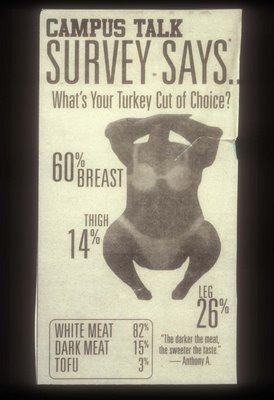
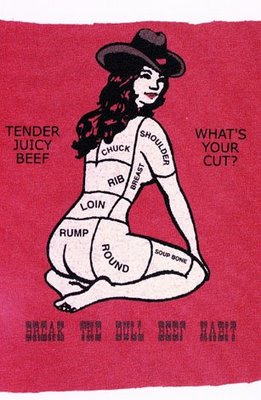
In her now-classic books The Sexual Politics of Meat and The Pornography of Meat, Carol Adams analyzes similarities in the presentation of meat products (or the animals they come from) and women’s bodies.

She particularly draws attention to sexualized fragmentation — the presentation of body parts of animals in ways similar to sexualized poses of women — and what she terms “anthropornography,” or connecting the eating of animals to the sex industry. For an example of anthropornography, Adams presents this “turkey hooker” cooking utensil:

Adams also discusses the conflation of meat/animals and women–while women are often treated as “pieces of meat,” meat products are often posed in sexualized ways or in clothing associated with women. The next eleven images come from Adams’s website:

For a more in-depth, theoretical discussion of the connections between patriarchy, gender inequality, and literal consumption of meat and symbolic consumption of women, we highly encourage you to check out Adams’s website.

This type of imagery has by no means disappeared, so we’ve amassed quite a collection of our own here at Sociological Images.

Blanca pointed us to Skinny Cow ice cream, which uses this sexualized image of a cow (who also has a measuring tape around her waist to emphasize that she’s skinny):

For reasons I cannot comprehend, there are Skinny Cow scrapbooking events.

Denia sent in this image of “Frankfurters” with sexy ladies on them. The text says “Undress me!” in Czech.

Finally, Teresa C. of Moment of Choice brought our attention to Lavazza coffee company’s 2009 calendar, shot by Annie Liebowitz (originally found in the Telegraph).

Spanish-language ads for Doritos (here, via Copyranter):

capture

panel_bikini

Amanda C. sent in this sign seen at Taste of Chicago:

mannys

Dmitiriy T.M. sent us this perplexing Hardee’s French Dip “commercial.”  It’s basically three minutes of models pretending like dressing up as French maids for Hardees and pouting at the camera while holding a sandwich is a good gig:

Dmitriy also sent us this photo of Sweet Taters in New Orleans:

photo

Jacqueline R. sent in this commercial for Birds Eye salmon fish sticks:

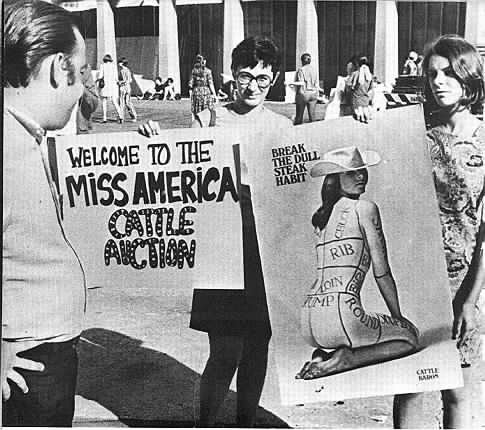
Crystal J. pointed out that a Vegas restaurant is using these images from the 1968 No More Miss America protest in advertisements currently running in the UNLV campus newspaper, the Rebel Yell. Here’s a photo from the protest:

-1

Edward S. drew our attention to this doozy:

Dmitriy T.M. sent us this example from Louisiana:

Haven’t had enough?  See this post, this post, and this post, too.

Originally posted in 2008.

Gwen Sharp is an associate professor of sociology at Nevada State College. You can follow her on Twitter at @gwensharpnv.

“We need to get rid of Obamacare,” says Ed Gillispie in a NYT op-ed. The reason: Obamacare’s “gravitational pull toward a single-payer system that would essentially supplant private insurance with a government program.”

Gillespie, who lays out his credentials at the start of the article – he ran for Senate in Virginia and lost – notes that Obamacare is unpopular. But he omits all mention of a government-run single-payer system that happens to be very popular – Medicare. No Republican dare run on a platform of doing away with it. Gillespie himself accused Obamacare of cutting Medicare, a statement that Politifact found “Mostly False.”

So how are seniors doing? Compared to their pre-Medicare counterparts, they are  probably healthier, and they’re probably shelling out less for health care. But compared to seniors in other countries, not so well. A Commonwealth Fund survey of eleven countries finds that seniors (age 65 and older) in the U.S. are the least healthy – the most likely to suffer from chronic illnesses.* 

Over half the U.S. seniors say that they are taking four or more prescription drugs; all the other countries were below 50%:

And despite Medicare, money was a problem. Nearly one in five said that in the past year they “did not visit a doctor, skipped a medical test or treatment that a doctor recommended, or did not fill a prescription or skipped doses because of cost.” A slightly higher percent had been hit with $2,000 or more in out-of-pocket expenses. 

In those other countries, with their more socialistic health care systems, seniors seem to be doing better, physically and financially.  One reason that American seniors are less healthy is that our universal, socialized medical care doesn’t kick in until age 65. People in those other countries have affordable health care starting in the womb. 

Critics of more socialized systems claim that patients must wait longer to see a doctor. The survey found some support for that. Does it take more than four weeks to get to see a specialist? U.S. seniors had the highest percentage of those who waited less than that. But when it came to getting an ordinary doctor’s appointment, the U.S. lagged behind seven of the other ten countries.

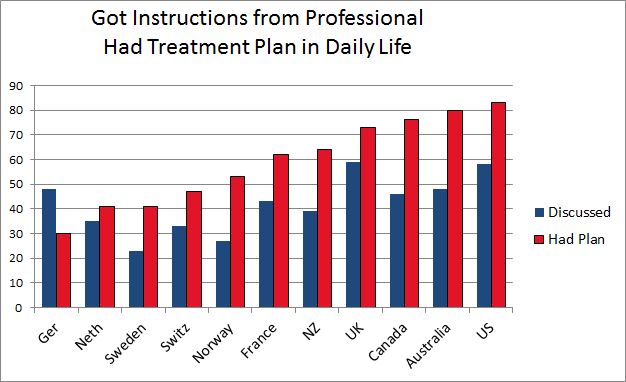
There was one bright spot for U.S. seniors. They were the most likely to have developed a treatment plan that they could carry out in daily life. And their doctors  “discussed their main goals and gave instructions on symptoms to watch for” and talked with them about diet and exercise.

Gillespie and many other Republicans want to scrap Obamacare and substitute something else. That’s progress I suppose. Not too long ago, they were quite happy with the pre-Obamacare status quo. Throughout his years in the White House, George Bush insisted that “America has the best health care system in the world.” Their Republican ideology precludes them from learning from other countries. As Marco Rubio put it, we must avoid “ideas that threaten to make America more like the rest of the world, instead of helping the world become more like America.”

But you’d think that they might take a second look at Medicare, a program many of them publicly support.

* Includes hypertension or high blood pressure, heart disease, diabetes, lung problems, mental health problems, cancer, and joint pain/arthritis.

Cross-posted at Montclair SocioBlog and Pacific Standard.

Jay Livingston is the chair of the Sociology Department at Montclair State University. You can follow him at Montclair SocioBlog or on Twitter.

Mainstream media outlets such as the Today ShowMarie Claire, and Huffington Post have been reporting on a new scientific study that claims “women talk more than men.” These media outlets report there’s new “biological evidence to support the idea that women are more talkative than men.”

Not quite! The results from the actual scientific study published in The Journal of Neuroscience have found the brain protein responsible for the difference between girls’ and boys’ language acquisition. The study is entitled, “Foxp2 Mediates Sex Difference in Ultrasonic Vocalization by Rat Pups and Directs Order of Maternal Retrieval.”

Admittedly, it doesn’t quite have the ring of “Women Talk More Than Men.” Additionally, the aforementioned media outlets have also been referencing (with no scientific citation) the statistic that on average women speak 20,000 words per day compared to the mere 7,000 words spoken my men. A study from 2007 published in the journal Science contradicts these findings. The researchers found that men and women actually speak about the same number of words per day.

But that didn’t stop Today from running an image of an irritated man being screamed at by an angry woman shouting into his ear through a megaphone to go along with their story.

The researchers do not mention anything about women talking more than men throughout the paper, but rather why girls tend to start speaking earlier and with greater complexity than boys of the same age. The researchers started to analyze the levels of Foxp2 protein in the brains of male and female rats. The protein levels were higher in males than females in brain areas associated with cognition, emotion, and vocalization and male rats made more noises. The researchers extended their findings to analyzing human brain tissue from girls and boys in a preliminary study of Foxpt2 protein. They found boys had lower levels of the Foxpt2 protein than girls in the brain region associated with language.

Therefore, the broader conclusion that can be drawn from this study is not that women talk more than men, but rather a possible origin as to why there are language differences between the sexes. The findings help to explain why girls may exhibit consistent advantages in early language acquisition and development compared to boys.

And the conclusion to be drawn from the media coverage is that our science news has a long way to go.

Mandi N. Barringer is a doctoral student in sociology at the University of Central Florida. Her primary areas of research include social inequalities, sexuality, and gender. Mandi is also the Research Coordinator for NeuroNet Learning, where this post originally appeared.

It is only 50 years ago that the state of Florida was hounding lesbians and gays from their jobs in schools and universities. Their persecution is distressing on many levels, the most far-reaching of which is the power that the state can hold when it is allowed to harass its citizens for no other reason than their choice of lovers.

In this case, this power could be exerted because an unrepresentative group, The Pork Chop Gang, was able to form a state-within-a-state, known as the Johns Committee in 1956 (after Charley Johns, a state senator). They collaborated with police forces and sympathetic university administrators. University of Florida President J. Wayne Reitz’s dubious career, or example, included “purges of gay and leftist employees, students,” and at least 85 African-American students.

Lisa Mills and Robert Cassanello have produced a documentary on the Johns Committee, a trailer for which can be seen here:

In 1964, the Committee published a hateful screed that became known as The Purple Pamphlet (full text). The section “What to do about homosexuality?” reveals that 64 Florida teachers had had their certificates revoked between 1959 and 1964, and that legislation had been strengthened to ensure more such revocations. Convicted teachers could meanwhile look forward to compulsory psychiatric treatment of the kind that killed Alan Turing in the U.K.

3

The lessons of this period remain potent in 2014, at a time when Texas Republicans are advocating “reparative therapy” for gay men. Such therapies could be a Trojan Horse for state power over gay peoples’ lives. They give hope to the politicians of today who would like to emulate the notorious feats of the Johns Committee which haunt our recent past.

Jonathan Harrison, PhD, is an adjunct Professor in Sociology at Florida Gulf Coast University and Hodges University whose PhD was in the field of racism and antisemitism. He writes for the History News Network, where this post originally appeared.

Flashback Friday.

Sally R. sent in a two-page Tropicana ad she found in her morning newspaper.  The ad features, as Sally puts it, a “hard (bad) surly girl in pants and [an] easy (nice) girl in a dress with a flowery gift and passive smile…”  The first is labeled “hard to handle” and the second “easy to handle.”  The new orange juice container is supposed to be more like the “easy” girl.

On the face of it, this ad is about parenting.  But there is so much more going on that makes the ad work.

Notice how easyness is communicated with symbols of femininity.  The message is that girls are, ideally, accommodating and passive.  Girls should be like objects, easy to “handle.”  Would the ad work quite the same way if the child was a boy?  Do we hope/expect that our boys will be completely passive and convenient to handle?

Sally also notes the “double meaning of easy” which, combined with the girl’s coy pose and smile, sends a sexual message.  The sexual promise that the ad makes (it/she is “easy to handle”) works despite (or because of?) her age.  Consider how similar the image is to these examples in which women and girls are simultaneously sexualized and infantilized with the use of passive poses and symbols of youth.

This conflation of object status, femininity, being female, and being well-behaved is obnoxious. It’s insulting to both boys and girls and affirms the false gender binary. It’s dangerous, too. It contributes to the idea that girls are objects to take advantage of who are misbehaving if they assert themselves. It’s disturbing to see it reproduced for something as trivial as an orange juice carton.

Lisa Wade, PhD is an Associate Professor at Tulane University. She is the author of American Hookup, a book about college sexual culture; a textbook about gender; and a forthcoming introductory text: Terrible Magnificent Sociology. You can follow her on Twitter and Instagram.
The interviewer asks: “Are you still in despair about the world?” James Baldwin replies:

I never have been in despair about the world. I’ve been enraged by it. I don’t think I’m in despair. I can’t afford despair. I can’t tell my nephew, my niece. You can’t tell the children there’s no hope.

In the 5min speech below, Malcolm X makes an argument in favor of violence when violence is called for.

Excerpts:

We are peaceful people, we are loving people. We love everybody who loves us. But we don’t love anybody who doesn’t love us. We’re nonviolent with people who are nonviolent with us. But we are not nonviolent with anyone who is violent with us.

Whatever kind of action program can be devised to get us the thing that are ours by right, then I’m for that action no matter what the action is.

I don’t think when a man is being criminally treated, that some criminal has the right to tell that man what tactics to use to get the criminal off his back. When a criminal starts misusing me, I’m going to use whatever necessary to get that criminal off my back.

And the injustice that has been inflicted on Negros in this country by Uncle Sam is criminal…

Watch: