Search results for The

Over the past 40 years, Americans have become increasingly likely to deny an affiliation with a religion. The graph below shows that people with “no religious preference” rose from about 5% of the population in 1972 to about 20% today. Overall, however, Americans do not report a corresponding decline in the a belief in God, life after death, or other religious ideas. What’s going on?

2

Sociologists Michael Hout and Claude Fischer — the guys who made the graph above — argue that the retreat from religious affiliation is essentially, a retreat from the political right. Religion has become strongly associated with conservative politics, so left-leaning people are choosing, instead, to identify as “spiritual but not religious.”

Here is some of their evidence. The data below represents the likelihood of rejecting a religious affiliation according to one’s political views. The more politically liberal one is, the more likely they have come to reject religion.
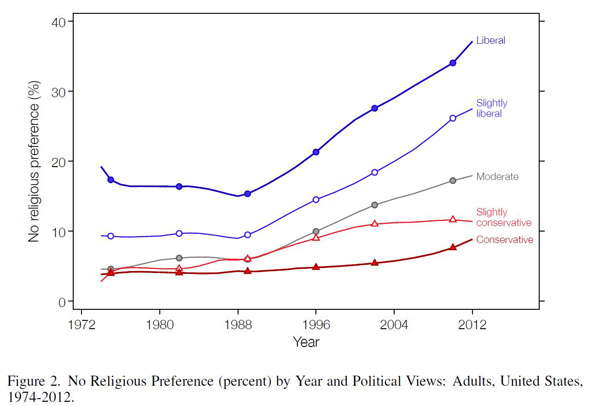
3

Using fancy statistical analyses, they explain: “generational differences in belief add nothing to explaining the cohort differences in affiliation.” That is, people haven’t lost their faith, they just disagree with religious leaders and institutions.  Hout and Fischer conclude:

Once the American public began connecting organized religion to the conservative political agenda — a connection that Republican politicians, abortion activists, and religious leaders all encouraged — many political liberals and moderates who seldom or never attended services quit expressing a religious preference when survey interviewers asked about it.

Democrats have wondered how to break the association of the right with religion and claim a little bit of moral authority for themselves. It looks like they may not need to or, even, that having failed to do so has a surprise advantage.

Lisa Wade, PhD is an Associate Professor at Tulane University. She is the author of American Hookup, a book about college sexual culture; a textbook about gender; and a forthcoming introductory text: Terrible Magnificent Sociology. You can follow her on Twitter and Instagram.
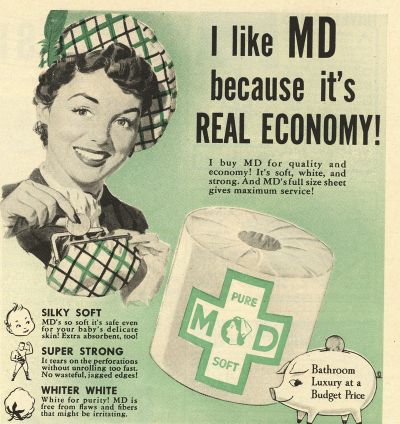
Flashback Friday.

A website called Found in Mom’s Basement posted this vintage toilet paper ad that plays on the stereotype that Scottish people are cheap. From the post:

Although the stereotype of the cheap Scotsman isn’t as widely known in the U.S. today, going back a few decades it was an ethnic stereotype that was used freely, often making the Scots the butt of jokes.

6a00d83451ccbc69e20105370a813a970b-400wi

The post has links to several examples, such as the Studebaker Scotsman, a low-cost, minimal-options car. As a commenter to that post pointed out, Safeway’s store brand cigarettes, advertised as being inexpensive, was “Scotch Buy.” For a more recent example, we have McFrugal, a hardware site (now down):

picture-1

A reader, Julia, noted that Scotch tape was named that because:

it originally had adhesive only on the edges of the tape.  [An early user] told a 3M salesman to go back to his “Scotch bosses” (presumably too cheap to put adhesive all over the tape) and make it stickier.

The Scots-are-cheap stereotype is a great example of how ethnic stereotypes can lose their power. Maybe I’m just oblivious, but until a few years ago, I’d never heard of the stereotype that Scots were cheap. Without that context, the associations the ads are attempting to make would be meaningless to me — I would have just thought it was odd that McFrugal had a guy with bagpipes, but not understood that it might have any meaning. When I asked students in my race class about this, only a couple had ever heard this stereotype.

Obviously, though, it used to be a very common, widely-recognized notion. Much like the Irish and other European ethnic groups, as Scots became part of the larger “White” racial category, ethnic distinctiveness and stereotypes have become less prominent.

Originally posted in 2009.

Gwen Sharp is an associate professor of sociology at Nevada State College. You can follow her on Twitter at @gwensharpnv.

If you are worried about the abuse and exploitation of non-human animals, you can become a vegetarian or a vegan. But if you worry about the abuse and exploitation of humans, there is no morally upright consumer choice you can make, short of growing 100% of your food yourself.

This is the main message of journalist Eric Schlosser in this 4min video produced by BigThink. In it, he summarizes the extent of the exploitation of poor people, mostly immigrants, in the restaurant industry, the meatpacking industry, and the production of fresh fruits and vegetables in the U.S.

Especially for the people who pick our produce, he insists, the working conditions “are more reminiscent of the mid-nineteenth century than they are with the twenty-first century.” It is “literally slavery.”

Watch here:

Lisa Wade, PhD is an Associate Professor at Tulane University. She is the author of American Hookup, a book about college sexual culture; a textbook about gender; and a forthcoming introductory text: Terrible Magnificent Sociology. You can follow her on Twitter and Instagram.

Most Americans, when asked if they are affected by advertising, will say “not really.” They think other people are influenced by cultural messages, but that they are somehow immune.

Whether people are shaped by the media they consume seems to be a perpetual question. The fact that billions of dollars are spent every year attempting to influence us is probably a sign that advertisers know it works. Scientists get in on the action, asking pressing questions like: Do violent video games increase violence in real life? Do sexy, thin models hurt girls’ self-esteem? We do the studies and the answers are often inconclusive, probably because of how complicated the relationships are.

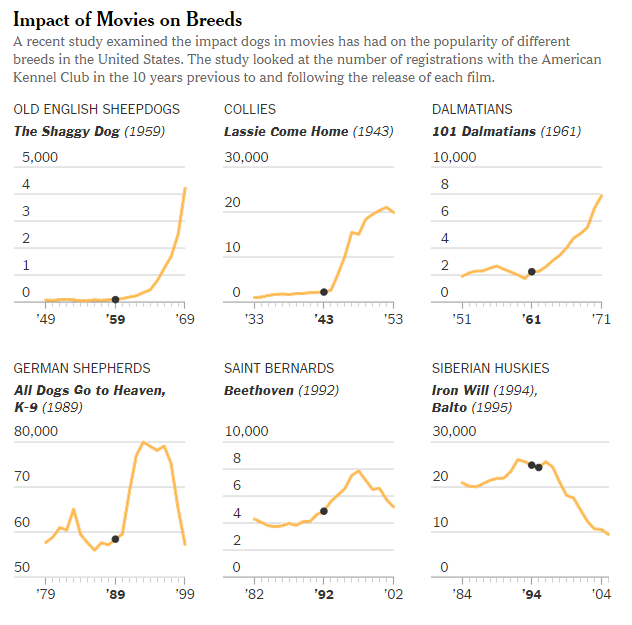
Psychologist Stefano Ghirlanda and his colleagues asked a slightly simpler question: Do celebrity dogs influence the popularity of dog breeds? They looked at 100 movies with prominent dog characters from 1939 to 2003 and compared the release date to breed registrations. The answer seems to be: with the exception of box office flops, yes.

2

Given that many dog movies are made for kids, I’d be interested in the mediating role of parenthood. Companies that make children’s products like sugary cereal know that they can get the parent to buy their product if the kid is annoying enough about it. So, they market to children directly. I’d love to see if people with and without small children were equally affected by the breed of dog in this year’s movie.

The researchers method of popularity, moreover, was registration with the American Kennel Club. Pure bred dogs are expensive. So, I wonder if the power of these trends varies by social class. If a family can’t afford a “Beethoven,” they may be more likely to just adopt a mutt from a neighbor’s litter.

In any case, though, this seems like incontrovertible evidence that we’re influenced by mass media. But you already knew everyone else was, didn’t you?

Lisa Wade, PhD is an Associate Professor at Tulane University. She is the author of American Hookup, a book about college sexual culture; a textbook about gender; and a forthcoming introductory text: Terrible Magnificent Sociology. You can follow her on Twitter and Instagram.
Flashback Friday.

Heather L. sent us a link to a business called The Occasional Wife. It’s slogan: “The Modern Solution To Your Busy Life.” The store sells products that help you organize your home and office, and provides all kinds of helpful services to support your personal goals.

capturea1captured

There are two things worth noting here:

First, the business relies on and reproduces the very idea of “wife.”  As the website makes clear, wives are people who (a) make your life more pleasurable by taking care of details and daily life-maintenance (such as running errands), (b) organize special events in your life (such as holidays), and (c) deal with work-intensive home-related burdens (such as moving), all while perfectly coiffed and in high heels.

But, the business only makes sense in a world where “real” wives are obsolete.  Prior to industrialization, most men and women worked together on home farms.  With industrialization, all but the wealthiest of families relied on (at least) two breadwinners. In the 1950s, the era to which this business implicitly harkens, Americans were bombarded with ideological propaganda praising stay-at-home wives and mothers (in part to pressure women out of jobs that “belonged” to men after the war).  Since then, women have increasingly participated in wage labor.  Today, the two parent, single-earner family is only a minority of families.

So, in our “modern” world, even when there is a wife in the picture, there’s rarely a “wife.”  But, as the founder explains, it’d sure be nice to have one:captureb

See, she was his wife, but not a wife.

Of course, this is nothing new.  Tasks performed by wives have been increasingly commodified (that is, turned into services for which people pay): for example, house cleaning, cooking, and child care.  This business just makes the transition in reality explicit by referencing the ideology.  The fact that the use of the term “wife” works in this way (i.e., brings to mind the 1950s stereotype) in the face of a reality that looks very different, just goes to show how powerful ideology can be.

Originally posted in 2009; the business has grown from one location to four.

Lisa Wade, PhD is an Associate Professor at Tulane University. She is the author of American Hookup, a book about college sexual culture; a textbook about gender; and a forthcoming introductory text: Terrible Magnificent Sociology. You can follow her on Twitter and Instagram.

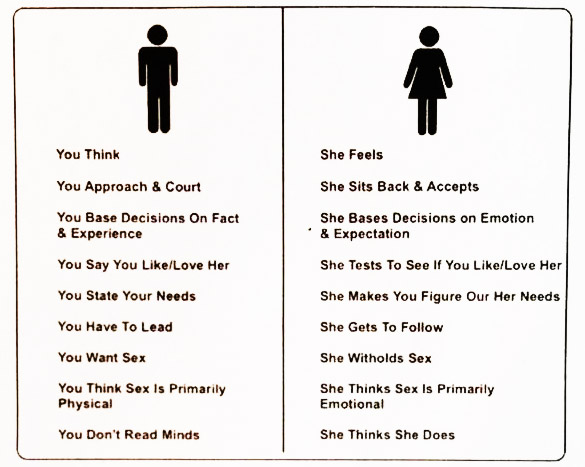
From Reddit comes the story of an assignment given to high school students in a sex education unit of health class in Columbus, Ohio (as reported in theDispatch). The introduction reads (typos included):

Appreciating Gender Differences: Often there are many stereotypes attached to being male or female. Yet male and female together keep our species alive! Through knowing and appreciating the many differences in brain development and psychological processes of males vs. female one learn to accept and appreciate the differences.”

Then there’s this graphic: 1 (3) - Copy Yes, boys and girls in the class all got the same handout, with the normal human described as “you” and the one in the dress labeled “she.” After the graphic is a list of questions for the students to ponder in an essay, such as, “How might knowing these differences influence and impact an intimate relationship you might currently have or develop in the future?”

In her defense, the teacher naturally told the Dispatch that the point was to just “stimulate conversation.” But nothing in the assignment suggests the stereotypes might not be anything but true. None of the essay questions cast doubt on the facts presented. Consider revising the text like this:

Appreciating Gender Similarities: Often there are many stereotypes attached to being male or female. Yet male and female together keep our species alive! Through knowing and appreciating the many similarities in brain development and psychological processes of males vs. female one learn to accept and appreciate the similarities.”

That could be a useful opening to a unit on gender and development for high school sex education (without the graphic). Where did this come from? The teacher said it came from “an outdated book.”

With the power of Google image search, you can follow this image around the Internet, where it has been used by a lot of people to illustrate supposedly funny-but-oh-so-true stereotypes, like “Hilarious differences between men and women,” and on pages with sexist aphorisms such as, “A woman worries about the future until she gets a husband; a man never worries about the future until he gets a wife,” and on relationship advice pages, with conclusions such as, “If we understand this basic fundamental, there will be better relationships … steadier !!,” and even “Real, Honest Female Advice” for men who want to “start having unbelievable success with women.” It always has the same typo (“Figure Our Her Needs”).

I can’t find an original use, or any serious attempt at educational use, but I’d love to know who came up with it.

Cross-posted at Pacific Standard.

Philip N. Cohen is a professor of sociology at the University of Maryland, College Park. He is the author of The Family: Diversity, Inequality, and Social Change and writes the blog Family Inequality. You can follow him on Twitter or Facebook.

We have become more aware that Americans’ chances of upward economic mobility have for decades been a lot lower than Americans imagined, that being poor or rich can last generations. Efforts to explain that lock-in have pointed to several patterns, from the intergenerational inheritance of assets (or debt, as the case may be) to intergenerational continuity in child-rearing styles (say, how much parents read to their children). In such ways, the past is not really past.

Increasingly, researchers have also identified the places – the communities, neighborhoods, blocks – where people live as a factor in slowing economic mobility. In a post earlier this year, I noted a couple of 2008 studies showing that growing up in poor neighborhoods impaired children’s cognitive skills and reduced their chances to advance beyond their parents. In this post, I report on further research by NYU sociologist Patrick Sharkey (here and here) suggesting that a bad environment can worsen the life chances not only of a child, but that of the child’s child, an unfortunate residential patrimony.

Consider the ways that the immediate environment shapes a child’s development. It does so physically. Air and soil pollution, noise, and traffic, for example, measurably affect children’s health, stress, and cognitive development. Local institutions and resources, such as the policing, quality of the schools, availability of health services, food options, parks, and so on matter, as well. And the social environment may matter most of all. Growing up in a community with gangs, dangerous streets, discouraging role models, confused social expectations, and few connections to outsiders commanding resources is a burden for any child. Just getting by day-to-day can be a struggle. (In a pair of studies, Sharkey found that a violent crime occurring near black children’s homes in the days before they took a standardized test reduced their scores on the test, presumably because of anxiety and distraction.)

In their research on historical effects, Sharkey and co-author Felix Elwert used a survey that has followed thousands of American families since 1968 (the PSID). The researchers know much about the adults in the survey, including where they lived when they were around 16, about the children they had and where those children lived around the age of six. The researchers also have the results from cognitive tests administered to those children in 2002.

Sharkey and Elwert found that living in a neighborhood where 20 percent or more of the residents are poor — many other things being held constant (including the parents’ education, health, and attitudes) — seems to lower the test scores of children. And so does having a parent who grew up in such a neighborhood. The effect on children of living in a poor neighborhood and having parents who had also are substantially greater than the effect of only the second generation living in a poor neighborhood. Moreover, the children of two generations of poor neighborhoods do much worse than those of two generations who managed to stay out of poor neighborhoods (over half a standard deviation worse). For technical reasons, these statistical results probably underestimate the real effect of neighborhood poverty on scores.

What appears to have happened is this: Survey respondents in the first generation who grew up in poor neighborhoods ran higher risks than other respondents, on average getting less education and worse jobs, if any, and bearing more physical, social, and psychological problems. Not surprisingly, they tended to end up in poor neighborhoods as adults. When this first generation became parents, they commonly passed on some of their personal disadvantages, such as weak reading skills, to their own children. And they also passed on their places, raising the second generation in poor neighborhoods, which further hampered their children. In this way, Sharkey and Elwert argue, neighborhood problems dragged down (at least) two generations.

No discussion of neighborhood effects can ignore the racial dimension, because the residential segregation of blacks has been and, though reduced, continues to be extreme: 41 percent of the African-American parent-child pairs in the study grew up in poor neighborhoods in both generations; only 2 percent of white families did. Poor whites were less likely to live in concentrated areas of poverty and are more likely to get out of them if they did. The weight of the past is much heavier for some than others.

Claude Fischer is a sociologist at UC Berkeley, is the author of Made in America: A Social History of American Culture and Character. This post originally appeared at Made in America and was re-posted on the Boston Review BR Blog.

This is the question that The1Janitor answers in his vlog below, offering some interesting perspective on cultural appropriation.

When white people ask him whether they should wear dreadlocks — a question he says he gets a lot — he explains that he gets the impression that they think that dreadlocks are a part of black culture. Here’s his response to that:

As far as I know, dreadlocks are mostly associated with the Rastafarian movement from Jamaica. And, as far as I know, that’s not a racial movement. And beyond that locks are worn in other places like Africa and the Middle East and Asian for many different reasons, sometimes spiritual or religious reasons.

Now I am not African or Jamaican or Rastafarian or even remotely spiritual or religious at all. Yet no one has ever accused me of cultural appropriation for having dreadlocks.

He makes a good point.

Culture is, itself, a political and politicized thing and it’s subject to social construction. Whether something counts as cultural — as opposed to, say, rational or biological or universal — is something that people figure out together in interaction, not always consciously. Dreadlocks aren’t African American, they’re lots of things to lots of people. But they also are African American, because Americans do tend to associate them with African Americans. This isn’t reality, though, it’s socially constructed reality.

Moreover, cultures are always changing, often in response to interaction with other cultures. So, to say that a thing like dreadlocks, even if they were African American in origin, could never be borrowed by another cultural group is both overly rigid and inevitably false.

His conclusion: “You’re allowed to like stuff, but you do have to take history into account,” including stuff like power and inequality.

I don’t necessary agree with all of his examples, but I like how he pushes us to think more carefully about cultural appropriation by putting the idea of culture front and center.

Here’s The1Janitor (I apologize if you encounter an ad):

Hat tip to @antoniojc75!

Lisa Wade, PhD is an Associate Professor at Tulane University. She is the author of American Hookup, a book about college sexual culture; a textbook about gender; and a forthcoming introductory text: Terrible Magnificent Sociology. You can follow her on Twitter and Instagram.