Search results for The

In this Farm Bureau Insurance ad, a father and son paint a room pink and commiserate about how their lives will be ruined by the arrival of a baby girl.

1. Essentialize gender. A girl is coming? That means playing with dolls and having tea parties. Girls are girls. Us, we’re boys, so automatically we…

2. …belittle femininity. The stuff girls do is boring and trivial. Only girls would want to do those things. Girls are such a drag!

In short, all girls are girly and girly stuff is dumb.

I didn’t find it, but I’ll give them the benefit of the doubt; maybe they made the opposite commercial, too. One in which a mom and her daughter cringe over the idea of having to put up with booger-flinging and farting at the table.

But that would be equally bad. We don’t know a child’s personality just by anticipating the stuff between their legs. And it’s not true that male and female humans are so different as to enjoy entirely non-overlapping sets of things.

In daily life, we recognize each other for the complex and varied people that we are. Think about it. Practically the only place we see stereotypes this retrograde are on TV and in the movies. We’re not “opposite sexes,” but we’re surrounded by the idea that we are.

Thanks to @DustinStoltz anyway!

Lisa Wade, PhD is an Associate Professor at Tulane University. She is the author of American Hookup, a book about college sexual culture; a textbook about gender; and a forthcoming introductory text: Terrible Magnificent Sociology. You can follow her on Twitter and Instagram.

I know, I know, Hercules is a demi-god. But he’s also all man. In Disney’s (1997) version, Hades says to Megara, “I need someone who can — handle him as a man.” And handle him she does:

herculesmegkiss

And since they involve him in such matters of the human flesh (and heart), that means their measurements are fair game for the Disney dimorphism series. If Disney is going to eroticize the relationship and sell it to innocent children, then we should ask what they’re selling.

As usual, they’re selling extreme sex dimorphism. I did some simple measurements from one pretty straight shot in the movie, and compared it to this awesome set of measurements taken of about 4,000 U.S. Army men and women in the late 1980s. Since Hercules is obviously extremely strong and this woman seems to be on the petite side, I compared their measurements to those of the biggest man versus the smallest woman on each dimension in the entire Army sample. The numbers shown are the man/woman ratios: Hercules/Meg versus the Army maximum/minimum.

As you can see, this cartoon Hercules is more extremely big compared to his cartoon love interest than even the widest man-woman comparison you can find in the Army sample, by a lot. (Notice his relaxed hands – he’s not flexing that bicep.)

To show how unrealistic this is, we can compare it to images of the actual Hercules. Here’s one from about 1620 (“Hercules slaying the Children of Megara,” by Allessandro Turchi):

hercules-turchi

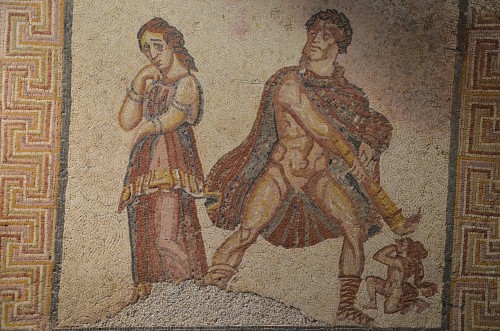
That Hercules is appallingly scrawny compared with Disney’s. Here’s another weakling version, from the 3rd or 4th century:

hercmegaramosaic

Now here is one from the 2014 Paramount movie, in which he is conveniently paired with the human female, Ergenia:

?????

That bicep ratio is only 1.5-to-1. And that’s not normal.

Seriously, though, isn’t it interesting that both the Disney and the Paramount versions show more extreme dimorphism than the ancient representations? Go ahead, tell me he’s a demigod, that it’s a cartoon, that it’s not supposed to be realistic. I have heard all that before, and responded with counterexamples. But that doesn’t explain why the modern versions of this myth should show more sex dimorphism than the old-school ones. That’s progress of a certain kind.

I’ve written so far about Frozen and BraveTangled, and Gnomeo and Juliet, and How to Train Your Dragon 2. It all goes back to the critique, which I first discussed here and Lisa Wade described here, of the idea that male and female humans aren’t just different, they’re opposites. This contributes to the idea that Mark Regnerus defends as the “vision of complementarity” — the insistence that children need a male and female parent — which drives opposition to same-sex marriage. If men and women are too similar, then we wouldn’t need them to be paired up in order to have complete families or sexual relationships.

In the more mundane aspects of relationships — attraction and mate selection — this thinking helps set up the ideal in which women should be smaller than men, the result of which is pairing couples by man-taller-woman-shorter much more than would occur by chance (I reported on this here, but you also could have read about it from 538’s Mona Chalabi 19 months later). The prevalence of such pairs increases the odds that any given couple we (or our children) observe or interact with will include a man who is taller and stronger than his partner. This is also behind some notions that men and women should work in different — and unequal — occupations. And so on.

So I’m not letting this go.

Philip N. Cohen is a professor of sociology at the University of Maryland, College Park. He is the author of The Family: Diversity, Inequality, and Social Change and writes the blog Family Inequality, where this post originally appeared. You can follow him on Twitter or Facebook.

To many Americans, globalization may mean Americanization but, in China, globalization is Koreanization. This is the impact of Hallyu (the Korean word for “Korean wave”), which began in 1997. Hallyu began with Korean television dramas and today extends throughout Chinese life: k-drama, k-pop, movies, fashion, food, and beauty.  It is argued to be the only example of a cultural power “that threatens the dominance of American culture.”

Its influence is impressive. For example, when a star on a Korean soap opera ordered chicken and beer for dinner — Korea’s chi-mek (or chi-meak) – and claimed it as her favorite food, Chinese audiences went crazy for the combination. Korean beer exports rose by over 200%:

Even the standard of beauty in China has been altered due to Hallyu. During this year’s National Day holiday (10/1-10/7), about 166,000 Chinese visited Korea. They flocked to top shopping districts to purchase a wide range of Korean products like cosmetics, each spending an average of $2,500.  Some of these Chinese tourists visited the Gangnam district (Apgujeng-dong), the capital of plastic surgery in Korea. They want to look like k-drama stars. They want to have Korean actresses’ nose or eyes.

The obsession with Korea has caused Chinese leaders a great deal of angst. It was a major issue at the country’s National People’s Congress where, according to the Washington Post, one committee spent a whole morning pondering why China’s soap operas weren’t as good as those made by Korea. “It is more than just a Korean soap opera. It hurts our culture dignity,” one member of the committee said.

Their concern isn’t trivial; it’s about soft power. This is the kind of power states can exert simply by being popular and well-liked. This enables a country to inflluence transnational politics without force or coercion.

Indeed, the Korean government nurtured Hallyu. The President pushed to develop and export films, pop music, and video games. As The Economist reports:

Tax incentives and government funding for start-ups pepped up the video-game industry. It now accounts for 12 times the national revenue of Korean pop (K-pop). But music too has benefited from state help. In 2005 the government launched a $1 billion investment fund to support the pop industry. Record labels recruit teens who undergo years of grueling [sic] training before their public unveiling.

It’s working. According to the Korea Times, China has made a trade agreement with Korea allowing it an unprecedented degree of access to the Chinese people and its companies, an impressive win for soft power.

Sangyoub Park, PhD is a professor of sociology at Washburn University, where he teaches Social Demography, Generations in the U.S. and Sociology of East Asia. His research interests include social capital, demographic trends, and post-Generation Y.  Lisa Wade, PhD is a professor of sociology at Occidental College and the co-author of Gender: Ideas, Interactions, Institutions. You can follow her on Twitter and Facebook.

Cross-posted at Pacific Standard.

Flashback Friday.

When it comes to forming an opinion on poverty, some Americans just can’t seem to understand why poor people can’t just stop being poor. One of the things that gets harped on is the idea that poor people spend money on frivolous things; somehow some people believe that, if the poor just gave up their cell phone and Nikes, they would pop up into the middle class.

What these people don’t realize is the extent to which being poor is living a life of self-denial.  To be poor is to be forced to deny oneself constantly. The poor must deny themselves most trappings of:

  • an adult life (their own apartment, framed pictures on the walls, matching dishes);
  • a comfortable life (a newish mattress, a comfy couch, good shoes that aren’t worn out);
  • a convenient life (your own car, eating out);
  • a self-directed life (a job you care for, leisure time, hobbies, money for babysitters);
  • a life full of small pleasures (lattes, dessert, fresh cut flowers, hot baths, wine);
  • a healthy life (fresh fruits and vegetables, health care, time for exercise);
  • and so, so many more things that don’t fit into those categories (technological gadgets, organic food, travel, expensive clothes and accessories).

They have to actively deny themselves these things every day. And, since most poor people remain poor their whole lives, they must be prepared to deny themselves (and members of their families) these things, perhaps, for the rest of their lives.

So when someone sees someone (they think is) poor walking down the street with a brand new pair of Nikes, perhaps what they are seeing is someone who decided (whether out of a moment of weakness or not) to NOT deny themselves at least one thing; perhaps they are seeing someone who is trying to hold on to some feeling of normalcy; perhaps what they are seeing is a perfectly normal person who just wants what they want for once.

I was thinking about this today when I saw a postcard at Post Secret (which, to be fair, may or may not have been submitted by someone who struggles financially).  The postcard, featuring a PowerBall receipt, reads “It’s the only time I feel hopeful”:

picture12

For many poor people, hope and the absence of fear and worry are also luxuries they live without.

Originally posted in 2009.

Lisa Wade, PhD is an Associate Professor at Tulane University. She is the author of American Hookup, a book about college sexual culture; a textbook about gender; and a forthcoming introductory text: Terrible Magnificent Sociology. You can follow her on Twitter and Instagram.

Thank you all for a truly fantastic year!

We rounded it out with more than six and a half million page views.  We almost doubled our Facebook followers — from 35,000 last December to more than 68,000 today. We are honored to enjoy over 21,000 Twitter followers, 13,000 on Pinterest and 20,000 on our one-year-old Tumblr page.  Much gratitude to everyone for your enthusiasm and support!

Highlights:

Two of us published textbooks!

2What else!

I’ve also signed contracts to write two more books, one on hookup culture and a Introduction to Sociology text. I’m excited to keep writing!

Best of 2014!

1 (3)

Over the last week I’ve highlighted my favorite and your most loved posts from 2014.  Here’s are the lists in case you missed it last week!

Reader’s Choice (plus # of likes/shares before we re-posted)

Most loved humor!

Editor’s picks

Happy New Year everyone!  Here’s to wonderful things in 2015!

Lisa Wade, PhD is an Associate Professor at Tulane University. She is the author of American Hookup, a book about college sexual culture; a textbook about gender; and a forthcoming introductory text: Terrible Magnificent Sociology. You can follow her on Twitter and Instagram.

SocImages News:

As we entered December, I collected a set of SocImages posts relevant to the deaths of black Americans at the hands of police. It includes sections on race and police work, the link between black men and criminals in our minds, proof that we have less empathy for black people, and evidence of the way that racism is deeply institutionalized throughout American society. I hope it’s a useful resource.

Meanwhile, at SocofGender…

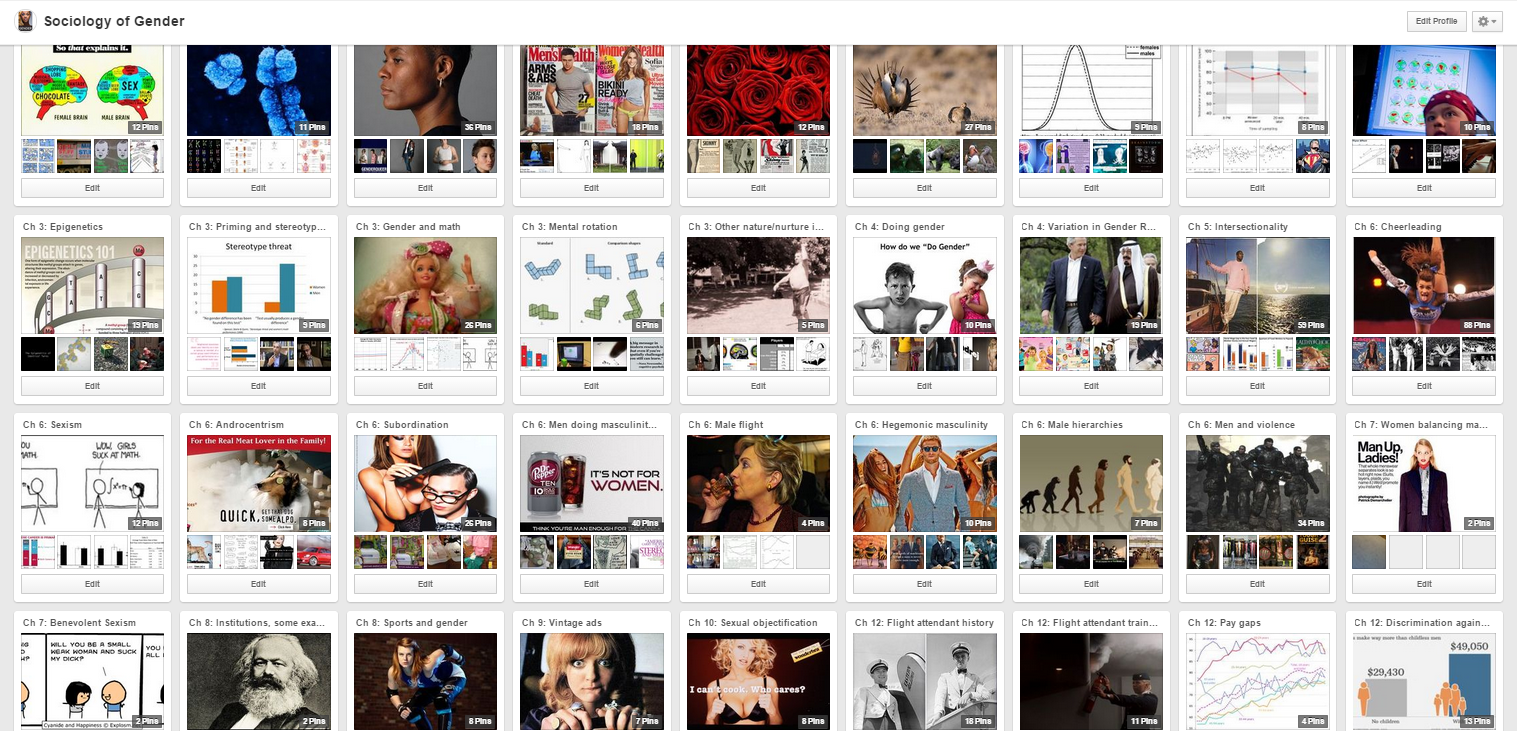
I have made a lot of progress toward building a Soc of Gender Pinterest page to accompany my textbook, organized by chapter and concept. Please feel free to visit and use it even if you don’t adopt the book. I’ve built 48 boards so far. Here are some of my favorites:

Look at how numerous and pretty!3

Best of December!

Christmas favorites:

Readers’ picks:

Women in apocalyptic fiction shaving was also the month’s winner on Tumblr, with over 78,000 likes and shares!

Editor’s pick:

Elsewhere on the Net:

SocImages’ Pointlessly Gendered Products was featured at i100: Nine Products that Have Been Pointlessly Gendered. They apparently especially liked one of our newest examples, bagpipes, and also went for one of my favorites, pickles.

And I had the pleasure of being quoted in a couple articles:

Social Media ‘n’ Stuff:

Finally, this is your monthly reminder that SocImages is on TwitterFacebookTumblrGoogle+, and Pinterest.  I’m on Facebook and most of the team is on Twitter: @lisawade@gwensharpnv@familyunequal, and @jaylivingston.

Finally…

In honor of the special place the anglerfish has in my heart — being so ugly and strange — here’s some rare footage of the fish in action. Want to learn more? Here’s the most humorous way.

Lisa Wade, PhD is an Associate Professor at Tulane University. She is the author of American Hookup, a book about college sexual culture; a textbook about gender; and a forthcoming introductory text: Terrible Magnificent Sociology. You can follow her on Twitter and Instagram.
2Anthropologist John Ziker decided to try to find out.  With his collaborators — Matt Genuchi, Kathryn Demps, and David — Nolin Ziker recruited a non-random sample of 16 professors at Boise State University and scheduled interviews with them every other day for 14 days.  In each interview, they reported how they spent their time the previous day.  In total, he collected data for 166 days.

It’s a small, non-random sample at just one university, but here’s what he discovered.

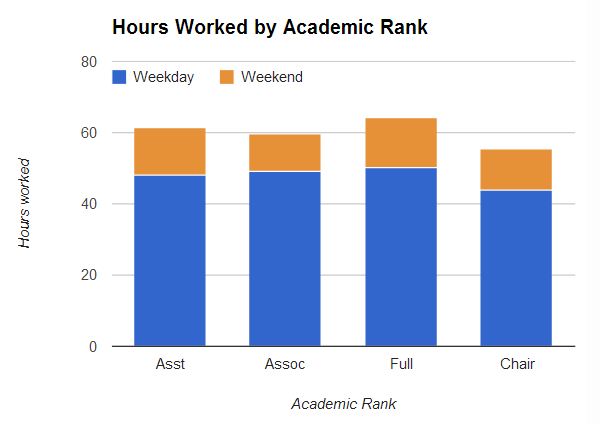
All ranks worked over 40 hours a week (average of 61 hours/week) and all ranks put in a substantial number of hours over the weekends:

1

Professors, then, worked 51 hours during the official workweek and then, in addition, put in ten hours over the weekend.

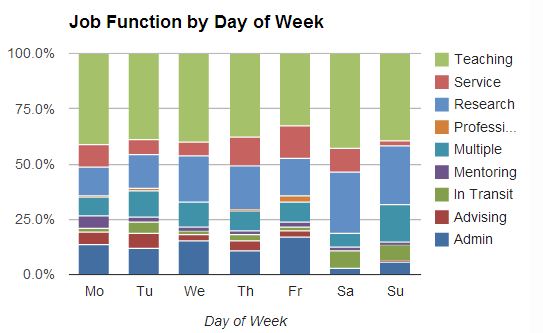
What were they doing those days?  Research, teaching, and service are the three pillars of an academic workload and they dominated professors’ time.  They used weekends, in particular, to catch up on the first two.  The suspension of the business of the university over the weekend gave them a chance to do the other two big parts of their job.

1b

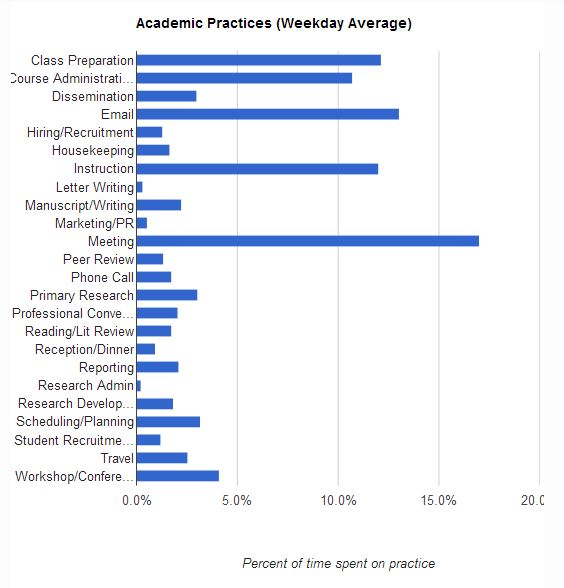
This chart breaks down the proportion of time they spend on different activities more clearly. Ziker is surprised by the amount of time faculty spend in meetings and I’m particularly impressed by the amount of time they spend on email.  Most professors will probably note, with chagrin, the little bars for primary research and manuscript writing.

1a

Interesting stuff.

This was just a first phase, so we can look forward to more data in the future.  In the meantime, I’ll add this data to my preferred answer when asked what I do all day:

5Cross-posted at Business Insider, Pacific Standard, Networked Scholar, and the Huffington Post.

Lisa Wade, PhD is an Associate Professor at Tulane University. She is the author of American Hookup, a book about college sexual culture; a textbook about gender; and a forthcoming introductory text: Terrible Magnificent Sociology. You can follow her on Twitter and Instagram.

2

Don’t you want to pinch it and squeeze it and bite its little face off!?

You’re not alone.

Rebecca Dyer and Oriana Aragon, graduate students in psychology, brought subjects into a lab, handed them a fresh sheet of bubble wrap, and exposed them to cute, funny, and neutral pictures of animals.  Those who saw the cute ones popped significantly more bubbles than the others.

Cute things make us aggressive!  It’s why we say things like: “I just wanna eat you up!” and why we have to restrain ourselves from giving our pets an uncomfortably tight hug. An aggressive response to cuteness, it appears, it “completely normal.”

The authors suggest that humans non-consciously balance extreme emotions with one from the other side of the spectrum to try to maintain some control and balance.  This, Aragon explains at her website, may be why we cry when we’re really happy and laugh at funerals.

In the meantime, if this makes you want to inflict some serious squishing, know that you’re in good company.

Photo from 820453820 flickr creative commons.

Lisa Wade, PhD is an Associate Professor at Tulane University. She is the author of American Hookup, a book about college sexual culture; a textbook about gender; and a forthcoming introductory text: Terrible Magnificent Sociology. You can follow her on Twitter and Instagram.