Search results for The

Today is the anniversary of the 34th American presidential election.  The year was 1920; it was the first presidential election in which women were allowed their own votes.  This seems like a good day to post a memento from the political battle over women’s suffrage, the right to vote and run for political office.

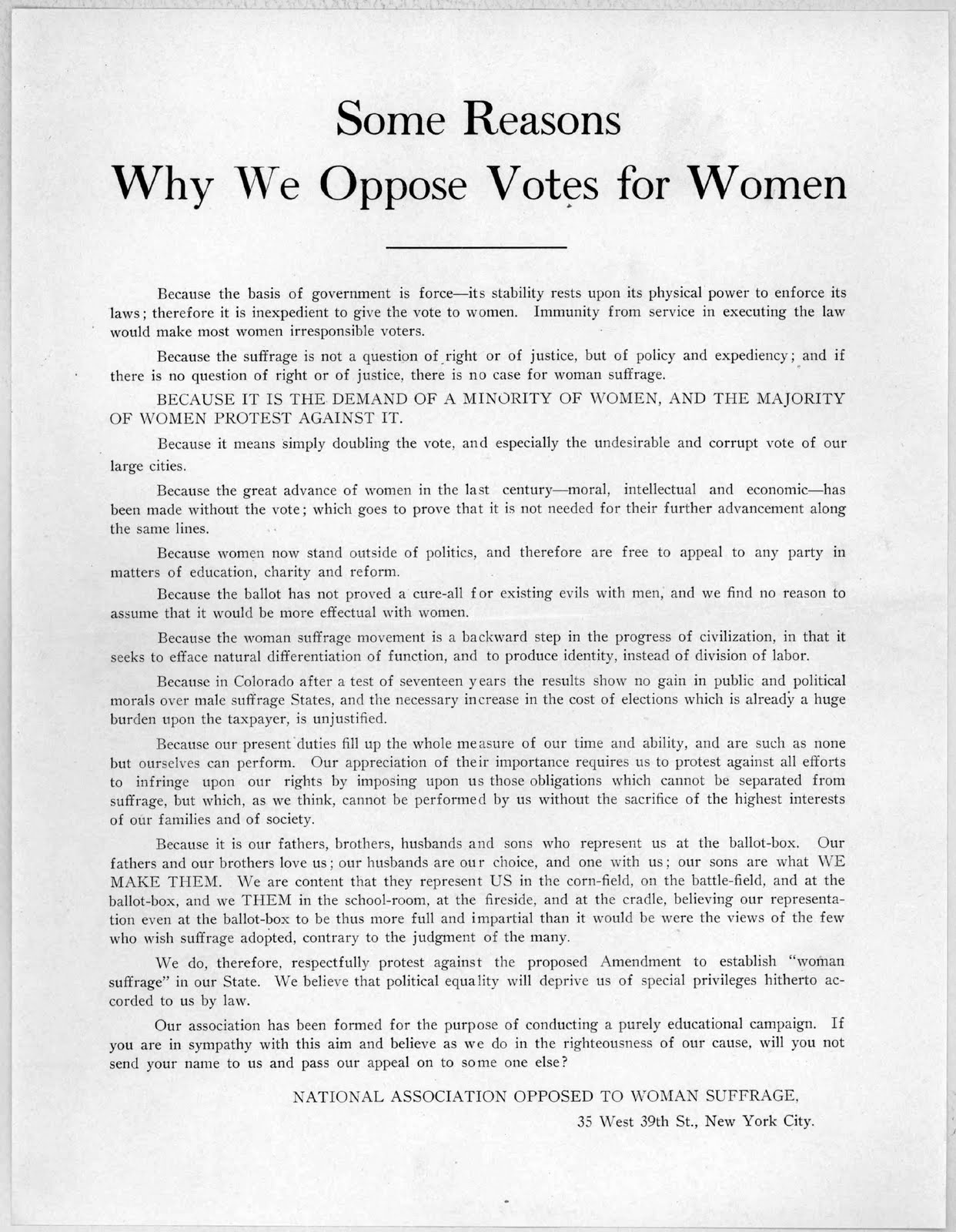
The fight for suffrage took decades and women were on both sides of the issue.  The document below is a copy of an argument against women’s suffrage — Some Reasons Why We Oppose Votes for Women — printed in 1894.  The National Association Opposed to Women’s Suffrage was led by Josephine Dodge.  (Open and click “full size” to read.)
1

Alice Duer Miller was on the other side of the fight.  In 1915, she wrote and circulated a satirical response titled Why We Oppose Votes for Men.  Drawing on parallel logic, she made a case for why it was men, not women, who shouldn’t be voting. (Click for a larger copy.)
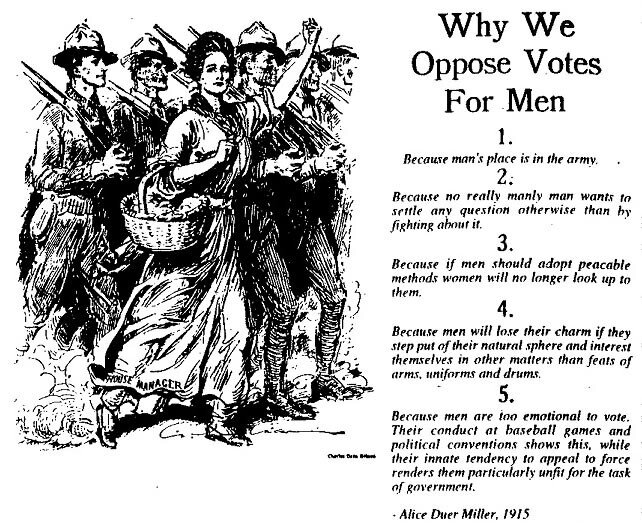
1aText:

1. Because man’s place is in the army.

2. Because no really manly man wants to settle any question otherwise than by fighting about it.

3. Because if men should adopt peacable methods women will no longer look up to them.

4. Because men will lose their charm if they step out of their natural sphere and interest themselves in other matters than feats of arms, uniforms and drums.

5. Because men are too emotional to vote. Their conduct at baseball games and political conventions shows this, while their innate tendency to appeal to force renders them particularly unfit for the task of government.

It helps to have a sense of humor.

Happy anniversary of the first gender inclusive American presidential election everyone.

Lisa Wade, PhD is an Associate Professor at Tulane University. She is the author of American Hookup, a book about college sexual culture; a textbook about gender; and a forthcoming introductory text: Terrible Magnificent Sociology. You can follow her on Twitter and Instagram.
Enjoy these earlier posts about Daylight Savings:

Lisa Wade, PhD is an Associate Professor at Tulane University. She is the author of American Hookup, a book about college sexual culture; a textbook about gender; and a forthcoming introductory text: Terrible Magnificent Sociology. You can follow her on Twitter and Instagram.
SocImages news!

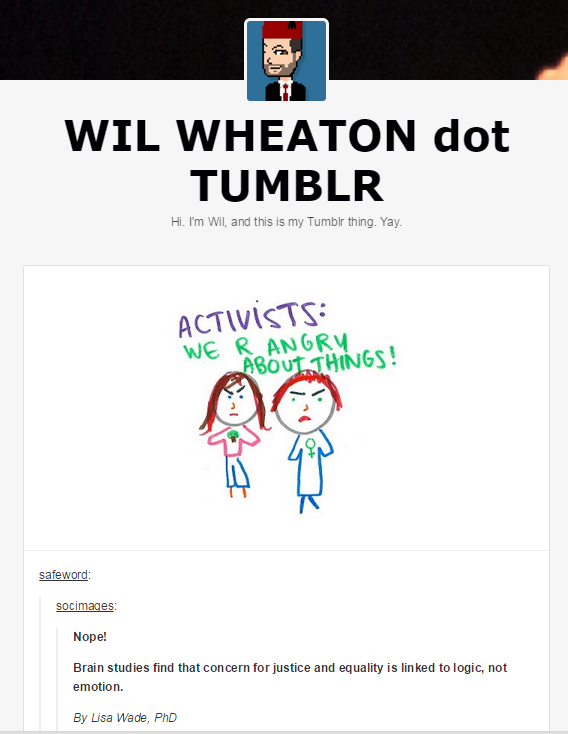
Our top post on Tumblr this month, with over 45,000 likes and re-blogs, discusses a brain imaging study that suggests that social justice is linked to logic, not emotion.

We earned some major nerd cred this month when Wil Wheaton tumbled it! Here is the awesome evidence of that fabulous day:

2

Seriously, folks. My inner 14-year-old girl downright squealed.

You like!  Here are our most appreciated posts this month:

Why do witches ride brooms was the clear winner with 9,300+ likes. And it’ll be obvious why if you click through to find out.

Other winners:

Thanks everybody!

Editor’s pick:

New Pinterest board!

In honor of Breast Cancer Awareness Month and its backlash, we put together a Pinterest board featuring the weirdest and most outrageous examples of pinkwashing. And we started it BEFORE the pinkwashed fracking drill bit was announced!

Social Media ‘n’ Stuff:

Finally, this is your monthly reminder that SocImages is on TwitterFacebookTumblrGoogle+, and Pinterest.  I’m on Facebook and most of the team is on Twitter: @lisawade@gwensharpnv@familyunequal, and @jaylivingston.

Finally…

Sociologist D’Lane Compton hopes you had a happy Halloween! Follow her on Twitter!

20140921_142917

Lisa Wade, PhD is an Associate Professor at Tulane University. She is the author of American Hookup, a book about college sexual culture; a textbook about gender; and a forthcoming introductory text: Terrible Magnificent Sociology. You can follow her on Twitter and Instagram.
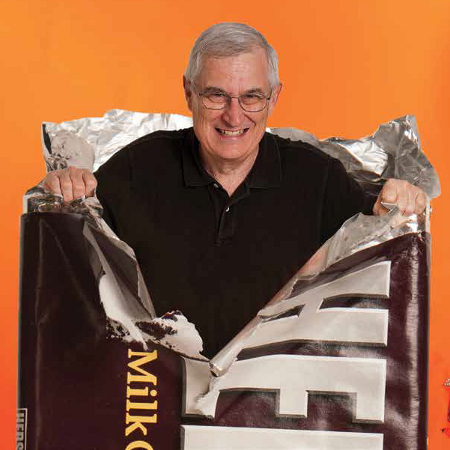
Joel Best, the sociologist famous for debunking the myth that your children might receive Halloween candy impregnated with poison and razor blades, wishes you a “Happy Halloween” and nothing but the Best candy:

joel_candy_big

Lisa Wade, PhD is an Associate Professor at Tulane University. She is the author of American Hookup, a book about college sexual culture; a textbook about gender; and a forthcoming introductory text: Terrible Magnificent Sociology. You can follow her on Twitter and Instagram.

Yesterday I wrote about how the money spent on adult Halloween revelry now rivals, or even exceeds, that spent on kids. This may seem like a surprising shift, but it turns out it’s the focus on children that’s new. Halloween as the kid holiday we know it in the U.S. today was really invented in the 1950s.

This, and more fun facts about the history of Halloween, in this two-minute History Channel summary:

Lisa Wade, PhD is an Associate Professor at Tulane University. She is the author of American Hookup, a book about college sexual culture; a textbook about gender; and a forthcoming introductory text: Terrible Magnificent Sociology. You can follow her on Twitter and Instagram.

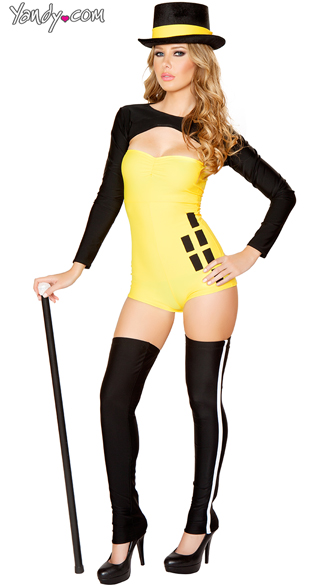
Here are my picks for the bizarrest sexy costumes this year. Enjoy!

Sexy George Washington (via):

2

Sexy Crime Scene:13


Sexy Lobster:

11

Sexy Yoda (via):

4

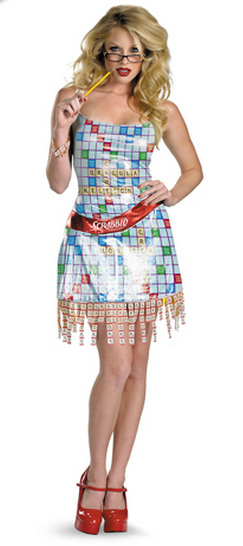
Sexy Scrabble (via):

2

Except — I know, I know — nothing’s sexier than Scrabble.


Sexy Mr. Peanut:

12

I take it back; that costume is fantastic.


Sexy BDSM pig (via):

3

Okay, I admit. I have absolutely no idea what’s going on here.

Want more? See sexy what!? (2012) and sexy what!? (2010) or What do sexy Halloween costumes for men look like?

Lisa Wade, PhD is an Associate Professor at Tulane University. She is the author of American Hookup, a book about college sexual culture; a textbook about gender; and a forthcoming introductory text: Terrible Magnificent Sociology. You can follow her on Twitter and Instagram.

According to an article by Megan Garber at The Atlantic, they did it for the drugs.

Starting in the 1300s, Europeans developed a taste for hallucinogenic drugs. Unfortunately, ingesting them often caused nausea and vomiting. Absorbing them through the skin came with fewer side effects and delivering them through the mucous membranes of the female genitals was ideal.

A physician quoted at The Guardian says the claim is medically sound:

Ointment would have been very effective as a delivery method… Mucous membranes are particularly good at transporting drugs – that’s why cocaine is snorted… Vaginal application would be pretty efficient, and the effects of the drugs would be noticeable quite rapidly.

According to legend, then, witches would coat the handle of a broom — a convenient household item — lift their skirts and get high.

The women who trafficked in hallucinogenic substances were often accused of being witches.  Or, conversely, women accused of being witches were also accused of making magic ointments (from the fat of murdered children, no less). And witch experts in the 15th century claimed that they used these ointments not just to get high, but to get high; that is, that they literally flew using ointments.

Hence, witches on brooms.

5
Flickr photo by Metro Centric; creative commons license.

Lisa Wade, PhD is an Associate Professor at Tulane University. She is the author of American Hookup, a book about college sexual culture; a textbook about gender; and a forthcoming introductory text: Terrible Magnificent Sociology. You can follow her on Twitter and Instagram.

Yesterday’s killing was the 39th school shooting in the U.S. this year.  Most of those got little press coverage. Unless someone is actually killed, a shooting might not even get coverage in the local news.

Yesterday’s did.

Why would an apparently happy kid shoot several classmates? That seems to be the question that’s getting the attention of the press and perhaps the public. “Struggling to Find Motive,” said one typical headline. That’s the way we think about school shootings these days.

It’s unlikely that any of the motives that turn up will be all that strange. Fryberg may have been upset by a racial comment someone had made the day before or by a break-up with a girl. He may have had other conflicts with other kids. Nothing unusual there.

But “why” is not the question that first occurs to me. What I always ask is how a 14-year old kid can get his hands on a .40 Beretta handgun (or whatever the weaponry in the shooting of the week is).  For Fryberg it  was easy. The pistol belonged to his father. Nothing strange there either.  Thirty million homes in the US, maybe forty million, are stocked with guns.

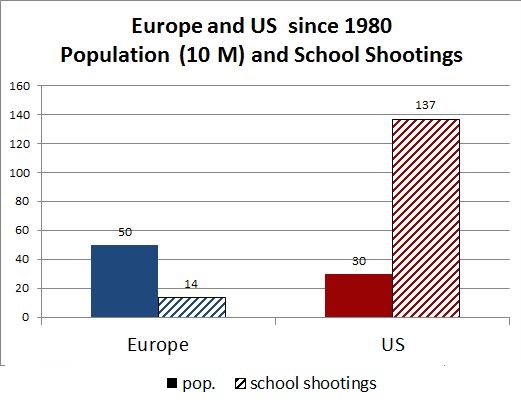
Do European countries have school shootings like this? Surely kids in Europe get upset about break-ups; surely they must have conflicts with their classmates; and surely, some of them may become irrationally upset by these setbacks.  So surely there must have been school shootings in Europe too.

I went to Wikipedia and looked for school shootings since 1980 (here and here).  I eliminated shootings by adults (e.g., Lanza in Sandy Hook, Brevik in Norway). I also deleted in-school suicides even though these were done with guns and were terrifying to the other students. I’m sure my numbers are not perfectly accurate, and the population estimate in the graph below  is based on current numbers; I didn’t bother to find an average over the last 35 years. Still the differences are so large that I’m sure they are not due to technical problems in the data.

1 (3) - Copy
Does the U.S. have a much greater proportion of kids who are mentally unstable? Do our schools have more bullying? Are European kids more capable in dealing with conflicts? Are they more stable after break-ups? Do they spend less time with violent video games? Do their schools have more programs to identify and counsel the potentially violent?  I’m not familiar with the data on these, but I would guess that the answer is no and that our kids are no more screwed up than kids in Europe. Or if there are differences, they are not large enough to explain the difference in the body count.

No, the important difference seems to be the guns.  But guns have become the elephant in the room that nobody talks about.  Even asking about access to guns seems unAmerican these days.  Thanks to the successful efforts of the NRA and their representatives in government, guns have become a taken-for-granted part of the landscape. Asking how a 14-year old got a handgun is like asking how he got a bicycle to ride to school.

When the elephant’s presence is too massive not be noticed – for example, when the elephant kills several people –  the elephant’s spokesmen rush in to tell us that “No, this is not the time to talk about the elephant.”  And so we talk about video games and psychological screening and parents and everything else, until the next multiple killing. But of course that too is not the time to talk about elephants.

Cross-posted at Pacific Standard.

Jay Livingston is the chair of the Sociology Department at Montclair State University. You can follow him at Montclair SocioBlog or on Twitter.