Search results for The

From the great documentary, Black Power Mix Tape, Angela Davis puts violence in perspective. She’s being interviewed about the tactics of the Black Panthers. The interviewer asks: “How do you get there? Do you get there by confrontation, violence?” She responds:

Oh, is that the question you were asking?

She smiles to herself.

Because of the way this society’s organized, because of the violence that exists on the surface everywhere. You have to expect that there are going to be such explosions. You have to expect things like that as reactions. If you… if a black person lives in the black community all your life and walks out on the street everyday seeing white policemen surrounding you…

I grew up in Birmingham, Alabama. Some very good friends of mine were killed by bombs, bombs that were planted by racists. I remember from the time I was very small, I remember the sounds of bombs exploding across the street, our house shaking. I remember my father having to have guns at his disposal at all times because of the fact that at any moment someone… we might expect to be attacked.

The… man who was at that time in complete control of the city government… would often get on the radio and make statements like: “Niggers have moved into a white neighborhood. We better expect some bloodshed tonight.” And, sure enough, there would be bloodshed.

In fact, when the bombing occurred one of the mothers of one of the young girls called my mother and said, “Can you take me down to the church to pick up Carol. We heard about the bombing and I don’t have my car.” And they went down and what did they find? They found limbs and heads strewn all over the place.

And then after that, in my neighborhood all of the men organized themselves into an armed patrol. They had to take their guns and patrol our community every night because they did not want that to happen again.

I mean, that’s why when someone asks me about violence, I just…. I just find it incredible. Because what it means is that the person asking that question has no idea what black people have gone through… what black people have experienced in this country since the time the first black person was kidnapped from the shores of Africa.

She’s no longer smiling.

The interchange begins at 1min 40sec:

There was violence and unrest following the news that Darren Wilson would not be indicted. Some argued that this was proof that the people involved were bad people. Jay Smooth responds with a question: “How much do you think people can take?”

Here is a partial transcript of his 5min discussion, embedded below:

Riots are things that human beings do because human beings have limits.

We don’t all have the same limits. For some of us, our human limit is when our favorite team loses a game. For some of us, it’s when our favorite team wins a game.

The people of Ferguson had a different limit than that. For the people of Ferguson, a lifetime of neglect and defacto segregation and incompetence and mistreatment by every level of government was not their limit.

When that malign neglect set the stage for one of their children to be shot down and left in the street like a piece of trash… that was not their limit.

For the people of Ferguson, spending one hundred days almost entirely peacefully protesting for some measure of justice for that child  and having their desire for justice treated like a joke by every local authority… was not their limit.

And then after those 100 days, when the so-called prosecutor waited till the dead of night to twist that knife one last time. When he came out and confirmed once and for all that Michael Brown’s life didn’t matter…

Only then did the people of Ferguson reach their limit.

So when you look at what happened Monday night, the question you should be asking is how did these human beings last that long before they reached their human limit? How do black people in America retain such a deep well of humanity that they can be pushed so far again and again without reaching their human limit?

Riots? Violence? Unrest?

That is what happens when you treat human beings that way.

Watch to the whole thing:

Have a Sexy Thanksgiving

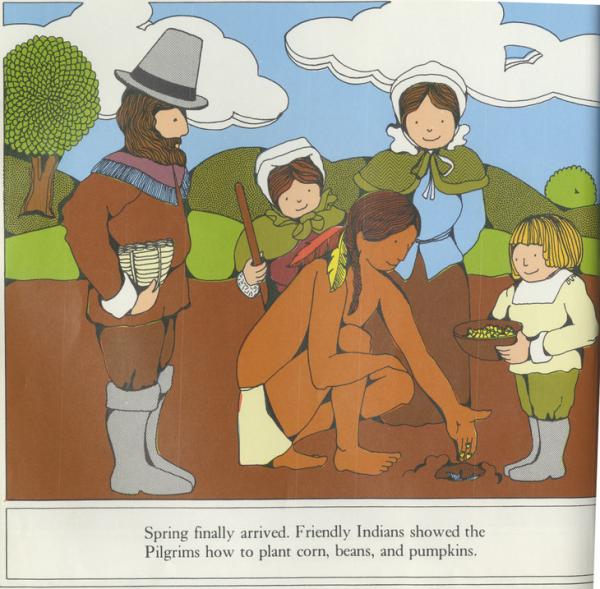
Thanksgiving Mythology

Theorizing Thanksgiving:

Some Fun History:

Cigarette Advertising, on this Holiday:

Thanksgiving, Race, and Gender:

Lisa Wade, PhD is an Associate Professor at Tulane University. She is the author of American Hookup, a book about college sexual culture; a textbook about gender; and a forthcoming introductory text: Terrible Magnificent Sociology. You can follow her on Twitter and Instagram.

“They were coming to college believing that all Indians are dead,” said education professor Sarah Shear of her experience in the classroom.

Her students’ seeming ignorance to the fact that American Indians are a part of the contemporary U.S., not just the historical one, led her to take a closer look at what they were learning. She examined the academic standards for elementary and secondary school education in all 50 states, these are the guidelines that educators use to plan curricula and write textbooks. The results are summarized at Indian Country.

Shear found that the vast majority of references to American Indians — 87 percent — portrayed them as a population that existed only prior to 1900.  There was “nothing,” she said, about contemporary issues for American Indian populations or the ongoing conflicts over land and water rights or sovereignty. Only one state, New Mexico, even mentions the name of a single member of the American Indian Movement.

2

Meanwhile, the genocidal war against American Indians is portrayed as an inevitable conflict that colonizers handled reasonably.  “All of the states are teaching that there were civil ways to end problems,” she said, “and that the Indian problem was dealt with nicely.”  Only one state, Washington, uses the word genocide. Only four states mention Indian boarding schools, institutions that represent the removal of children from their families and forced re-socialization into a Euro-American way of life.

The fact that so many people absorb the idea that Native Americans are a thing of the past — and a thing that we don’t have to feel too badly about — may help explain why they feel so comfortable dressing up like them on Halloween, throwing “Conquistabros and Navahos” parties, persisting in using Indian mascots, leaving their reservations off of Google maps, and failing to include them in our media. It might also explain why we expect Indian-themed art to always feature a pre-modern world.

Curricular choices matter. So long as young people learn to think of Indians no differently than they do Vikings and Ancient Romans, they will overwhelmingly fail to notice or care about ongoing interpersonal and institutional discrimination against American Indians who are here now.

Cross-posted at Pacific Standard.

Lisa Wade, PhD is an Associate Professor at Tulane University. She is the author of American Hookup, a book about college sexual culture; a textbook about gender; and a forthcoming introductory text: Terrible Magnificent Sociology. You can follow her on Twitter and Instagram.

In her provocative book, The Technology of Orgasm, Rachel Maines discusses a classic medical treatment for the historical diagnosis of “hysteria”: orgasm administered by a physician.

Maines explains that manual stimulation of the clitoris was, for some time, a matter-of-fact part of medical treatment and a routine source of revenue for doctors. By the 19th century, people understood that it was an orgasm, but they argued that it was “nothing sexual.” It couldn’t “be anything sexual,” Maines explains, “because there’s no penetration and, so, no sex.”

So, what ended this practice? Maines argues that it was the appearance of the vibrator in early pornographic movies in the 1920s.  At which point, she says, doctors “drop it like a hot rock.” Meanwhile, vibrators become household appliances, allowing women to treat their “hysteria” at home. It wasn’t dropped from diagnostic manuals until 1957.

Listen to it straight from Maines in the following 7 minutes from Big Think:

Bonus: Freud was bad at this treatment, so he had to come up with some other cause of hysteria. After all, she says, “this was the guy who didn’t know what women wanted.” No surprise there, she jokes.

Cross-posted at Pacific Standard.

Lisa Wade, PhD is an Associate Professor at Tulane University. She is the author of American Hookup, a book about college sexual culture; a textbook about gender; and a forthcoming introductory text: Terrible Magnificent Sociology. You can follow her on Twitter and Instagram.

First, there were the accolades. More than 100 instances of street harassment in a two minute video, testifying powerfully to the routine invasion of women’s lives by male strangers.

Then, there was the criticism. How is it, people asked, that the majority of the men are black? They argued: this video isn’t an indictment of men, it’s an indictment of black men.

Now, we’ve reached the third stage: lessons for research methods classes.

Our instructor is sociologist Zeynep Tufekci, writing at The Message. Our competing hypotheses are three:

1. Black men really do catcall more than other kinds of men.

2. The people who made this video are unconsciously or consciously racist, editing out men of other races.

3. The study was badly designed.

As Tufekci points out, any one of these could account for why so many of the catcallers were black. Likewise, all three could be at play at once.

Enter, the data wrangler: Chris Moore at Mass Appeal.

Moore and his colleagues looked for landmarks in the video in order to place every instance of harassment on the map of New York City. According to their analysis, over half of the harassment occurs on just one street — 125th — in Harlem.

2

Did the time the producers spent in Harlem involve denser rates of harassment, supporting hypothesis #1. Did they spend an extra amount of time in Harlem because they have something against black men? That’d be hypothesis #2. Or is it hypothesis #3: they were thoughtless about their decisions as to where they would do their filming.

Honestly, it’s hard to say without more data, such as knowing how much time they spent in each neighborhood and in neighborhoods not represented in the video. But if it’s true that they failed to sample the streets of New York City in any meaningful way — and I suspect it is — then hypothesis #3 explains at least some of why black men are over-represented.

And that fact should motivate us all to do our methods right. If we don’t, we may end up offering accidental and fallacious support to ideas that we loathe.

Cross-posted at Pacific Standard.

Lisa Wade, PhD is an Associate Professor at Tulane University. She is the author of American Hookup, a book about college sexual culture; a textbook about gender; and a forthcoming introductory text: Terrible Magnificent Sociology. You can follow her on Twitter and Instagram.

If you’ve ever given an academic job talk or lecture, you’ve been this kid…

1 (2)

Via Next Scientist.

Lisa Wade, PhD is an Associate Professor at Tulane University. She is the author of American Hookup, a book about college sexual culture; a textbook about gender; and a forthcoming introductory text: Terrible Magnificent Sociology. You can follow her on Twitter and Instagram.

Flashback Friday.

In her article “Unpacking the Invisible Knapsack,” Peggy McIntosh talks about a number of types of white privilege, including using the phrases “flesh tone” or “nude” to describe light skin and featuring mostly white people in tv, movies, and advertising.

When I’ve had students read this article, they often argue that it just makes sense to do that, since the majority of people in the U.S. are white. They also question what other color could be used as a “neutral” or “normal” one.  In fact, this is exactly what was argued in the comments to this post about the “white” Facebook avatar.

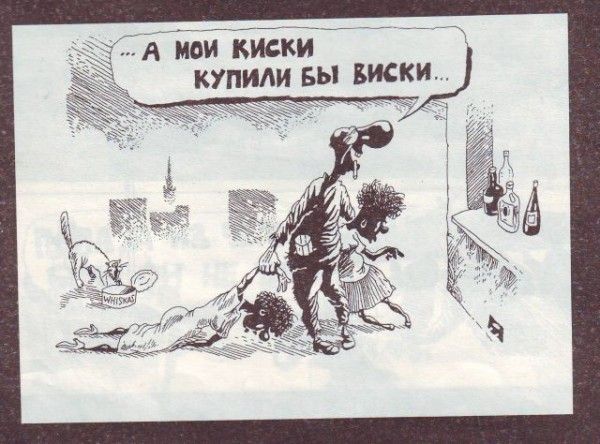
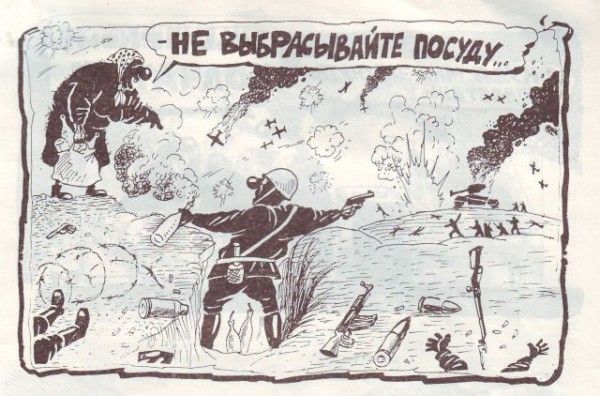
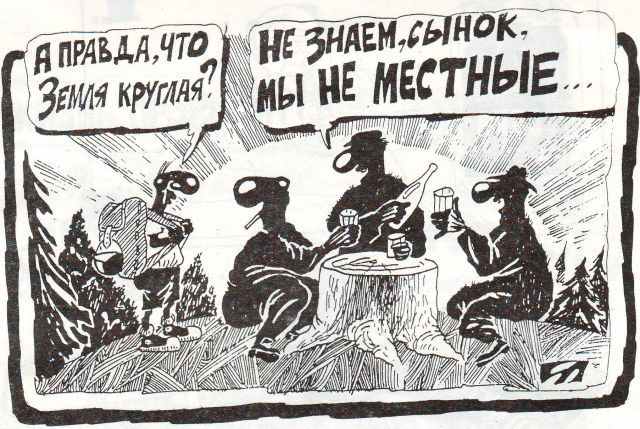
But English Russia points out that in Russia, it’s not uncommon for people in cartoons to be black; not Black racially, but literally black. Below are examples of these cartoons, introduced with English Russia‘s translations.

“My pussy could have Whiskas instead of whiskey.”

11

“Sir, don’t throw away the empty bottle, I would take it to the recycle point for spare money.”

21

“Tourist: ‘Is it true that the Earth is round?’ Men: ‘We don’t know son, we’re not locals.'”

31

Despite the fact that many people in Russia would be classified in the U.S. as white, these cartoons obviously use the color black as a neutral color — the people in the cartoons aren’t Black in any racial sense, it’s just the standard color the artist has used for everyone. You might contrast these with things in the U.S. that are labeled “flesh” or “nude” to counter the idea that there are no other options but a sort of light peach color to be the fallback color when you aren’t specifically representing a racial minority.

Thanks to Miguel at El Forastero for the link! Originally posted in 2009.

Gwen Sharp is an associate professor of sociology at Nevada State College. You can follow her on Twitter at @gwensharpnv.