

Search results for The

2Perusing my Facebook feed, I came across a photo proudly posted by a former student — now a hair and makeup artist — of two brides at a wedding.  It was beautiful and the young, conventionally attractive brides were leaning in for a kiss.  Or engagement celebrations, like this:

Embed from Getty Images

When I saw the image, my mind immediately pulled up similar images it has in storage — frequently described as girl-on-girl action — and I was struck by the similarity of the images and their powerfully different messages.

Until recently, “hot girl-on-girl action” was the primary visual that involved women kissing.  In mainstream culture, genuine and open female same-sex attraction was almost entirely invisible, hidden and denied.  Today, the proliferation of same-sex marriages offer a new visual landscape for framing what it means for two women to kiss each other.

The meaning, moreover, could not be more different.  Though often women with same-sex desire use this assumption to explore real attraction, girl-on-girl action shots are ostensibly between two heterosexually-oriented women who are kissing for male attention.  These brides are presumably doing the opposite of that.  They are displaying love and commitment to one another. The kiss is for them and no one else and they are, implicitly if not actually, openly committing to making themselves sexually unavailable to anyone else, male or female.  This is far from the notion that they are just kissing a girl to get guys to think they’re sexy.

I wonder how these images — ones that depict sexual intimacy between women who love one another and do not seek male attention — will ultimately change how we think about “girl-on-girl” action in the U.S.  As they proliferate, will they push back against the male-centrism and heterocentrism of our society?  I think they very well might.

Lisa Wade, PhD is an Associate Professor at Tulane University. She is the author of American Hookup, a book about college sexual culture; a textbook about gender; and a forthcoming introductory text: Terrible Magnificent Sociology. You can follow her on Twitter and Instagram.
2Earlier this year I reviewed a study that found that, simply by changing the weight of an object in hand, psychologists can manipulate how seriously a person takes an issue.  In other words, when holding something heavy, matters seem heavy.  Or, concerns seem weightier when one is weighed down.

Thanks to an email from USC professor Norbert Schwarz, I was introduced to a whole series of studies on what psychologists call metaphorical effects.  These are instances in which a metaphor commonly used to describe a psychological state or social reality can, in turn, induce that state or reality.  So, for example, holding a warm cup of coffee makes people feel warmly toward each other (here), getting the cold shoulder makes people feel cold (here), people placed in a high location seem to be high in a hierarchy (here), and cleaning one’s hands makes a person feel morally clean (here).

Schwarz was the co-author, with Spike W.S. Lee, on another example of a metaphorical effect.  They wanted to know if smelling something fishy made people suspicious.  It did!

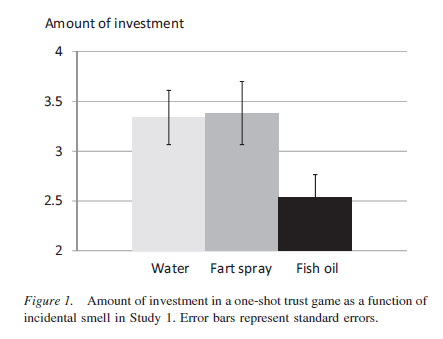
Asked to participate in a fake study on whether they’d be willing to invest money in a scheme, subjects who were exposed to a fishy smell invested less than those exposed to no smell and less than those exposed to another icky smell that was “metaphorically irrelevant”: fart.

From sensory perception to psychological state.  Boom.

1

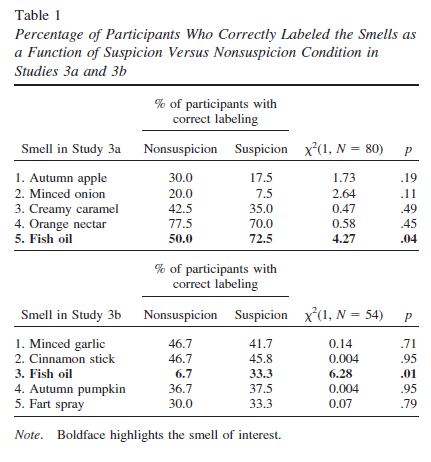
Lee and Schwarz were also interested in the reverse process.  Did being suspicious increase the likelihood that they would identify a fishy smell as fishy.  Sometimes smells can be hard to figure out, but when people are primed with the answer, they are more likely to get it right.  Would the metaphorical effect work in the other direction: from psychological state to sensory perception?

They asked another group of subjects to sniff five different vials and attempt to label each smell.  Half the time, they induced suspiciousness by having the experimenter say: “Obviously, it’s a very simple task and, you know, there’s . . . there’s nothing we’re trying to hide here.”  The experimented would then spot a document on the table, whisk it away nervously and repeat:

Sorry, it shouldn’t have been there. But . . . ahem . . . anyway. Where was I? Oh yes, it’s all very simple. There’s nothing we’re trying to hide or anything.

Did subjects induced to be suspicious identify the fishy smell correctly more often?  Yep!

2

This is a fun literature, but it has serious implications.  It reveals that the associations we have in our minds impact how we perceive the world and each other.

Sociologists believe that essentially all of life is socially constructed, meaning that we collectively learn and internalize arbitrary connections between things: like being male and computing or being black and athleticism.  These connections literally structure our brain, such that thinking about one is likely to trigger thoughts of the other.

Fishy and suspicious are connected in our minds and, so, when we are exposed to one, we are more likely to experience the other.  In other cultures, Lee and Schwarz point out, it is not fishiness, but other smells that are associated with suspicion.  These things are not natural or universal, but they drive our perceptions nonetheless.

Cross-posted at Pacific Standard.

Lisa Wade, PhD is an Associate Professor at Tulane University. She is the author of American Hookup, a book about college sexual culture; a textbook about gender; and a forthcoming introductory text: Terrible Magnificent Sociology. You can follow her on Twitter and Instagram.
2Holding a college degree, it is widely assumed, improves the likelihood that a person will be successful in the labor market.  This maxim draws individuals into college across the class spectrum and aspiring students who are low-income or non-white may find themselves enrolled at a for-profit college.

For profit colleges have been getting slammed for their high prices, low bars, and atrocious graduation rates.  Now we have another reason to worry that these institutions are doing more harm than good.

Economist Rajeev Darolia and his colleagues sent out 8,914 fictitious resumes and waited to see if they received a response.  They were interested in whether attending a for-profit college actually enhanced job opportunities, as ads for such schools claim, so they varied the level of education on the resumes and whether the applicant attended a for-profit or community college.

Photo by Ryan McNight flickr creative commons.

It turns out that employers evaluate applicants who attended two-year community colleges and those who attended for-profit colleges about equally.  Community colleges, in other words, open just as many doors to possibility as for-profit ones.

Darolia and his colleagues then tested whether employers displayed a preference for applicants who went to for-profit colleges versus applicants with no college at all.  They didn’t. Employers treated people with high school diplomas and coursework at for-profit colleges equivalently.

Being economists, they staidly conclude that enrolling in a for-profit college is a bad investment.

H/t Gin and Tacos. Image borrowed from Salon.com. Cross-posted at Pacific Standard.

Lisa Wade, PhD is an Associate Professor at Tulane University. She is the author of American Hookup, a book about college sexual culture; a textbook about gender; and a forthcoming introductory text: Terrible Magnificent Sociology. You can follow her on Twitter and Instagram.

2In 1897, sociologist Émile Durkheim published research arguing that suicide – something previously believed to be decidedly unsociological – could be understood as a social phenomenon. He pointed out that suicide rates are not evenly distributed in or across societies; that cultural or structural factors might influence individuals’ risk of suicide, regardless of their individual psychologies; and that those factors might explain the variation.

Recently another set of sociologists borrowed Durkheim’s approach, substituting serial killing for suicide. James DeFronzo and three of his colleagues asked whether cultural and structural variables might predict state variation in the rate of male serial killer activity. This, it turns out, varies quite widely, as DeFronzo et al. write:

[U]sing a method that assigns a male serial killer to the state where he perpetrated his largest number of homicides, from 1970 to 1992 California had a rate of 18.6 male serial killers per 10 million residents, whereas Florida had a rate of 10.3, Texas had a rate of 7, New York had a rate of 6.3, Illinois had a rate of 6.1, Ohio had a rate of 3.7, and Pennsylvania had a rate of 3.4.

To do the study, the authors drew on existing literature, positing seven factors that might increase the rate of serial killing in a state.

Their structural factors included population density (large, urban, dense cities allow for greater anonymity and offer more potential victims) and variables that increased individuals’ vulnerability (being divorced, living alone, and being unemployed).

For the cultural factors, the authors considered variables that might indicate a high tolerance for or presence of violence. They argue:

Norms prescribing or tolerant of violent behavior contribute to shaping the fantasies of the developing serial killer, help to objectify and dehumanize potential victims, and consequently provide a necessary link in converting sexually sadistic urges in the violent behavior.

As measures of this, they include the overall homicide rate in the state, whether the state is in the South (see the “culture of honor” thesis), and the use of capital punishment.

They figured that the structural variables might predict the states in which killers killed because they measured opportunity. Whereas the cultural variables might incite young serial killers, thus they’d be related to the states in which serial killers grew up.

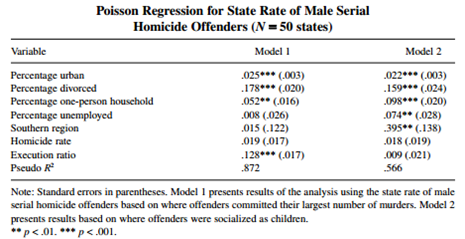
Here are the results. All of the relationships are positive – as the rate of divorce goes up, for example, so does the rate of serial killing – and about half of the relationships are statistically significant.

Model 1 (the first column of numbers) shows the relationship between our independent variables and the state where serial killers committed their largest number of murders. Model 1 offers good evidence that social structural variables influence whether serial killers actually kill. Vulnerable individuals living in high density environments may enable these crimes.

2

Model 2 (the column on the far right) shows the relationship between the independent variables and where offenders were socialized as children. DeFronzo and his colleagues don’t theorize a relationship between their structural variables and the production of a young serial killer, so the significance of these relationships are a mystery. It might be, they argue, just an artifact of the fact that most serial killers killed in the same states in which they were raised.

One cultural variable was significant for this model: Southern region. Being exposed to violence as a child can trigger a genetic potential for violence that would otherwise remain unexpressed. Or, Southerners may simply grew up with greater tolerance for and approval of violence.

Like Durkheim, DeFronzo and his colleagues show us that even phenomenon we think are explained by other disciplines can benefit from sociological analysis. Thanks to their research, we now better understand the factors that increase the risk of being a victim of serial homicide. This is a great example of how we need all of the sciences to put together a complete picture of the world we live in.

Cross-posted at Pacific Standard.

Lisa Wade, PhD is an Associate Professor at Tulane University. She is the author of American Hookup, a book about college sexual culture; a textbook about gender; and a forthcoming introductory text: Terrible Magnificent Sociology. You can follow her on Twitter and Instagram.
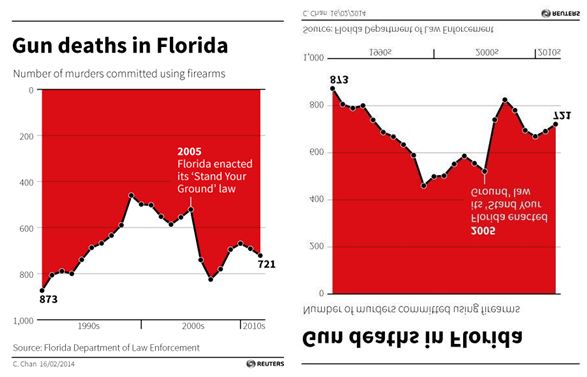
2At Junk Charts, Kaiser Fung drew my attention to a graph released by Reuters.  It is so deeply misleading that I loathe to expose your eyeballs to it.  So, I offer you this:

1The original figure is on the left.  It counts the number of gun deaths in Florida.  A line rises, bounces a little, reaches a 2nd highest peak labeled “2005, Florida enacted its ‘Stand Your Ground’ law,” and falls precipitously.

What do you see?

Most people see a huge fall-off in the number of gun deaths after Stand Your Ground was passed.  But that’s not what the graph shows.  A quick look at the vertical axis reveals that the gun deaths are counted from top (0) to bottom (800).  The highest peaks are the fewest gun deaths and the lowest ones are the most.  A rise in the line, in other words, reveals a reduction in gun deaths.  The graph on the right — flipped both horizontally and vertically — is more intuitive to most: a rising line reflects a rise in the number of gun deaths and a dropping a drop.

The proper conclusion, then, is that gun deaths skyrocketed after Stand Your Ground was enacted.

This example is a great reminder that we bring our own assumptions to our reading of any illustration of data.  The original graph may have broken convention, making the intuitive read of the image incorrect, but the data is, presumably, sound.  It’s our responsibility, then, to always do our due diligence in absorbing information.  The alternative is to be duped.

Cross-posted at Pacific Standard.

Lisa Wade, PhD is an Associate Professor at Tulane University. She is the author of American Hookup, a book about college sexual culture; a textbook about gender; and a forthcoming introductory text: Terrible Magnificent Sociology. You can follow her on Twitter and Instagram.
2

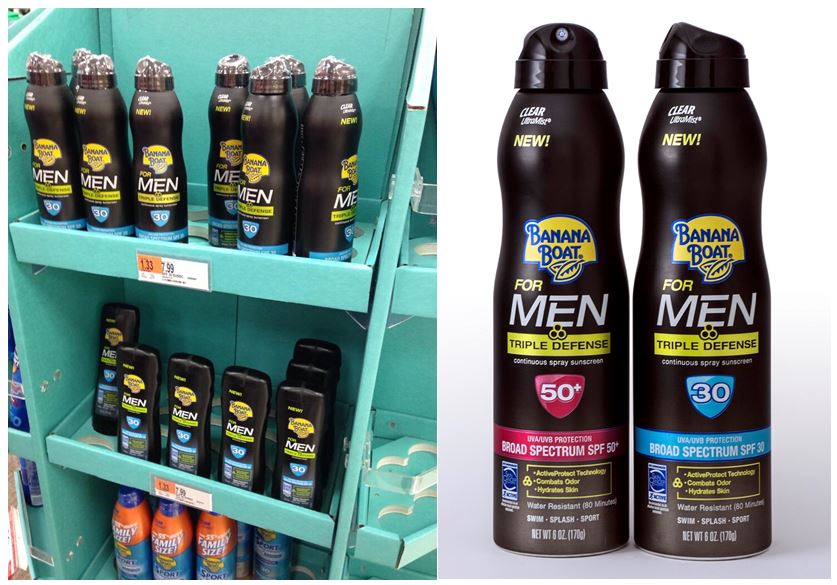
Lotion is socially constructed as feminine in the U.S. and so some men, attempting to avoid the prevailing insults of our time — gay, fag, bitch, pussy, douche, girl, and woman — are disinclined to use it.

Eeeew, lotion!

You know who you are, guys.

Sunscreen is a category of lotion and so putting on sunscreen is equivalent to admitting you’re the sun’s bitch.  Men are supposed to let the sun bake their face into a tough, craggy masculinity that says “yeah, I go outdoors and, when I do, I don’t give a shit.”

Because caring about one’s health is for pussies, some scholars argue that being male is the single strongest predictor of whether a person will take health risks.  In fact, thanks in part to the stupid idea that lotion carries girl cooties, men are two to three times more likely to be diagnosed with skin cancer.

So, fine dudes, here’s some sunscreen for men.  For christ’s sake.

1

Thanks to @r0setayl0r and @ryesilverman for sending along the product!  Check it out on our truly humorous pointlessly gendered products Pinterest board.

Lisa Wade, PhD is an Associate Professor at Tulane University. She is the author of American Hookup, a book about college sexual culture; a textbook about gender; and a forthcoming introductory text: Terrible Magnificent Sociology. You can follow her on Twitter and Instagram.
2A new study finds that people with high “justice sensitivity” are using logic, not emotions.  Subjects were put in a fMRI machine, one that measures ongoing brain activity and shown videos of people acting kindly or cruelly toward a homeless person.

Some respondents reacted more strongly than others — hence the high versus low justice sensitivity — and an analysis of the high sensitivity individuals’ brain activity showed that they were processing the images in the parts of the brain where logic and rationality live.   “Individuals who are sensitive to justice and fairness do not seem to be emotionally driven,” explained one of the scientists, “Rather, they are cognitively driven.”

Activists aren’t angry, they reasonably object to unjust circumstances that they understand all too well.

Image borrowed from Jamie Keiles at Teenagerie, who is a high sensitivity individual.

Lisa Wade, PhD is an Associate Professor at Tulane University. She is the author of American Hookup, a book about college sexual culture; a textbook about gender; and a forthcoming introductory text: Terrible Magnificent Sociology. You can follow her on Twitter and Instagram.

A merry day of celebration to those of you who care, from The Society Pages and card-maker extraordinaire, Letta Page!

2

Lisa Wade, PhD is an Associate Professor at Tulane University. She is the author of American Hookup, a book about college sexual culture; a textbook about gender; and a forthcoming introductory text: Terrible Magnificent Sociology. You can follow her on Twitter and Instagram.