Search results for The

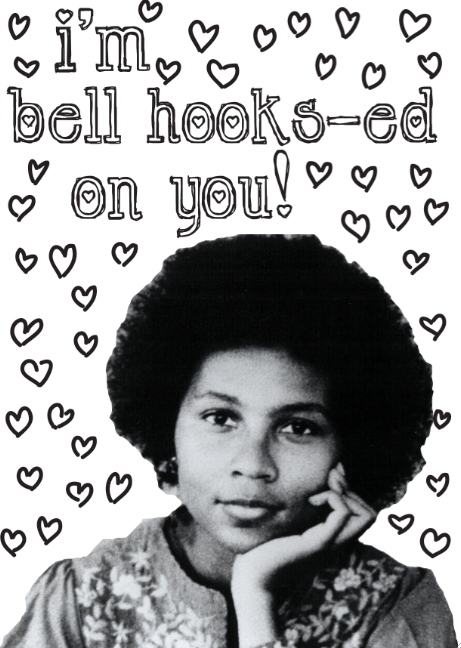
Here’s a bell hooks Valentine card for you:
1

POSTS FROM VALENTINE’S DAYS PAST

Cultural and Historical Variation

Race/Ethnicity

Heteronormativity

Compulsory Coupling:

Gender

Marketing:

Consumption:

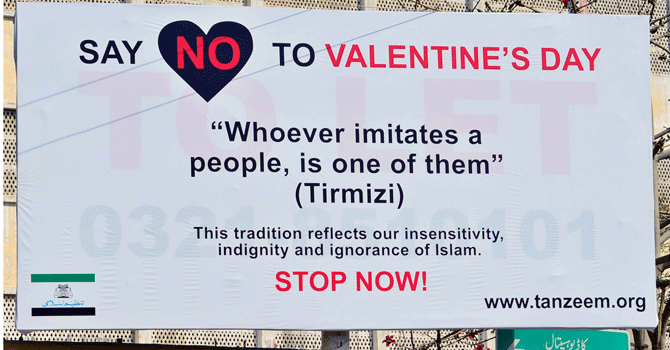
On Valentine’s day last year, my Facebook feed exploded with Pakistani memes that, on the one hand, used Islamic texts to criticize the day as unIslamic and, on the other, poked fun at the religious opposition to the holiday.
6a00d83451e32769e2017c37de69e8970b-800wi
When I conducted interviews with Pakistani women in Karachi over the summer, I expected Valentine’s day to be a salient event for my participants.  I did find religious resistance to Valentine’s Day.  The more religious-minded participants  were likely to say things like: “St. Valentine is remembered for fathering illegitimate children, so the day is sinful.”

Less religious women, however, seemed surprised that I even asked about it.  “I can’t remember what I did,” they would say, or they would criticize it as “cheesy” or  “too commercial.” A few respondents asked: “Why does there have to be one day for love? Every day should be a celebration of love.”

Based on the media, I was expecting a contest between people who embraced Valentine’s Day and people who rejected it, but I only found one side of the debate: the rejection.  There didn’t seem to be a large group of women who embraced it. Among those who didn’t outright reject it, I discovered only disinterest.

All this suggests that the push to make Valentine’s Day a thing in Pakistan is more about capitalism and the globalization of Western norms and practices, than it is about a grassroots desire for such a celebration.  It is the marketers, mall managers, and restaurant owners that seem most interested in Valentine’s Day.  I originally thought of this as a battle between the religious and secular members of the society, but it seems to be, instead, a resistance by some to efforts of companies to find one more way to make money.

Fauzia Husain is a PhD student in sociology at the University of Virginia.  She is currently studying globalization through an exploration of Pakistani women’s narratives about love.

Thanks for the comic about meta-analyses, xkcd.

Flashback Friday.

I have always found it bizarre that lipstick is supposed to make a woman’s lips more irresistible, yet kissing a woman with lipstick gets sticky red or pink smudge all over both faces. So women dress up and look all gorgeous and then their dates can’t kiss them. Or, it’s the end of the night and a woman wants her date to kiss her, does she put on lipstick or go for the chapstick?  Gah, being a woman is hard. And I supposed it can’t be that easy being the person who wants to kiss her in that situation either.

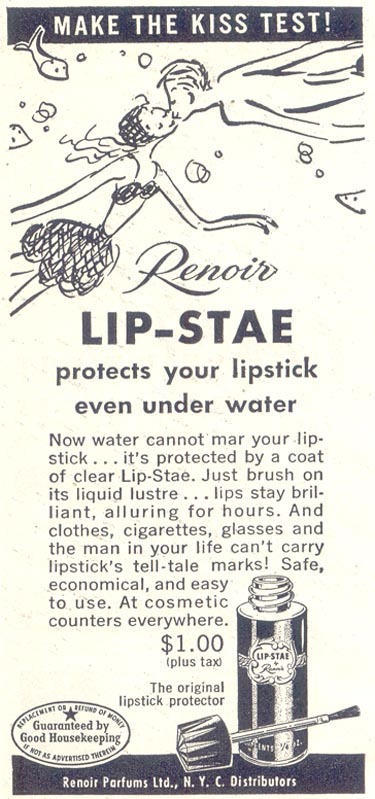
It’s odd to me that this kiss-ability paradox is never addressed in lipstick advertising.  So I was intrigued to see it in this vintage ad:

2b3b0750

Text:

Now water cannot mar your lipstick… it’s protected by a coat of clear Lip-Stae.  Just brush on its liquid lustre… lips stay brillint, alluring for hours.  And clothes, cigarettes, glasses and the man in your life can’t carry lipstick’s tell-tale marks!  Safe, economical, and easy to use. At cosmetic counters everywhere. (my emphasis)

There is so much to unpack here, but I think it all revolves around the fact that women are supposed to wear makeup, but pretend that the face that they put on is their real face.  As the copy reads, lipstick leaves “tell-tale marks.”  Those marks reveal a degree of deception regarding her true attractiveness and, in fact, this is exactly how makeup was characterized in the Victorian era.  This is why a woman’s lipstick must remain on her lips (and be left nowhere else) even when swimming or kissing.  Because, in principle, she’s not wearing lipstick at all.

This post originally appeared in 2009.

Lisa Wade, PhD is an Associate Professor at Tulane University. She is the author of American Hookup, a book about college sexual culture; a textbook about gender; and a forthcoming introductory text: Terrible Magnificent Sociology. You can follow her on Twitter and Instagram.

Karl Marx argued that capitalist modes of production always involve the exploitation of the working class by the owning class. The owning class are the capitalists. They secure the means of production — the factories, tools, and machinery — and employ workers to use those resources to produce goods.

When these goods are sold, capitalists extract the surplus value. This isn’t an magical good that blinks into existence thanks to the Capital Fairy, it’s a concrete good derived directly from the exploitation of the working class. Surplus value only exists when workers are paid less than the value they added with their work. If they were paid as much as their work was worth, capitalists would break even. And that’s not what they have in mind.

This comic at A Softer World illustrates this idea perfectly.

In other words, if capitalists paid workers what their work was actually worth, there wouldn’t be any profit left to skim off the top, leaving the rest of us with a value deficit.

Lisa Wade, PhD is an Associate Professor at Tulane University. She is the author of American Hookup, a book about college sexual culture; a textbook about gender; and a forthcoming introductory text: Terrible Magnificent Sociology. You can follow her on Twitter and Instagram.

I am so grateful to reader Emma Farais for recommending that I look into the history of the leotard. It was invented by — well, who else — Jules Léotard.

Born in 1842, Jules grew up to be an acrobat. He is credited with inventing trapeze and performed with French circuses. He invented and then began performing in leotards and he was a big hit. According to the Victoria and Albert Museum:

The original leotard was an all-in-one knitted suit. It allowed freedom of movement, was relatively aerodynamic and there was no danger of a flapping garment becoming entangled with the ropes. Even more importantly, it showed off his physique to its best advantage.

He was a huge hit with the ladies. Alas, he died at age 28. Or 32, depending on the source.

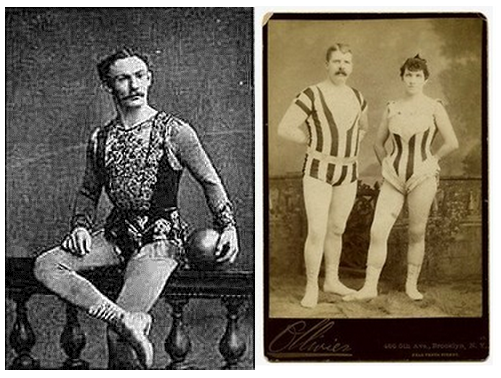
But the leotard lived on. Leotards were adapted for women, but the form and function were similar. Think vintage muscle men and women.

Jules Léotard, circa 1850 (left); Circus Strong Man and Women, circa 1890 (right):4

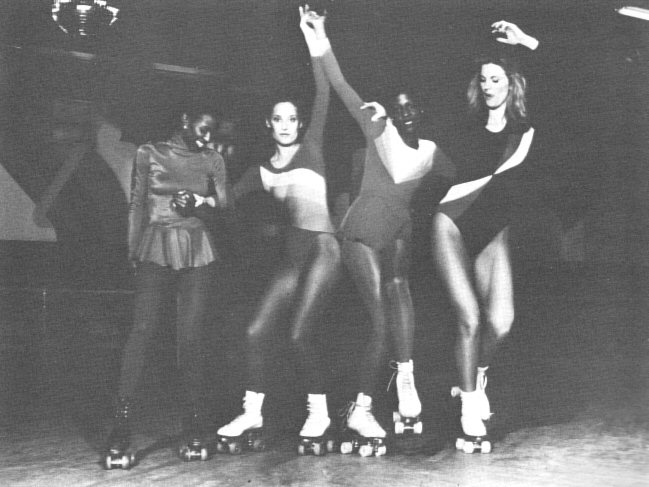
Male dancers, athletes, and thespians wore leotards well into the ’70s. Eventually, though, disco happened. Disco fashion emphasized leotard fashion for women, as this roller disco shot from the Empire Rollerdome reveals:

2

(Oh, to be a roller disco queen in ’70s Brooklyn. Sigh.)

Men eventually abandoned leotards as they became increasingly popular with women. We saw the same pattern, of course, with high heels and cheerleading: male flight from feminizing fashions and activities. The more women wore leotards, the less men wore them. Eventually, companies stopped making leotards for men altogether.

To the disappointment of all the (het) ladies, I’m sure.

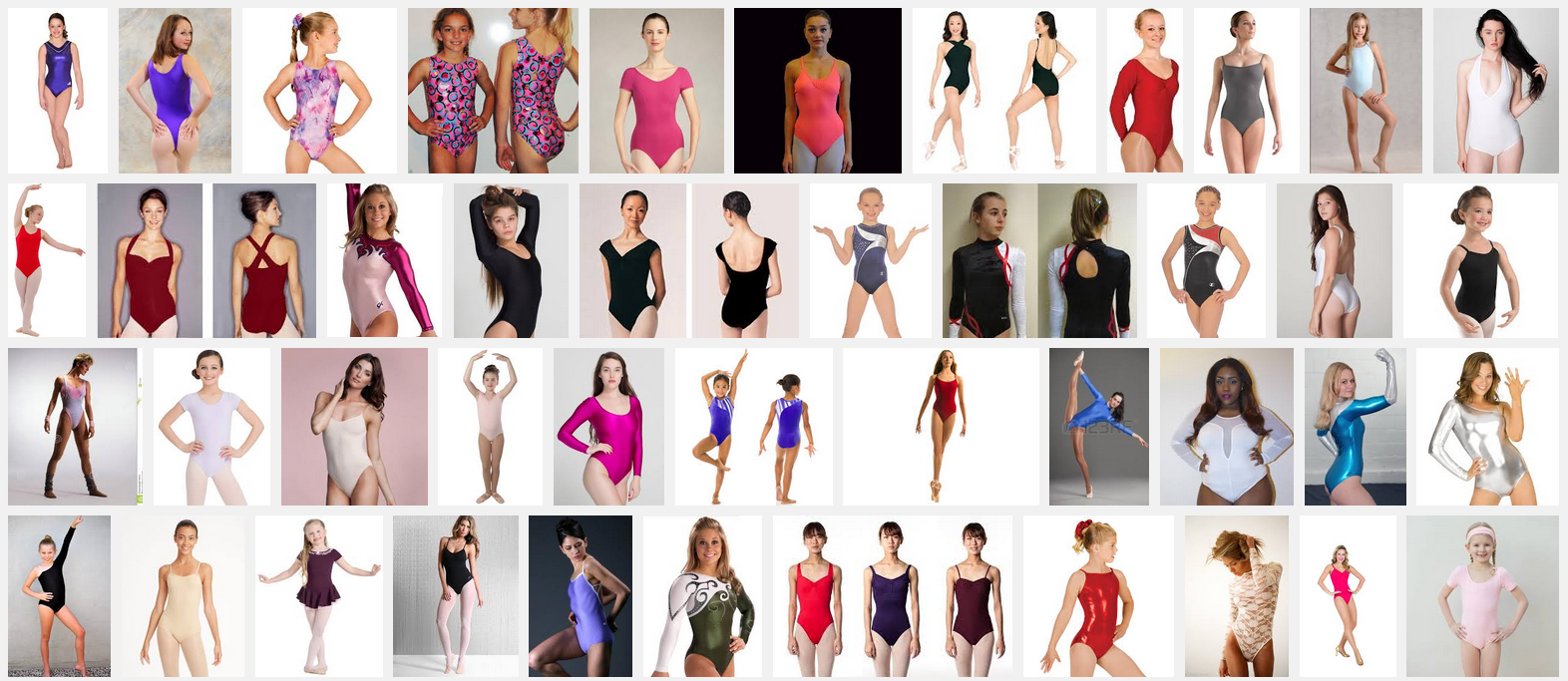
Today, a Google Image search for leotard returns all ladies. Mostly girls, in fact. Not a guy in the bunch:

4

I can only think of two arenas in which leotards for men still hold sway: wrestling and professional weight lifting. And, now I guess we know why.

Lisa Wade, PhD is an Associate Professor at Tulane University. She is the author of American Hookup, a book about college sexual culture; a textbook about gender; and a forthcoming introductory text: Terrible Magnificent Sociology. You can follow her on Twitter and Instagram.

You like!  Here are our most appreciated posts this month:

Editor’s pick:

Top funny:

Social media milestone!

We reached 70,000 fans on Facebook this month. We’ll keep trying to feed interesting, useful, and funny sociological stuff. Thanks everybody!

Social Media ‘n’ Stuff:

Finally, this is your monthly reminder that SocImages is on TwitterFacebookTumblrGoogle+, and Pinterest.  I’m on Facebook and most of the team is on Twitter: @lisawade@gwensharpnv@familyunequal, and @jaylivingston.

Lisa Wade, PhD is an Associate Professor at Tulane University. She is the author of American Hookup, a book about college sexual culture; a textbook about gender; and a forthcoming introductory text: Terrible Magnificent Sociology. You can follow her on Twitter and Instagram.

Disentangling the effects of race and class on the social mobility of black Americans is one of sociology’s important jobs. A new study by S. Michael Gaddis is a nice contribution.

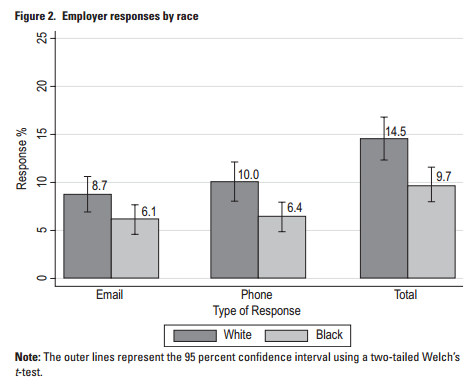
Gaddis sent resumes to 1,008 jobs in three parts of the United States. Some of these fictional job applicants carried degrees from an elite university: Stanford, Harvard, or Duke. Some had names that suggested a white applicant (e.g., Charlie or Erica) and others names that suggested a black applicant (e.g., Lamar or Shanice).

Both phone and email inquiries from people with white-sounding names elicited a response more often than those from black-sounding names. Overall, white-sounding candidates were 1.5 times more likely than black-sounding candidates to get a response from an employer. The relationship held up when other variables were controlled for with logistic regression.

2

Gaddis goes on to show that when employers did respond to candidates with black-sounding names, it was for less prestigious jobs that pay less.

Comparing applicants who are black and white and have elite vs. more middle-of-the-road university degrees, blacks with elite degrees were only slightly more likely than whites with less impressive degrees to get a call back. As is typically found in studies like these, members of subordinated groups have to outperform the superordinated to see the same benefit.

H/t Philip Cohen.


Lisa Wade, PhD is an Associate Professor at Tulane University. She is the author of American Hookup, a book about college sexual culture; a textbook about gender; and a forthcoming introductory text: Terrible Magnificent Sociology. You can follow her on Twitter and Instagram.