Search results for The

Flashback Friday.

Beautiful:

Flickr Creative Commons, Rowena Waack

Disgusting:

Flickr Creative Commons, Brendan Wood

Dirt:

Flickr Creative Commons, Mark O’Rourke

Soil:

Flickr Creative Commons, JaulaDeArdillo

In the classic book, Purity and Danger (1966), Mary Douglas points to the social construction of dirt. She writes:

There is no such thing as absolute dirt: it exists in the eye of the beholder.

If dirt and dirtiness is socially constructed, what do things we identify as dirt, filth, rubbish, and refuse have in common?

Douglas suggests that dirt is really a matter of disorganization. Literally, that a thing becomes dirt or garbage when it is out-of-place. “Dirt,” she writes, “offends against order.”

Eliminating it is not a negative movement, but a positive effort to organise the environment.

I chose the images above to try and illustrate this idea. Hair in the drain, like dirt on our hands, is out-of-place. It doesn’t belong there. In both cases, our reaction is disgust. Hair on the head, in contrast, is beautiful and becoming, while dirt outside is life-giving soil and part of the beauty of nature.

Images royalty free from Getty. Originally posted in 2009.

Lisa Wade, PhD is an Associate Professor at Tulane University. She is the author of American Hookup, a book about college sexual culture; a textbook about gender; and a forthcoming introductory text: Terrible Magnificent Sociology. You can follow her on Twitter and Instagram.
Sociologists are quite familiar with the combination of marginalized identities that can lead to oppression, inequalities, and “double disadvantages.” But can negative stereotypes actually have positive consequences?

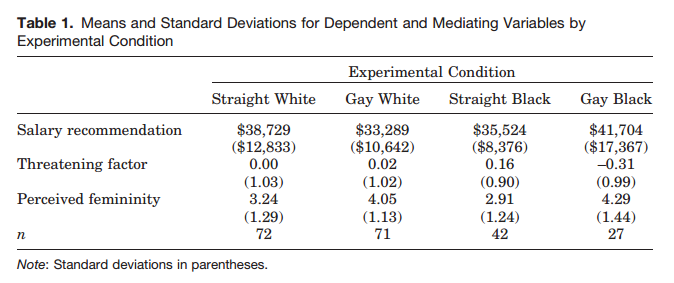
Financial Juneteenth recently highlighted a study showing that gay black men may have better odds of landing a job and higher salaries than their straight, black, male colleagues. Led by sociologist David Pedulla, the data comes from resumes and a job description evaluated by 231 white individuals selected in a national probability sample. The experiment asked them to suggest starting salaries for the position and answer questions about the fictional prospective employee. To suggest race and sexual orientation, resumes included typically raced names (either “Brad Miller” and “Darnell Jackson”) and listed participation in “Gay Student Advisory Council” half the time.

Pedulla found that straight Black men were more likely to be perceived as threatening, measured with answers as to whether the respondent thought the applicant was likely to “break workplace rules,” make “female co-workers feel uncomfortable,’’ or “steal from the workplace.” In contrast, gay Black men were considered by far the least threatening. Gay black men were also judged to be the most feminine, followed by gay white men.

Perhaps most surprisingly, the combination of being gay, Black, and male attracted the highest salaries. Gay Black men were considered the most valuable employee overall. Straight white men were offered slightly lower salaries and gay white men and straight black men were offered lowered salaries still.

333

Pedulla’s findings have sparked a conversation among scholars and journalists about the complexity of stereotypes surrounding black masculinities and sexualities. Organizational behavior researcher and Huffington Post contributor Jon Fitzgerald Gates also weighed in on the findings, arguing that the effeminate stereotypes of homosexuality may be counteracting the traditional stereotypes of a dangerous and threatening black heterosexual masculinity.

Cross-posted at Citings and Sightings.

Caty Taborda is a graduate student in sociology at the University of Minnesota, where she’s on the Grad Editorial Board for The Society Pages. Her research concerns the intersection of gender, race, health, and the body. You can follow her on twitter.

Flashback Friday.

Yesterday I went to Marshall’s and overheard a conversation between a teenager and her mother that perfectly illustrated what I was planning on posting about. The teen pulled her mom over to look at a purse she wanted for Christmas. It was $148, but she was making a case to her mom that it was actually a great buy compared to how much it would have been at the original price, which, as she pointed out to her mom, was listed as $368.

Ellen Ruppel Shell discusses this topic at length in Cheap: The High Cost of Discount Culture.

It indicates that you are getting a great deal by shopping at Marshall’s compared to the original price of the item.

Except that is not, in fact, what they are saying. The wording is “compare at…” The tags do not say “marked down from” or “original price” or “was.” There is a crucial difference: when you are told to “compare at,” the implication is that the shoes were originally $175, making them a super steal at $49. The “manufacturer’s suggested retail price” (MSRP) gives you the same info.

But as Shell points out, these numbers are largely fictional. Marshall’s is not actually telling you that those shoes were ever sold for $175. You’re just supposed to “compare” $49 to $175. But $175 may be an entirely meaningless number. The shoes may never have been sold for $175 at any store; certainly no specifics are given. Even if they were, the fact that a large number of them ended up at Marshall’s would indicate that many customers didn’t consider $175 an acceptable price.

The same goes for the MSRP: it’s meaningless. Among other things, that’s not how pricing works these days for big retail outlets. The manufacturer doesn’t make a product and then tell the retailer how much they ought to charge for it. Retailers hold much more power than manufacturers; generally, they pressure suppliers to meet their price and to constantly lower costs, putting the burden on the suppliers to figure out how to do so (often by reducing wages). The idea that manufacturers are able to tell Macy’s or Target or other big retailers how much to charge for their items is ridiculous. Rather, the retailer usually tells the manufacturer what MSRP to print on the tag of items they’ll be purchasing (I saw some tags at Marshall’s where it said MSRP but no price had been printed on it).

So what’s the point of a MSRP on a price tag, or a “compare at” number? These numbers serve as “anchor” prices — that is, they set a high “starting” point for the product, so the “sale” price seems like a great deal in comparison. Except the “sale” price isn’t actually a discount at all — it’s only a sale price in comparison to this fictional original price that was developed for the sole purpose of making you think “Holy crap! I can get $175 shoes for just $49!”

The point is to redirect your thinking from “Do I think these shoes are worth $49?” to “I can save $126!” This is a powerful psychological motivator; marketing research shows that people are fairly easily swayed by perceived savings. A sweater we might not think is worth $40 if we saw it at Banana Republic suddenly becomes worth $50 if we see it at Marshall’s (or T.J. Maxx, an outlet mall, Ross, etc.) and are told it used to sell for $80. We focus not on the fact that we’re spending $50, but on the fact that we’re saving $30.

And that makes us feel smart: we’ve beat the system! Instead of going to the mall and paying $368 for that purse, we hunted through the discount retailer and found it for $148! We worked for it, and we were smart enough to not get conned into buying it at the inflated price. Shell describes research that shows that, in these situations, we feel like we didn’t just save that money, we actually earned it by going to the effort to search out deals. When we buy that $148 purse, we’re likely to leave feeling like we’re somehow $220 richer (since we didn’t pay $368) rather than $148 poorer. And we’ll value it more highly because we feel like we were smart to find it; that is, we’re likely to think a $148 purse bought on “sale” is cooler and better quality than we would the identical purse if we bought it at full price for $120.

And stores capitalize on these psychological tendencies by giving us cues that seem to indicate we’re getting an amazing deal. Sometimes we are. But often we’re being distracted with numbers that seem to give us meaningful information but are largely irrelevant, if not entirely fictional.

Originally posted in 2009.

Gwen Sharp is an associate professor of sociology at Nevada State College. You can follow her on Twitter at @gwensharpnv.

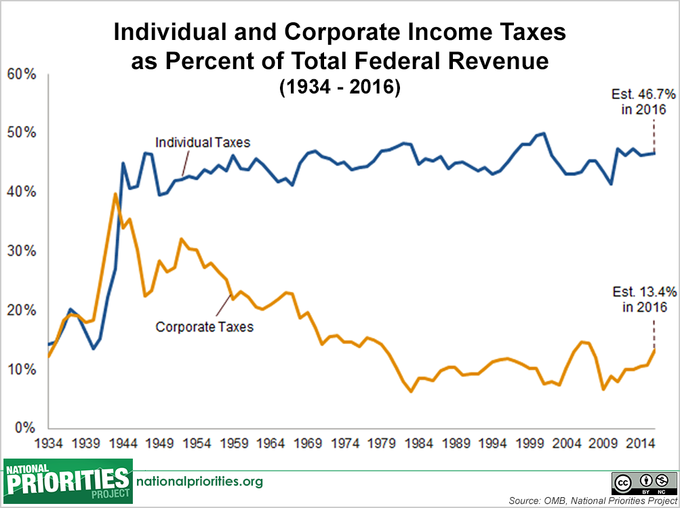
Every year the National Priorities Project helps Americans understand how the money they paid in federal taxes was spent. Here’s the data for 2014:

2

Since the 1940s, individual Americans have paid 40-50% of the federal government’s bills through taxes on income and investment. Another chunk (about 1/3rd today) is paid in the form of payroll taxes for things like social security and medicare. This year, corporate taxes made up only about 11% of the federal government’s revenue; this is way down from a historic high of almost 40% in 1943.

3

Visit the National Priorities Project here and find out where state tax dollars went, how each state benefits from federal tax dollars, and who gets the biggest tax breaks. Or fiddle around with how you would organize American priorities.

Lisa Wade, PhD is an Associate Professor at Tulane University. She is the author of American Hookup, a book about college sexual culture; a textbook about gender; and a forthcoming introductory text: Terrible Magnificent Sociology. You can follow her on Twitter and Instagram.

1 (3)The Numbers

Some History

The Winners and the Losers

Tax Cultures

Lisa Wade, PhD is an Associate Professor at Tulane University. She is the author of American Hookup, a book about college sexual culture; a textbook about gender; and a forthcoming introductory text: Terrible Magnificent Sociology. You can follow her on Twitter and Instagram.
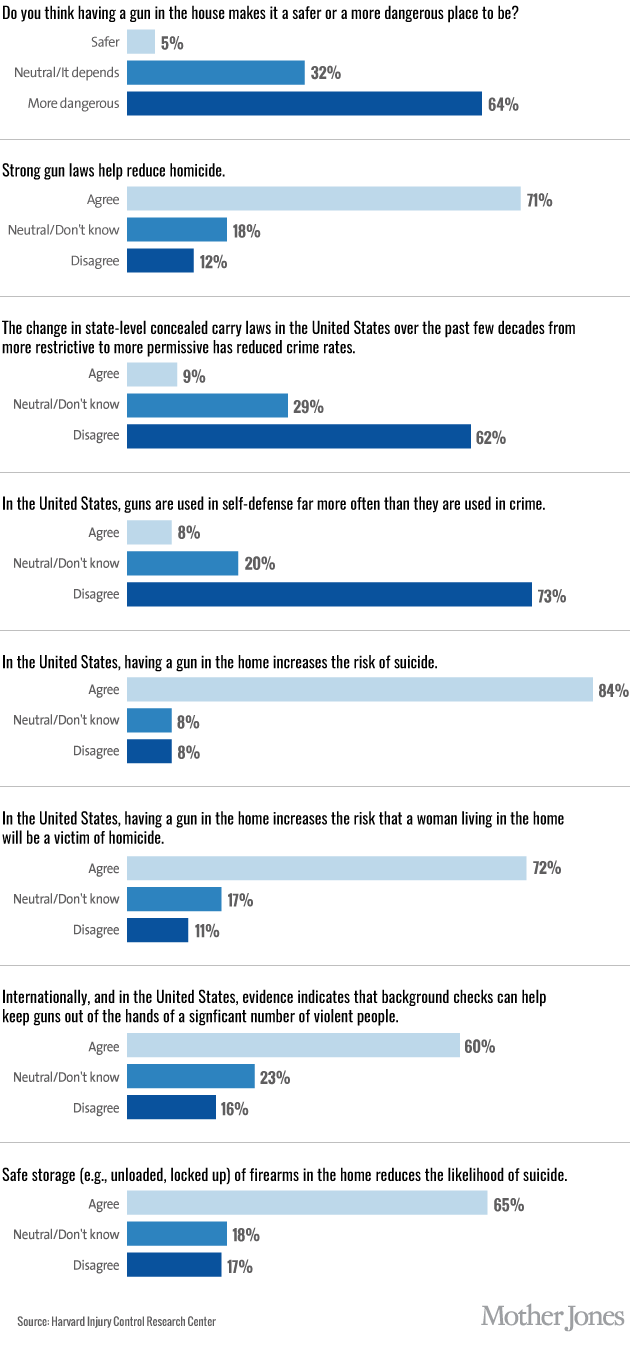
In the face of contentious debate about the value of guns, public health professor David Hemenway decided to have the experts weigh in. He modeled his research on the study of climate change experts that produced the familiar statistic that 97% of them believe that humans are causing climate change. He identified 300 scholars who have published about firearms in the fields of public health, public policy, sociology, and criminology. About 100 each have replied to nine surveys asking their opinions about common controversial statements.

Here is your image of the week:

12

At Mother Jones, Julia Lurie writes: These data “show that a clear majority of experts do not buy the NRA’s arguments.”

Lisa Wade, PhD is an Associate Professor at Tulane University. She is the author of American Hookup, a book about college sexual culture; a textbook about gender; and a forthcoming introductory text: Terrible Magnificent Sociology. You can follow her on Twitter and Instagram.

Studies of Americans’ unconscious beliefs shows that most people — white and black — think black people are dangerous and both average folks and police are quicker to shoot black than white people.

Where does the cognitive belief that black people are dangerous come from?

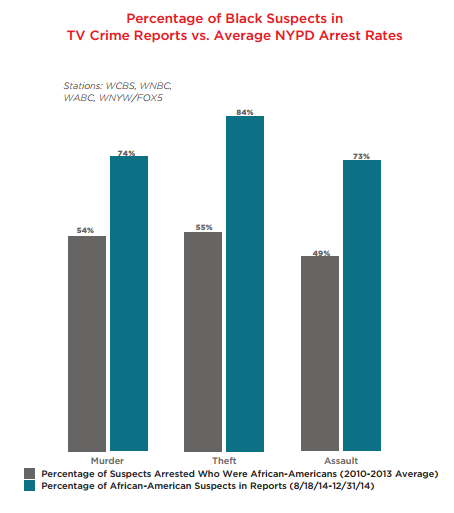
Partly, it comes from the media. A new study by Color of Change found that, while 51% of the people arrested for violent crime in New York City are black, 75% of the news reports about such arrests highlighted black alleged perpetrators.

2

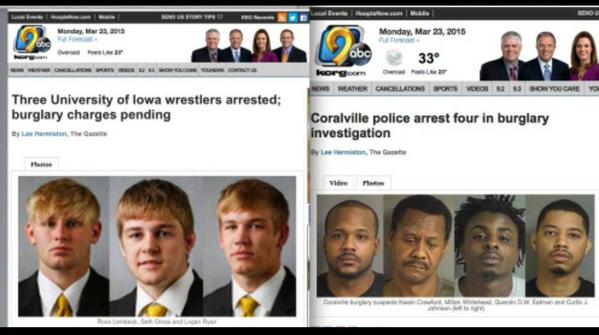
Meanwhile, when people of color are arrested, they are more likely to be portrayed in ways that make them seem threatening than white people. This happened this week:

1a

See also, portrayals of Mark Duggan and Mike Brown.

Each time we see a black person on TV who is linked with a violent crime or portrayed as a criminal, the neurons in our brain that link blackness with criminality fire. The same for people of other races. The more often a link is triggered, the stronger it becomes. Disproportionate reporting like the kind captured in this study make the neural links in our brain — it’s actual physical structure — reflect the racism inherent in the reporting itself.

These associations, unfortunately, are pre-conscious. Those neurons fire faster than we can suppress them with our conscious mind. So, even if we believe in our heart-of-hearts that these connections are unfair or untrue, our unconscious is busy making the associations anyway. Biased reporting, in other words, changes the minds of viewers, literally.

Lisa Wade, PhD is an Associate Professor at Tulane University. She is the author of American Hookup, a book about college sexual culture; a textbook about gender; and a forthcoming introductory text: Terrible Magnificent Sociology. You can follow her on Twitter and Instagram.
It’s always a treat to find a good candidate for our series on babies-who-totally-learn-how-to-do-things. In previous editions, we’ve featured a baby rapperbaby preacher, baby worshipper, and two babies mimicking a conversation.

These videos are entertaining because they’re babies, but the message their actions send is more than just adorable. They remind us of how deeply cultural we are as human beings.

In this edition, baby gives CPR:

There’s nothing natural about giving CPR. There’s no gene, no evolutionary push for that behavior, no particular brain organization, and no special mix or hormones that can explain why that baby can mimic the steps of cardiopulmonary resuscitation. Instead, that baby is learning.

Learning is coded in our genes. We’re deeply and naturally flexible that way, able to learn whatever our particular culture needs and values. Many people make biologically deterministic arguments — ones that draw a causal arrow from our biology to our behavior — but that’s usually wrong. More often, we are biologically designed to be contingent, our behavior is naturally dependent on whatever it is in the world that we encounter.

Lisa Wade, PhD is an Associate Professor at Tulane University. She is the author of American Hookup, a book about college sexual culture; a textbook about gender; and a forthcoming introductory text: Terrible Magnificent Sociology. You can follow her on Twitter and Instagram.