Search results for The

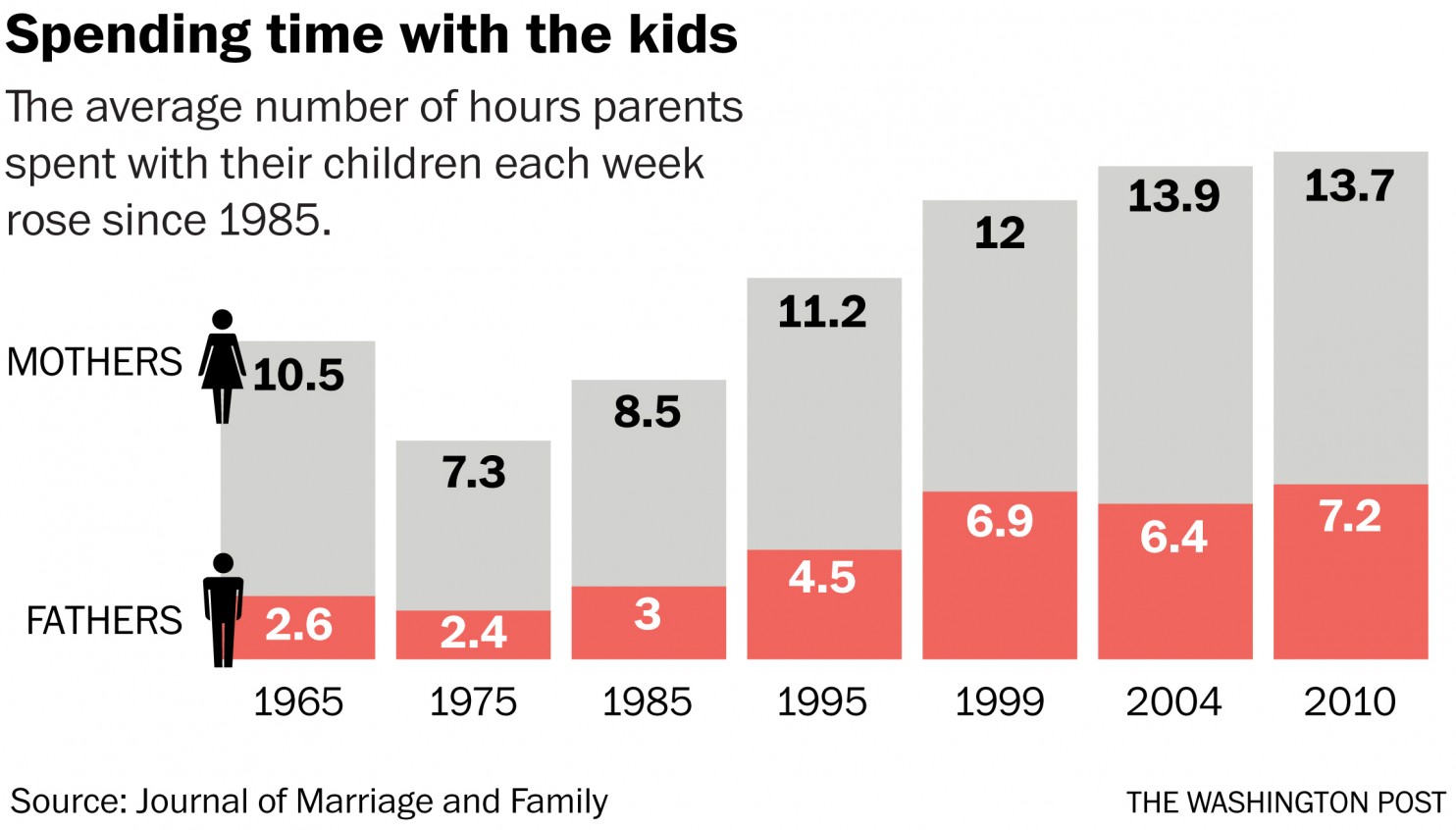
While the ’50s is famous for its family-friendly attitude, the number of hours that parents spend engaged in childcare as a primary activity has been rising ever since:
1c

The driving force behind all this focused time is the idea that it’s good for kids. That’s why parents often feel guilty if they can’t find the time or even go so far as to quit their full-time jobs to make more time.

This assumption, however, isn’t bearing out in the science, at least not for mothers’ time. Sociologist Melissa Milkie and two colleagues just published the first longitudinal study of mothers’ time investment and child well-being. They found that the amount of time mothers spent with their children had no significant impact on their children’s academic achievement, incidence of behavioral problems, or emotional health.

Quoted at the Washington Post, Milkie puts it plainly:

I could literally show you 20 charts, and 19 of them would show no relationship between the amount of parents’ time and children’s outcomes… Nada. Zippo.

Benefits for adolescents, they argued, were more nuanced, but still minimal.

These findings suggest that the middle-class intensive mothering trend may be missing its mark. As Brigid Shulte comments at the Washington Post, it’s really the quality, not the quantity that counts. In fact, Milkie and colleagues did find that “family time” — time with both parents while engaged in family activities — was related to some positive outcomes.

The findings also offer evidence that women can work full-time, even the long hours demanded in countries like the U.S., and still be good mothers. Shulte points out that the American Academy of Pediatrics actually encourages parent-free, unstructured time. Moms just don’t need to always be there after all, freeing them up to be people, workers, partners, and whatever else they want to be, too.

Lisa Wade, PhD is an Associate Professor at Tulane University. She is the author of American Hookup, a book about college sexual culture; a textbook about gender; and a forthcoming introductory text: Terrible Magnificent Sociology. You can follow her on Twitter and Instagram.
Flashback Friday.

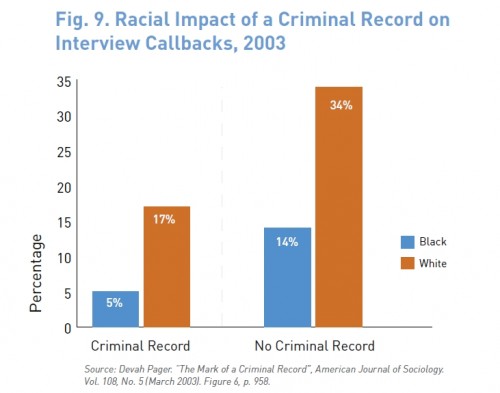
Having a criminal record negatively affects the likelihood of being considered for a job. Devah Pager conducted a matched-pair experiment in which she had male testers apply for the same entry-level jobs advertised in Milwaukee newspapers. She gave the assistants fake credentials that make them equivalent in terms of education, job experience, and so on. Half were Black and half White.

One tester from each pair was instructed to indicate that they had a past non-violent drug possession offense. Pager then collected data on how many of the applicants were called back for an interview after submitting their fake applications.

The results indicate that getting a job with a criminal record is difficult. Having even a non-violent drug offense had a significant impact on rates of callbacks:

Pager

What was surprising was that race actually turned out to be more significant than a criminal background. Notice that employers were more likely to call Whites with a criminal record (17% were offered an interview) than Blacks without a criminal record (14%). And while having a criminal background hurt all applicants’ chances of getting an interview, African Americans with a non-violent offense faced particularly dismal employment prospects. Imagine if the fake criminal offense had been for a property or violent crime?

In addition, according to Pager, employers seemed to expect that Black applicants might have a criminal record:

When people think of Black men they think of a criminal. It affects the way Black men are treated in the labor market. In fact, Black testers in our study were likely to be asked up front if they have a criminal record, while whites were rarely asked…

African American men face a double barrier:  higher rates of incarceration and racial discrimination.

Originally posted in 2009.

Gwen Sharp is an associate professor of sociology at Nevada State College. You can follow her on Twitter at @gwensharpnv.

All politicians lie, said I.F. Stone. But they don’t all lie as blatantly as Chris Christie did last week in repeating his vow not to legalize marijuana in New Jersey.

Every bit of objective data we have tells us that it’s a gateway drug to other drugs.

That statement simply is not true. The evidence on marijuana as a gateway drug is at best mixed, as the governor or any journalist interested in fact checking his speech could have discovered by looking up “gateway” on Wikipedia.

If the governor meant that smoking marijuana in and of itself created a craving for stronger drugs, he’s just plain wrong. Mark Kleiman, a policy analyst who knows a lot about drugs, says bluntly:

The strong gateway model, which is that somehow marijuana causes fundamental changes in the brain and therefore people inevitably go on from marijuana to cocaine or heroin, is false, as shown by the fact that most people who smoke marijuana don’t. That’s easy. But of course nobody really believes the strong version.

Nobody? Prof. Kleiman, meet Gov. Christie

Or maybe Christie meant a softer version – that the kid who starts smoking weed gets used to doing illegal things, and he makes connections with the kinds of people who use stronger drugs. He gets drawn into their world. It’s not the weed itself that leads to cocaine or heroin, it’s the social world.

That social gateway version, though, offers support for legalization.  Legalization takes weed out of the drug underworld. If you want some weed, you no longer have to consort with criminals and serious druggies.

There are several other reasons to doubt the gateway idea. Much of the evidence comes from studies of individuals. But now, thanks to medical legalization, we also have state-level data, and the results are the same. Legalizing medical marijuana did not lead to an increase in the use of harder drugs, especially among kids. Just the opposite.


1a

First, note the small percents. Perhaps 1.6% of adults used cocaine in the pre-medical-pot years. That percent fell slightly post-legalization. Of course, those older people had long since passed through the gateway, so we wouldn’t expect legalization to make much difference for them. But for younger people, cocaine use was cut in half. Instead of an open gateway with traffic flowing rapidly from marijuana through to the world of hard drugs, it was more like, oh, I don’t know, maybe a bridge with several of its lanes closed clogging traffic.

Jay Livingston is the chair of the Sociology Department at Montclair State University. You can follow him at Montclair SocioBlog or on Twitter.

SocImages Update:

I am so excited to share the news that the American Sociological Association has granted Sociological Images this year’s Distinguished Contributions to Teaching Award. I am thrilled that sociologists find the site useful and I am so grateful for all of the sociologists out there who keep doing fantastic and amazing research that I have the opportunity to share. To us!!!

I would also like to say a HUGE thanks to the Midwest Sociological Society for offering me the opportunity to share some SocImages behind-the-scenes, and to its members for being so supportive and complimentary. It was a wonderful experience and I was so happy to meet you all!

In the News:

The New Zealand Herald picked up on our article about how unpopular fish that haven’t yet been over harvested get new names to make them seem more appetizing.

You like!  Here are our most appreciated posts this month:

We had an especially fantastic month thanks in part to the fact that I appear to have developed the interests of a 12-year-old boy. Er, I mean my trying out some of the material I’m working up for The Society Pages’ next edited volume.

Thanks everybody!

Fav comic:

Editor’s pick:

Top post on Tumblr this month:

Follow us!

Finally…

A huge thank you to Kara McGhee and the whole crew at University of Missouri, Columbia. I’m having an amazing visit and am excited to deliver my talk tonight. Hopefully there’ll be lots of #overheardatmizzou!20150330_134004

Lisa Wade, PhD is an Associate Professor at Tulane University. She is the author of American Hookup, a book about college sexual culture; a textbook about gender; and a forthcoming introductory text: Terrible Magnificent Sociology. You can follow her on Twitter and Instagram.

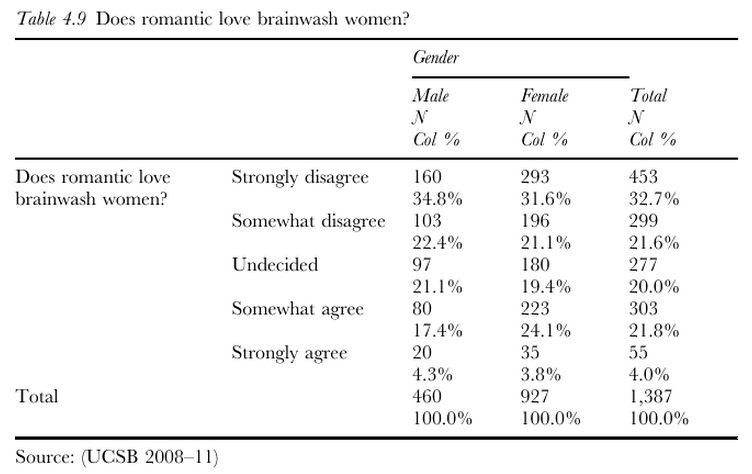
According to a survey of 1,387 students in Sociology 101 classes at a large west coast university,  25.8% of college students “somewhat” or “strongly agree” that romantic love brainwashes women. Another 20% could be convinced.  Interestingly, the numbers were similar for men and women, though women were a bit more likely to agree.

8

Data from “Hey God, is that You in my underpants?” by Roger Friedland and Paolo Gardinali, published in Intimacies: A New World of Relational Life.

Lisa Wade, PhD is an Associate Professor at Tulane University. She is the author of American Hookup, a book about college sexual culture; a textbook about gender; and a forthcoming introductory text: Terrible Magnificent Sociology. You can follow her on Twitter and Instagram.

Flashback Friday.

In his book, Authentic New Orleans, sociologist Kevin Fox Gotham explains that originally, and as late as the late 1800s, the term meant “indigenous to Louisiana.”  It was a geographic label and no more.

But, during the early 1900s, the city of New Orleans racialized the term. White city elites, in search of white travel dollars, needed to convince tourists that New Orleans was a safe and proper destination. In other words, white. Creole, then, was re-cast as a white identity and mixed-race and black people were excluded from inclusion in the category.

Today most people think of creole people as mixed race, but that is actually a rather recent development. The push to re-define the term to be more inclusive of non-whites began in the 1960s, but didn’t really take hold until the 1990s.  Today, still racialized, the term now capitalizes on the romantic notions of multiculturalism that pervade New Orleans tourism advertising, like in this poster from 2011:

12

Like all other racial and ethnic designations, creole is an empty signifier, ready to be filled up with whatever ideas are useful at the time. In fact, the term continues to be contested. For example, this website claims that it carries cultural and not racial meaning:

Capture4

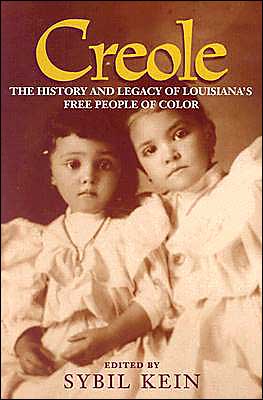
This book seems to define creole as free people of color (and their descendants) in Louisiana:

7711139

Whereas this food website identifies creole as a mix of French, Spanish, African, Native American, Chinese, Russian, German, and Italian:

Capture3

In short, “creole” has gone through three different iterations in its short history in the U.S., illustrating both the social construction of race and the way those constructions respond to political and economic expediency.

Lisa Wade, PhD is an Associate Professor at Tulane University. She is the author of American Hookup, a book about college sexual culture; a textbook about gender; and a forthcoming introductory text: Terrible Magnificent Sociology. You can follow her on Twitter and Instagram.
President Obama continues to press for a form of fast track approval to ensure Congressional support for two major trade agreements: the Trans-Pacific Trade Partnership Agreement (with 11 other countries) and the Trans-Atlantic Trade and Investment Partnership Agreement (with the entire European Union).

Both agreements, based on leaks of current negotiating positions, have been structured to promote business interests and will have negative consequences for working people relative to their wages and working conditions, access to public services, and the environment.

These agreements are being negotiated in secret: even members of Congress are locked out of the negotiating process.  The only people that know what is happening and are in a position to shape the end result are the U.S. trade representative and a select group of 566 advisory group members selected by the U.S. trade representative.

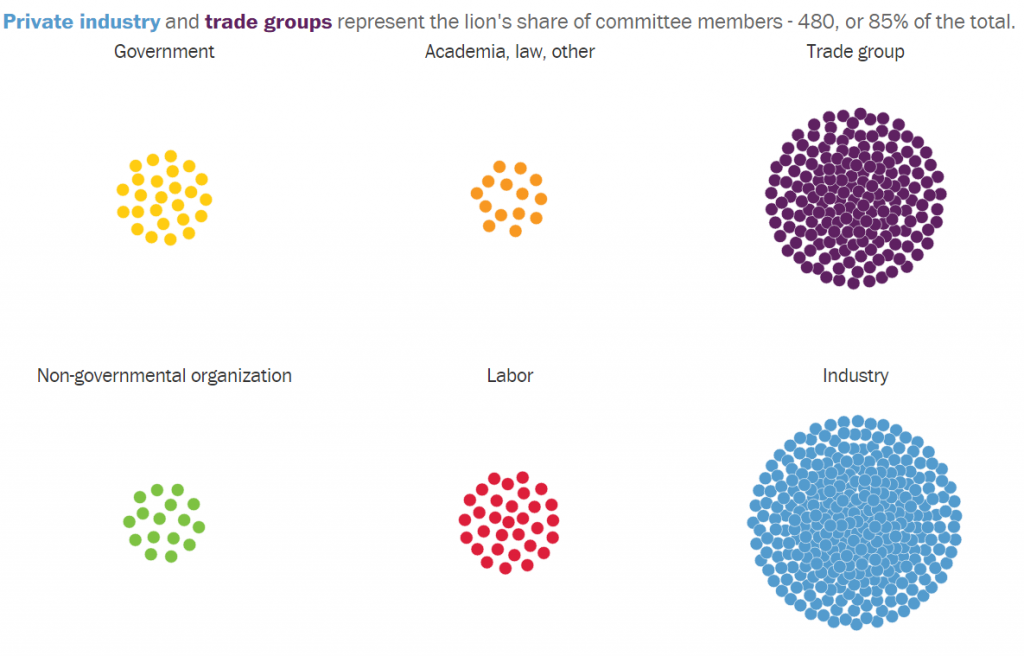
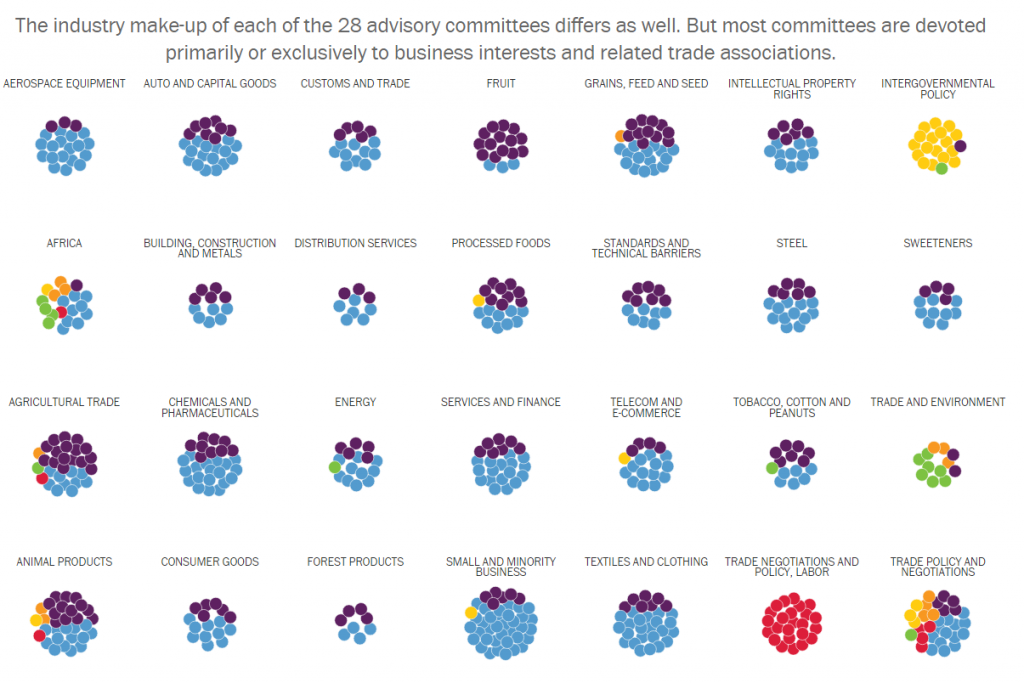
Thanks to a recent Washington Post post we can see who these advisory group members are and, by extension, whose interests are served by the negotiations.  According to the blog post, 480 or 85% of the members are from either industry or trade association groups.  The remaining 15% are academics or members of unions, civil society organizations, or government committees.  The blog post includes actual names and affiliations.

Here we can see the general picture of corporate domination of U.S. trade policy as illustrated by the Washington Post.
3
9 10

In short, corporate interests are well placed to directly shape our trade policies.  No wonder drafts of these treaties include chapters that, among other things, lengthen patent protection for drugs, promote capital mobility and privatization of public enterprises, and allow corporations to sue governments in supra-national secret tribunals if public policies reduce expected profits.

Cross-posted at Reports from the Economic Front and Pacific Standard.

Martin Hart-Landsberg is a professor of economics at Lewis and Clark College. You can follow him at Reports from the Economic Front.

Not surprisingly, the new interactive chart Gendered Language in Teacher Reviews has been the subject of a lot of conversation among sociologists, especially those of us who study gender. For example, it reminded C.J. of an ongoing conversation she and a former Colorado College colleague repeatedly had about teaching evaluations. Comparing his evaluations to C.J.’s, he noted that students would criticize C.J. for the same teaching practices and behaviors that seemed to earn him praise: being tough, while caring about learning.

We’ve long known that student evaluations of teaching are biased. A recent experiment made headlines when Adam Driscoll and Andrea Hunt found that professors teaching online received dramatically different evaluation scores depending upon whether students thought the professor was a man or a woman; students rated male-identified instructors significantly higher than female identified instructors, regardless of the instructor’s actual gender.

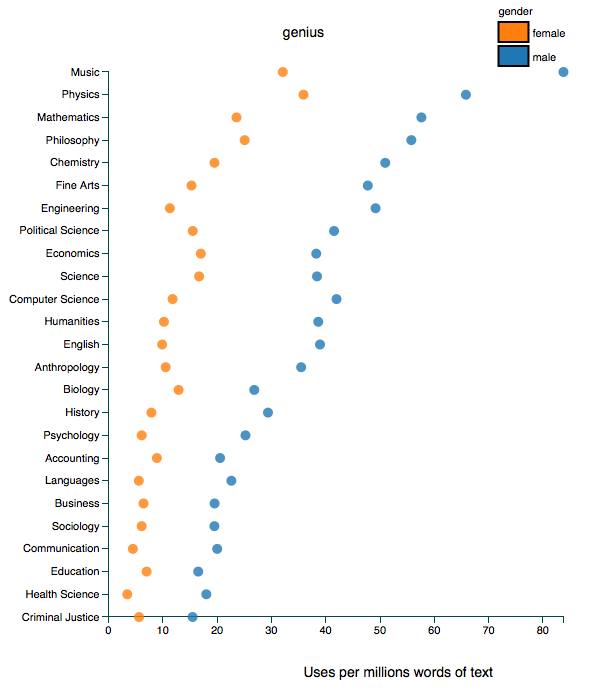
Schmidt’s interactive chart provides a bit more information about exactly what students are saying when evaluating their professors in gendered ways. Thus far, most commentaries have focused on the fact that men are more likely to be seen as “geniuses,” “brilliant,” and “funny,” while women, as C.J. discovered, are more likely to be seen as “bossy,” “mean,” “pushy.”

18

These discrepancies are important, but in this post, we’ve used the tool to shed light on some forms of gendered workplace inequality that have received less attention: (1) comments concerning physical appearance, (2) comments related to messiness and organization, and (3) comments related to emotional (as opposed to intellectual) work performed by professors.

Physical Appearance

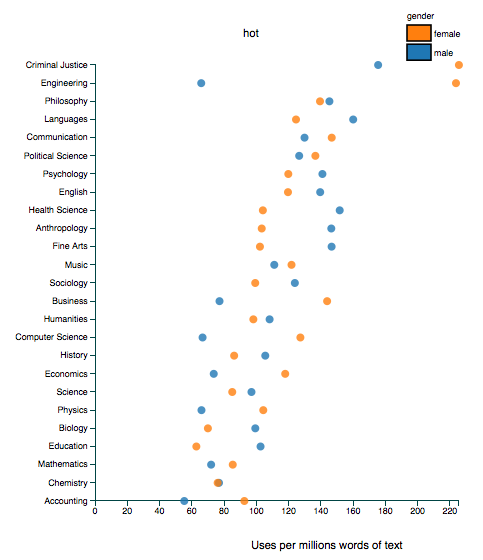
The results from Schmidt’s chart are not universally “bad” or “worse” for women. For instance, the results for students referring to professors as “hot” and “attractive” are actually mixed. Further, in some fields of study, women are more likely to receive “positive” appearance-based evaluations while, in other fields, men are more likely to receive these evaluations.

A closer examination, however, reveals an interesting pattern. Here is a list of the fields in which women are more likely to be referred to as “hot” or “attractive”: Criminal Justice, Engineering, Political Science, Business, Computer Science, Physics, Economics, and Accounting. And here is a list of fields in which men are more likely to receive these evaluations: Philosophy, English, Anthropology, Fine Arts, Languages, and Sociology.

111

Notice anything suspicious? Men are sexualized when they teach in fields culturally associated with “femininity” and women are sexualized when they teach in fields culturally associated with “masculinity.”

Part of this is certainly due to gender segregation in fields of study. There are simply more men in engineering and physics courses. Assuming most students are heterosexual, women teaching in these fields might be more likely to be objectified. Similarly, men teaching in female-dominated fields have a higher likelihood of being evaluated as “hot” because there are more women there to evaluate them. (For more on this, see Philip Cohen’s breakdown of gender segregation in college majors.)

Nonetheless, it is important to note that sexual objectification works differently when it’s aimed at men versus women. Women, but not men, are systematically sexualized in ways that work to symbolically undermine their authority. (This is why “mothers,” “mature,” “boss,” and “teacher” are among men’s top category searches on many online pornography sites.) And, women are more harshly criticized for failing to meet normative appearance expectations. Schmidt’s chart lends support to this interpretation as women professors are also almost universally more likely to be referred to as “ugly,” “hideous,” and “nasty.”

Level of (Dis)Organization

Christin and Kjerstin are beginning a new research project designed to evaluate whether students assess disorganized or “absent-minded” professors (e.g., messy offices, chalk on their clothing, disheveled appearances) differently depending on gender. Schmidt’s interactive chart foreshadows what they might find. Consider the following: women are more likely to be described as “unprepared,” “late,” and “scattered.” These are characteristics we teach little girls to avoid, while urging them to be prepared, organized, and neat. (Case in point: Karin Martin’s research on gender and bodies in preschool shows that boys’ bodies are less disciplined than girls’.)

In short, we hold men and women to different organizational and self-presentation standards. Consequently, women, but not men, are held accountable when they are perceived to be unprepared or messy. Emphasizing this greater scrutiny of women’s organization and professionalism is the finding that women are more likely than men to be described as either professionalorunprofessional,” and eitherorganizedordisorganized.”

Emotional Labor

Finally, emotional (rather than intellectual) terms are used more often in women’s evaluations than men’s. Whether mean, kind, caring or rude, students are more likely to comment on these qualities when women are the ones doing the teaching. When women professors receive praise for being “caring,” “compassionate,” “nice,” and “understanding,” this is also a not-so-subtle way of telling them that they should exhibit these qualities. Thus, men may receive fewer comments related to this type of emotion work because students do not expect them to be doing it in the first place. But this emotional work isn’t just “more” work, it’s impossible work because of the competence/likeability tradeoff women face.

There are all sorts of things that are left out of this quick and dirty analysis (race, class, course topic, type of institution, etc.), but it does suggest we begin to question the ways teaching evaluations may systematically advantage some over others. Moreover, if certain groups—for instance, women and scholars of color (and female scholars of color)—are more likely to be in jobs at which teaching evaluations matter more for tenure and promotion, then unfair and biased evaluations may exacerbate inequality within the academy.

Cross-posted at Girl w/ Pen.