Search results for The

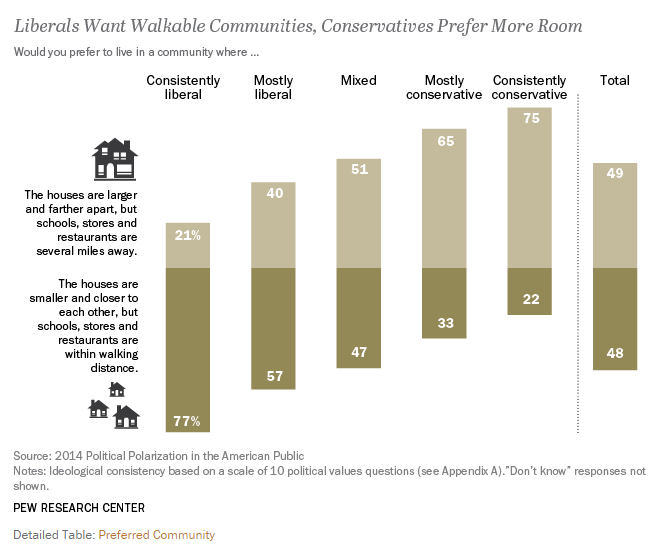
Urban planning is a partisan issue. The graph below, produced by the Pew Research Center, shows that the American public are evenly split between small, walkable communities (48%) and sprawling suburbs with McMansions (49%), but that split is strongly partisan.

77% of consistent liberals want to live in neighborhoods where “the houses are smaller and closer to each other, but schools, stores, and restaurants are within walking distance.” In contrast, 75% of consistent conservatives prefer it when “houses are larger and farther apart, but schools, stores, and restaurants are several miles away.”
12

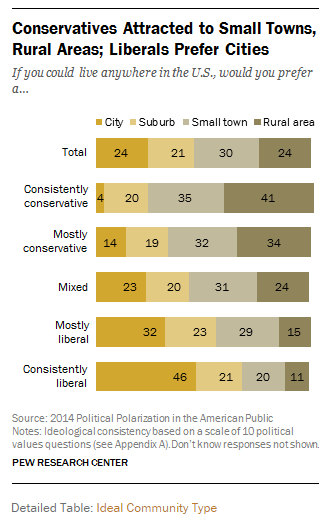
Relatedly, Americans are about evenly split between those who prefer to live in cities, suburbs, small towns, and rural areas, but there is a clear partisan divide.
11

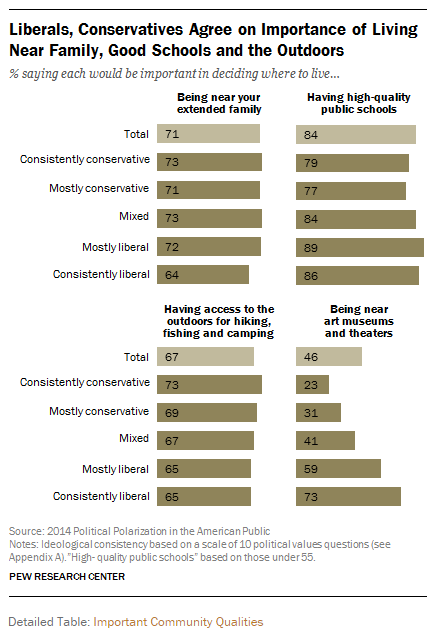
And everyone seems to agree that they want to be near family, good schools, and the outdoors, but liberals are significantly more likely to care if they’re near art museums and theaters.
13

I’m familiar with the idea of the urban liberal and the rural conservative, but I’m still surprised by the strength of these correlations. If the preferences hold true in real life, it means that there is significant partisan residential segregation. That would translate into fewer friendships between people on different sides of the political spectrum, fewer conversations that help them see the others’ point of view, and more cross-group animosity.

In fact, that’s exactly what we see: a strongly partisan population that doesn’t talk to each other very much.

H/t Conrad Hackett. Cross-posted at Pacific Standard.

Lisa Wade, PhD is an Associate Professor at Tulane University. She is the author of American Hookup, a book about college sexual culture; a textbook about gender; and a forthcoming introductory text: Terrible Magnificent Sociology. You can follow her on Twitter and Instagram.

SocImages News:

You like!  Here are our most appreciated posts this month:

We had one BIG winner this month! In “Where Do Negative Stereotypes about Feminists Come From,” I collected some pre-1920s anti-suffrage propaganda that revealed that stereotypes about feminists are 100 years old or more.  It got 5,200 likes here on SocImages and 16,250 notes on our Tumblr. Thanks everybody!

Editor’s pick:

My favorite was the one about tomatoes.

Upcoming Lectures and Appearances:

  • If anyone’s going to MSS this year, I’d love to say “hi”! I’ll be giving a plenary on March 27th titled “Doing Public Sociology: Notes from a Practitioner.”
  • Afterward I’ll be dropping by to the University of Missouri, Columbia to give a talk on hookup culture. Drop me a line if you’d like to meet up!

Follow us!

Finally…

I’ve started a little side project. Just a place to store and collect my thoughts about New Orleans. Most of what’s on there now has already been posted here, and I can’t promise that won’t be the case for what comes next. But if you’d like to follow along, please be my guest. It’s part of my long-term fantasy of writing a social science-inspired guidebook to the city. You know, for nerds.2 (1)

Lisa Wade, PhD is an Associate Professor at Tulane University. She is the author of American Hookup, a book about college sexual culture; a textbook about gender; and a forthcoming introductory text: Terrible Magnificent Sociology. You can follow her on Twitter and Instagram.
Flashback Friday.

Dating site OKCupid did an analysis of 500,000 inquiry messages to determine what keywords correlate most strongly with getting a reply.  It has some great lessons about dating and some counter-stereotypical news about what heterosexual women want from men.

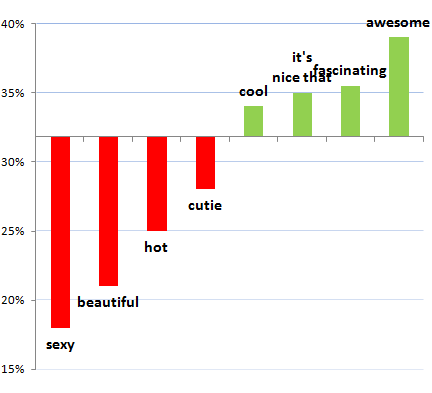
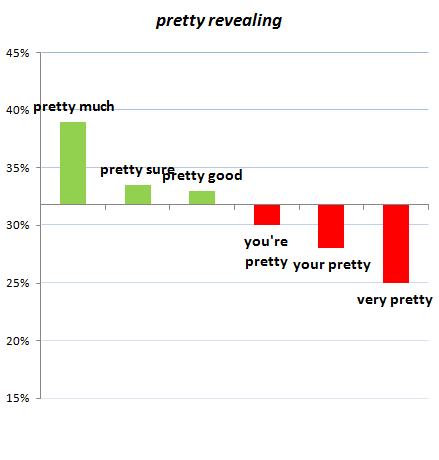
This first graph shows that mentioning someone’s level of attractiveness decreased the likelihood of getting a response (for both men and women), though men were more likely to mention looks.  But general compliments about one’s profile increased the likelihood of getting a response (the middle line is the average number of responses, the green bars signify an increase in the number of responses, and the red bars a decrease):

compliments-chart

A good lesson in operationalization: “pretty” is used in two ways in our culture, so when they made sure to differentiate between pretty (meaning “sort of”) and pretty (meaning “attractive”), you can see clearly the way that commenting on looks decreases the recipients’ interest:
pretty-chart

So, in contrast to stereotypes, many women cannot be flattered into a date (though the figure above includes men and women, I’m assuming most people being called “pretty” are female).

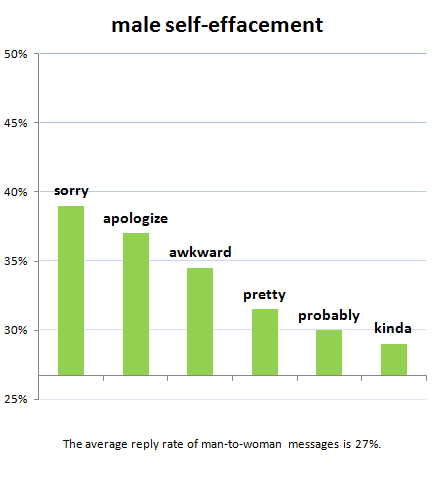
Further, the site found that when men sent messages, female recipients preferred humility to bold self-confidence.  The words below all increased the chances of a woman responding to a man’s inquiry:
efface-chart

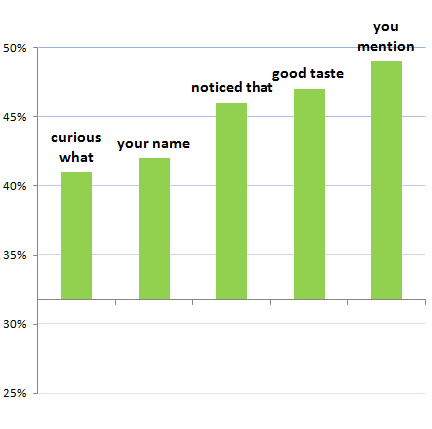
Instead of bravado and flattery, women appear to actually like men who take an interest in them.  They respond positively to phrases that indicate that a guy actually read their profile and is interested in the content of their person:
engage-chart

The lesson: Treat a woman (on the OK Cupid dating site) like a human being and she will respond positively.

And to answer the question, “What do women want?”  As my dear friend David Landsberg would say: “Everything!

This post originally appeared in 2009.

Lisa Wade, PhD is an Associate Professor at Tulane University. She is the author of American Hookup, a book about college sexual culture; a textbook about gender; and a forthcoming introductory text: Terrible Magnificent Sociology. You can follow her on Twitter and Instagram.
Flashback Friday.

When companies offer instructions as to how much of their product to use, what do you think drives their decisions as to what advice to give?

Theory 1:  They give the best advice.

Theory 2:  They give reasonably good advice, erring on the side of you using more product versus less.

I’m with Theory 2.  The quicker you go through their product, the more frequently you have to purchase it, and the richer they get.  So they have an interest in your over-using their product.

Dan Myers agrees.   He put up a great example of this on his website, Blue Monster. He writes:

When you buy laundry detergent these days, the cap usually serves as a handy measuring cup… Now, if you were a company that wanted to get people to use it up as fast a possible (read: waste as much of it as possible) so you could get some more out of them, what would you do? Well, having a devious mind myself, I’d make the cup bigger that it needs to be hoping people would consistently use more than they need. Especially given that people are more likely than not to fill the cup up to the top.

And that is exactly what you get on with the TIDE packaging. The cap, shown here, has three measuring lines in it: 1, 2, and 3. All of these are significantly lower than the top of the cap.

Furthermore, if one actually takes the time to read the instructions on the bottle, the 1 line is for “medium” loads, the 2 line is for large loads, and the 3 line is not even mentioned!!!

Why is it there if it isn’t mentioned? I say that it’s because for those who actually look at the cup instead of just filling it up, they want to give you the impression that 1 is small, 2 is medium, and 3 is large–thereby getting you to use more than necessary every time you launder. Scam Masters!!!

In another illustration, Myers videos himself brushing his teeth with the liberal swirl of toothpaste seen in your average advertisement. The result is a hilarious excessive frothing. A blob of toothpaste the size of a pea is likely sufficient for most of us, but toothpaste companies would probably prefer that you overdo it.

Relatedly, I’ve always been suspicious of how gas stations order the gas by quality/expense. Sometimes it goes cheaper on the left to expensive on the right, which is what you’d expect because we read left to right, but sometimes it’s reverse. Do people sometimes hit the far left button, assuming it’s the cheap gas, and accidentally spend more than they have to? I bet they do.

There must be hundreds of examples of this kind of trick.

This post originally appeared in 2009.

Lisa Wade, PhD is an Associate Professor at Tulane University. She is the author of American Hookup, a book about college sexual culture; a textbook about gender; and a forthcoming introductory text: Terrible Magnificent Sociology. You can follow her on Twitter and Instagram.
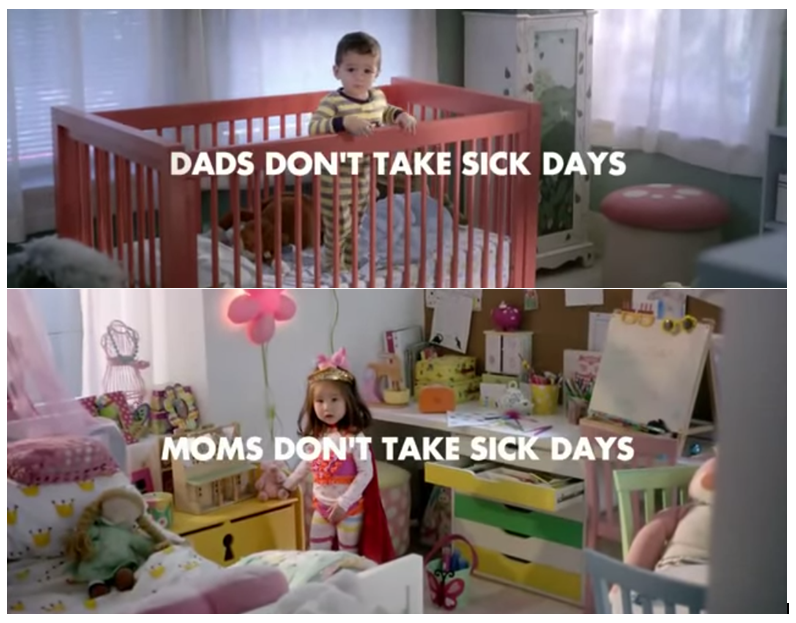
Sociologists have known for a while now that even though women are more integrated in the workplace, men are not as integrated at home. This disparity places extra constraints on women’s time, which Arlie Hochschild calls the “second shift.” During the second shift, women have an obligation to spend their time off caring for their houses and their children without equivalent effort from men.

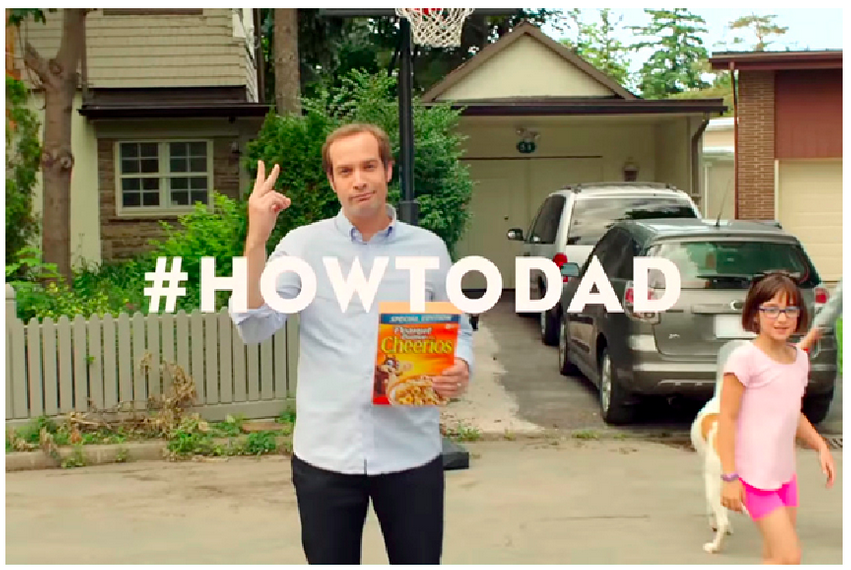
For the most part, advertising has reflected that (see over 150 examples here). Ads directed at women often tie the product to a smiling, laughing, or hugging child. But until recently, dads have been largely absent from the picture—unless it’s conveniently close to Father’s Day. When dads have made an appearance in an ad, they have been accompanied by an explanation for why their unique take on parenting can be manly, implying that childcare is still women’s work.

Recently, dads have found their way into the ads and they’re starting to look more comfortable there. Swiffer has a father taking care of his son by himself, Dove connects masculinity to caring for kids of all ages, and NyQuil even has two ads with the same plot about the constant demands of parenting for a mother and father.

2

But is active fatherhood the new norm?

Not quite. While some ads casually use competent dads to sell laundry detergent, others use themes that reflect a more troubled transition into a hands-on fathering style. For example, the Nissan Superbowl commercial tells the story father with a risky profession that keeps him on the road and away from home. The ad ends with the dad physically being in the same space as his teenage son. This is cast as a huge victory, but in reality, it’s a pretty low bar. Still, the ad got a lot of attention for being a tearjerker for its emphasis on fatherhood.

When considered as a group, these ads imply not that we’ve arrived at gender equality in the home, but instead that we’re in a stage of transition. We can appreciate active fatherhood, but we’re not entirely sure what it should look like. With the recent popularity of dadvertising, we can expect to see the commercial conversation around fatherhood continue, giving us the chance to watch as Americans learn #HowToDad.

3

Nicole Bedera is a PhD student in sociology at the University of Maryland, College Park. She is currently studying college sexual assault and construction of young men’s sexualities.

Today is the first day of the Christian season of Lent, a period of voluntary self-denial that is the excuse for the indulgence of Mardi Gras. Last year a credit card processing company traced spending in New Orleans on both Fat Tuesday and Ash Wednesday. They found a spike in the days leading up to the big day (below) and then a crash the day after.

2

According to Mark Waller at nola.com:

…people spent 30 percent more at restaurants in the weekend before Mardi Gras than they did in an average of the four previous weekends…

What were they buying? Indulgences: “duck fat fries, king cake burgers, and crab and crawfish mac and cheese.” Mmmmm. The week before they’d mostly bought lattes.

Comparatively:

…restaurant, retail shops and other merchants logged about half the business on Ash Wednesday compared with the Wednesday before.

What was the most popular food item that day? Soda.

Lisa Wade, PhD is an Associate Professor at Tulane University. She is the author of American Hookup, a book about college sexual culture; a textbook about gender; and a forthcoming introductory text: Terrible Magnificent Sociology. You can follow her on Twitter and Instagram.
The Baby Doll Ladies pose during Mardi Gras in New Orleans on Tuesday.Happy Fat Tuesday to all our friends in New Orleans! Don’t do anything we wouldn’t do!

If you’re not in the middle of the revelry, enjoy these Mardi Gras posts from previous years:

Lisa Wade, PhD is an Associate Professor at Tulane University. She is the author of American Hookup, a book about college sexual culture; a textbook about gender; and a forthcoming introductory text: Terrible Magnificent Sociology. You can follow her on Twitter and Instagram.
Your mother wonders why you like studying something so depressing. And rightly so.

1 (4) - Copy 1 (4) 1 (5) 1 (6)

See more at Contexts.

Lisa Wade, PhD is an Associate Professor at Tulane University. She is the author of American Hookup, a book about college sexual culture; a textbook about gender; and a forthcoming introductory text: Terrible Magnificent Sociology. You can follow her on Twitter and Instagram.