Search results for The

Fish farming, the raising of fish in captivity, is often seen as a more sustainable way to feed the increasingly global hunger for seafood.  At least, the story goes, it doesn’t contribute to the over-fishing of our oceans.

Right?

The answer turns out to be: not necessarily.  Carnivorous species of farmed fish still need to be fed, so there is  an entire secondary industry: fishing for fish food.  Just about anything that can be caught will do; the mix of sea animals is simply ground up and made into pellets.  So, the fisherman typically catch absolutely everything that they can, sterilizing a small piece of the ocean.  They don’t distinguish between large and small fish (the large they can sell as human food, the small they sell as fish food) or adults and juveniles. By taking the larger fish, they’re taking out populations before they have a chance to reproduce.  You can see how this is a system with a devastating expiration date.

This 9-minute clip from Grinding Nemo covers the environmental impact of this practice, as well as the inhumane working conditions of some of the men hired to work in this industry:

Via Sociology in Focus.

Lisa Wade, PhD is an Associate Professor at Tulane University. She is the author of American Hookup, a book about college sexual culture; a textbook about gender; and a forthcoming introductory text: Terrible Magnificent Sociology. You can follow her on Twitter and Instagram.
JUST THE HIGHLIGHTS!

ALL OUR COVERAGE OF THE 2012 U.S. PRESIDENTIAL ELECTION

History:

Culture and Psychology:

Systems:

Religion:

Media:

Money:

Race:

Class:

Sexual Orientation:

Gender:

After the Election:

Lisa Wade, PhD is an Associate Professor at Tulane University. She is the author of American Hookup, a book about college sexual culture; a textbook about gender; and a forthcoming introductory text: Terrible Magnificent Sociology. You can follow her on Twitter and Instagram.
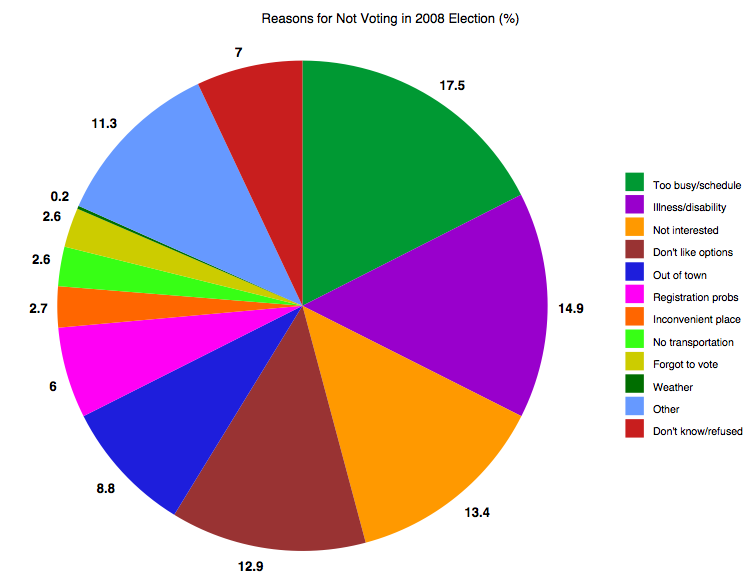
Last week I posted about voter turnout patterns. In 2008, about 64% of eligible citizens voted. So what reasons do non-voters give for not taking part in the election? The Census Bureau asked. I created a chart of the data found on p. 14 of the report by Thom File and Sarah Crissey.

UPDATE: Please note this data is for registered non-voters; about 89% of this group votes, significantly higher than that for eligible citizens overall. I apologize that I didn’t make the distinction clearer in my initial post.

Here are the reasons registered non-voters gave:

So the single most common reason (17.5%) for not voting was that the person was too busy or their schedule conflicted with available voting hours (at least those the respondent was aware of). Other common reasons were illness or disability (14.9%), the person just wasn’t interested in the election (13.4%), didn’t like the candidates or issues (12.9%), and other (11.3%).

Many of these barriers to voting could likely be addressed by the same basic changes: expanding voting options. Scheduling conflicts, being too busy or out of town, lack of transportation, and problems caused by illness or disability might all be ameliorated by expanded early voting and/or making it easy to vote by mail.

These issues were not equally problematic for all racial/ethnic groups. For instance, Asian-Americans and Hispanics (of any race) were more likely to report being too busy or that voting conflicted with their schedule than were White non-Hispanics or African Americans:

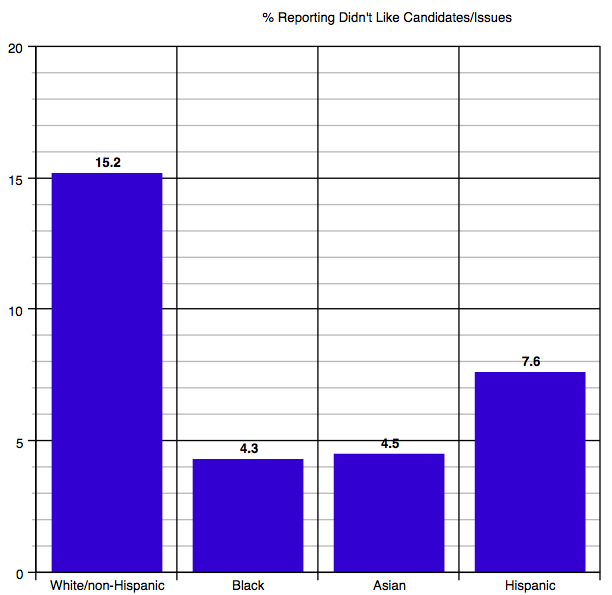
White non-Hispanics were more likely than other groups to say they didn’t vote because they didn’t like the candidates or issues:

The report also breaks responses down by age and education, so check out p. 14 if you’re interested in the patterns based on those demographics. It also includes data on why people don’t register, either — the most common being lack of interest or involvement in politics.

Gwen Sharp is an associate professor of sociology at Nevada State College. You can follow her on Twitter at @gwensharpnv.

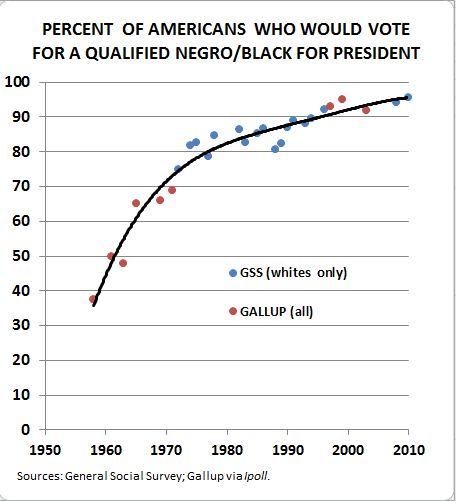
Over at his blog, Made in America, Claude Fischer discusses data showing that the percentage of (White) Americans who say that they will vote for a qualified Black president has been rising since the 1950s. Today it sits at about 96%.

Fischer rightly observes that it’s difficult to know exactly what to make of this information. The trend likely reflects a combination of a real decrease in prejudice and a rising appreciation for the fact that it’s unpopular to admit that you wouldn’t vote for a Black person, even on a survey.

Still, assuming for the moment that it represents real attitudinal change, Fischer asks, is “the glass 96 percent full or is it 4 percent empty?”  Given our two-party partisan political system, elections are frequently decided by margins this narrow.  Obama won with just 53% of the popular vote in 2008.  Political scientists estimate that there was a 5 point racial penalty (that is, if he had been White, he would likely have won 58% of the vote).

Tomorrow is election day and it’s difficult to know if race will play more or less of a role than it did in the last election.  On the one hand, most people who were worried that Obama would be a racially radical President now know that he is not (some people will never be convinced) and others may have become more used to seeing an African American face in the White House.  On the other hand, racial progress usually incites a backlash.  That face in such a venerated position of power may have aggravated people who are now actively racist instead of complacently so.

Finally, as Fischer observes, we have absolutely no data on the penalty Romney will pay for being Mormon.

Happy election day eve, America. May we all end tomorrow with a strong beverage of consolation or celebration.

Lisa Wade, PhD is an Associate Professor at Tulane University. She is the author of American Hookup, a book about college sexual culture; a textbook about gender; and a forthcoming introductory text: Terrible Magnificent Sociology. You can follow her on Twitter and Instagram.

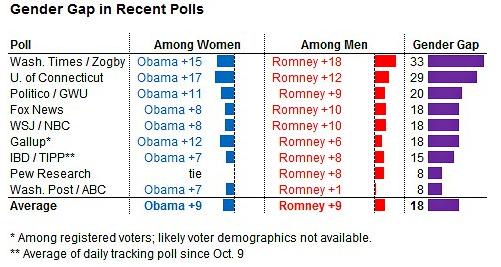
Nate Silver, the statistics guru behind FiveThirtyEight, is predicting that the gender gap in tomorrow’s election will be “near historic highs.”   According to Silver’s averaging of recent poll data, Obama has a 9-point lead among women, Romney has the same size lead among men.

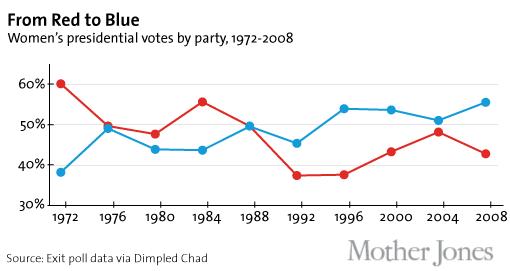
Women haven’t always leaned Democratic.  The trend started in the 1990s, as data at Mother Jones reveals:

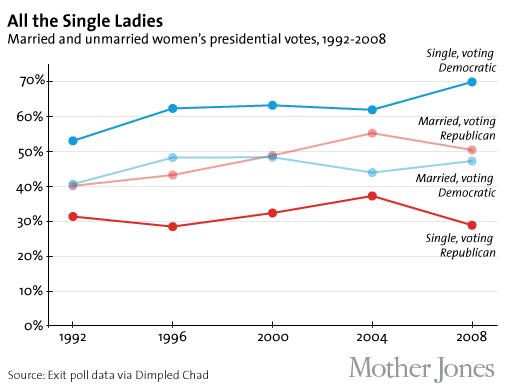
Single women are especially likely to vote Democratic.  Seventy percent voted for Obama in 2008:

A concern for reproductive rights, especially in light of recent Republican comments, are likely a big driver of women’s retreat from the political right.  Their concerns very well may swing the election.  In a poll of swing states, Gallup found that abortion topped the list of concerns for women; it didn’t make men’s top five:

It will be interesting to see how long the Republicans will hold onto positions unfriendly to women’s reproductive options.

Lisa Wade, PhD is an Associate Professor at Tulane University. She is the author of American Hookup, a book about college sexual culture; a textbook about gender; and a forthcoming introductory text: Terrible Magnificent Sociology. You can follow her on Twitter and Instagram.
Cross-posted at Montclair SocioBlog.

At the GOP convention in August, Mitt Romney’s cavalier dismissal of global warming got the intended laughs.  Today, it seems less funny and the Democrats are capitalizing on the turn of events:

Here’s the transcript:

President Obama promised to begin to slow the rise of the
oceans and to heal the planet.  My promise is to help you and your family.

In two short sentences, Romney gives us the broader context for the denial of global warming:  the denial of society itself.  He echoes Margaret Thatcher’s famous dictum

There is no such thing as society. There are individual men and women, and there are families.

This doesn’t mean that there are no groups beyond the family.  But those larger groups are valid only because individuals, consciously and voluntarily, chose to create them.  This way of thinking about the relation between individuals and groups has long been an underlying principle of American thought.  Claude Fischer, in Made in America calls it “voluntarism” – the idea that the only legitimate groups are the ones that people voluntarily form or join.*  The individual has a strong obligation to those groups and their members, but he has little or no obligation towards groups and people he did not choose.

That is a moral position.  It tells us what is morally O.K., and what is not.  If I did not choose to join a group, I make no claims on others, and it is wrong for others – whether as individuals or as an organized group, even a government – to make any claim upon me.

That moral position also shapes the conservative view of reality, particularly about our connectedness to other people and to the environment.  Ideas about what is right determine ideas about what is true.  The conservative rejects non-voluntary connections as illegitimate, but he also denies that they exist.  If what I do affects someone else, that person has some claim upon me; but unless I voluntarily enter into that relationship,  that claim is morally wrong.  So in order to remain free of that claim, I must believe that what I do does not affect others, at least not in any harmful way.

It’s easy to maintain that belief when the thing being affected is not an individual or family but a large and vague entity like “society” or “the environment.”  If I willingly join with many other people, then I will see how our small individual acts – one vote, one small donation, one act of charity, etc. – add up to a large effect. That effect is what we intended.  But if we separately, individually, drive a lot in our SUVs, use mega-amounts of electricity, and so on, we deny that these acts can add up to any unintended effect on the planet.

As Fischer says, voluntarism is characteristically American.  So is the denial of global warming.  At a recent Romney rally (video here), when a protester yelled out the question, “What about climate?” Romney stands there, grinning but silent, and the crowd starts chanting, “USA, USA.”  The message is clear: we don’t talk about climate change; we’re Americans.

Jay Livingston is the chair of the Sociology Department at Montclair State University.  You can follow him at Montclair SocioBlog or on Twitter.  Two more posts on voluntarism are here and here.

SocImages News:

It’s been a busy month at SocImages!

Gwen’s photographs of a small town in her native Oklahoma were featured in a Business Insider photo-essay about the economic aftermath of an oil boom.  It’s pretty great!

Some of our Halloween archives informed a Huffington Post Parents slideshow about the changing nature of costumes: “from silly to sexy.”  They quote me using the word “extremification,” so that was fun.  And I was pleased to be a part of a piece on race and Halloween costumes at USA Today.

We put together a Halloween-themed Pinterest page, so you can peruse our entire collection of images and click through to our posts if you like.  Browser beware!

Finally, I was part of a CNN radio story about the pressure young people are under to make themselves desirable college applicants: The Teenage Pressure Cooker (listen).

And I did a segment for the Los Angeles NBC affiliate about sexy Halloween costumes.  I don’t say much of note, but I did manage to say that Halloween was a “gender display ritual,” even for kids and that it a lot in common with a high school prom.  I also do an awkward stride through the Occidental College library.  Ah, local news.  :)

Upcoming Lectures and Appearances:

I have three talks scheduled for Spring so far. If you’re in Boston or Akron, I’d love to schedule a meet up!

  • Western Political Science Association (Hollywood, CA, Mar. 28-30): panels on “Public Intellectualism” and the “Twenty-First Century Sex Wars”
  • Harvard University (Women’s Week, Mar. 8-14): “A Feminist Defense of Friendship”
  • University of Akron (Apr. 19): “Anatomy of an Outrage: Female Genital Cutting and the Politics of Acculturation”

Social Media ‘n’ Stuff:

Finally, this is your monthly reminder that SocImages is on TwitterFacebookGoogle+, and Pinterest.  We’re inching up towards 20,000 followers on Facebook, so that’s pretty exciting!

I’m on Facebook too, and most of the team is on Twitter: @lisadwade@gwensharpnv@familyunequal@carolineheldman@jaylivingston, and @wendyphd.

Lisa Wade, PhD is an Associate Professor at Tulane University. She is the author of American Hookup, a book about college sexual culture; a textbook about gender; and a forthcoming introductory text: Terrible Magnificent Sociology. You can follow her on Twitter and Instagram.
A few years back I posted an photograph of two costumes side-by-side: labeled “Beer Man” and “Beer Girl.”  I wrote that the practice of using “man” alongside “girl” “reinforces a gender hierarchy by mapping it onto age.”  We see this outside of a Halloween context too, like in this vintage ad for pens.

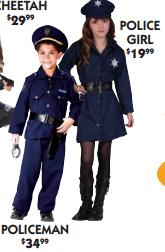
Sara P. found another example, this time from iparty.  The flyer puts a girl and a boy side-by-side in police officer costumes.  The boy’s is labeled “policeman” and the girl’s is labeled “police girl.”

This phenomenon is an example of just how mundane and ubiquitous gender messages can be.

Lisa Wade, PhD is an Associate Professor at Tulane University. She is the author of American Hookup, a book about college sexual culture; a textbook about gender; and a forthcoming introductory text: Terrible Magnificent Sociology. You can follow her on Twitter and Instagram.