Search results for The

Today’s post marks the third time that we’ve highlighted a fashion-related appropriation of homelessness.  We saw it on America’s Next Top Model and in a catwalk show for a Vivienne Westwood collection.  This time it’s a fashion editorial in Vogue Germany in which a model poses as a “bag lady.”  Thanks to Ann Marie N. for sending it in.

When homelessness is made into a fashion object, it trivializes the pain and suffering of the homeless, transporting the issue into “something hip adopted by the beautiful people.”   Dressing like a “bag lady” can only be understood as fashionable when it’s a purposeful choice.  As I wrote in a previous post about the topic, “actual homeless people are not and never will be ‘fashionable’ in this sense; they will always simply be homeless.”

Or, as Judith Williamson was quoted saying on Threadbared (a sociology and fashion blog):

It is currently “in” for the young and well-fed to go around in torn rags, but not for tramps to do so. In other words, the appropriation of other people’s dress is fashionable provided it is perfectly clear that you are, in fact, different from whoever would normally wear such clothes.

So, while the appropriation of homelessness in the fashion industry may look like an homage, really it’s just a way to further marginalize and “other” the actual homeless.  It’s a way for fashionable people to demonstrate difference from, not similarity to, actual homeless people.

For the same phenomenon with race and people from post-colonial countries, also see: whiteness in fashion, non-whites as fashion props, black bodies as propsexotification of people and places in fashion, Orthodox Jew-inspired fashion show, and exoticizing India in Vogue UK.

Lisa Wade, PhD is an Associate Professor at Tulane University. She is the author of American Hookup, a book about college sexual culture; a textbook about gender; and a forthcoming introductory text: Terrible Magnificent Sociology. You can follow her on Twitter and Instagram.
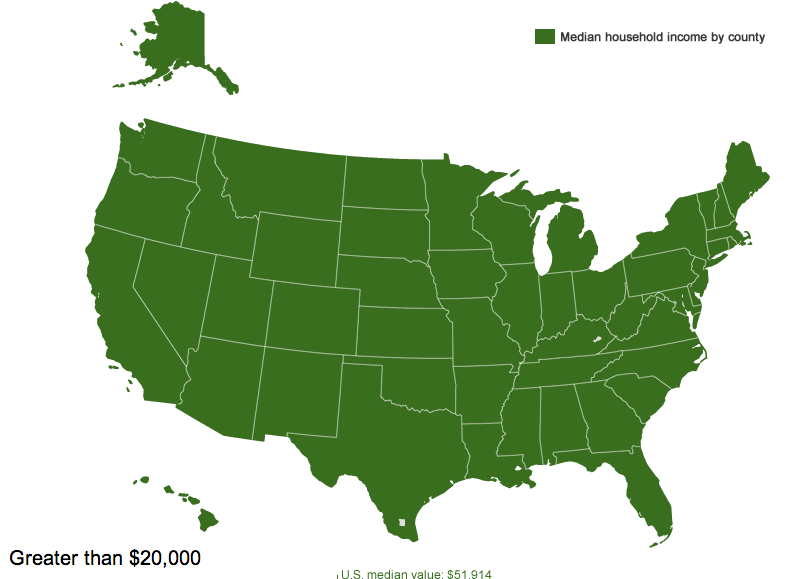
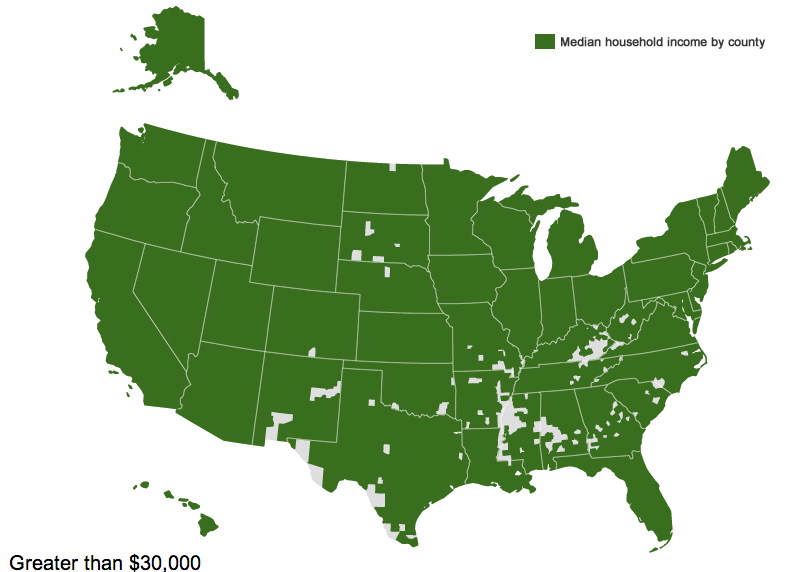
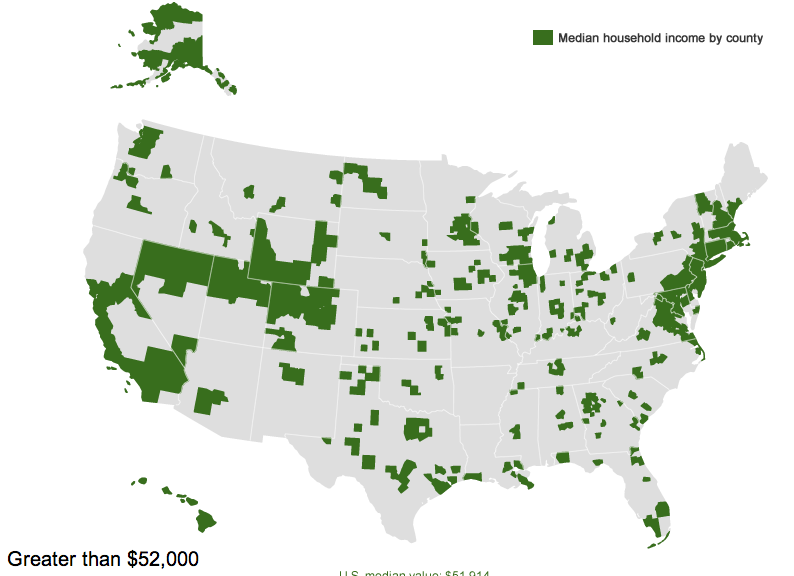
The Census Bureau has created an interactive map that lets you see median household income by county. Median household income for the entire U.S. is $51,914, but of course there is enormous variety around the country. The map lets you select an amount and see which counties have medians below that level.

Three counties — Owsley and Breathitt in Kentucky and Brooks in south Texas — have median household incomes below $20,000 a year (the white spot in Louisiana is water):

So half of households in those areas are living on less than $20,000 a year.

If we go up to $30,000 a year, we see a clear pattern. The counties are particularly concentrated in the South, especially along the Mississippi River, in Appalachia, in southern Texas, a few areas of New Mexico, and several counties in South Dakota that include Native American reservations:

If we look at the $52,000 mark — right at the overall U.S. median — we see, unsurprisingly, a lot of counties on the coasts or that have at least mid-sized cities in them, though there are certainly some counties that don’t fit that pattern:

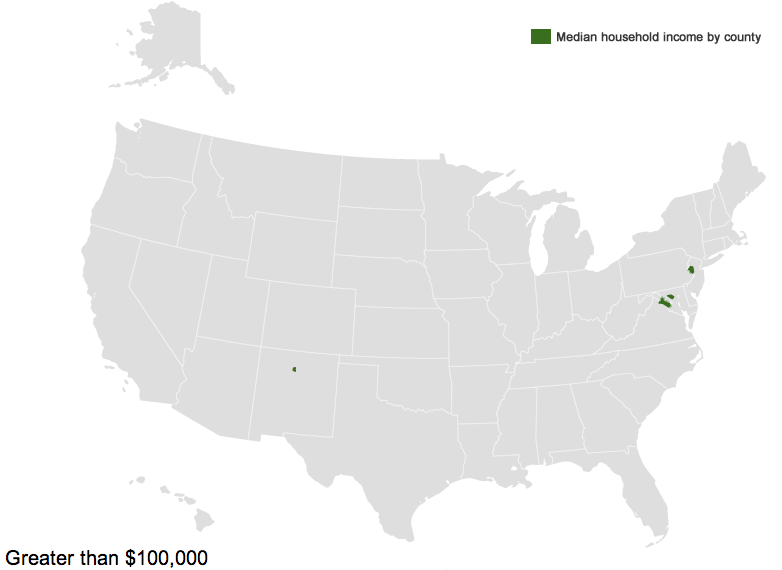
On the upper end, there are six counties where the median household income is above $100,000 — Hunterdon, in New Jersey; Howard, in Maryland; Los Alamos, New Mexico; and three Virginia counties, Fairfax, Falls Church, and Loudoun:

You can see the Census Bureau’s table of median household income in every county in the U.S. here.

Mark Fischetti has posted an interactive graphic at Scientific American that lets you look at the prevalence of several behaviors or characteristics measured on the Centers for Disease Control and Prevention’s survey on risk factors. The graphic includes data on exercise, tobacco use, heavy drinking, binge drinking, and obesity. Commenters on the post suggested it’s unnecessarily snarky about obesity; that said, it provides a quick snapshot of several behaviors demographers often use to judge general trends in health. For each topic, a graph shows the state where it is highest and lowest; you can also select up to 3 additional states to compare.

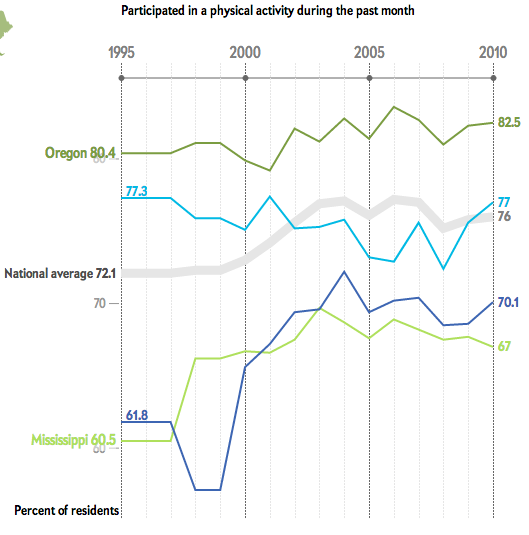
For instance, the percent of people who took part in a physical activity in the last month is highest in Oregon and lowest in Mississippi; I added my home state of Oklahoma (dark blue) and current residence of Nevada (light blue) too:

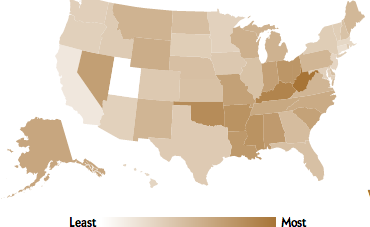
You also get a map for each topic that shows where it’s most or least common. Here’s the map for smoking:

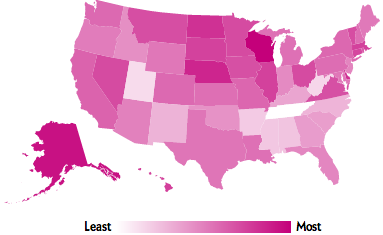
Sconnies, you may not be surprised to know that Wisconsin leads the nation in binge drinking:

I can’t embed the graphic, so you’ll have to go to Scientific American’s post to play around and compare your own state.

New York City’s stop-and-frisk policy has gotten intensified scrutiny recently. A stop and frisk refers to police officers stopping and searching individuals who are out in public. These stops don’t require a warrant; the police officer has to have reasonable cause to believe the person is engaged in criminal activity.

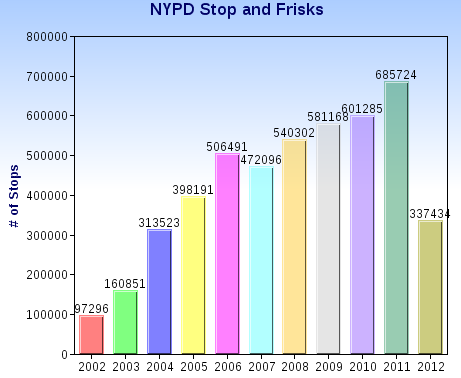
Critics point out that these stops are incredibly inefficient, and that relying on cops’ evaluations of who is suspicious opens the door to widespread racial profiling. The New York Civil Liberties Union analyzed the NYPD’s own data, which they are required to record about all stops. Over the past decade, literally millions of people have been the targets of stop-and-frisks, with steady growth in the use of the program. I made a chart of the data from 2002 through the first 6 months of 2012:

Yet all these stops have led to little discovery of actual crime. Overall, about 87-89% of stops lead to no evidence of wrong-doing.

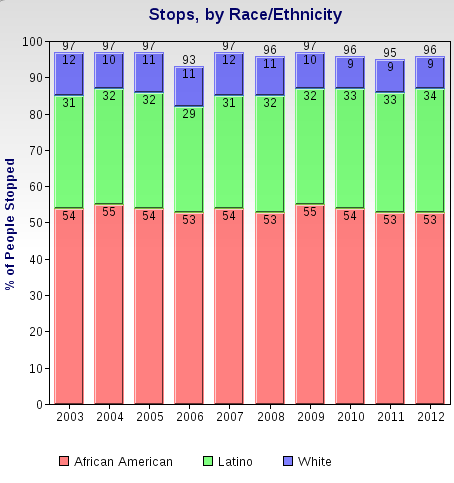
These stops have also disproportionately affected minorities. Here’s a breakdown by race/ethnicity, based on the NYPD data:

You can read more about the data on stop-and-frisks at the NYCLU website.

The Nation recently posted a video that discusses the impacts of stop-and-frisk on the lives of those targeted and on perceptions of the police, as well as police officers discussing the pressure to complete stop-and-frisks. The clip includes an audio recording that a 17-year-old made when he was being targeted for a stop-and-frisk after having just been stopped a couple of blocks earlier. As the video makes clear, these stops are about more than an inconvenience in citizens’ lives; they involve real harassment and fear of violence for those who find themselves the target of police suspicions:

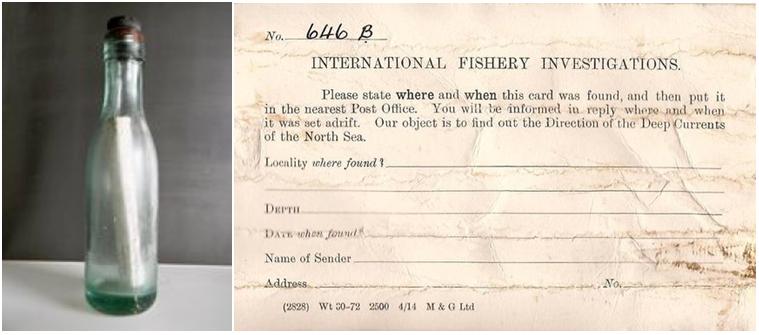
A message written in 1914 and curled into a corked bottle was scooped out of the North Atlantic last month (NatGeo).  Not a love note, but a research instrument.The Glasgow School of Navigation sent 1,890 such bottles adrift, hoping to map deep ocean currents.  They were weighted to float just above the ocean floor.  The message inspires me to contemplate just how far our research methods have come in the last 98 years.

Via BoingBoing.

Lisa Wade, PhD is an Associate Professor at Tulane University. She is the author of American Hookup, a book about college sexual culture; a textbook about gender; and a forthcoming introductory text: Terrible Magnificent Sociology. You can follow her on Twitter and Instagram.
Well, first, they’re not baby carrots.  The two-inch carrots marketed as juveniles are actually pieces of regular sized carrots that are cut off and shaved into a “baby carrot” shape.  So, there’s no reason to expect the babies to be fresher, more tender, or sweeter. (Sorry, baby carrot lovers.)

But revealing how baby carrots are made is only Part I of the answer to the question of where they come from.  Who had the idea to make “baby carrots” and for what reason?

It turns out the idea came from a grower named Mike Yurosek.  According to Douglas McGray at Fast Company, it was grocery stores that pushed Yurosek to invent the baby carrot.  McGray writes:

…Yurosek had become frustrated with all the waste in the carrot business. Supermarkets expected carrots to be a particular size, shape, and color. Anything else had to be sold for juice or processing or animal feed, or just thrown away. Yurosek wondered what would happen if he peeled the skin off the gnarly carrots, cut them into pieces, and sold them in bags.

He whipped up two prototypes: the baby carrot with which we’re all familiar and “bunny balls,” 1-inch round carrot bites.  Somehow the latter didn’t catch on.  The rest is history.

Thanks to Annie C. for sending in the link!

Lisa Wade, PhD is an Associate Professor at Tulane University. She is the author of American Hookup, a book about college sexual culture; a textbook about gender; and a forthcoming introductory text: Terrible Magnificent Sociology. You can follow her on Twitter and Instagram.
Tricia Mc.T. sent in a video that illustrates the tendency to associate non-White women’s bodies with curves. Fruit of the Loom’s “Flawless” commercial celebrates women’s bodies, offering the message that they’re flawless at any size. But as Tricia points out, though there is variety in the bodies of the women in the commercial, “women of color are the only ones with ‘curves’,” and the woman whose body is farthest from the thinness ideal is an African American woman:

It’s a small example of a larger pattern in which non-White women are associated with curviness and we’re comfortable depicting women of color as larger — think of all the TV shows you’ve seen where the only plump female character is the African American woman.

For more on this pattern, see our post on who has curves in a Levi’s ad, an ad for shapewear to get “Latino curves,” Vogue emphasizes Beyonce’s body, fetishizing African American women’s butts, and conflating “ethnic” with “curvy.

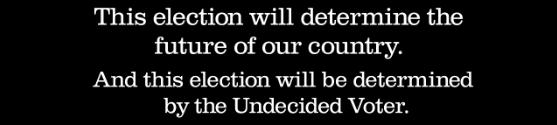
The political humor of Saturday Night Live (SNL) has become a mainstay of modern elections in the United States. The show is especially well known for its impersonations of candidates. However, so far this season SNL’s spoof political advertisement from a fictitious group called Low Information Voters of America is generating the greatest amount of political discussion.

The mock advertisement depicts undecided voters as lacking basic civic knowledge as they ask questions about when the election is held, who is running and whether or not they are an incumbent, how long the president serves, who succeeds the president, and whether or not both sexes can legally vote. SNL presents these few remaining swing voters in a way that implies they might have a problematic amount of influence in a close election.

However, is low information an issue only with just late deciding swing voters, or are they much more prevalent in the United States? A little known Zogby poll conducted in 2006 on a representative sample of adults (+/- 2.9%) in the United States provides some insight about how uniformed voters are by comparing political knowledge to awareness of popular culture.

Whereas 73.8% of respondents correctly named the three stooges; only 42.3% of knew the three branches of the U.S. government. Fifty-six percent knew the name of J.K. Rowling’s Fictional boy wizard; yet only 49.5% correctly identified the Prime Minister of England—and this was during the fallout of Iraq war and Downing Street Memo. Sixty-three percent of those polled could not name one Supreme Court justice; 85% were able to identify at least two of the seven dwarfs. Twice as many respondents (22.6%) knew the last American Idol than the last justice confirmed to the Supreme Court (11.3%).

Democracy needs an informed electorate, although the level of information necessary to maintain an effective republic is open for debate. This poll (which does need to be redone because it is becoming quite dated) finds that many adults in the United States — both the decided and undecided — are more informed about popular culture than politics. Thus, while voters may be “informed enough,” it is still difficult to subjectively claim it is healthy for a democracy to have a populace more knowledgeable about reality television, children’s books and fairy tales than civics.

—————————

Jason Eastman is an Assistant Professor of Sociology at Coastal Carolina University who researches how culture and identity influence social inequalities.