Search results for The

Racialicious posted a link to what looks like a fantastic project.  Titled Question Bridge, it focuses our attention on what they call “arguably the most opaque and feared demographic in America”: Black men.  In the film, participants look directly at the camera, creating a feeling of intimacy, and ask and answer tough questions.

The trailer gives you a taste:

A primary lesson the producers aim to impart is the diversity within the category in order to challenge stereotypes.  They write:

By creating an identity container (e.g. “Black” and “Male”), then creating a way of releasing the diversity of identities and thought within that container, we can break the container.

The project is already getting recognition from film festivals.  Also, there’s a donate button.

Lisa Wade, PhD is an Associate Professor at Tulane University. She is the author of American Hookup, a book about college sexual culture; a textbook about gender; and a forthcoming introductory text: Terrible Magnificent Sociology. You can follow her on Twitter and Instagram.

 

Some Fun History:

Cigarette Advertising, on this Holiday:

Thanksgiving, Race, and Gender:


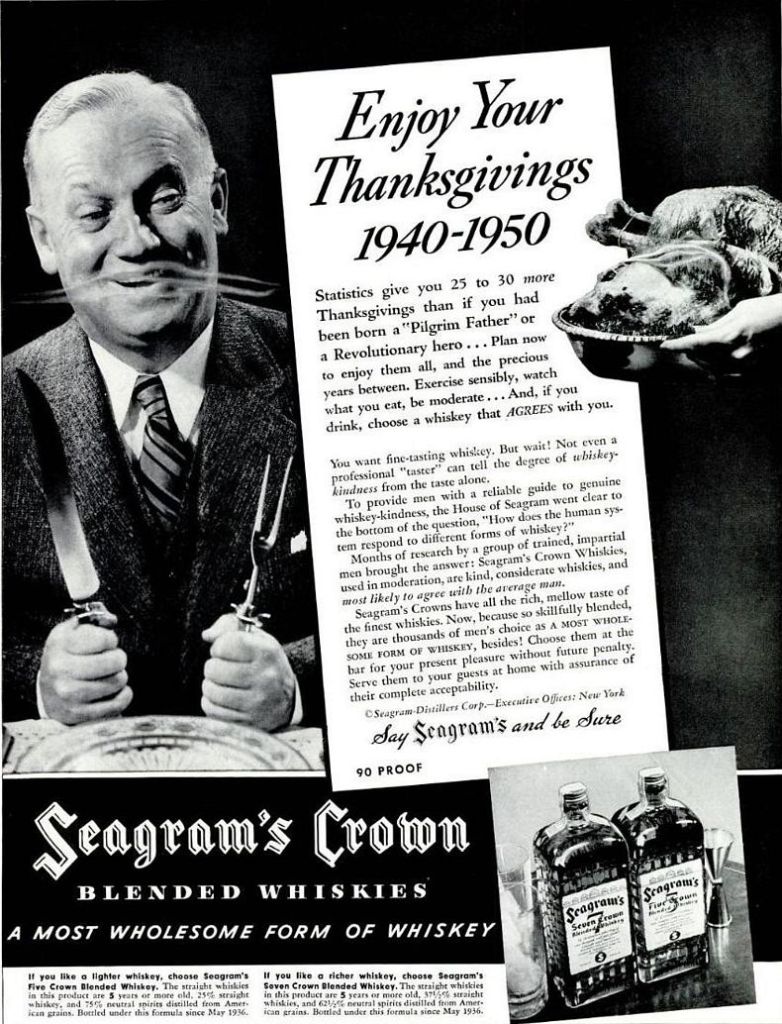
In a now-unfamiliar advertising strategy, this 1936 Thanksgiving-themed ad for whiskey suggests you make the scientifically “wholesome” choice: Seagram’s Crown.

Partial transcript:

Months of research by a group of trained, impartial men brought the answer: Seagram’s Crown Whiskies, used in moderation, are kind, considerate whiskies, and most likely to agree with the average man… they are thousands of men’s choice AS A MOST WHOLESOME FORM OF WHISKEY, besides!  Choose them at the bar for your present pleasure without future penalty.

I’d like to practice… er, review the research methods.

Found at Vintage Ads.  Just for fun, see also: Whiskey-flavored toothpaste.

—————————

Lisa Wade is a professor of sociology at Occidental College. You can follow her on Twitter and Facebook.

In a fun five minutes, Mike Rugnetta manages to invoke John Stewart Mill and Judith Butler, plus discuss how “bronies” — male fans of My Little Pony: Friendship is Magic — challenge rigid rules of masculinity.

Thanks to Griff for sending the link!

Lisa Wade, PhD is an Associate Professor at Tulane University. She is the author of American Hookup, a book about college sexual culture; a textbook about gender; and a forthcoming introductory text: Terrible Magnificent Sociology. You can follow her on Twitter and Instagram.

This month the Census Bureau released a supplemental poverty report to provide a broader picture of the poor in the U.S. The official poverty rate is based on a measure developed in the early 1960s. Researchers at the time determined that families spent about 1/3 of their income on food, so they calculated the lowest possible cost of a minimally nutritionally sufficient diet for a particular family size, multiplied it by 3, and the resulting number determined who was defined as poor. The amount has been adjusted for inflation but otherwise the measure is the same.

Critics argue this definition may no longer make sense. Since the 1960s, food has generally gotten cheaper while housing has become a much bigger portion of many families’ budgets. The measure doesn’t account for the different costs of living (especially for housing) in different parts of the U.S. It also doesn’t take government benefits a family might be receiving into account.

The supplemental measure is meant to address some of these problems; it will be released each year along with the standard poverty measure. It attempts to determine how much is needed to cover housing, food, clothing, utilities, and a bit for other needs (transportation, personal care items, etc.), while taking public assistance benefits into account.

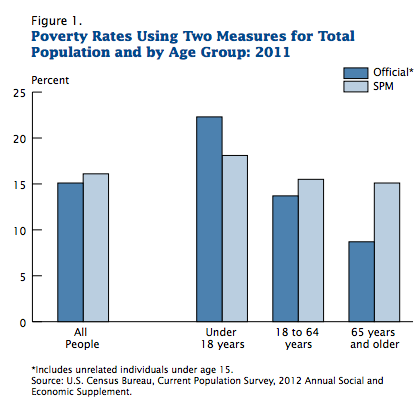
The supplemental poverty measure (SPM) showed a somewhat higher poverty rate overall (16.1% vs. 15% with the official poverty rate). Because it takes benefits such as daycare subsidies, nutritional assistance programs, etc., into account, the SPM actually showed a lower poverty rate for children under 18 than the official rate does. However, adults were more likely to be defined as poor with the SPM. This is especially true for older adults. For those over 65, 8.7% are officially poor, but with the SPM, it’s 15.1%:

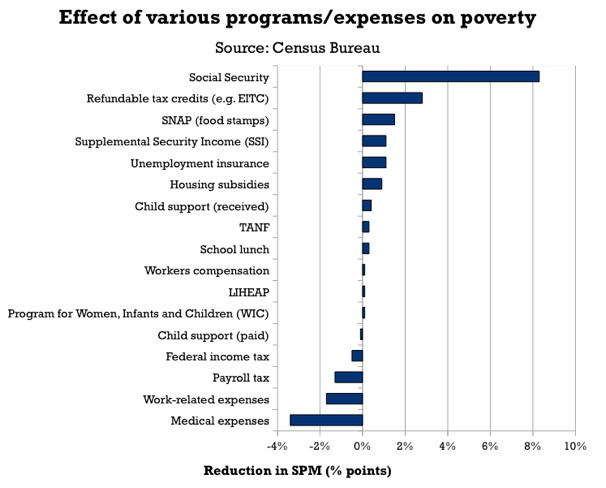
Dylan Matthews, at the Washington Post, created a graph to show the impact of some important expenses and government assistance programs on poverty, since the SPM takes benefits, and a greater range of expenses, into account in its measure. The graph shows how much each program/expense reduced the adjusted poverty rate, based on data presented in the report.

Social Security has the single biggest impact; it reduced the SPM by 8 percentage points. That is, if they had not included Social Security benefits in the measure, the SPM poverty rate would have been 24.1%, not 16.1%. On the other hand, taking Temporary Aid to Needy Families (TANF), the cash assistance program created in the welfare reform process in the 1990s, into account did little to affect the calculated poverty rate, indicating it does little to alleviate poverty (intentionally so, many would argue). Note the axis is percentage points, not percent:

At the bottom of the graph we see several items that increased the supplemental poverty rate: looking at how much income tax people paid (countering the myth that low-income people don’t pay income taxes), payroll axes, expenses related to work, and medical expenses, with out-of-pocket medical expenses being the largest factor.

There’s tons of data in the tables that show which groups would be more or less likely to be defined as poor in the official and supplemental poverty rates. Check out the full report.

Gwen Sharp is an associate professor of sociology at Nevada State College. You can follow her on Twitter at @gwensharpnv.

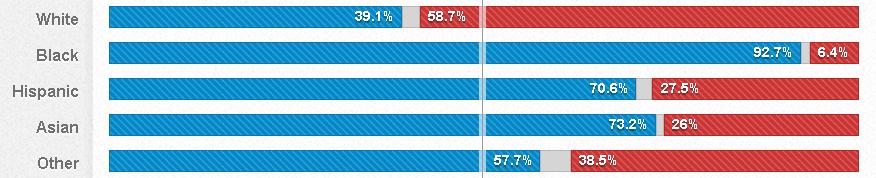
Barack Obama won just over 50% of the popular vote last week, but he earned 80% of non-white votes.  According to USA Today exit poll data, he secured 93% of the Black vote, 73% of the Asian vote, 71% of the Hispanic vote, and 58% of the non-white Other vote.

This data suggests are real and palpable difference between how (some) Whites and (most) non-Whites see the world, a difference that will become increasingly influential.

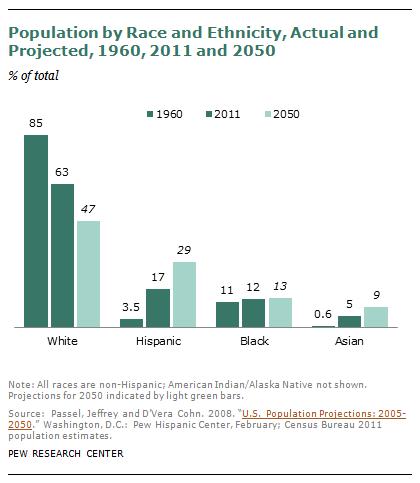
Earlier this month the Pew Research Center released an updated prediction for the racial/ethnic composition of the U.S. in 2050.  They expect that, by 2050, Whites will be a minority, adding up to only 47% of the population.  By that time, they expect Hispanics to account for 29% of the population, and Blacks and Asians to account for 13% and 9% respectively.

Paul Taylor and D’Vera Cohn, at Pew, observe that the demographics of the voting population will change a bit slower since the majority of the demographic change is from births and deaths, not immigration.  In 2011, for example, whites were 66% of those ages 18 and older, but only 56% of 18-year-olds.  In other words, it takes 18 years to grow a voter.

Whatever the pace of change, the era of winning U.S. elections by pandering to the worldview of a single group is ending.  Future politicians will likely have to put effort into attracting a wide range of voters, as Obama did on Tuesday.

Lisa Wade, PhD is an Associate Professor at Tulane University. She is the author of American Hookup, a book about college sexual culture; a textbook about gender; and a forthcoming introductory text: Terrible Magnificent Sociology. You can follow her on Twitter and Instagram.
Yesterday NPR’s Morning Edition included a segment by Alix Spiegel about cultural differences in approaches to teaching and learning. Researchers have found interesting differences in how teachers and parents in the U.S. and Japan encourage kids to learn.

Americans tend to focus on intelligence as the source of school success; you do well because you’re smart, kids learn. But Jim Stigler’s observations in Japan indicated that teachers focused more on effort, on letting kids publicly struggle with problems until they finally got the right answer. From this perspective, learning doesn’t occur because you’re inherently smart; it occurs because you keep working at a difficult problem until you figure it out. Jin Li has also found that parents tend to socialize kids in the U.S. into thinking of their successes as a sign of their intelligence more than their hard work, while Chinese parents focus more on persistence and concentration.

These lead to different perceptions of what it means to struggle to learn. As Stigler explains, in the U.S., we often assume that learning comes easily to you if you’re smart, and if you struggle to learn, that you lack ability. This can lead to fatalism; students who don’t easily grasp a concept can quickly see it as impossible. But as Spiegel says,

Obviously if struggle indicates weakness — a lack of intelligence — it makes you feel bad, and so you’re less likely to put up with it. But if struggle indicates strength — an ability to face down the challenges that inevitably occur when you are trying to learn something — you’re more willing to accept it.

It’s an interesting report on differences in cultural perceptions of learning, what it means if you struggle to grasp something, and the implications this might have for students’ experiences of their own learning process. It’s worth a listen.

I couldn’t get the audio file to upload; you can listen to it at the NPR site. You can read the full transcript here.

Gwen Sharp is an associate professor of sociology at Nevada State College. You can follow her on Twitter at @gwensharpnv.