Search results for The

Kay, a student at a University in Munich, sent along an invitation for a Corps Isaria fraternity, or or “Burschenschafts,” party. The cover for the invitation reads “Isarias Gute Kinderstube” which, she explains, “translates literally to good nursery and means something like being well raised, knowing how to behave.”

Picture1

When you open the invitation you see a naked woman, covered only by a teddy bear, alongside baby-related items (a Snuffalufagus, a rocking Zebra, and a crib) and party-related items (a disco ball, a stag’s head, and high heeled shoes):

Picture2

Kay explains that the copy, “Das Corps Isaria gibt sich die Ehre und laedt zur eskaloesesten Pyjamaparty der Stadt” translates into something like “The Corps Isaria is honored to host the most risque sleepover in town.”

The invitation is another example of the infantilization of women. Or, as Kay put it, a “mixture of the male gaze and child porn fetishism.”

For more infantilization of women, see here, here, here, here, and here, and here.

—————————

Lisa Wade is a professor of sociology at Occidental College. You can follow her on Twitter and Facebook.
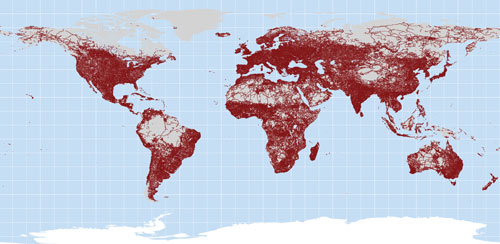
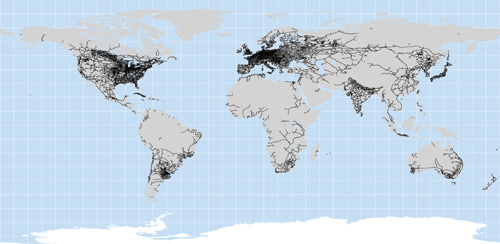
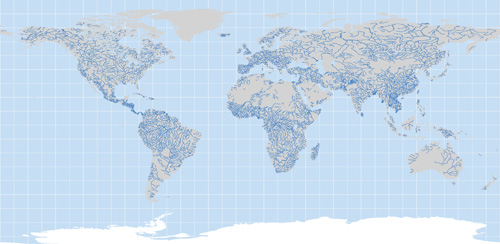
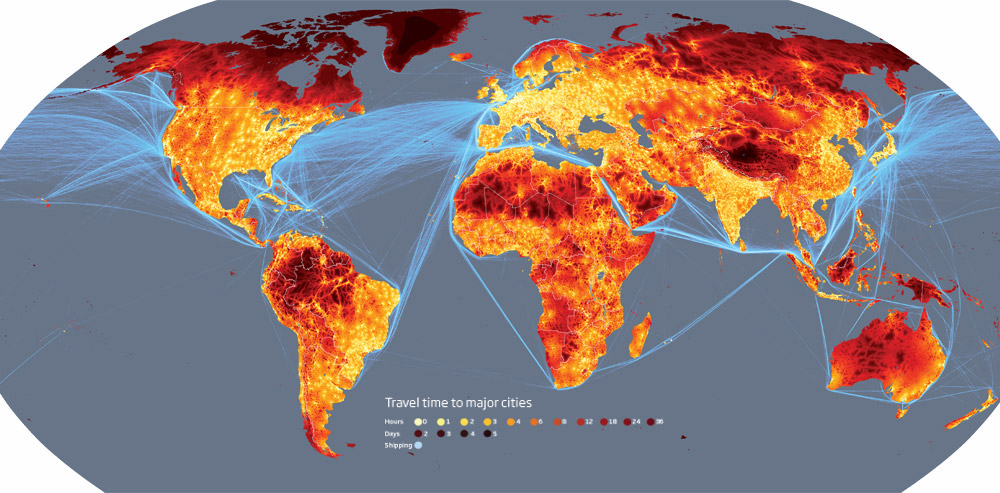
How much of the earth can humans now access?  Some images developed by the New Scientist (via ChartPorn) give us some great visuals showing just how thoroughly we’ve colonized the (non-ocean) planet.

A map of all roads:

roads

A map of all railroads:

railways

A map of all navigable rivers:

major_rivers

Considering all of these modes of transportation and the type of terrain, the New Scientist calculated how long it would take, from everywhere on the planet, to get to a city of 50,000 people or more:

mg20227041_500-1_1000

They estimate that less than 10% of the world is more than two days from the nearest city. The most remote place, they calculate, is the Tibetan plateau.

—————————

Lisa Wade is a professor of sociology at Occidental College. You can follow her on Twitter and Facebook.
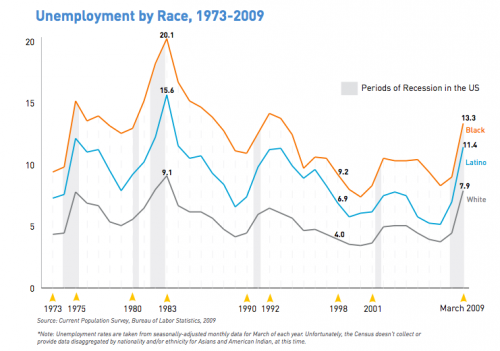
Yvonne Liu, at the Applied Research Center, told us about their report, Race and Recession, which includes a lot of useful information about the disparate effects of the economic crisis for different groups of Americans.

While an overall unemployment rate of just under 10% is bad regardless, that statistics hides the fact that Latinos and African Americans are experiencing even higher levels (note: the government agencies that the information comes from didn’t provide breakdowns for Asians or Native Americans, so the report was unable to show comparisons for those groups):

arc1

In a comment, thoughtcounts Z points out,

My immediate reaction…: the worst points (highest unemployment) on the “White” curve are generally around or below the best points (lowest unemployment) on the “Black” curve.

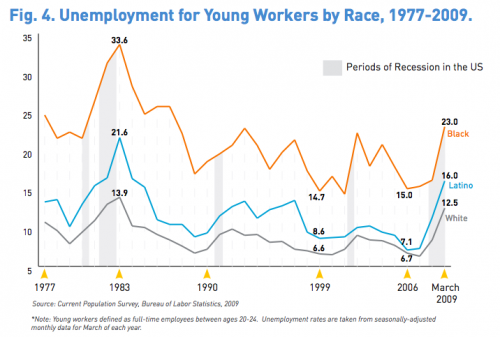
Unemployment rates for those aged 20-24:

unemployment young race

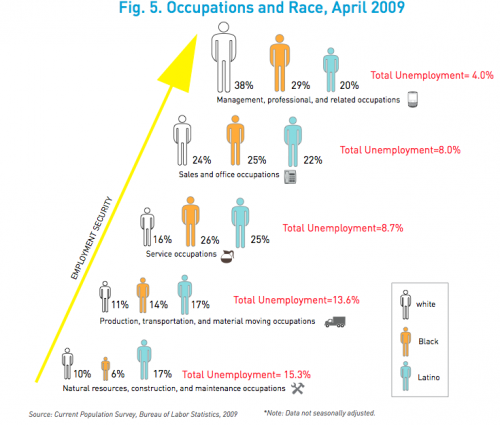
This figure indicates what % of each racial group falls into each occupational category (the median indicates that half fall above and half fall below that level):

occupations race

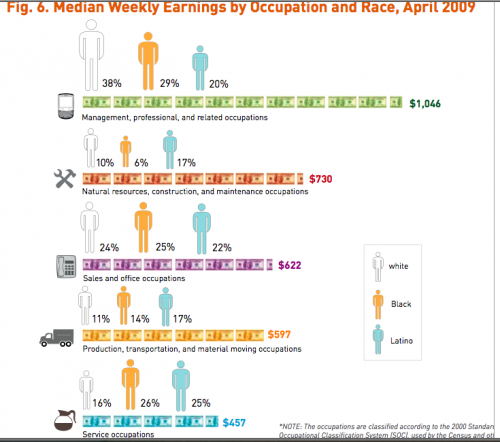
Median earnings for each occupational category (again, the figures represent the % of each race that have jobs in that category):

earnings race

So as we see, Whites are disproportionately employed in management and professional occupations, while relatively few are employed in the service industry, whereas both African Americans and Latinos are significantly more likely to be employed in services.  And while there’s a big gap between the % of Whites and Blacks in management/professional occupations, I was somewhat surprised that it wasn’t larger than it is.

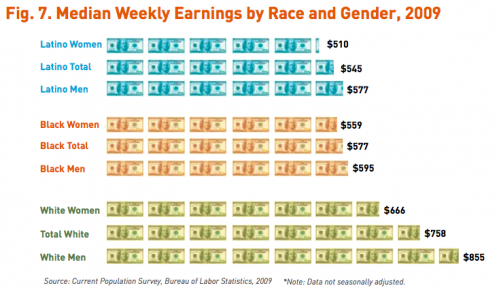
Earnings broken down by both race and gender:

earnings race gender

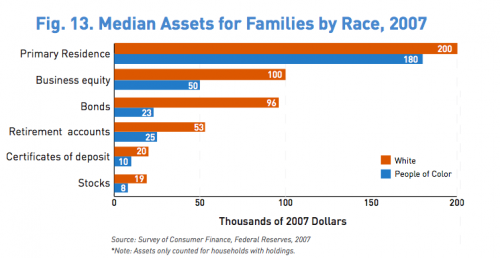
Assets by race:

assets race 2

See also: images of the downturn, job loss by region, unemployment by education level, another map of job loss by region, the dilemma of the duplex, not everyone knows there’s a recession, Detroit’s decline, job losses, gender and recession, and tips to the rich on how to be discreet during a recession.

Triathlon is the new Golf: As a young lawyer making a name for himself in the mid-seventies, my father’s superiors told him to “pick up golf” as a way to rise quickly within the firm, and to land lucrative clients. It’s still all about who you know, but if you want to get ahead in business today, don’t hit the putting green, sign up for an Ironman. Why?

Like Golf, Triathlon is cost prohibitive: The average annual income of an Ironman participant is nearly $160,000, while the average golfer makes a measly $100,980 a year, according to Golf.com’s 2009 Survey.

With Ironman entry fees upwards of $500 each (plus the flight and lodging expenses associated with destination racing), a decent bike starting around $3,000 (plus $400 for the shoes, helmet, peddles and accessories), $200 for swim, bike and run gear, and $300/month in coaching and facilities fees; you start to understand the need for that extra $60,000/year.

Triathletes make better business connections: Like Golf, Triathlon entrances “Type A” personalities, obsessed with winning, even if victory requires continuous practice and focus. Unlike golf, Triathlon also demands incredible pain tolerance and phenomenal endurance. Consequently, “the sport attracts high-income, driven, focused individuals who are able and willing to pay the price in time and money,” says David Samson, Florida Marlins president, and Hawaii Ironman 2006 finisher.

Not only are triathletes more driven, they’re also younger. On average, Ironman triathletes are 35-44, while avid golfers are generally in their early 50’s. Consequently, triathletes are at the peak of their professional careers, while many golfers are contemplating retirement, and thereby less effective in helping you infiltrate the network or company of your choosing.

Triathlon is a better way to schmooze (on a Micro Level): Now that you’ve drawn all of the rich, hard working, high powered individuals into one sport, it is time to make connections. Typically, only four players participate in a round of golf, which takes around 4.5 hours. You likely know at least one or two of the other competitors if you’ve been invited to play in the first place, so you’re left with at best two networking opportunities, which isn’t an efficient way to find the right contact for you.

Most of the Multi-Sport fitness groups in my home town (Marin County, CA), host weekly group rides, averaging thirty to fifty participants. The group usually covers seventy miles in a given ride, thereby providing five hours (plus a group brunch) to make friends, and connections. The group usually breaks into smaller packs of evenly matched athletes after a ten mile warm-up. As competitive, Type A folks, multiple members in a given group will eventually ask you how old you are, what team you belong to, and what you do (probably to ascertain how much time you have to train, how long you’ve been serious about the sport, who coaches you, and what if any advantage your bike may provide you).

It is during this hierarchical ranking process that you establish dominance over the somewhat older, not-as-fast man on the really expensive bike. He may be the CEO of a major tech company in Silicon Valley, but that is the professional “Pond” (Frank, 1987) or “Sphere” (Putnam, 1995). Right now, you’re both in the triathlon sphere, where you’re fitter, faster and had a better time at Ironman Canada last year. As Frank noted, it is relative status that creates happiness and satisfaction, and in this pond, your status is higher than his.

So, for the remainder of the ride (and during brunch afterward), he picks your brain about triathlon, and you arrange to have lunch with him at his office next week, a networking win you’d never enjoy if you’d attempted to engage said CEO in the professional Sphere.

Triathlon as a character reference: Not only have you now procured a meeting, you’ve already passed the first round of the interview process. The ability to withstand (and even enjoy) suffering is a form of ‘bonding social capital’ (Putnam, 2001) that forges a strong sense of collective identity. It implies a preference for achieving work-like goals in the leisure sphere, which translates seamlessly into a strong, professional recommendation from your new friend, the high powered CEO.

Triathlon is a better way to schmooze (on a Macro Level): There is no other sport in which every race includes Professional, Amateur and “Age Group” triathletes from under ten to over eighty, separated only by “wave” times, which are determined by age and gender. As Bob Babbitt, publisher of Competitor Magazine put it: “I can’t pitch to Barry Bonds or tee off with Tiger Woods, but I can be on the starting line with the top people in triathlon.” Consequently, you can train, compete and network with individuals of all ages and abilities, from around the world.

While the world of triathlon is growing rapidly (223,594 US adults participated in a triathlon in 2007, up from just 83,612 just ten years ago), Triathlon is still a small community, even at the Macro level. With a limited number of Ironman (2.4mi Swim, 112mi Bike, 26.2mi Run), Half Ironman (1.2mi Swim, 56mi Bike, 13.1mi Run), Olympic (.9mi Swim, 26mi Bike, 6.1mi Run) and Sprint (.5mi Swim, 16mi Bike, 2mi Run) distance races, you are assured to become familiar (and even friendly) with similarly matched athletes from across the country, and the world.

Triathlon is a reciprocal Panopticon: Your athletic club affiliations are declared on your uniform, and your age is written on your calf prior to each race (so you can check the legs of everyone you pass and everyone who passes you, to estimate ranking in on your age group during the actual race).

Your relative time and ranking is posted within minutes of completing the race, so all can see where you fall amongst the 2,000 or so athletes who participated that day. Award ceremonies are performed immediately, and results are posted online within 24 hours. You can even look up their participant’s photos!

Basically, Triathlon is a Panopticon (Bentham 1995 [1785]; Foucault 1995 [1977]), in which everyone is given the role of prison guard and prisoner. You can’t hide anything about yourself, but in turn, you know everything about everyone else.

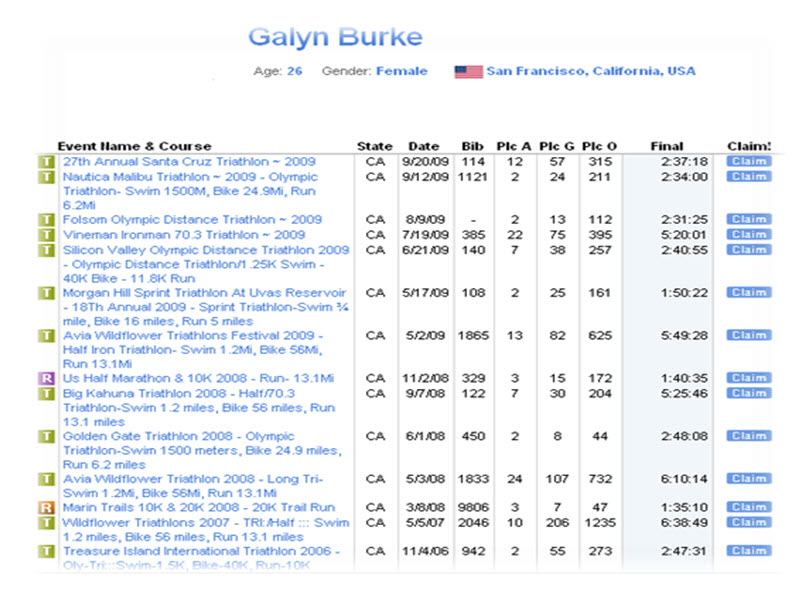
Athlink.com results display an athlete’s age, gender, city, and results for every event completed:

Athlink_Results_Image_4

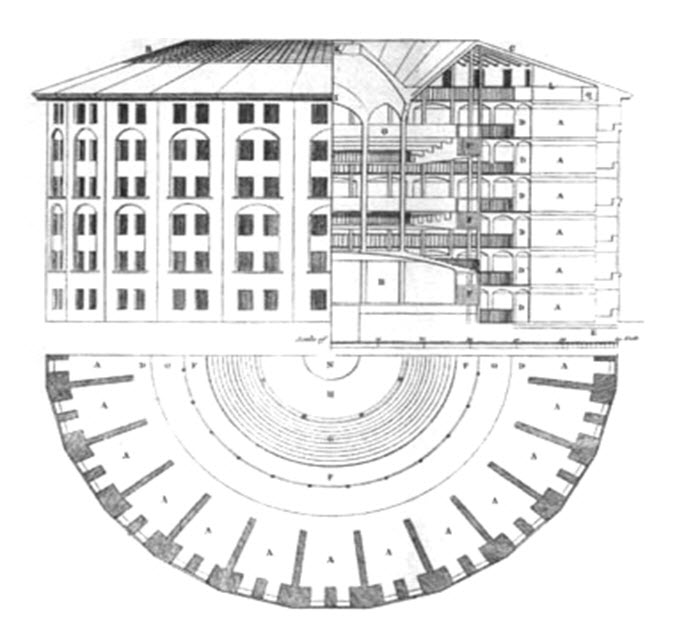
Bentham’s Panopticon: A theoretical prison that allows guards to observe (-opticon) all (pan-) prisoners, who can’t reciprocally tell whether they are being watched:

Panopticon_Image_5

Conclusion: Triathletes are a self selecting group of affluent, highly motivated individuals, who spend countless hours forging bonds through the competitive, grueling, and socially cohesive ritual of endurance athletics. The greater community convenes several times a year to establish relative rank by sex, age, casual, amateur and pro standards. With access to the region, age, gender and past performances of every athlete in this group, Triathletes are “tee’d up” to make local, national and international connections that turn into husbands, wives (38% of Triathletes are now women), employees, employers and friends. In a world where it’s all about whom you know, it doesn’t hurt to know the rich, successful, driven group that is Triathlon.

References:

Bentham, Jeremy. 1995 [1785]. Panopticon Letters. Miran Bozovic (Ed.). London: Verso.

Foucault, Michel. 1995 [1977]. Discipline and Punish: The Birth of the Prison. New York: Vintage.

Frank, Robert. 1987. Choosing the Right Pond: Human Behavior and the Quest for Status. New York: Oxford University Press.

Putnam, Robert. 2001. Bowling Alone: The Collapse and Revival of American Community. New York: Simon and Schuster.

Galyn Burke–Brown, formerly a competitive equestrienne, is now an enthusiastic triathlete.   She blogs at Economic Sociology.

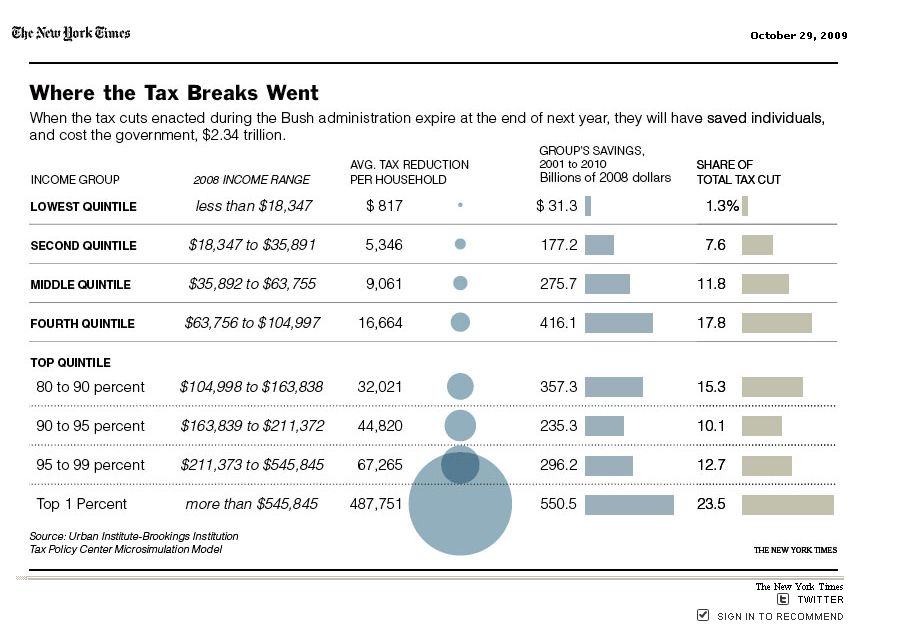
Last week the New York Times released this table illustrating who benefited the most from the Bush tax cuts.  As you will see, people in the top 1% of income, making more than $545,845 a year benefited, by leaps and bounds, more than anyone else. And their share of the tax cut?  Almost a quarter went to the top 1%.

00_Tax_cut

Also see our post on social class and the tax burden.

Via MontClair SocioBlog.

—————————

Lisa Wade is a professor of sociology at Occidental College. You can follow her on Twitter and Facebook.
Several stores, including Target, Walgreens, and Amazon.com, offered an “Illegal Alien” costume for sale.  The costume, which includes a orange (prison?) jumpsuit, a green card, and a space alien mask, conflates undocumented immigrants with aliens from outer space.

alientarget

After a round of criticism, Target pulled its “Illegal Alien” costume from its shelves.

Hat tip to Lotería Chicana, via Resist Racism.

—————————

Lisa Wade is a professor of sociology at Occidental College. You can follow her on Twitter and Facebook.
These two Halloween costumes in a mall display, snapped by Deeky (here and here, via Shakesville), make a joke of women working in masculine occupations by suggesting that they’re, essentially, sex workers.

Captain Layover:

captlayover

Free Rides:

taxi

See our other Halloween-related posts: two extra-special costumes (the Anna Rexia costume and the Sexy Scholar), Max Weber jack o’lantern (by yours truly), Obama mask sold as terrorist mask, a Sarah Palin effigy, handling sex offenders on trick-o’-treat day, and costume catalog analyses (here and here).

—————————

Lisa Wade is a professor of sociology at Occidental College. You can follow her on Twitter and Facebook.
Serena Williams is on the cover of ESPN this month, as Becky T. pointed out. And Becky is torn. I’d like to put it up for discussion.

The cover:

article-0-06B88949000005DC-200_468x682

So, on the one hand:   Dude. Why is it that a woman rarely makes it onto the cover of ESPN and, when she does, she’s freakin’ naked? And, of course (*sarcasm*), it’s for “The Body Issue” (because women’s bodies are where it’s at, right fellas?). I did a google image search for “espn cover” and the first page of results includes only two women. One is naked (Williams) and the other is pregnant.

On the other hand:  The cover doesn’t appear to be trying to hide or diminish Williams’ strength.  The girl is STRONG.  Check out that bicep!  Part of me wants to say that she looks good.  DAMN good.

What do you think?

—————————

Lisa Wade is a professor of sociology at Occidental College. You can follow her on Twitter and Facebook.