Search results for The

In an attempt to further muddy some conceptual waters, I present you this Finnish music video:

Shava are probably the only representatives so far of the genre of Suomibhangra, a Finnish take on the South Asian diaspora dance genre, bhangra. One one level there’s a lot to be critical of here, perhaps – the wilful exoticism, the fake Indian dancers, the almost-brownface of someone like the “Finnjabi bad boy” in the video.

On the other hand, though, which I think is perhaps more interesting, there’s the reaction in the bhangra community. I actually found the track on a bhangra blog, it’s been reposted and become popular on a bhangra youtube channel where it’s generated positive comments, the band has toured to desi audiences in Canada and it’s played on several bhangra radio stations… The bhangra community is not offended at all, they rather like it. (For as they say: Imitation is…)

So who’s right? Us radical critics or the people we think we’re defending? Perhaps it’s worth thinking about.

——————————-

Johan Palmeis a musicology student in Stokholm, Sweden.  He blogs about music and other stuff at Birdseed’s Tunedown.

If you would like to write a post for Sociological Images, please see our Guidelines for Guest Bloggers.
Rachel U. sent us a 1968 American Airlines ad (larger available at Modern Mechanix):

The text:

She only wants what’s best for you.
A cool drink. A good dinner. A soft pillow and a warm blanket.
This is not just maternal instinct. It’s the result of the longest
Stewardess training in the industry.
Training in service, not just a beauty course.
Service, after all, is what makes professional travellers prefer American.
And makes new travellers want to keep on flying with us.
So we see that every passenger gets the same professional treatment.
That’s the American Way.

Rachel says,

Before I read the headline of the ad, my brain registered the woman as a typical “sexy stewardess” image that seems to be standard industry fare when air travel started booming:  knees bent up toward the face, one hand touching her face…extremely focused gaze that seems a bit “come hither.”

Of course, that’s what the pose is. It’s just that being sexually attractive doesn’t mean women weren’t also supposed to also take on a caretaking role. It’s one way we’ve constructed femininity over the years: women were supposed to be nurturing and supportive in a “maternal” way, while also sexually alluring enough to keep their men from wandering (because if he wandered, it was definitely their fault for not keeping him happy at home).

Notice also the implicit denigration of stewardesses in general: at American Airlines they get real training, “not just a beauty course.” At first reading that could seem as though they were saying they emphasize skill, not physical attractiveness, but the image makes it clear you can look forward to getting both.

Gwen Sharp is an associate professor of sociology at Nevada State College. You can follow her on Twitter at @gwensharpnv.

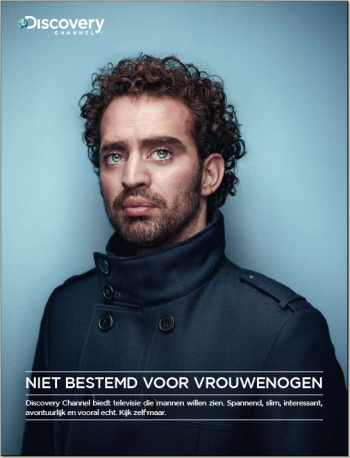
Benno K. sent in a link to some ads he saw in the Netherlands for the Discovery Channel, which Benno describes as “the channel that used to be for science, but is now mostly explosions and motor bikes.” In both posters the men have “women’s” eyes–that is, they appear wide-eyed and long-lashed, with mascara:

Discovery1

discovery2

The caption says:

Not for women’s eyes. Discovery Channel has television men want to watch. Exciting, smart, interesting, adventurous, and most of all real. Watch for yourself.

I know that as a woman, I hate smart, interesting stuff. It’s just too hard to understand and it makes my brain hurt. I try to only watch TV shows that are dull, dumb, boring, cautious, and totally fake.

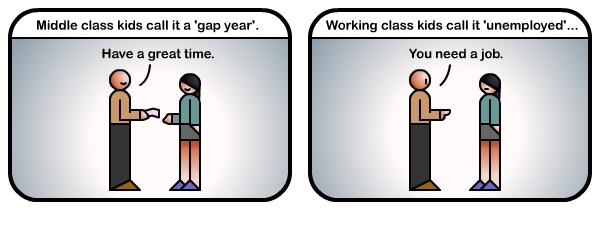
This cartoon illustrates how a work-free year is interpreted as lazy and irresponsible if you’re a working class person and a well-deserved treat if you’re middle class or better.

gapyear
Found at The Ongoing Adventures of ASBO Genuis, via Missives from Marx.

Lisa Wade, PhD is an Associate Professor at Tulane University. She is the author of American Hookup, a book about college sexual culture; a textbook about gender; and a forthcoming introductory text: Terrible Magnificent Sociology. You can follow her on Twitter and Instagram.

I spent a day in Salzburg this September with a man from Dubai.  We had a wonderful time comparing perspectives.

Dubai, he explained, was a wildly modern, multicultural city.  The default language in public was English due to the international population.  He was a stockbroker who had gone to college in London and gone part way through an MBA.

He interacted with veiled, Middle Eastern women and non-veiled Western European women daily.  He seemed to have no qualms with the two styles of presentation, considering them simple choices; they were unpoliticized and carried no deeper meaning.  To him, women who veiled were simply religious, like the men he knew who would not drink alcohol, and himself when he would not eat meat improperly slaughtered.

In any case, women in Dubai, he felt, were liberated.  As an example, he explained how there was now a woman’s taxi service.

“A woman’s taxi service?”

“Yes, with women drivers.”

You see, it is not proper for women to be alone with a non-relative male and, so long as all taxis were driven by men, women (who also do not drive) could not run errands or visit friends.  They were largely neighborhood-bound.  To my friend, a woman’s taxi service was liberation.  And, indeed, from the perspective of their rules, it must have seemed like freedom indeed.

I was reminded of this chat when Happy A. sent in a link to a story about a new women’s taxi service in Mexico.  The taxis, painted pink, are driven by women and only women can hire them. The taxi service isn’t designed to allow women to travel, but to allow them to travel without the threat of harassment and assault.

Women’s groups, however, have called the taxis insulting.  They suggest that the girly pink, the protectionism, and the make-up mirrors in the back seats seem to encourage the very objectification that makes women targets in the first place.

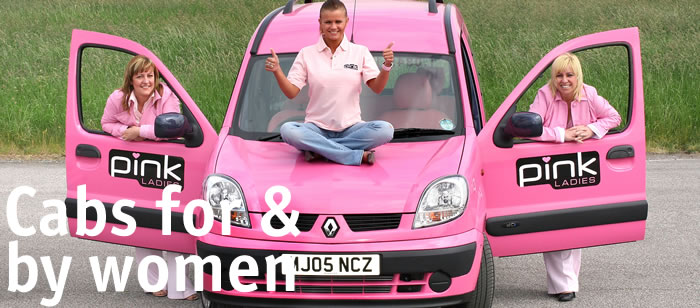
Pink Ladies, in the U.K., rationalizes its service with the same protectionism:

pink_ladies

And, in Moscow, they have Ladies Red Taxi:

Capture

I think these examples, considered together, do a really good job of undermining any absolutist ideas about what is good for women.

The situations in the different countries are dramatically different.  Women’s taxis improve the quality of life for women in Dubai (who can afford them) much more significantly than the taxis in, say, the U.K.

A radical feminist bent on destroying the system altogether may say that such taxis reinforce a gender binary and are easily co-opted by patriarchy (I wonder whose errands women are doing in those pink taxis?), a reformist feminist may say that the move is a good option for women both there and elsewhere, if not actually an end to male domination.

I think both are good points.

Does the fact that the Mexico service is run by the city and the U.K. service by a private company make a difference?  In the first case it is driven by concern for women’s safety, in the second case it is driven, at least partially, by profit.  Should people be profiting from women’s vulnerability?

Is a woman’s taxi service inherently feminist and liberating?  Or is it always sexist and demeaning?

I’m  not sure what I think about women’s taxis, but I like how cross-cultural comparisons like these remind us that context matters.

Click here for another sociologist’s take on the extent to which the pink taxis should be seen as liberating for women.

Lisa Wade, PhD is an Associate Professor at Tulane University. She is the author of American Hookup, a book about college sexual culture; a textbook about gender; and a forthcoming introductory text: Terrible Magnificent Sociology. You can follow her on Twitter and Instagram.

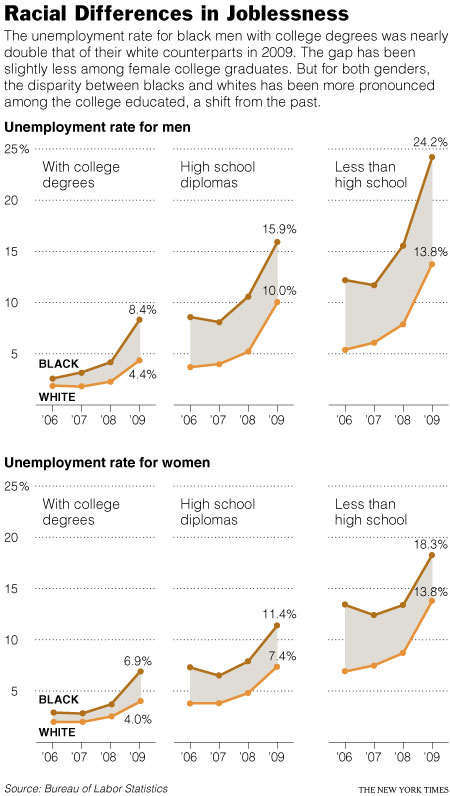
This week the New York Times featured a story about joblessness rates among black and white men and women.   As the figures below show, black men and women always face higher levels of unemployment compared to whites of the same education level; for men, the disparity increases as education level increases; and for black women, that pattern holds at least for 2009.

popup

For more detailed data on this phenomenon, see our posts on race and the economic downturn, the intersection of race and criminal record, and education and unemployment.

Lisa Wade, PhD is an Associate Professor at Tulane University. She is the author of American Hookup, a book about college sexual culture; a textbook about gender; and a forthcoming introductory text: Terrible Magnificent Sociology. You can follow her on Twitter and Instagram.

Gwen M. and David B. sent us a link to a story on the Globe and Mail website about a video game that has a gay scene in it and the reaction in the gaming community:

video

The game is Dragon Age: Origins, which, according to the website, is “an epic tale of violence, lust, and betrayal.”

From the Globe and Mail article:

Earlier this year, to promote Call of Duty: Modern Warfare II , one of the biggest games of the year, the game’s developer, Infinity Ward, released a video online asking players to Fight Against Grenade Spam. The company eventually pulled the ad following complaints about the acronym.

Last year, Microsoft was accused of homophobia after banning gay-related gamertags – the names created by Xbox users to identify themselves online – such as theGAYERgamer and RichardGaywood.

As the article points out, it’s not that gay or bisexual characters/scenes haven’t appeared in video games before, but they’ve often been portrayed in very stereotypical or negative ways. And while some gamers have reacted positively, many have basically responded with “ew, gross!”

As Gwen said, this effort to normalize gay relationships in a popular video game, and the reactions to it, are “both encouraging — and saddening.”

Gwen Sharp is an associate professor of sociology at Nevada State College. You can follow her on Twitter at @gwensharpnv.

Trivial Pursuit reinforces the idea that men and women are on opposite sides:

Capture

Lisa Wade, PhD is an Associate Professor at Tulane University. She is the author of American Hookup, a book about college sexual culture; a textbook about gender; and a forthcoming introductory text: Terrible Magnificent Sociology. You can follow her on Twitter and Instagram.