Search results for The

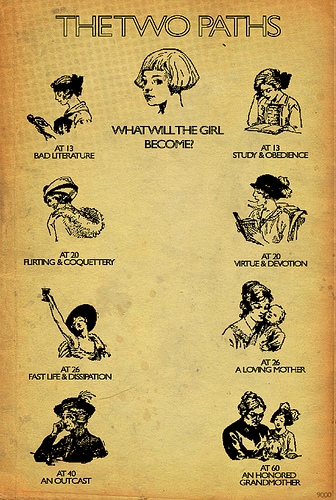
Kristyn G. sent in this excellent image showing the clear division of the world into two paths: that of the sexually active flirt, destined to a life of shame and loneliness (by age 40), and the good girl who can become a happy mother and grandmother:
tumblr_kqnumyaNpl1qzyj2xo1_400

Apparently it appeared in a “social hygiene” manual in the early 1900s.

Also see these trailers for old movies about teens gone wild.

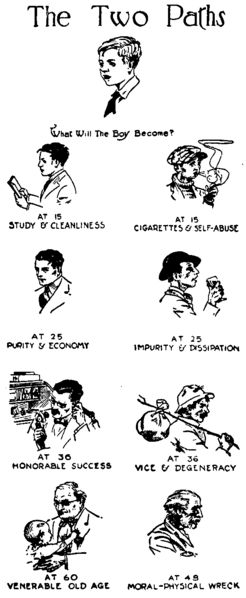
NEW! Awesome reader Maria found the boys’ version:
246px-The_two_paths_(m)

Nikki L. sent us a link to this fascinating Tickle Me Elmo commercial.  In introduces a new Tickle Me Elmo product, “Tickle Hands.”

The ad takes place on what appears to be an urban street (reminiscent of Sesame Street).  Two of the kids appear white, while the other two look (probably deliberately vaguely) “racial,” maybe Asian and Latino (perhaps biracial).  At the very end of the commercial the kids pose in front of a brick wall with a picture of Elmo graffiti-style.  Two of them look like they’re flashing gang signs and Elmo, no joke, says “Yeahhhhhh Booooy.”  Here’s a screen shot of the moment:

Capture

So let’s trace the evolution of the gangster meme.

1.  Government policy strips urban centers of resources, jobs leave (along with useful things like grocery stores), housing prices fall and the poor become concentrated, and those with means move to the suburbs.  With few “above ground” economic options, people turn to “underground” economies.  With only the “underclass” left, politicians (who tend to listen more to those with economic power and cultural clout) continue policies that disinvest in urban communities of color.  Say “goodbye” to things like nice parks and excellent fire protection.

2.  In a world where obeying the rules gets you nowhere fast, violence flourishes.

3.  The suffering and resourcefulness of young black, Latino, and Asian men in these communities appeals to a (mostly) white “mainstream” America for whom depictions of men of color doing violence confirms their beliefs about white superiority and advanced “civilization.”  Hip hop and rap music becomes a huge money maker for music studios and producers (and a handful of men of color).

4.  As hip hop and rap become commodified, they are depoliticized.  The “oppositional consciousness” that once characterized these art forms becomes largely lost.  For the most part, any artist that wants to “make it” has to be and say what producers think that mainstream Americans want them to do and say.

5.  Now depoliticized, being “hard” and “urban” becomes synonymous with being “cool.”  Everyone wants to be cool.

6.  Being “gangster” is appropriated by white suburban youth.

7.  Stripped of any meaning, it filters down to younger and younger kids.

Enter: Tickle Me Elmo “tickle hand” gang signs.

For more examples of this phenomenon, see these advertising images at a shoe store, Beyonce’s House of Dereon clothing line for girls, the marketing for the Alvin and the Chipmunks remake, and these candy “grills.”

—————————

Lisa Wade is a professor of sociology at Occidental College. You can follow her on Twitter and Facebook.

Lisa Wade, PhD is an Associate Professor at Tulane University. She is the author of American Hookup, a book about college sexual culture; a textbook about gender; and a forthcoming introductory text: Terrible Magnificent Sociology. You can follow her on Twitter and Instagram.

One way to study social problems is to take a social constructionist approach.  This approach suggests that the degree to which a social problem is perceived as problematic, as well as the kind of problem it is understood to be, is a function of social interaction.  For example, many Americans consider drunk driving to be a very bad thing and a serious threat.  Drunk driving is not only embarrassing, it is punishable by law, and a conviction could result in social opprobrium.  It wasn’t always that way, and it still isn’t all that stigmatized in some parts of the U.S. and, of course, elsewhere.

So, social problems aren’t immediately obvious, but need to be interpreted and presented to us.  And, of course, some people have more power to deliver a message to the public than others.

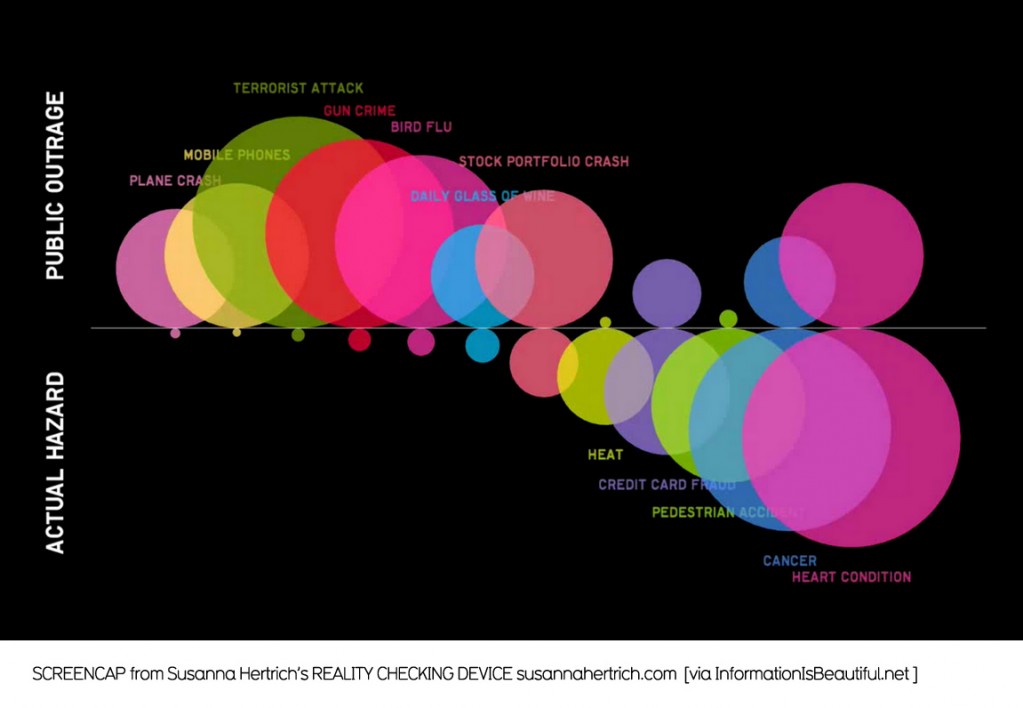
Artist Susannah Hertrich developed this graphic (via) designed to bring to consciousness the difference between the likelihood of harm from certain threats and public outrage:

susanna_hertrich_reality

I am unsure as to how she measured both “public outrage” and “actual hazard” but, giving her the benefit of the doubt and assuming that this information is based on some reasonable systematic measurement, the image nicely draws our attention to how some social problems can receive a disproportionate amount of outrage, contributing to their social construction as significant or insignificant social problems (or, alternatively, their social construction as public problems for which outrage is appropriate and useful, versus private problems that have no public policy dimensions).

So, for example, heat is seen as relatively harmless even though, as Eric Klinenberg shows in his book Heat Wave: A Social Autopsy of Disaster in Chicago, it kills many, many people every year and is severely exacerbated by social policies both directly and indirectly related to weather.  But the people who die from heat, and those who love them, tend to be relatively powerless members of our society: usually the elderly poor.

Conversely, the threat of terrorism attracts a great deal of public outrage, but is not a significant threat to our individual well-being.  Still, certain members of our society with an ease of access to the media and authoritative roles in our society (mostly politicians and pundits) can raise our fears of terrorism to disproportionate levels.

Similarly, bird flu makes for a fun story (as all gruesome health scandals can) and gun crime feeds “mainstream” fears of the “underclasses” (often perceived as black and brown men).  Both make for good media stories.  Less so, perhaps, pedestrian accidents.

—————————

Lisa Wade is a professor of sociology at Occidental College. You can follow her on Twitter and Facebook.

tumblr_kpgy8xxhuW1qz7ng1o1_500-1

In the Bible (book of Genesis), God sends two angels to the cities of Sodom and Gomorrah. These angels were charged with the task of evaluating the rate of sin within the walls. If the people were completely overridden by sin, God would destroy them.

What if those angels were statisticians, with access to GIS and geomapping software? How would the story have been different?

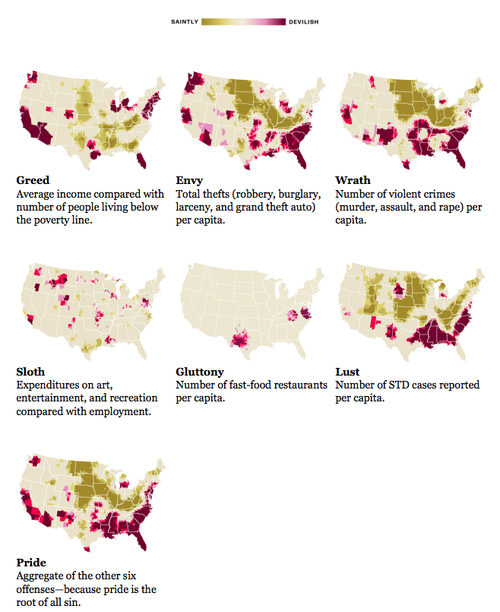
Some geographers at Kansas State University recently did an analysis of the spacial distribution of EVIL in the United States. Which part of the country is most afflicted by sloth? Lust? Greed? Envy? Wrath? Gluttony? Pride?

That’s right, folks – these geographers have operationalized sin, quantified it, then measured and mapped it. Pride is the aggregate distribution of all other sins, since it is supposedly the root of all evil (though one could also make a good case for apathy). Here’s how the sins are measured (and here’s a good view of the maps):

  • Greed: Average incomes versus total inhabitants below the poverty line
  • Envy: Total number of thefts (robbery, burglary, larceny, and stolen cars)
  • Wrath: Total number of violent crimes (murder, assault and rape) per capita
  • Lust: Sexually transmitted diseases per capita
  • Gluttony: Number of fast-foot restaurants per capita
  • Sloth: Expenditures on arts, entertainment and recreation versus rate of employment
  • Pride: An aggregate of the six other sins

By looking at sin at the aggregate level, what they’re doing here is examining sin as a social fact, as opposed to an individual trait. This would be a good extension of a lesson on Durkheim and suicide as a social fact. This study really shows why we really can’t truly measure concepts such as this across space and time, since the meaning of these individual acts will vary. Are the same acts categorized and labeled as rape in Montana as they are in New York? How violent does a person need to be before they are arrested for assault, and does that differ by region? Are we really measuring rates of STDs, or rates at which people get treatment for them? If my measure of gluttony is different than yours, can I apply my measure to your actions and call you gluttonous? Or should I be using your measures to evaluate your actions? Is this aggregate data showing different rates of sin, or is it just an effect of different meanings attached to the concepts?

This would also be useful in showing how we can’t extrapolate individual characteristics from aggregate data. For example, I live in Indiana (but teach in Kentucky). This region is low in envy, lust, wrath, and pride; average in gluttony, sloth, and greed; and not particularly high in any of the sins. Apparently I live in one of the more virtuous parts of the country.

I guess I can cancel that fire and brimstone insurance.

But does this aggregate data also indicate that I, Anomie, have greater odds of being virtuous? NO. The fact that I am virtuous in every way is merely a coincidence. You see, their data is not measuring individual sinful behavior. Rather, it’s measuring social facts, and structural conditions, that they hypothesize to be correlated with individual sinful behavior (but I take issue with some of the measures). For example:

  • I don’t have any STDS. CLEARLY I am not lustful. CLEARLY.
  • If you have more fast food restaurants within a five mile radius of your house than I do, are you more gluttonous than me? No. But at the aggregate level, this may be a good quick and dirty device. At least they didn’t use obesity rates as their measure.
  • And if I make $100k (one can dream) in Indiana, then move elsewhere to a job with the same salary, does that mean my greediness has changed along with my place of residence?

Now, excuse me while I get back to my slothful appreciation of art.

——————————

Angie Andriot, also known as Wicked Anomie, maintains the (mostly) sociology blog Wicked Anomie: Sociology Run Amok. On occasion, she likes to toss off her cape, hop offline, and play the role of Angie Andriot: Grad Student Extraordinaire – deftly juggling the writing of her dazzling dissertation at Purdue University with the imparting of wisdom to her lovely students at University of Louisville. She is particularly fond of symbolic interactionism. And cheese.

If you would like to write a post for Sociological Images, please see our Guidelines for Guest Bloggers.


We have, of course, posted a number of examples of toys that socialize girls into motherhood and housework (for instance). But this 1960s commercial for the Suzy Homemaker line of toys, sent in by Monica B., is the most comprehensive example I’ve ever seen, including everything from cooking, doing laundry, vacuuming, to looking pretty:

I’m not quite sure why, but I find this commercial really creepy. Maybe it’s the underlying message that you should do housework and be pretty at the same time if you want to be “queen of your home” and, presumably, the housewife everyone else admires and envies.

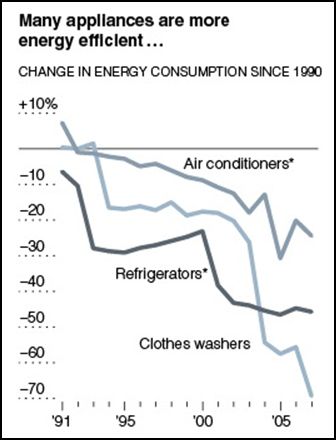
Last week the New York Times featured an article and graphic (via) illustrating the way in which the increasing energy efficiency of electricity-drawing technologies correlates with an increase in overall use of energy nonetheless due to a rise in our consumption of those technologies.

1

But, “Americans now have about 25 consumer electronic products in every household, compared with just three in 1980”:

2One culprit of the rising electricity use is video game consoles:
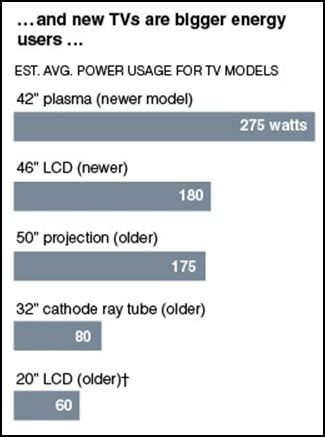
Noah Horowitz, at the Natural Resources Defense Council, calculated that the nation’s gaming consoles, like the Xbox 360 from Microsoft and the Sony PlayStation 3, now use about the same amount of electricity each year as San Diego, the ninth-largest city in country.

But an even bigger culprit are those giant plasma screen TVs:

3

The energy-efficiency of video game consoles and televisions are both unregulated, compared to the efficiency of those appliances showing increasing energy efficiency in the first figure (refrigerators, air conditioners, and clothes washers).

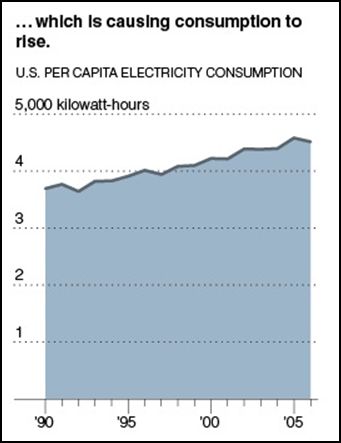
So, consumption, overall, is going up:

4

The corporations that build TVs, game consoles, and other unregulated appliances are, of course, resisting any federal laws regarding their efficiency.  According to the article, there was little will under the Bush administration.  We will have to wait and see what happens now.

—————————

Lisa Wade is a professor of sociology at Occidental College. You can follow her on Twitter and Facebook.

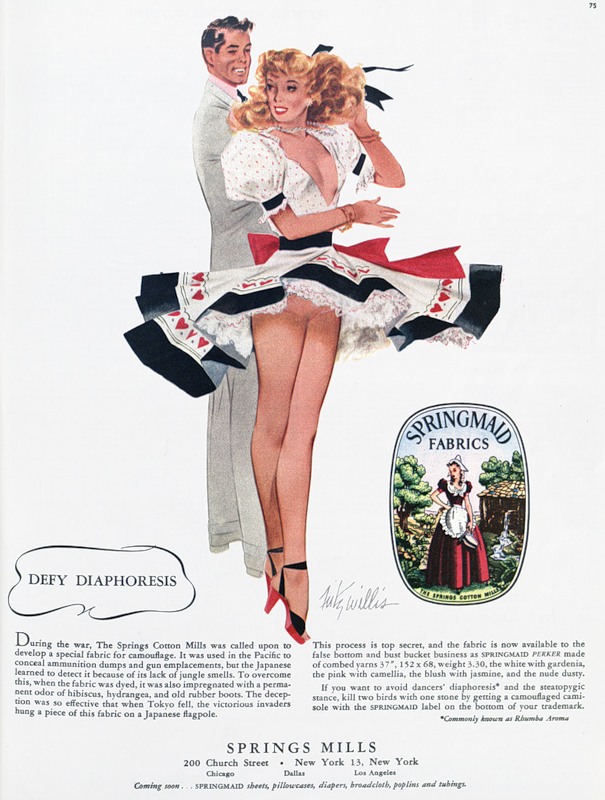
World War II was, among other things, an engine for the development of new technologies.  After the war, however, companies needed new markets for their products that would allow them to continue to reap profits.  We’ve posted below on this effort as related to food.  The 1948 ad below, for a scent-reducing and slimming camisole, is a great example of this in that the text makes it explicit (via):

0_2f753_b3c78add_XL

Text:

During the war, The Springs Cotton Mills was called upon to develop a special fabric for camouflage.  It was used in the Pacific to conceal ammunition dumps and gun emplacements, but the Japanese learned to detect it because of its lack of jungle smells.  To overcome this, when the fabric was dyed, it was also impregnated with a permanent odor of hibiscus, hydrangea, and old rubber boots.  The deception was so effective that when Tokyo fell, the victorious invaders hung a piece of this fabric on a Japanese flagpole.

This process is top secret, and the fabric is now available to the false bottom and bust bucket business as SPRINGMAID PERKER made of combed yarns… the white with gardenia, the pink with camelia, the blush with jasmine, and the nude dusty.

If you want to avoid dancers’ diaphoresis* and the steatopygic stance, kill two birds with one stone by getting a camouflaged camisole with the SPRINGMAID label on the bottom of your trademark.

* Commonly known as Rhumba Aroma.

And also, a quick google search shows, “ballerina bouquet” and “skater’s steam.”

—————————

Lisa Wade is a professor of sociology at Occidental College. You can follow her on Twitter and Facebook.

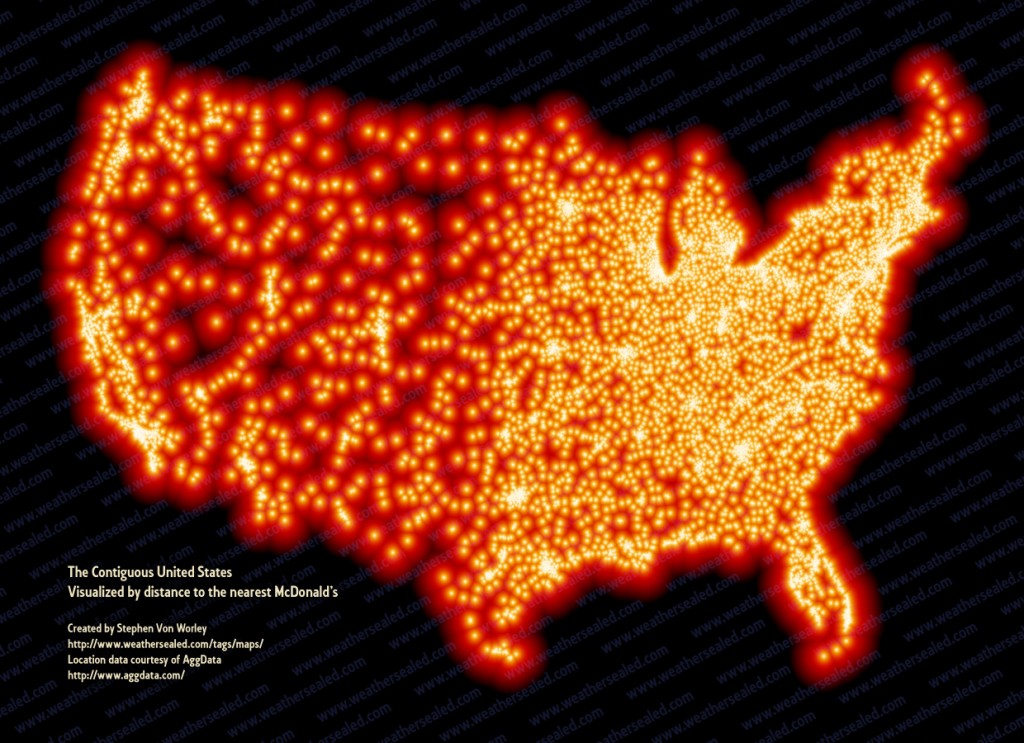
Behold “a visualization of the contiguous United States, colored by distance to the nearest [of the about 13,000] domestic McDonald’s” developed by Stephen Von Worley at Weather Sealed:

mcd_us_high

Von Worley writes:

As expected, McDonald’s cluster at the population centers and hug the highway grid.  East of the Mississippi, there’s wall-to-wall coverage, except for a handful of meager gaps centered on the Adirondacks, inland Maine, the Everglades, and outlying West Virginia.

For maximum McSparseness, we look westward, towards the deepest, darkest holes in our map: the barren deserts of central Nevada, the arid hills of southeastern Oregon, the rugged wilderness of Idaho’s Salmon River Mountains, and the conspicuous well of blackness on the high plains of northwestern South Dakota.  There, in a patch of rolling grassland, loosely hemmed in by Bismarck, Dickinson, Pierre, and the greater Rapid City-Spearfish-Sturgis metropolitan area, we find our answer.

Between the tiny Dakotan hamlets of Meadow and Glad Valley lies the McFarthest Spot: 107 miles distant from the nearest McDonald’s, as the crow flies, and 145 miles by car!

Suffer a Big Mac Attack out there, and you’re hurtin’ for certain!

Via a blog I’ve been borrowing a lot from lately, Chart Porn.

—————————

Lisa Wade is a professor of sociology at Occidental College. You can follow her on Twitter and Facebook.