Search results for The

[I posted this a couple of days ago but accidentally deleted it last night, so I’m reposting it. I apologize for the confusion, and for the loss of all the comments. I’m going to see if I can recover the comments, but I don’t know how it’ll go. Thanks to Dangerous Minds I was able to save my original commentary.]

Our tech wizard, Jon S., and reader Katie C. sent in a link to a Danish campaign by the organization Children Exposed to Violence at Home to raise awareness of domestic violence. The campaign is called “Hit the Bitch!” and features a game where you can smack a woman around using either a mouse or your own hand if you have a web cam:

bitch1

The game has now been limited to Danish users only.

The woman gets increasingly bruised and bloodied as you hit her.  I forced myself to try the site and hit her twice, and it was honestly sickening to watch her head jerk backward or to the side and hear the sound of the slap and her reacting.  At the top, a counter keeps track; you start out as 100% Pussy, 0% Gangsta, but your Gangsta rating goes up every time you hit her:

bitch2

Apparently, though, when you get up to where you’d be at 100% Gangsta, it instead says 100% Idiot, as though this is a real put-down that is going to make you think really seriously about domestic violence.  I am trying to think of any context that would make this seem like a good idea, or an effective way to combat domestic violence.  I mean, ok, yeah, I guess people might be made more aware of it after hearing about or playing the game, but is it likely to have any positive effect?

It seems more likely that people who don’t already take domestic violence seriously would either be uncomfortable, leave the site, and never think about it again, or find it funny to play for a few minutes just to see what would happen…and somehow encouraging people to slap around an image of a woman for fun seems like a really weird way to get people to think more seriously about domestic violence.

UPDATE: Comments closed.


The Daily Show calls itself “a fake news show,” but it often does what the “real” news shows won’t. It documents how what people on news shows try to pass off as “spontaneous and unrehearsed” (as the opening of Meet the Press used to put it) is really planned and scripted at Talking Points Central. The Daily Show will give a quick montage of clips in which different people on different shows all use the same unusual word or phrase.

Last night it was “dithering.” A series of right-wingers, culminating in Dick Cheney, all accuse President Obama of “dithering” on Afghanistan.

Slide to 3:37:

It was just like the old days, when The Daily Show would string together clips from Bush Administration figures and right-wing commentators all using the same key words. But then, the statements all came on the same day, so the central direction was obvious. (I mean, it was obvious to Daily Show viewers, not to viewers of “real” news programs.)

The popularity of dithering may be more a case of contagion than planning. Note the dates of the O’Reilly and Cheney clips, more than two weeks apart.

Dithering is not a frequently used word. Lexis-Nexis shows only 27 instances in TV news transcripts for the first nine months of the year. The first use in connection with Afghanistan comes on September 24 – on Australian ABC, but the speaker was from the American Enterprise Institute, a conservative think tank in Washington. So it’s likely that dithering represented one idea of how to attack Obama. That idea took hold.

Over the course of the next month, dithering begins to reverberate. Republican senators use it in hearings in early October, TV news people bounce it back, and right-wing commentators start yodeling it loudly.

They are changing the rationale for why we are in Afghanistan. What’s really going on here is a dither, a big dither, indecisiveness. (William Bennett on CNN, Oct. 18)

And finally the Cheney quote on Oct. 21 that is echoed in every news story about that speech.

The White House must stop dithering while America’s forces are in danger.

Quite possibly, Cheney’s speech was written by someone at the American Enterprise Institute or someone else in that neo-con circle. Still, I don’t see the dithering as a matter of “talking points” distributed by the RNC. Instead, it’s an example of what I mentioned in another post – a word (dithering, issues) that spreads because it just sounds “right,” at least to certain people.

I expect that the dithering life cycle will be mayfly brief. Issues to mean problems was slower to catch on, and it may hang around for a good while.

Shirley A. sent in a Zellers sale flyer that is really interesting in light of the recent post we did on a Best Buy promotion. Whereas the Best Buy promotion was aimed directly at men, you’ll see that this flyer, for a store that sells household items instead of fancy gadgets, is aimed staunchly at women… who have to buy for their whole family and their home as well as themselves.

Capture

For more on gender and responsibility for the home:

First, check out this longitudinal data on how much housework wives and husbands do.

Then, for more examples of how women are responsible for the home, see this KFC advertisement offering moms a night off, this a commercial montage, Italian dye ad with a twist, women love to clean, homes of the future, what’s for dinner, honey?, liberation through quick meals, and my husband’s an ass.

See also these humorous illustrations: I love it when you talk clean to me, men do housework fantasy calendar, the househusbands of Hollywood, and porn for new moms.

—————————

Lisa Wade is a professor of sociology at Occidental College. You can follow her on Twitter and Facebook.

In this 20 minute video, novelist Chimamanda Adichie describes, with insight and grace, the problem of the “single story.”  She says, “Show a people as one thing, and only one thing, over and over again, and that is what they become.”  Focusing on her experience as an “African” in the U.S. (she is from Nigeria), she also describes her own experiences with realizing that she has heard only a single story, whether of rural Nigerians or Mexicans.

Highly recommended (or read the transcript here):

Via Stuff White People Do.

—————————

Lisa Wade is a professor of sociology at Occidental College. You can follow her on Twitter and Facebook.

Lisa Wade, PhD is an Associate Professor at Tulane University. She is the author of American Hookup, a book about college sexual culture; a textbook about gender; and a forthcoming introductory text: Terrible Magnificent Sociology. You can follow her on Twitter and Instagram.

I hate you, Zach A., for making me play the Klondike Bar Mancave video game.

Are you bored of companies targeting their products at men with tired and insulting stereotypes? Well, too bad. Because ya’ll keep sendin’ them to us and it’s our job to show them to you.

In this installment of “men-are-idiots,-let’s-try-to-sell-them-shit-p.s.-women-are-annoying”: the Klondike Bar.

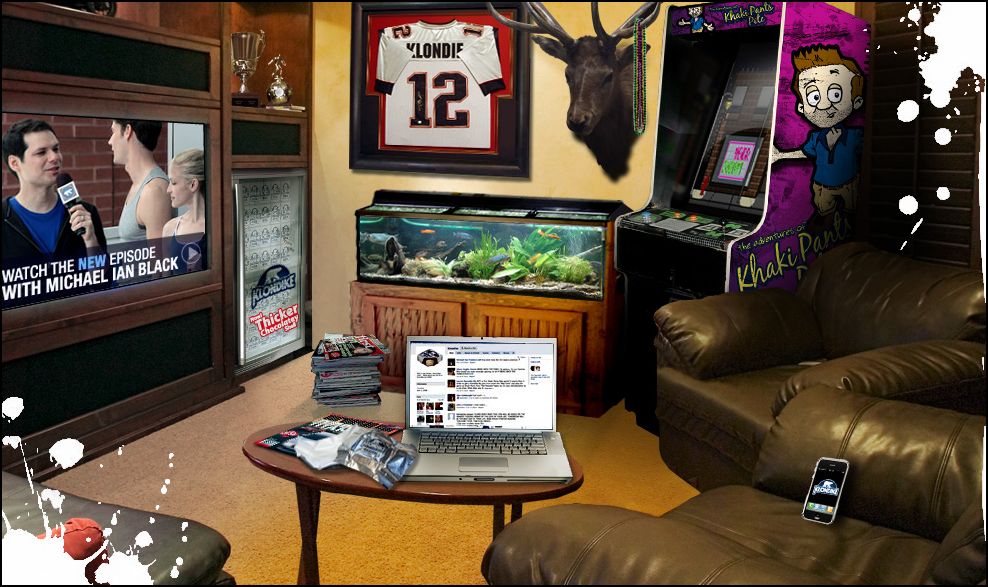
First, the Klondike Bar “Mancave” home page:

8

Notice the Mardi Gras beads?  Nice touch.

Also, is that splooge in the corners?

If you click on the video game, you get to the entry page.  It is for “Big Boys” only:

1

Poor Pete.  He lives in the (domesticated and feminized) suburbs and wears khakis.  Accordingly, he has become a woman:

2

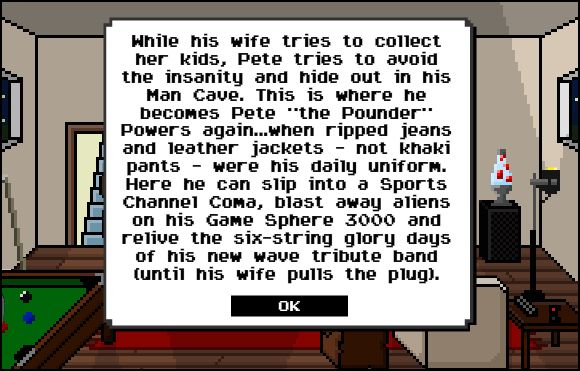
Gah.  Being a family is so crappy.  It involves hiding in the basement while your wife takes care of “her” kids, until she cock blocks your cock rocking of course:

3

Not being able to watch violence and sex makes Pete’s testicles shrivel up:

4

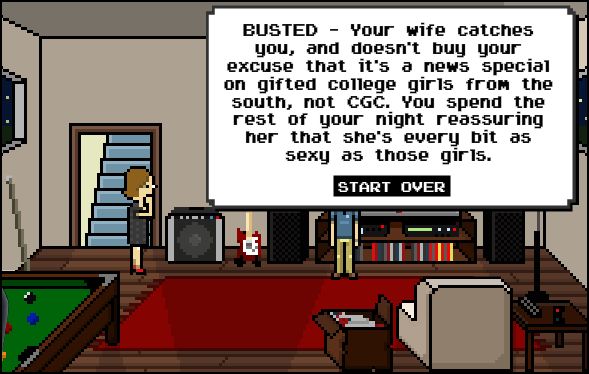
And when he pops in his secret porn DVD (featuring college age women, of course), your wife just nags and nags:

5

YOU LOSE:

7

So, tell me why this guy is so appealing to so many men?  The man is selfish: his wife and the babysitter are desperately trying to get the kids to bed and he retreats from the chaos; it’s annoying that the TV is set up so as to make sure his kids don’t watch violence and sex; he hides a stash of porn featuring college age women from his wife.  But at least doesn’t have to do housework!  Amirite!?  Oh yeah, and women are annoying!  Go dudes!

It’s pathetic, really.  Sociologically, I mean.

Finally, in case you thought Klondike was equal opportunity, here is the screen shot of the generic (non-Mancave) website.  It leads you straight there:

0

“Dude,” now it’s “thicker.”

—————————

Lisa Wade is a professor of sociology at Occidental College. You can follow her on Twitter and Facebook.

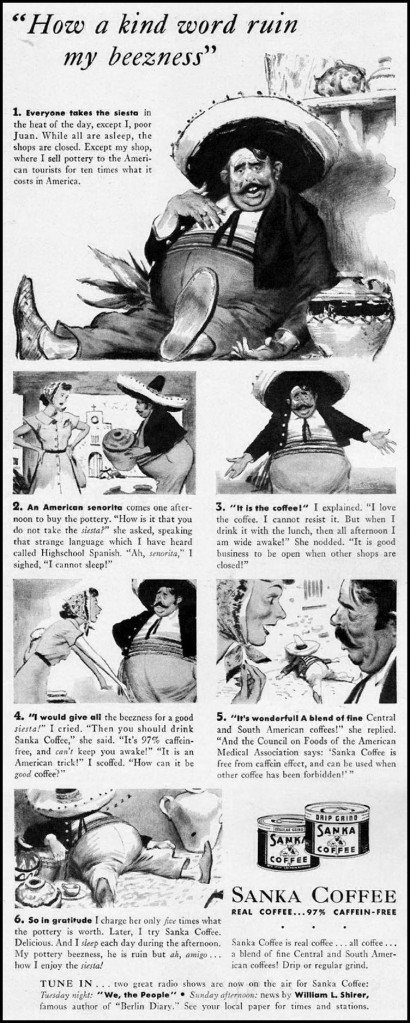
In the vintage ad below, Sanka sells coffee by joking about how Mexicans (I think) lack good ol’ American capitalist values (text below):

sankalife09291941044m5a
Text:

“How a kind word ruin by beezness”

1. Everyone takes the siesta in the heat of the day, except I, poor Juan.  While all are asleep, the shops are closed.  Except my shop, where I sell pottery to the American tourists for ten times what it costs in America.

2. An American senorita comes one afternoon to buy the pottery.  “How is it that you do not take the siesta?” she asked, speaking that strange language which I have heard called Highschool Spanish.  “Ah, senorita,” I sighed, “I cannot sleep!”

3.  “Is it the coffee!” I explained.  “I love the coffee. I cannot resist it.  But when I drink it with the lunch, then all afternoon I am wide awake!”  She nodded.  “It is good business to be open when other shops are closed!”

4. “I would give all the beezness for a good siesta!” I cried.  “Then you should drink Sanka Coffee,” she said.  “It’s 97% caffein-free [sic], and can’t keep you awake!”  “It is an American trick!”  I scoffed.  “How can it be good coffee?”

5. “It’s wonderful!  A blend of fine Central and South American coffees!” she replied.  “And the Council on Foods of the American Medical Association says: ‘Sanka Coffee is free from caffein [sic] effect, and can be used when other coffee has been forbidden!’ ”

6.  So in gratitude I charge her only five times what the pottery is worth.  Later, I try Sanka Coffee.  Delicious.  And I sleep each day during the afternoon.  My pottery beezness, he is ruin but ah, amigo… how I enjoy the siesta!

See also our post on the Frito Bandito and a vintage Tequila ad.

Found at Vintage Ads.

—————————

Lisa Wade is a professor of sociology at Occidental College. You can follow her on Twitter and Facebook.

The Oral Cancer Foundation released this video last month, just a couple of weeks before the FDA was scheduled to vote on approval of the ‘male’ Gardasil vaccine.

Whether you’re pro- or anti-vaccine, you might wonder why has FDA testing of and approval for Gardasil’s use on males lagged three years behind the female-only “cervical cancer” vaccine? Most of us who have followed Gardasil’s development were not surprised when the FDA recently voted to approve its use on boys and young men for the prevention of genital warts. However, this limited focus on male genital warts ignores the growing number of medical studies which have shown causal connections between two cervical-cancer causing types of HPV (covered by Gardasil) and a variety of cancers that can have devastating health consequences in female and male bodies.

In light of this body of research, many were dismayed by the fact that the CDC decided against recommending routine use of the Gardasil vaccine for boys.  A NYT article reported that this committee will likely consider data on Gardasil’s ability to protect against male cancers when it meets again in February.

As more Americans learn about the causal links between HPV strains covered by Gardasil and serious (sometimes fatal) oral and anogenital cancers, it will be interesting to see if U.S. boys/young men get vaccinated at as high a rate as girls/young women.

To educate people about the risk of oral cancer from sexually-transmitted HPV, the Oral Cancer Foundation released this video:

———————————————

Adina Nack is an associate professor of Sociology at California Lutheran University specializing in medical sociology, gender inequality and sexual health.  Nack’s book, Damaged Goods?  Women Living with Incurable Sexually Transmitted Diseases came out in 2008.  You can see an earlier post of hers, about sexually transmitted disease and stigma, here.

If you would like to write a post for Sociological Images, please see our Guidelines for Guest Bloggers.

Cate M. emailed us about the promo for the movie “The Killer Inside Me,” saying,

The level of violence is at NSFW levels and quite possibly one of the most ‘trigger warning’ vids I’ve ever seen used to promote a non-horror film.

We get a lot of submissions about sexualized violence toward women, so I thought, “well, ok, we’ll see.” And then I watched it, and at 1:15 in had to pause because I was already horrified. Here’s the whole 5:42 promo. It’s Not At All Safe for Work, and you won’t want to watch it if scenes of sexualized brutality toward women would be a trigger for you. And also, I guess, Spoiler Alert, if that’s your main concern.

UPDATE: The promo keeps being taken down; here’s a link that works for now, but I don’t know for how long.

Clearly, Casey Affleck’s character is a sadistic asshole (the cigar on the guy’s hand), but in the promo, at least, the graphic, sexualized violence is reserved for women…who also appear to like it, at least for a while. Jessica Alba gives in to him, and apparently starts a relationship with him, after he pulls her pants down and whips her. Perhaps that’s because she’s a prostitute; of course she’d like a dominant man who plays rough, right?

The thing is, you could make this movie and tell the same story without actually showing all the violence in such a graphic way. Movies imply things all the time. It’s a choice to show this type of violence toward women as a form of entertainment…and to show the women liking it.

See our posts on increases in violence toward women on primetime TV, sexualized violence on TV crime procedurals, and the movie “DeadGirl.”