Search results for The

Ricardo G. of Bifurcaciones sent in this ad from a catalog sent to homes in the U.K. by the company Hillier (via):
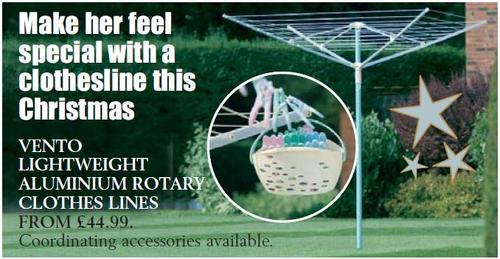
clothesline

“Coordinating accessories available.” How thrilling. It reminds me of this post about how housecleaning is depicted as a joyful activity for women.

After being inundated with complaints, the company apologized, claiming it was a joke but they recognize it was inappropriate and should not have gone out.

While this does illustrate the gendering of housework, I think there’s another angle worth thinking about here. A number of the complaints weren’t just about it implying housework is women’s responsibility, but also that it is unromantic and therefore offensive to pose as a potential gift. I’m really interested in the idea of what makes an appropriate gifts, and that gifts between spouses should always be “romantic.” Romantic gifts are often things that have little intrinsic value; their value comes from the emotional and social implications attached to them.

Jewelry, flowers, lingerie–none of these are really helpful items, and they don’t make the recipients’ daily lives easier. A clothesline might, in fact, be a gift that would improve the lives of people who have to hang their clothing to dry. In my family,  both men and women highly value gifts perceived as practical and useful, rather than simply sentimental or romantic. One year my mom and uncle got my grandma an air compressor because she would find it very useful on the ranch; she was thrilled. Once I paid to have my mom’s dog spayed and vaccinated because she’d been too busy to have it done. Men in my family regularly get leather work gloves and tools, and they never seem disappointed.

I think there may be a class element here. In Making Ends Meet, Kathryn Edin and Laura Lein discuss how low-income women often partially rely on the contributions of boyfriends to buy the things they need each month. The women complained, however, that boyfriends often bought unnecessary things they thought the women would like, but that did not really improve their lives, such as a stereo or purse. The women often referred to these gifts as a waste of money, something that was already in short supply. They much preferred to receive gifts that they found useful.

So not to defend a clothesline as a suggested present to women–even my mom got mad when my stepdad gave her a mop for either Mother’s Day or their anniversary–but the construction of “unromantic” gifts as inherently offensive is fascinating, and assumes that everyone believes money should be spent on non-essential items in order to display emotional attachment.
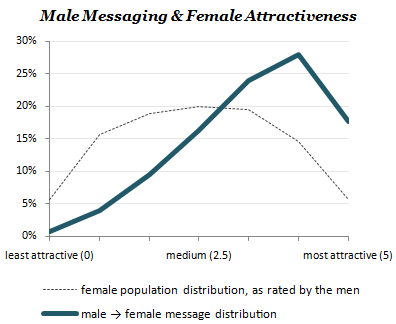
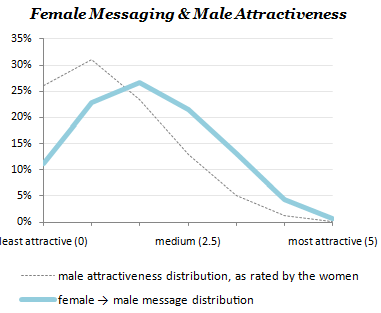
OKCupid, an online matchmaking site, offers data on gender and perceived attractiveness that I might use in my spring deviance course (via boing). The figures might help me make a Durkheimian society of (hot) saints point about the relative nature of beauty and a Goffman point on stigma affecting social interaction, while providing another illustration of the taken-for-grantedness of heteronormativity.

In any case, the first figure shows that male OKCupid ratings of female OKCupid users follows something like a normal distribution, with mean=2.5 on a 0-to-5 scale from “least attractive” to “most attractive.” Also, women rated as more attractive tend to get more messages. At first, I thought I saw evidence of positive deviance here, since women rated as most attractive get fewer messages than those rated somewhat below them — the 4.5s garner more attention than the 5.0s. But, as I’ll show below with the next chart, that would probably be an incorrect interpretation — confounding the “persons” in the dashed lines with the “messages” in the solid lines.

The next figure shows that female OKCupid users tend to rate most male OKCupid users as well below “medium” in attractiveness. According to OKCupid, “women rate an incredible 80% of guys as worse-looking than medium. Very harsh. On the other hand, when it comes to actual messaging, women shift their expectations only just slightly ahead of the curve, which is a healthier pattern than guys’ pursuing the all-but-unattainable.”

Hmm. The latter point isn’t wrong, I guess, but it shouldn’t obscure the bigger point that more attractive men still get more messages than less attractive men. Again, note that persons (OKCupid members) are the units of analysis for the dashed lines and messages (messages sent by OKCupid members) are the units for the solid lines. On first scan, I read the graph as suggesting that the top “attractiveness quintile” was getting fewer messages than the bottom attractiveness quintile — that uglier men were actually doing better than more attractive men — but that’s not the case at all. Instead, it just means that in the land of the hideous, the somewhat-less-than-loathsome man is king.

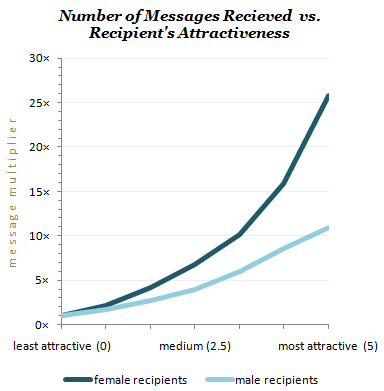
If almost everybody is rated as unattractive, most of the messages will go to those rated as unattractive. Nevertheless, the rate of messages-per-person still rises monotonically with attractiveness. As the “message multiplier” chart below shows, the most attractive men get about 11 times the messages of the least attractive men — and the most attractive women get about 25 times the messages of the least attractive women.

—————————

Chris Uggen is Distinguished McKnight Professor and Chair of Sociology at the University of Minnesota.  His writing appears in American Sociological Review, American Journal of SociologyCriminology, and Law & Society Review and in media such as the New York Times, The Economist, and NPR.  With Jeff Manza, he wrote Locked Out: Felon Disenfranchisement and American Democracy.

If you would like to write a post for Sociological Images, please see our Guidelines for Guest Bloggers.

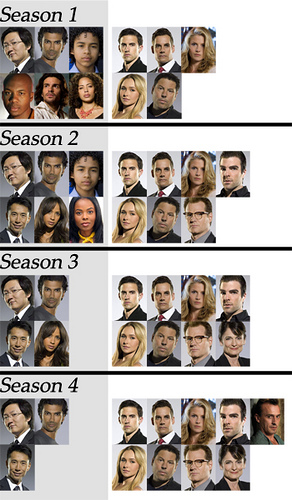
Arturo R. Garcia, at Racialicious, posted this graphic illustrating how the cast of Heroes has become increasingly white over its four seasons:

4130311080_16ced94012

—————————

Lisa Wade is a professor of sociology at Occidental College. You can follow her on Twitter and Facebook.

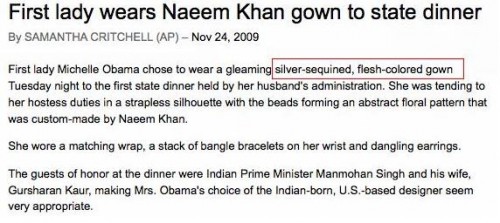
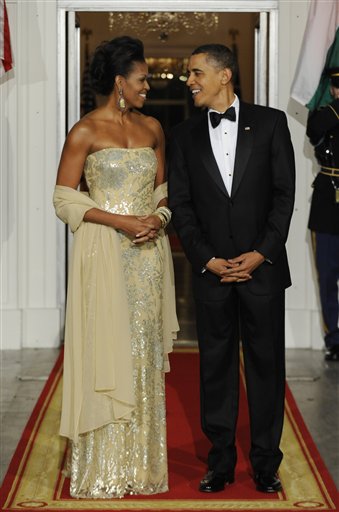
The Associated Press, a news service subscribed to by news outlets all over the world, distributed a story about the first Obama Administration State Dinner. In the story, sent in by Elisabeth R., Samantha Critchell describes Michelle Obama’s dress as “flesh-colored.”

gown2

[Thanks to Madeline T., Anne Marie, Therese S., and Drugmnky for the screencap!]

Gee, what could possibly be wrong with calling this dress “flesh-colored”?

APTOPIX Obama US India

This is what happens when white people are considered people and black people are considered a special kind of people, black people.  “Flesh-colored” becomes the skin color associated with whites and darker-skinned peoples are left out of the picture altogether.  We see this all the time.  Bandaids, for example, are typically light beige (though they rarely call them “flesh-colored” anymore), as are things like ace bandages.

See our post on “flesh-colored” for these examples and more.  See also this post on lotion for “normal to darker skin.”

For contrast, see this post about how the generic human in Russian cartoons is colored black instead of white.

—————————

Lisa Wade is a professor of sociology at Occidental College. You can follow her on Twitter and Facebook.

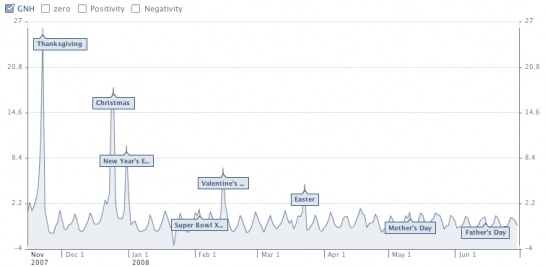
At least it is according to words referencing happy and unhappy states in our Facebook status updates:

happiness_facebook_4mkip08h4k8wscss8gscsk4wo_8td8r2s3w1cs4kksc4okksgg8_th

It’s probably just an artifact of people using the word “grateful” because they’re supposed to.  Then again, maybe being reminded to be grateful really does make people happy for a day.

Source: Facebook via Flowing Data.

—————————

Lisa Wade is a professor of sociology at Occidental College. You can follow her on Twitter and Facebook.

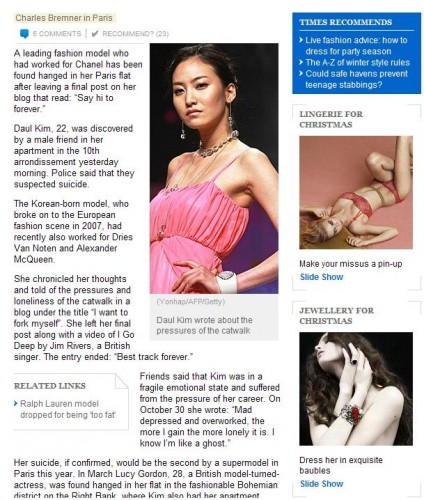
Kate M. sent us a link to a story in the Times Online about the recent suicide of model Daul Kim. Kim had worked for a number of high-fashion companies, including Chanel. Her blog contained many posts about the pressure and loneliness of being a model. Kate points out that the links surrounding the story undermine any message that we should actually care about this topic:

model2

Notice on the side the “Lingerie for Christmas” feature on the side, with a scantily clothed, very thin woman; it lets you “make your missus a pin-up.” Below that you can “dress her in exquisite baubles.” Women are sexy, thin, mostly naked playthings for you to dress up and play with at will. How could that possibly have anything to do with the thinness ideals models and other women are pressured to meet?

The “Ralph Lauren model dropped for being too fat” story refers to the woman we wrote about in this post, where her body had been photoshopped beyond recognition.

I recently posted about the de-gaying of the movie A Single Man in promotional posters and trailers for different audiences. James H. (of Town Creek Poetry) sent us an example of how the cover of the book Spice & Wolf was changed for the U.S. market (the original is the Japanese version; image found at siliconera):

spice_wolf_covers1

So we move from a fully-clothed manga character to a cover with a photo of a naked woman with her head cut out of the image, removing all subjectivity. The publisher says they did so in order to try to draw in a wider audience than people who are already interested in manga, and apparently they decided that a naked woman is the way to draw the interest of U.S. readers.

I wish I could say they’re totally wrong and it would never work. But clearly Evony also thought it would be effective. I wish I knew how their sales have changed as their advertising became more boob-centric.

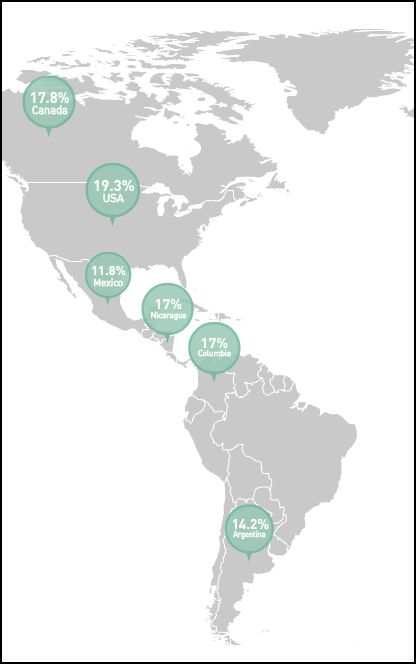
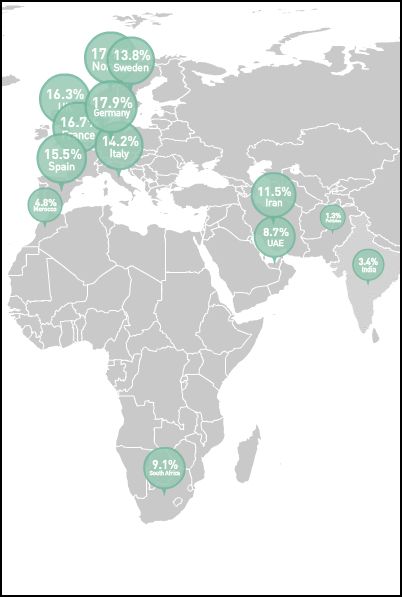
Visual Economics posted a (mildly) interactive page comparing what percentage of their budget different nations spend on health, education, and their military. The three screenshots below are for health:

3

4

5

You can also look at the data via a list.  This data is the percentage of the budget spent on the military:

2

Via Look At This.

—————————

Lisa Wade is a professor of sociology at Occidental College. You can follow her on Twitter and Facebook.