Search results for The

Jessica H. S. sent in this photo:

4002407705_1ab27d71e0_o

Not that there is anything wrong with any of these games or careers, per se. It’s just the constant reinforcement of these gendered ideas of appropriate roles/careers/interests that is disheartening. Many of these games focus on roles that emphasize appearances, whether of people or homes; otherwise, you can care for children.

Though I will say, Peggle is awesome. I eventually had to delete it from my laptop for the sake of ever accomplishing anything again.


Jessica G. drew our attention to the promotional material of Panty Raid.  Panty Raid is two guys, Josh Mayer and Marty Folb, who produce dance music.  As you might guess from their name, their materials include a dismissal of women as fans and an endorsement of men’s entitlement to sexual access to women.  Their slogan for their album, Marine Parade, is: “Audio fondling your girlfriend.”

Capture

So, “you” are a straight guy.  And, like it or not, these guys are such hegemons that they are makin’ it with your girl, whether she likes it or not.

There is more of this typical misogyny at their website (you can google it), but it was the promo shot below that Jessica felt compelled to send in.

Picture1

This is a great illustration of what it looks like to embrace both white and male privilege.  We see the bottom half of a black woman sitting with her legs apart and her underwear at her ankles.  Were it not dark between her legs,  you could see her vulva.  Mayer and Folb, both white men, sit in front of her and look at the camera.  Their expression and posture suggest utter disinterest.

This is where I think the privilege is revealed, and embraced, loud and clear.  She is not a human being, she is a vagina and, even as a vagina, she is uninteresting.  She is nothing, really.  Like their sneakers, their trucker hats, and their hoodies, she is only a prop.  What does a sexually available black woman signify?  Urban cred?  Masculine domination of women?  High status in a hierarchy of men?  All of the above?  Congratulations dudes: racist and sexist message sent and received.

—————————

Lisa Wade is a professor of sociology at Occidental College. You can follow her on Twitter and Facebook.

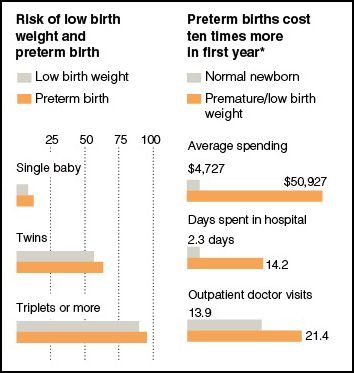
Last year I posted a table showing the dramatic rise in the birth of twins among women 45-49 (from less than 25 per 1,000 to almost 200 per 1,000 in 2002).  The graphic below, included alongside a New York Times article on the topic, shows the increased risk of preterm birth and low birth weight that comes with multiple births and the cost of taking care of premature babies (almost $51,000 versus under $5,000 for a baby born at term):

1

Given that the U.S. is discussing health care reform at the moment, it might be worth while to consider whether having a biological child is “worth” it.

—————————

Lisa Wade is a professor of sociology at Occidental College. You can follow her on Twitter and Facebook.

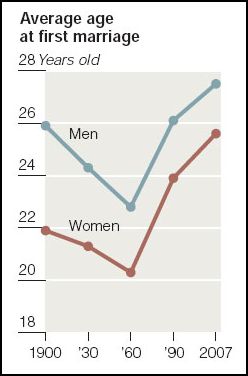
In the U.S., when people refer to the “traditional family,” they usually mean a family that they associate with the 1950s.  But the 1950s was a really unusual time in American history.  Elsewhere I’ve written about how the husband breadwinner/wife homemaker model is an American anomaly.  The data below, put together by the New York Times, shows that the 1950s was an unusual time in terms of age of marriage also:

Capture2

Though the data is rough (five points across 107 years), you can see a distinct dip in the age of marriage that includes the ’50s.

So history isn’t, as we often suppose, a straight line from one point to another.  It’s a complicated story.  And the 1950s… well, to choose that era as “traditional” is no more reasonable than to choose today or the enlightenment or the dark ages or…

Also see: everyone needs a wife and what does “traditional marriage” look like?

—————————

Lisa Wade is a professor of sociology at Occidental College. You can follow her on Twitter and Facebook.


Hermes sent in a link to a feature in The Morning News titled “Men at Their Most Masculine,” in which men were asked about what made them feel masculine and photographed in situations that reflect their masculine identities. Some quotes from men included in the project:

“I feel masculine when I am home, I can take care of myself. I often feel emasculated when I leave my apartment though, with everyone asking me if I need help. I don’t need any help.”

“To be masculine is to dominate in one’s field of study.”

“I want to show that, despite stereotypes, gay men can be masculine too.”

“I feel most masculine when I am lying in bed naked.”

“I am strong emotionally, have always stood up for myself, and fear nothing. I happen to be physically strong but that isn’t where I derive my masculinity.”

“I am masculine because I abandon women after taking their love. Because when you study Freud, you don’t let him study you. Because I study philosophy, not literature.”

Visit at photographer Chad States’s website. He apparently found all of the featured men via craigslist.

The photos and quotes illustrate some interesting contradictions in definitions of masculinity. Several of the men define masculinity in fairly traditional terms, using words like “dominate” or expressing masculinity as the ability to use women and then leave them. There is also an emphasis on being independent and not needing help from anyone else.

In other cases, the men redefine masculinity to at least some extent, such as the gay man who reclaims masculinity for gays, the guy who focuses on being emotionally strong, and the man shown posed in a way we’re more used to seeing with women.

It’s an interesting look at some of the ways men define masculinity at a time when we expect men to be more emotionally available and involved in family life (as opposed to the 1950s emotionally closed-off model) but provide mixed signals by also still judging men harshly if they seem too emotional or don’t meet ideals of what “real” men should be like.

Gwen Sharp is an associate professor of sociology at Nevada State College. You can follow her on Twitter at @gwensharpnv.

In the U.S. today, men enroll in college at a lower rate and drop out at a higher rate. In 2005, there were 57 women on campus for every 43 men.

This is such a significant problem, that college admissions officers are letting in a larger percentage of male applicants, even sometimes admitting less qualified men over more qualified women.

But this isn’t just a gender story.

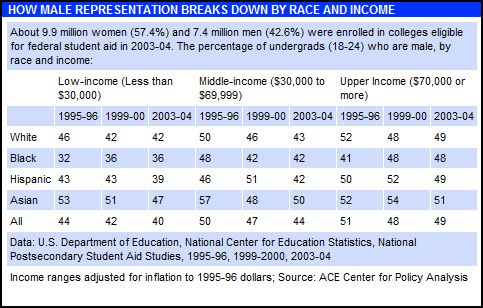
A USA Today story offered this data from the ACE Center for Policy and Analysis:

Capture

Looking at the very bottom line of the table (and just at 2003/2004), you can see that the gender gap is largest among lower income students.  Men make up 40% of undergraduates 18-24 when you consider low-income students only, and 49% when you look at upper income students.

The gender gap also correlates with race.  Asian students show the smallest gender gap, whites the next smallest, with Hispanics and blacks trailing.

You might notice that the correlation of the gender gap with race mirrors the class correlation.  That is, income and wealth data for racial categories follows the same pattern with Asians out earning whites (categorically speaking) and whites out earning Hispanics and blacks.  So there may be an interesting exacerbation effect here.

The gender gaps for each racial/ethnic group, however, decreases as the students’ families get richer.  And, among the upper income groups, the racial difference shrinks to only three percentage points (from 11 among low- and middle-income kids).

So, it’s not just about race, it’s not just about class, and it’s not just about gender.  Then, what is it about being poor, black or Hispanic, andmale that results in low male enrollment in college and a higher drop out rate?

—————————

Lisa Wade is a professor of sociology at Occidental College. You can follow her on Twitter and Facebook.

As a fan of both sci fi and pre-WWII pop culture, I naturally have a lot of affection for Alex Raymond’s Flash Gordon. There’s much to be enjoyed about the original comic strip (which basically invented the style that led to the creation of super-hero comics), the 1936 serial starring Buster Crabbe, and even the 1980 movie, which I’ve mentioned before.  The 1970’s softcore porn version, Flesh Gordon, is also a lot of fun.  Although the various incarnations get pretty complicated, the basic story is of a regular guy from Earth who ends up on a bizarre alien planet, where he inadvertently becomes a hero in the struggle against Emperor Ming, the tyrant who has been keeping the whole planet under his thumb.  With the recent rebirth of big budget sci fi and comic book adaptations, the time almost seems perfect for a new Flash Gordon movie.  It’s never quite been done cinematic justice, and the basic story would hold up well to a modern interpretation.

Unfortunately, there’s one rather big problem: Emperor Ming.  As the name implies, Flash’s nemesis is an unreconstructed “yellow peril” Asian stereotype.  Despite being an alien, he’s undeniably portrayed as the worst sort of racist view of a Chinese ruler.  He’s a vindictive, inscrutable tyrant with an affection for ornate finery and a lecherous eye for (white) Earth women.  In the original comic he has bright yellow skin, long fingernails, a high-collared robe, and a Fu Manchu goatee.

Unsurprisingly, the serial was faithful to this version, casting a white actor named Charles Middleton and putting him in the same kind of “yellowface” make-up that was common in those days for portrayals of Asian characters.  Of course, the actual skin tone was irrelevant in a monochromatic film.

Concerns about racism never even entered anyone’s mind until the 1980 film.  By that time, it was necessary to be at least a little racially sensitive (but not too much).  The answer was to leave Ming basically unchanged, while pretending there was never anything Asian about him.  Swedish actor Max von Sydow was given a look that was immediately recognizable as the classic Ming, but with just enough of the Asian elements replaced with a more futuristic, “alien” look for plausible deniability.

The animated versions of Ming, in both the Filmation’s Flash Gordon series and the later Defenders of the Earth, took this idea a step further.  Ming was given green skin, as if to say, “See, this guy’s clearly an alien!  How could you accuse him of representing an Earthly race?”

Even with these attempts at a more extraterrestrial appearance, however, anyone who’s at all familiar with longstanding racist depictions of Asian men can recognize Ming as an embodiment of that unfortunate tradition.  Meanwhile, more sympathetic characters who are clearly of the same race as Ming, such as his traitorous daughter Aurra and her lover Prince Barin, were unambiguously white.  They did have yellow skin in the original comics, but even then they were less recognizable Asian than Ming.  Later portrayals, even the cartoons in which Ming is green, show them as totally caucasian.  The message seems to be that the more evil you are, the more alien you are, and alien in this case looks a lot like Chinese.

Naturally, when the Sci Fi Channel decided to adapt Flash Gordon for TV in 2007, they were eager to avoid anything that could be perceived as racism.  Their answer to the Ming problem was to completely remake the character, removing every bit of his previous look to create a very white sort of fascist dictator.

There was a lot wrong with this adaptation (it was unwatchably boring, for one), but one of the complaints against it was that Ming was lackluster and missing everything that had made him a memorable villain.  Regardless of his origins, we expect certain things from Ming: a bald head, facial hair, an ornate robe.  Exoticism.  So what is to be done?  There can be no Flash Gordon without Ming the Merciless, but it’s possible that Ming is a character too wrapped up in racism to ever escape.

In my idle moments I’ve given some thought to how Hollywood could pull off a successful Flash Gordon revamp, and the only idea I have for Ming is this: don’t run away from his faux-Chinese heritage; push it in the other direction.  Cast a Chinese actor as Ming, and make Aurra, Barin, and the rest of their people equally Chinese.  Eliminate Earth entirely, setting the story in the future and making Flash’s planet one that was colonized by the United States, while Ming’s planet was colonized by China.  You don’t need exposition for this- just imply it with production design.  For Ming’s costumes, create a futuristic variation on what Chinese emperors actually wore, rather than just an American’s simplistic idea of the look.  Do away with Ming’s predatory behavior toward Flash’s girlfriend.  It’s a creepy and dated element regardless of his race.  Finally, sweep away the blond=good/dark=bad undertone of the original by making Flash Gordon black.  After all, it would make a great role for Will Smith, a charismatic action hero who’s been hurting for a sci fi property that’s actually worth watching.

As for the role of Ming himself, there are plenty of aging action stars who could pull it off.  Given the inevitable campiness of the project, Jackie Chan might work.  I’d suggest Chow Yun Fat, except that it could be hard to distinguish his version of Ming from the character he played in the last Pirates of the Caribbean movie.

But would this be enough to redeem the character and the franchise?  Maybe privileged white fans like me need to accept that some characters and stories have too much bigotry in their history to ever be redeemed.  After all, nobody is trying to create an acceptable new version of Uncle Remus (although I say this with hesitation, because it seems possible that someone in a locked room at Disney might right now be doing that very thing).  If there is to be no more Flash Gordon, I’ll accept that, but I do wish someone could find a way to solve the problem of Emperor Ming.

———————————

Dustin Collins is pursuing an MA at the Ohio University School of Film.  When he has time between classes and screenings, he blogs about film, pop culture, and Betty Boop at okaywithme.

If you would like to write a post for Sociological Images, please see our Guidelines for Guest Bloggers.

Lisa Wade, PhD is an Associate Professor at Tulane University. She is the author of American Hookup, a book about college sexual culture; a textbook about gender; and a forthcoming introductory text: Terrible Magnificent Sociology. You can follow her on Twitter and Instagram.

Tom Schaller at FiveThirtyEight.com posted a summary of the book Authoritarianism & Polarization in American Politics:

…authoritarianism is really about order–achieving it, maintaining it, and affirming it–and especially when citizens are uncertain or fearful. This, they say, is why authoritarians seek out and elevate, well, authorities–because authorities impose order on an otherwise disordered world. They provide a useful review the existing literature on authoritarian traits, which have been connected to negative racist stereotyping, a belief in biblical inerrancy, a preference for simple rather than complex problem-solving, and low levels of political information.

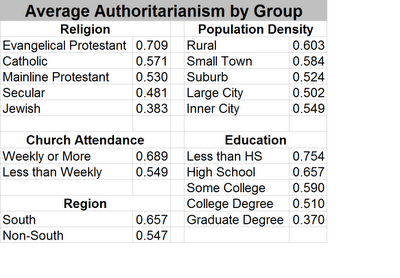
The authors, Marc Hetherinton and Jonathan Weiler, provide a breakdown of average levels of authoritarianism in the U.S. based on various characteristics:

authority

Over at the Huffington Post, Weiler discusses the connection between authoritarianism and racial attitudes:

Authoritarian-minded individuals are, after all, likely to judge more negatively minority groups and those negative judgments, in turn, inform a host of political positions…

We find that in a politics organized by authoritarianism, even non-racial issues are becoming a matter of race and, more broadly, are taking on more visceral symbolic significance…

In sum, there is reason to think that beneath the arguments about government intrusion into the health care market, death panels, and such, a much more visceral dynamic is at work. To be perfectly clear, it is far from the case that every opponent or skeptic of significant health-care reform is a racist or racially motivated in her or his thinking. But there is, at the least, very strong circumstantial evidence that views of race and beliefs about health care reform are linked significantly among many Americans, which probably explains why the debate on health care reform has caused a much stronger uproar in 2009 than it did in 1994.

For an example of this type of racial resentment, see our recent post on Rush Limbaugh’s description of “Obama’s America.”