Search results for The

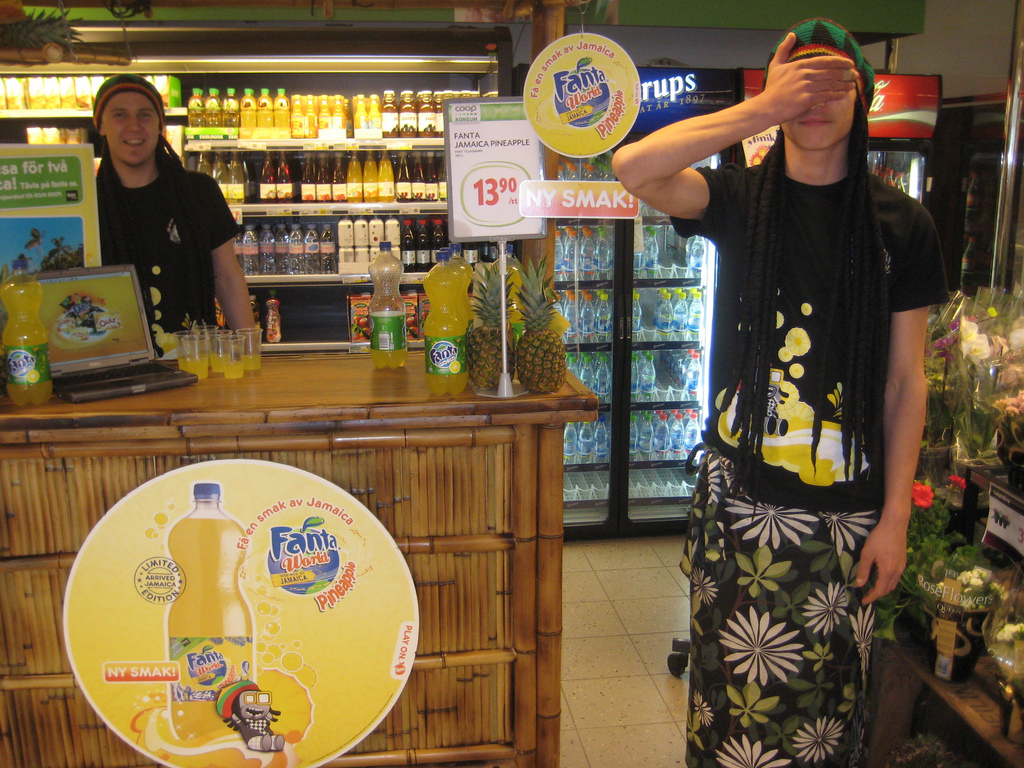
Birdseed sent in this photo he took at a grocery store in Stockholm (which he posted at his blog as well):
3487134506_c2b6058547_b1

The product is a new beverage, Fanta World Pineapple: Inspired by Jamaica. The two guys in the photo were hired to promote it at the little tiki-style counter. Johan says,

A couple of things leap out at me straight away:

* The continued (post-)colonial association of Jamaica with its plantation produce. The “inspiration” seems limited to the fact that pineapples are grown there for the consumption of the global North. (Canned goods like pineapples still have the charming moniker “kolonialvaror” (colonial merchandise) in Swedish retail jargon.)

* The ridiculous (verging on blackface) stereotypical representation of “Jamaicans” that the kids are suppsed to portray. It seems to have been done with extreme sloppiness – for instance, the Polynesian lava lava (a type of sarong) that they wear has absolutely nothing to do with Jamaica at all, but rather acts to represent an identity-less generalised tropics, dehumanised exotica.

The music was, of course, bad reggae.

I think Johan hits on an important issue here–how often the cultures of non-Westernized countries are mixed together into an undifferentiated image of exoticness–for instance, “tribal” fashion and “traditional” handicrafts often supposedly represent “Africa,” which is a meaningless category given the enormous diversity of cultures, languages, clothing styles, artistic motifs, and so on. But if you put some geometric designs and maybe an elephant on some cloth, it evokes “Africa.”

it’s also interesting that a certain hat shape and dreads have become such easily-identifiable shorthand symbols of Jamaica, and that Fanta is commodifying the idea of Jamaica to sell a product that has no reason to be more “inspired” by Jamaica than anywhere else pineapple is grown–Hawaii, Mexico, Costa Rica, etc. etc. etc.

Gwen Sharp is an associate professor of sociology at Nevada State College. You can follow her on Twitter at @gwensharpnv.
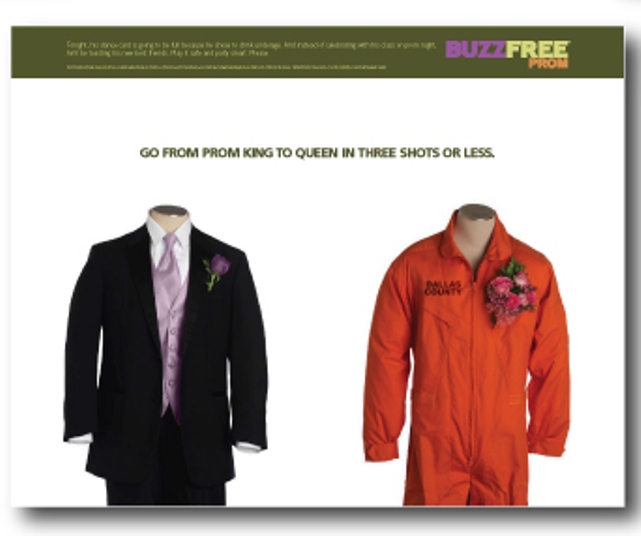
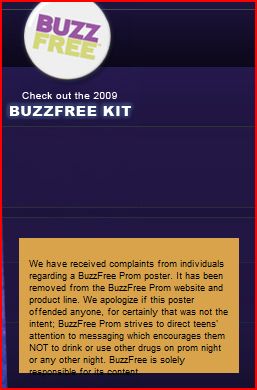
Objections to a BuzzFreeProm ad has led the organization to pull it and apologize.  The ad reads: “Go from prom king to queen in three shots or less.”7

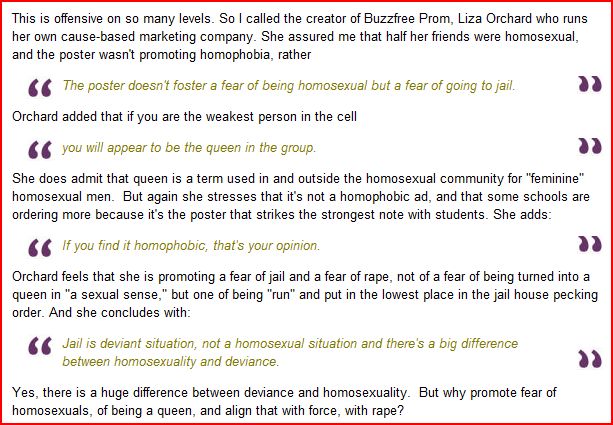
Lisa Derrick at La Figa had the following exchange with the talent behind the ad:

capture21

I will go further.  I think that being a “queen,” in the jail sense, is about being, both literally and figuratively, on the bottom.  The imprisoned, gay men and, for that matter, women, are all on the bottom in this sense.   (The corsage on the prison uniform is a hint that it’s not just about being gay, but about being female.)  The problem with this ad, for me, is that it conflates sex and power.  That the conflation can span so many different categories suggests that it resonates strongly.  And that is what is disappointing to me.  I would prefer to live in a world in which sex and power could be disentangled, as opposed to one that affirmed their entanglement.  Let’s try to keep kids safe some other way, eh?

BuzzFreeProm has since put up an apology:

capture6

Other anti-drug and anti-drinking ads: an anti-meth campaign reminiscent of reefer madness, a vintage hanna-barbara anti-drug commercial, bizarre anti-drinking and driving messages, and threatening women with unattractiveness.

NEWS!

In addition to friending us on Facebook, you can now follow us on Twitter!

FROM THE ARCHIVES:

April last year:  This fascinating Italian anti-immigrant poster suggests that, if immigration to Italy is allowed, immigrants will persecute the native Italians like U.S. colonizers did American Indians.  It’s a pretty amazing tactic.

NEWLY ENRICHED POSTS (bottom of post may not be safe for work!):

Total Drek revised an xkcd cartoon on the difference between causation and correlation.  So we added it to our original post.


Sex sells ‘n stuff:

Sarah Haskins makes fun of euphemistic references to female genitalia.  We added her video to our post on our efforts to avoid using the real terms.  

Related to discomfort with women’s genitalia, Taylor D. sent in a link to even more vintage ads for Lysol as a douche, which we added to this post.

We added a vintage ad to our sex sells post.  This one tells men that if they don’t buy Firestone tires, they won’t get laid.  Women?  Well I guess they don’t drive.  

Also in sex sells, we updated our post on the sexualization of food, this time with a Max Factor ad and a not-to-be-missed Hardee’s commercial featuring Padma Lakshmi having quite the sensual experience with a bacon burger (scroll all the way to the bottom). 

We also added another image to our post with examples of sex as “scoring.”

Now to sperm: We added three more images affirming the idea that we were all once a mighty sperm (eggs, apparently, just add nutrition, if that) to this post on the weird ways in which sperm are socially constructed.  In one of them, a condom ad suggests that one condom could have prevented the holocaust by dressing a sperm up as Hitler.  Another example dates back to the beginning of the idea in 1694.


On race and ethnicity:

We added material to two posts in our series on how and why people of color are included in ads aimed at white people.  First, we added a set of photographs taken by Joshua B. at Office Max to our post showing how people of color are often portrayed as being more, eh em, colorful.  Second, we added an image to our post on how people of color are literally background or arranged so that the focal point (visually or through action) is the white person or people in the ad.

We added images of sculptures that comically/stereotypically (depending on your point of view) represent European countries to this post about stereotyping nationalities. The installation was supposedly by 27 different artists, but it turns out to be a hoax; all of them were created by a single Czech artist.

Also in ethnic stereotypes, we added a cartoon from Life magazine suggesting that monkeys are insulted by being given Irish names.  We added it to our collection of anti-Irish sentiment from the 1800s.

And visit this post to see our newest example of using the notion of the “savage” to sell in the 1950s.

Miguel sent us an image of a “White” Obama, which we added to our post that asks “What do Black and White look like, anyway?”

Philip D. sent us a set of Crown Royal ads that reportedly target a “general” and a specifically African American audience, respectively, which we added to our post about marketing products to different groups. 

On gender: 

Elizabeth M. sent us a link to fashion designer Nina Ricci’s new line of shoes.  They’re high high HIGH heels!  We added it to some other real hobblers here

Women cannot be counted on to hold it together in the face of low calorie sweets… or at least that’s what another commercial tells us. 

Ben O. sent us a link to a company that makes pink protective gear for female construction workers.  We added it to our post featuring pink handcuffs for cops.  

There’s now another image up from the Evan Williams bourbon “The Longer You Wait” ad campaign

Keely W. sent in a link to the new Fling candy bar, just for girls.  We added it to our post on gendered candy marketing.

The Daily Show spoofed the obsession with Michelle Obama’s clothes.  Andrea G. sent in the link and we added it to our collection of examples of this obsession.  We also added a picture of the cover of a new book: Michelle Style: Celebrating the First Lady of Fashion.

We added a picture of a sink that looks like a woman’s lower half to our post about urinals shaped like women’s bodies

And, finally, does a month go by where we don’t update our BOOBS! post?  Rarely.  This time, though, we’ve got something special: Jezebel offered us a photo essay of a boob shaped milk cartoon, from fridge to trashcan.  Visit our updated post here (scroll to the bottom) and enjoy this teaser:

0041

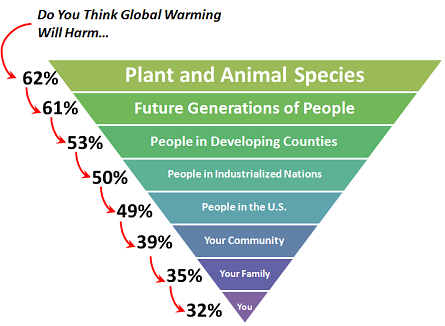
Nate Silver at FiveThirtyEight put up an image that illustrates the findings of a recent survey by George Mason University’s Center for Climate Change Communication.This inverted pyramid shows the percent of those polled who said they think global warming will hurt each group “a great deal” or “a moderate amount”:

warming

So as we see, the closer the question got to the person answering the survey, the less severe they thought the impacts of global warming were likely to be. Silver says,

These beliefs are not necessarily irrational. Climate change probably will have more impact on the developing world than the developed one, and it almost certainly will have more impact on our children than it does on ourselves.

But if individuals don’t perceive climate change to really have negative consequences for them or their families, they may not support climate change policies if they fear those policies will hurt jobs/business in the short-term, since they may be more likely to see the economic impacts as personally problematic.

UPDATE: An anonymous commenter pointed out that the 538 pyramid is a bit misleading. Brad Johnson at Wonk Room created a more representative one:

global_warming_perceptions

Thanks for the tip!

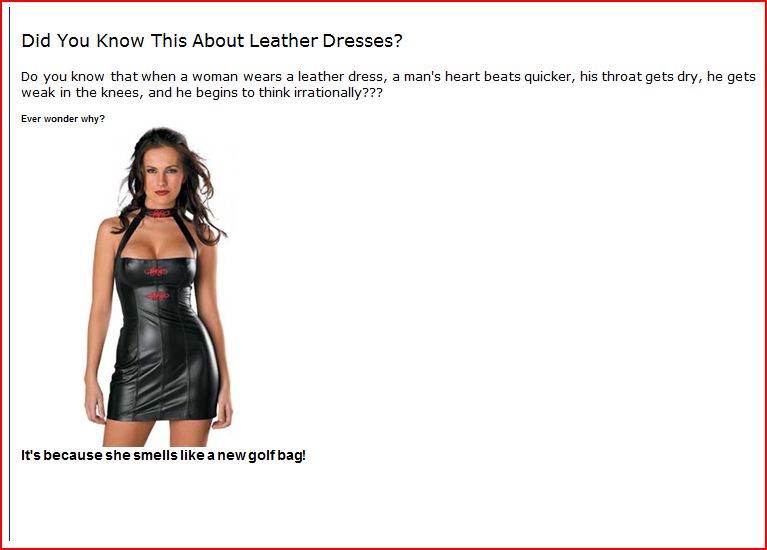
I presume, though I have never seen any evidence for this, that we don’t all get the same email forwards.  For instance, I never received this forward… but Steve W. did:

capture11

Text:

Did You Know This About Leather Dresses?

Do you know that when a woman wears a leather dress, a man’s heart bests quicker, his throat gets dry, he gets weak in the knees, and he begins to think irrationally???

Ever wonder why?

It’s because she smells like a new golf bag!

Why don’t I typically receive such forwards?  To suggest that it has something to do with my sex, which was my first guess, is probably too simple of an explanation.  I suspect it also has something to do with my class, politics, and occupation. 

What kind of forwards do you (not) get?  Do you think you might be surprised at what other people receive in their inbox? 

Do you selectively forward certain sentiments to some people and not others?  Do certain sentiments come from some people in your social network and not others?

What does the big wide world of forwarding look like?  Who forwards what to who?  Or, what part of the forwarding-whole is largely invisible to you?

Something I read in another blog sent me digging into the statistics on homicide between husbands and wives or other “intimates.” I remembered from my days in the crim biz that the US was unique in that wives here killed their husbands almost as frequently as husbands killed wives. This statistic, the “spousal rate of killing” (SROK), was introduced in a now-classic 1992 article by Margo Wilson and Martin Daly. In most countries, that rate is 25-30%. In the US, Wilson and Daly pointed out, it was about 75%.

But something has happened, over the last thirty years or so (data here). And as far as I can tell from a quick search on the Internet, nobody seems to have noticed.

(Click on the graph for a larger view.)


Between 1976 and 2005, the number of women killed by their male partners decreased by about 25%, less than the decrease in all homicides nationwide. But the number of men killed by women dropped dramatically, from 1300 to 330, a 75% decrease (since the population increased in those three decades, the change in rates is probably even greater. The SROK fell from 82% to 28%.

My Internet search for explanations was cursory at best, but it turned up nothing. I have only two ideas:

1. Men Behaving Better. Men have stopped doing those things that made women want to kill them.

I offered this explanation to two women in the Justice Studies department here. They rejected it out of hand and without comment. (Maybe they didn’t like the blaming-the-victim assumption: if women kill men, it’s because of what men do. Or maybe they were using a convenience sample of anecdotal data on men’s behavior.). One of these women, Lisa Anne Zilney, offered a counter-explanation . . .

2. Women Having Options. Women’s shelters and other facilities have given women an alternative. Without these, the only way to escape an intolerable situation at home was to get rid of the cause. Providing abused and desperate women a safe place to go saves lives – and apparently not just the lives of women.

I’m not wild about either of these explanations for the steep decline in the SROK (and as I recall, Wilson and Daly weren’t wild about any of their explanations of why it was so high).

Any ideas?

———————————–

Thanks Jay!  Read his other guest post: When grown men loved teddy bears.

If you would like to write a post for Sociological Images, please see our Guidelines for Guest Bloggers.

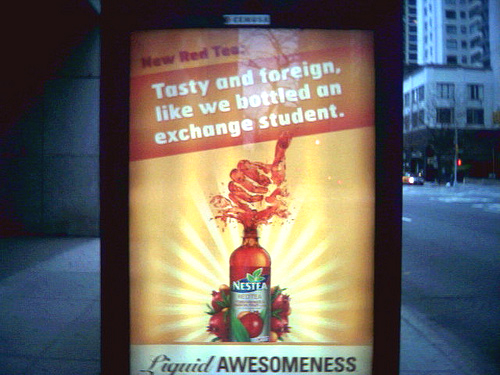
We have posted previously about how ethnic difference is made available for consumption through products (see here, here, and here).  This product, Nestea’s red tea, suggests that you can consume other people, not just their culture.

nesteaad

Text:

Tasty and foreign, like we bottled an exchange student. Liquid awesomeness.

Via Shakesville.

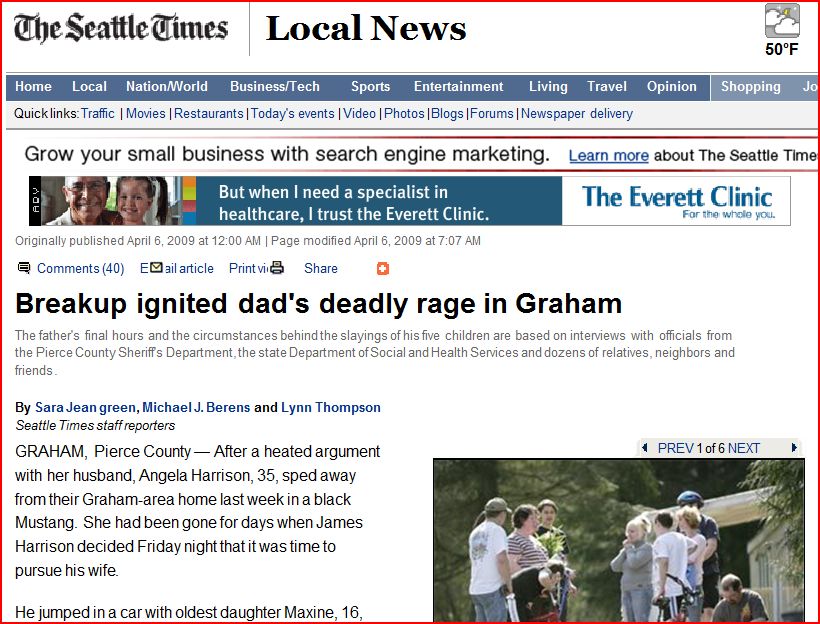
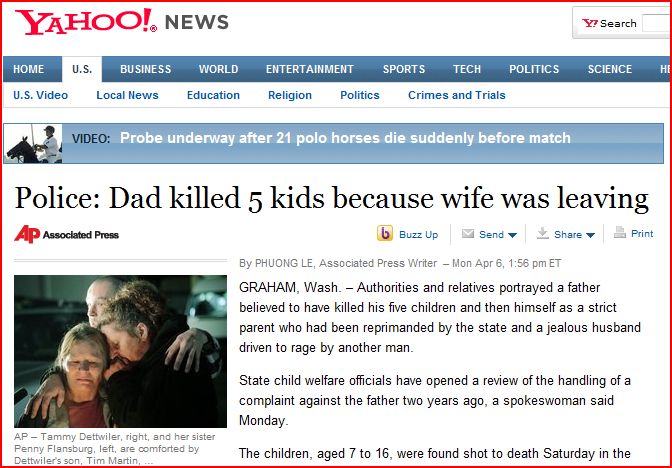
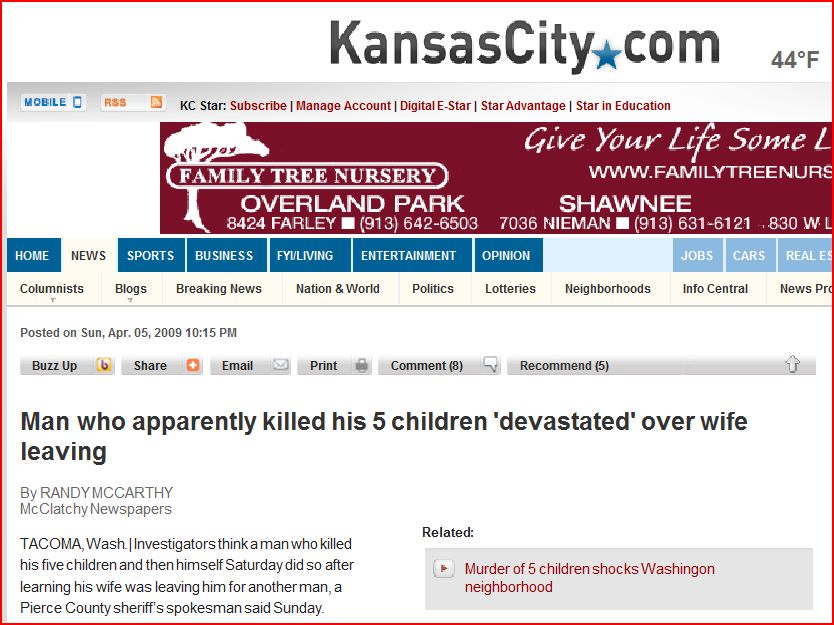
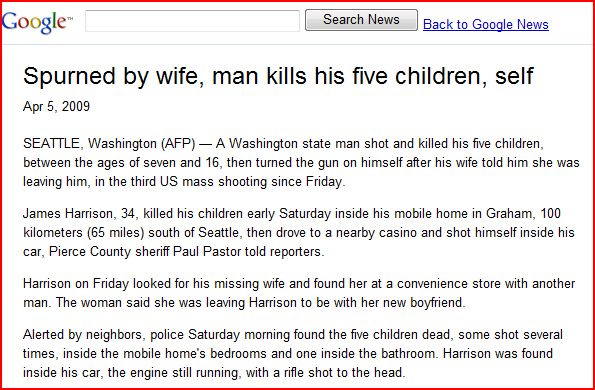
When Rihanna was beaten by Chris Brown, many people blamed Rihanna for enraging him.   Laura McDe sent in another example of victim-blaming in a case of domestic violence.  This time a man killed his five children, and then himself, after discovering that his wife had left him for another man.  Many headlines placed the blame on his wife (via Shakesville):

The Seattle Times:

capture4

Yahoo News:

yahoo

Kansas City.com:

kansas

Google News:

google

Instead of focusing on the husband’s abusive and frightening behavior, his mental instability, and his horrific decision to kill five children, the headlines focus on his wife’s behavior and how it “ignited” his own.  To complete the metaphor, if you are flammable, when you burst into flame, it is the match striker’s fault.

NEW! Shakesville highlighted another example of the excusing men’s violence against women:

actualheadline3

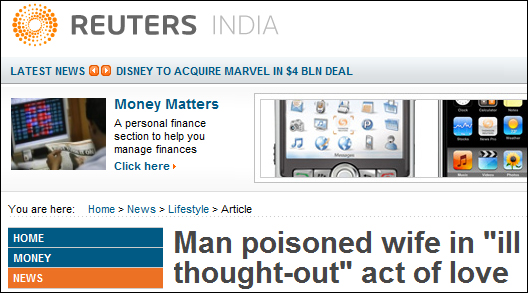
That’s right.  Poisoning your wife is an act of love.  You see, they were estranged and he wanted to make her ill so that he could nurse her back to health and have-her-no-she-can’t-get-away-I’ll-make-sure-of-it.  Story here.

Also in blaming the victim: mothers are responsible for their children’s addiction, renters are responsible for lead poisonous apartments, girls are responsible for internet predators, and women are responsible for preventing sexual harassment.