Search results for The

I happened upon a list of figures that display lots of information about who majors in science and engineering (S&E), all available at the NSF page on Women, Minorities, and Persons with Disabilities in Science and Engineering. All are for institutions in the U.S. only, as far as I can tell.

Here we see the number of bachelor’s degrees in S&E and non-S&E fields, by sex:
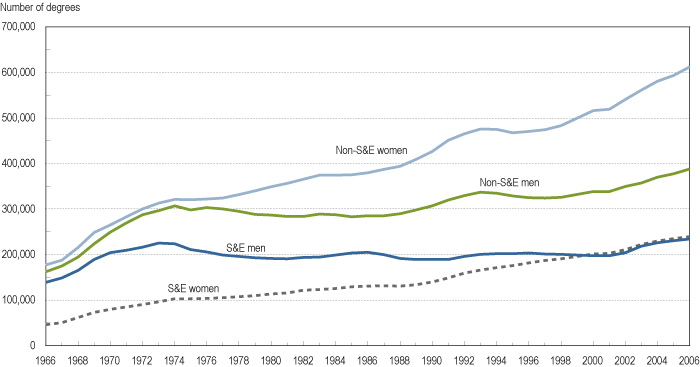
figc-12

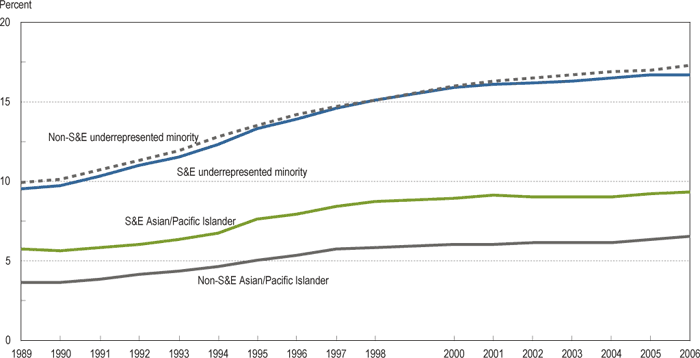
Percent of S&E and non-S&E bachelor’s degrees earned by racial minorities:
figc-21

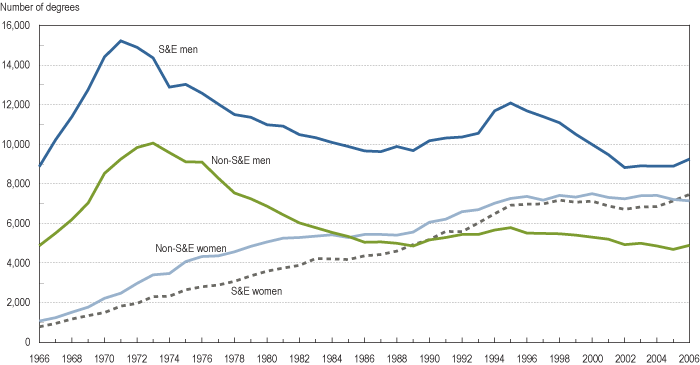
Number of doctoral degrees earned by sex:
figf-1

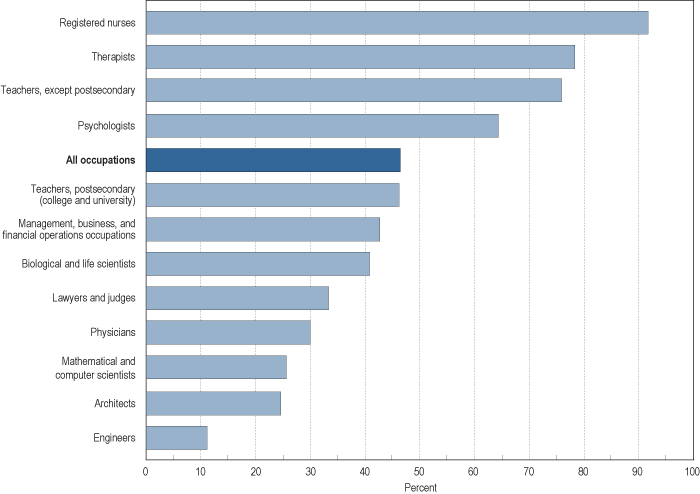
Percent of female workers in selected occupations in 2007:
figh-1

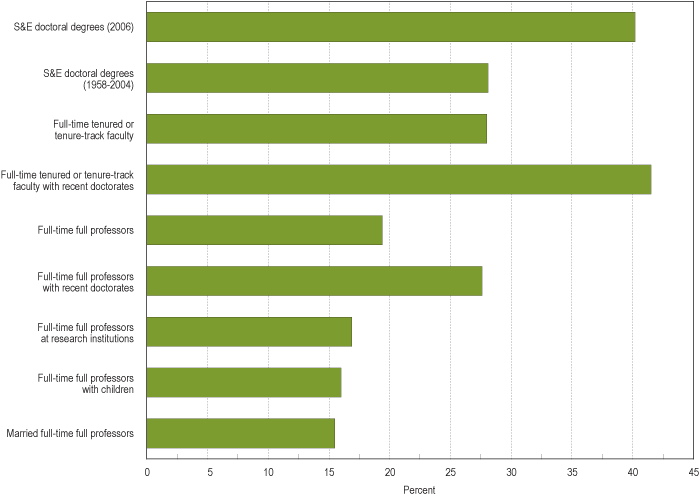
Percent of S&E Ph.D.-holding employees at 4-year colleges and universities that are women:
figh-3

Notice that while women are pretty well represented among “full-time tenured or tenure-track faculty,” they make up barely 15% of “full-time full professors with children,” “married full-time full professors,” and “full-time full professors at research institutions.” Some of this may be a matter of time, in that because being promoted to full professor takes years, an increase in the number of women getting Ph.D.s in a particular field will take a while to show up as a similar increase in number of women as professors in that field, everything else being equal.

But everything else isn’t equal. Women, even highly-educated ones, still do the majority of childcare and housework, and are more likely than men to consider how potential jobs could conflict with future family responsibilities when they are deciding what type of career to choose. So the lower proportion of female full professors at research institutions is likely a combination of some old-school unfriendliness to women in some departments, but also of women opting out of those positions–that is, deciding that the time and energy required to get tenure in a science/engineering department at a research school would conflict too much with family life, so they pursue other career options (for instance, women make up a higher proportion of faculty at community colleges, which are often perceived as being easier to get tenure at, since you don’t necessarily have to do lots of publishing–though anyone who has ever taught 5 courses a semester may question the assumption that it takes less time and work to teach than to publish).

And of course some women try to combine a tenure-track job with their family responsibilities and find it difficult, and either leave academia voluntarily or are turned down for tenure because they have not published enough or are not see as adequately involved and committed. Because of inequalities in the family, men are less likely to face those situations, though certainly some do.

I wish the report had a graph for non-S&E faculty, although it might just depress me.

UPDATE: Commenter Sarah says,

Check out the report “Women in Science: Career Processes and Outcomes” by Yu Xie and Kimberlee A. Shauman.  They find no evidence to support the hypothesis that women are under-represented at the tenure level due to a lag between getting PhDs and acquiring tenure track positions.  In the life sciences, women have been getting PhDs at the same rate as men for many years now, but inequality persists at the tenure-track level.  Xie and Shauman find that a variety of  social factors are responsible for actively hindering women at the highest levels of academia.
NEWS:

Last month Lisa posted about some interesting, if subtle, differences in a Spanish- and English-language pamphlet for pregnant women at Kaiser.  Siobhan O’Connor at GOOD put up her own blog post about the pamphlets and called Kaiser to see what was up.  A representative, Socorro Serrano, visited our site and replied in the comments.  Check out her reply, now in the post, here.  Thanks for chiming in, Socorro!

Join our fandom at our Facebook page!

NEW FEATURE!  FROM THE ARCHIVES:

Sometimes we get nostalgic for our old posts.  So, each month we’re going to resurrect a post from one year ago.  (In July we turn two-years-old and we’ll start resurrected two!)

From March 2008:  The marketers behind the Brazilian yogurt ads in this post counted on their viewers being disgusted by, gasp, fat women!  But some of us thought the women looked great.  What do you think?

NEWLY ENRICHED POSTS:

We added another Postsecret postcard to our post on confessions of true feelings about interracial sex.  Also in race and sex:  We updated our post on Resident Evil 5 again, this time adding an image of an African woman from the game attired in a sexualized animal-print outfit.

Nearly a year ago we argued that a promo poster for Gossip Girl represented the “pornification” of everyday life.  The stars are on the new cover of Rolling Stone and, well, we still think it’s pretty porny.  Speaking of: Breck C. sent us another image of things shaped like boobs, which we added to our extensive boobs post.

We published a post about a Dutch bus-stop bench that is a also a scale and publicly displays your weight when you sit on it.  We went back and added images of a design for a toilet seat that does the same thing

We added images of a man’s electric back hair shaver and a Nads commercial about a woman whose life was transformed when she was able to wax away her beard to this post about our growing disgust with body hair, even on men.  Also in hygiene: Kim D. sent us in another vintage Lysol douche ad, which we added to a post with several others.

Bri a sent in four ads to add to one of our posts discussing how people of color are included in ads aimed primarily at white people.  See the whole series starting here or check out the newly enriched post that discusses how people of color are used to represent “spice,” “flavor,” and, literally, “color.”

Bri also sent us an awesome Ralph Lauren ad that romanticizes colonialism, we added it to a previous fashion spread that did the same.  Relatedly, to our post about using third world people in fashion ads, we added a set of images advertising Suit Supply, sent in by Geerte S.

Matt W. sent us a map that overlaid concentrations of rural poverty with rates of religious adherents, and we added it to our post about religion and geography.

We added a floral-print hammer to this post about gendering products.  Speaking of gendering products: We added another strip from the Sheldon Comics “Make-up But for Dudes” series and an SNL sketch about make-up for men to this post.

We added an advertisement for Cessna’s fleet of private jets to this post in which private air travel is linked with ideal fatherhood.

Our post on what “organic” means now has a link to the Cornucopia Institute’s photo gallery, which has lots of photos from large containment livestock facilities that sell to Horizon and other companies.

We, of course, had a new ad for our post on sexualizing food, this time a Three Olives vodka ad about your “O Face” sent in by Tiffany L.  We also added more images of how the green “female” M&M is sexualized (sent in my Kristi) to this post.  Also related to food: We added a link to the mock commercial for Powerthirst 2 to our original post about this hilarious send-up of energy drinks and masculinity.

Finally, to our post about various companies trivializing women’s power, we added print ads for Nuvaring (“Let Freedom Ring”) and Spanx’s new “power panties.”   We also added another image of women sexually dominating men to our post on the theme.  It’s a doozy, too.

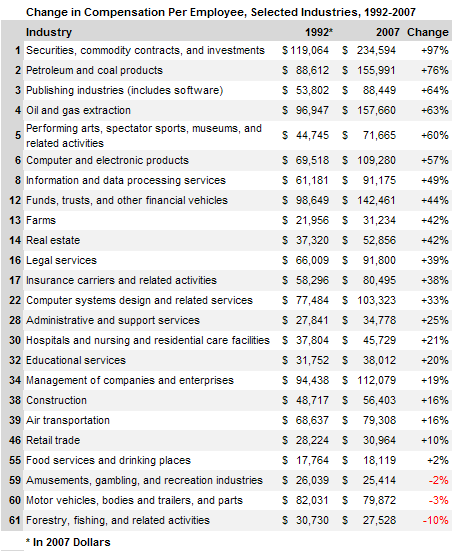
Yes, it’s another table from Nate Silver at FiveThirtyEight. He’s had some great stuff up lately. Here we have changes in compensation (per employee) between 1992 and 2007 for various industries, based on Bureau of Labor Statistics data:

finpay2

I do question some of these classifications–for instance, is “performing arts, spectator sports, museums, and related activities” really a coherent category? Nonetheless, it provides a relatively consistent measurement of compensation, which is useful for comparing change over time.

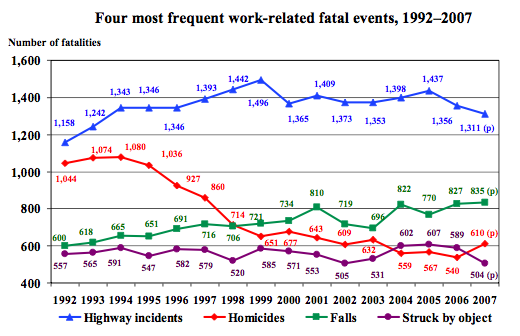
I wandered over to the BLS website and ended up on their Occupational Injuries and Illnesses page. There I discovered this in the National Census of Fatal Occupational Injuries in 2007:

picture-18

Along with the graph, we learn,

Workplace homicides involving police officers and supervisors of retail sales workers both saw substantial increases in 2007.

Police officers makes sense. But retail supervisors? Huh. I wonder what the actual numbers are.

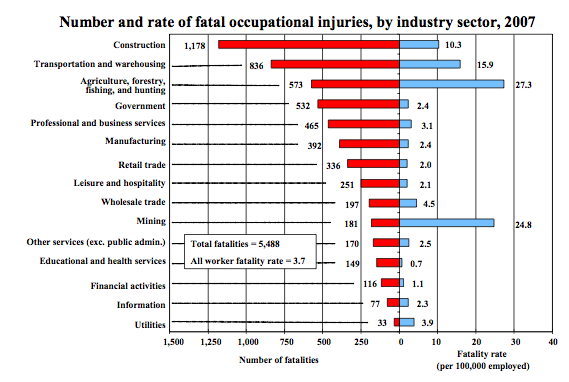
From the same report we get the number and rate of fatalities by industry:

picture-19

The extraction industries (mining, forestry, farming, fishing, hunting) are noticeable outliers here, with significantly higher fatality rates (though not overall numbers) than any other industries.

So there’s some totally unconnected information about the labor force for you.


Kelly Zen-Tie Tsai asks Obama to include the even-less-visible minorities (by which she doesn’t mean the purple, blue, and green):

Via Stuff White People Do, where there is also a nice discussion.

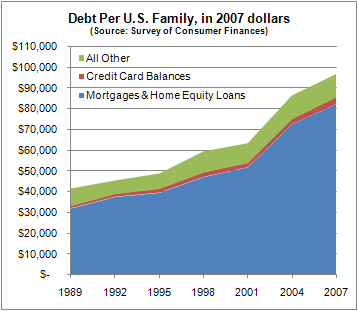
Nate Silver at FiveThirtyEight put up this graph of U.S. household debt (from the 2007 Survey of Consumer Finances):

debt2

Silver says,

Per-family household debt increased by about 130% in real dollars between 1989 and 2007, from roughly $42,000 per family in 1989 to $97,000 eighteen years later. Most of that increase has come during the past six or seven years — household debt increased by 52% between 2001 and 2007 alone. Almost all of the debt (about 85%) falls into the category that the Fed calls “secured by residential property” — which means mortgages and home-equity loans.

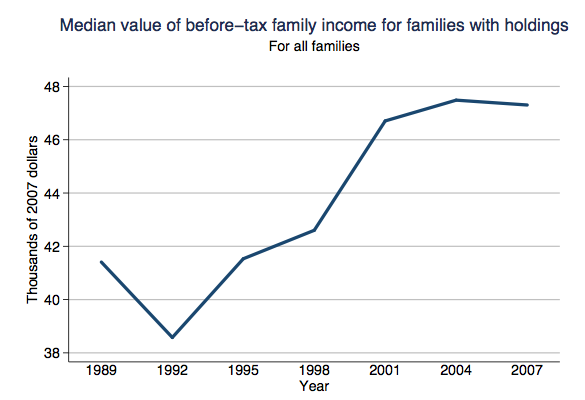
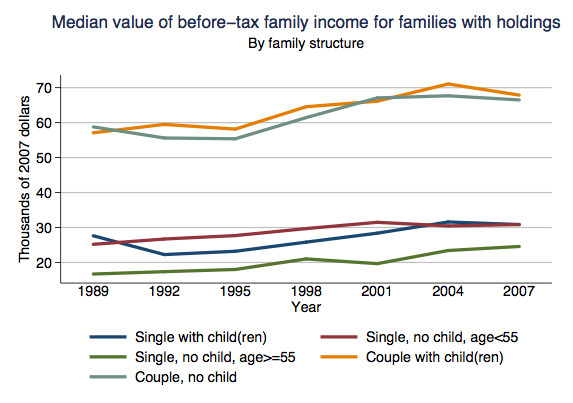
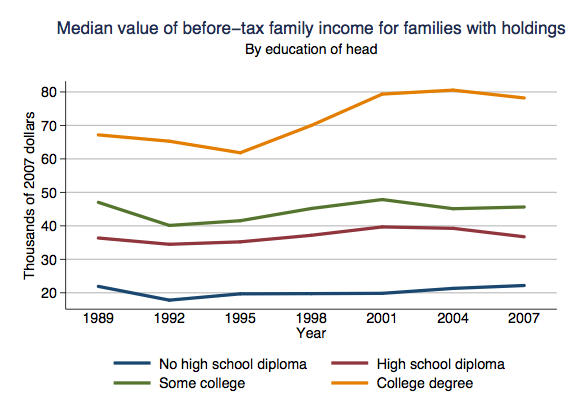
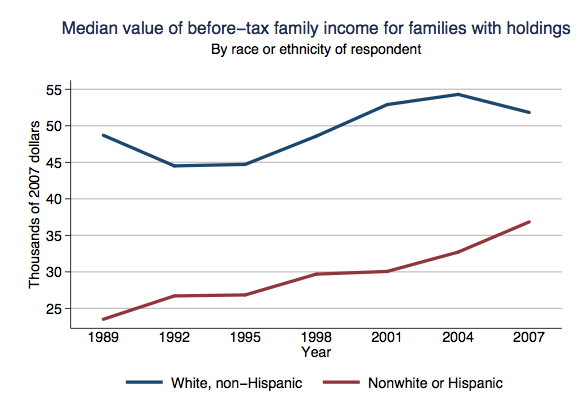
Some other images from the SCF Chartbook (available here)–and pay attention to the y axis, since the scale isn’t the same in all of them:

picture-16

picture-23

picture-3

picture-4

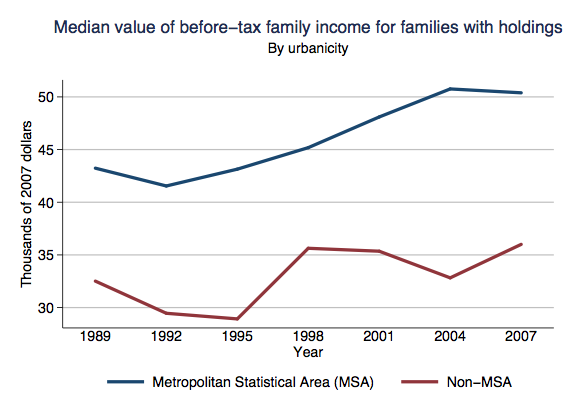
This next one is for rural (non-MSA) and urban (MSA) areas:

picture-5

picture-6

The Chartbook has images of the mean values for all these calculations as well, I just prefer the median to reduce the effects of outlier incomes.

I found the following Web site, PzG, as I was comparison shopping on the Web for a 1:6 action figure that I wanted for customization [to strip of the Nazi associations and use for other, fictional purposes!]. PzG bills itself as “Your Third Reich Nazi Adolf Hitler HQ!” According to its index page, it sells

Distinctive Panzer, Kriegsmarine, Luftwaffe, Waffen SS, and German WWII Nazi resources for hobbyists, teachers,museums and all students of Third Reich history in one convenient location.

As I clicked through the various pages of the site, I quickly realized that it was an Aryan supremacist/Nazi apologist storefront.  Interestingly enough, though, PzG knows that its views are objectionable to many and even addresses this on the page selling mousepads.

One of many mousepads for sale at PzG

The mousepad page says:

No place to hang your favorite war art or recruitment poster? Wife or roomate [sic] dosn’t [sic] approve of your artwork selections? NOT A PROBLEM ANYMORE! Get your perfect piece of historical nazi artwork in an everyday usable format. Get all your favorite designs and change your mousepads often to keep your workspace an inspiring and motivational headquaters [sic].

Note how the page acknowledges that spouses and housemates probably won’t like pro-Nazi displays in their houses. Nevertheless, the page accentuates the “positive” attributes of Nazi culture and iconography [creating an “inspiring and motivational” work place], but never forgets its militaristic origins [mousepads are used in “headquaters”]. This site especially sparks discussions about the use of language to construct a societally acceptable image for a group that most people would find viscerally objectionable.

Incidentally, on the same site, you can also find the site owners’ discussion of the Mothers’ Cross [medals given to women under the Third Reich who birthed many children]. The historical discussion of these medals shifts almost seamlessly into a glorification of the site owner’s large, expanding family, with photos of wife and children as they grow. Is this family practicing the principles elaborated in our earlier discussion about the Mothers’ Cross medal?

I guess sociologists are off the charts!

picture_2

Here, via The American Virgin.

080620_abortion

Found here.