Search results for The


Andrea G. sent us a link to this five-minute peek into Sut Jhally and Jackson Katz’s documentary Wrestling with Manhood, about masculinity and professional wrestling.

Jackson Katz has an earlier documentary, Tough Guise, about masculinity and violence. Here are seven-minutes of excerpts:

See also Gwen’s post on changing ideals of masculinity (measured in guns and cars) inspired by Tough Guise.

For more on masculinity and violence, see our posts about how men’s violence is naturalized or made invisible (here and here), our posts on finding humor in men’s violence (here, here, here and here), and some I’m not sure how to characterize (here, here, here, here, and here).

—————————

Lisa Wade is a professor of sociology at Occidental College. You can follow her on Twitter and Facebook.
And while we’re at it…

Another theme re-emerged among the safer sex ads that Julie C. pointed us to: the use of insects arachnids and reptiles to symbolize sexually transmitted infectiousness (you might have already seen a preview here).

After the jump, partly because of the creepiness factor:

more...

This new commercial for Kentucky Fried Chicken’s grilled option features an assortment of people and, then, two Asian guys in Asian-looking garb with fake Asian accents acting like fools (found at Racialicious):

I’m sort of speechless here. (1) I can’t imagine how KFC could have thought that this made any sense at all. (2) I don’t understand how they could fail to notice that this is racist.

Then again, as we argued about the recent Sotomayor cover, maybe the truth is that it’s simply fine to be racist these days as long as it’s shrouded in the thinnest film of “humor.”

In a post on Racialicious, Arturo Garcia made a point about Sasha Baron Cohen’s work that resonated with me deeply and, I think, captures how I feel about this new brand of satirical humor/hipster racism:

Maybe we’ve had it wrong all along – Borat and the upcoming [film] Bruno aren’t comedies at all – they’re horror movies, holding up the mirror to our new idea of funny.

—————————

Lisa Wade is a professor of sociology at Occidental College. You can follow her on Twitter and Facebook.

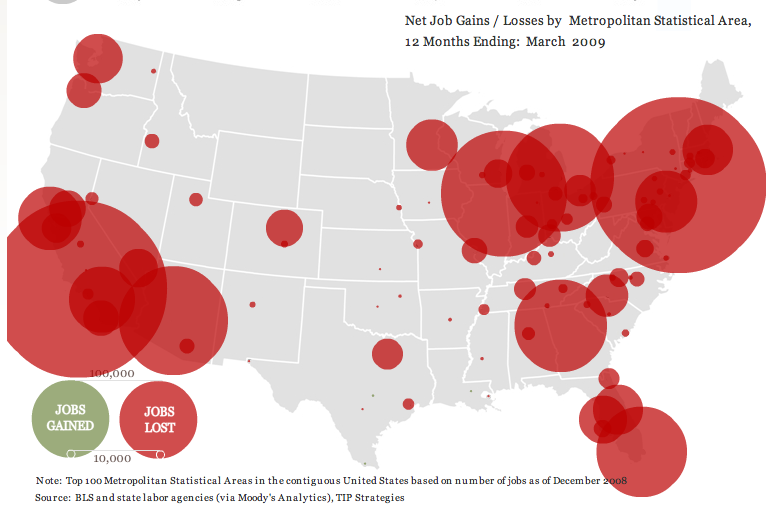
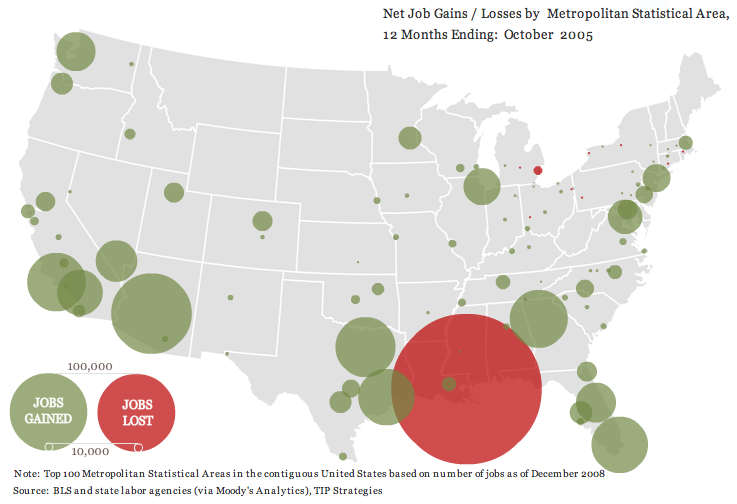
thewhatifgirl let us know about a really interesting interactive website that shows job gains and losses for the 100 largest metropolitan areas in the U.S. from the beginning of 2004 until March 2009, based on Bureau of Labor Statistics data. I took a few screenshots.

Right after Hurricane Katrina:

picture-4

From April 2006 to March 2007, the economy’s looking good for everybody but beleaguered Detroit:

picture-3

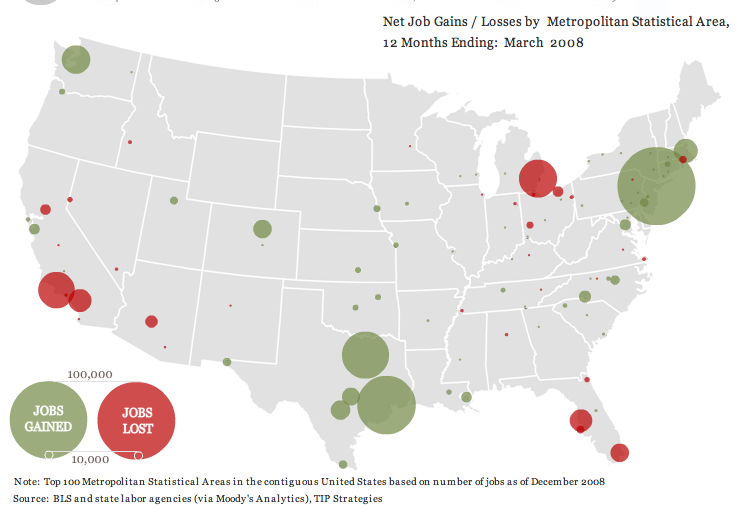
We start seeing a few more problem areas and a lot less job growth from April 2007 to March 2008:

picture-2

And then things go really badly. Notice the job loss circle in L.A. is so big that it got cut off on the website, and there’s not a single job growth circle [Note: eagle-eyed commenter Ali points out there are a few teensy job-gain circles, one in Louisiana, one around Austin, TX, and one way down at the tip of Texas along the border, and it’s possible there are some other small ones covered by the red]:

picture-11

UPDATE: Commenter Miss Prism cautions,

The maps could be straight out of “How to Lie with Statistics”, though.  The diameter (rather than the area) of the circles increases linearly with jobs lost, so a ten times bigger job loss gives the visual impression of being 100 times worse.

So just be aware that it’s how wide the circles are that indicates job loss.

Other posts on the economic meltdown: a county-level map, duplexes and home foreclosures, state budget shortfalls, who feels the recession?, Michigan’s economy, where stimulus money is going, U.S. household income and debt, defending private jet travel, all kinds of data from The Guardian, average stimulus dollars per person by state, unemployment rates by county, video on the credit crisis, framing the stimulus package, beer consumption, the New York Post monkey cartoon, a graph of job losses, gender and job loss, unsold cars, Hyundai’s job-loss insurance program, the economic downturn at the mall, employment/population ratio, home equity as a percent of net worth, advice to the rich: be discreet during a recession, different measures of joblessness, and changes in wages.

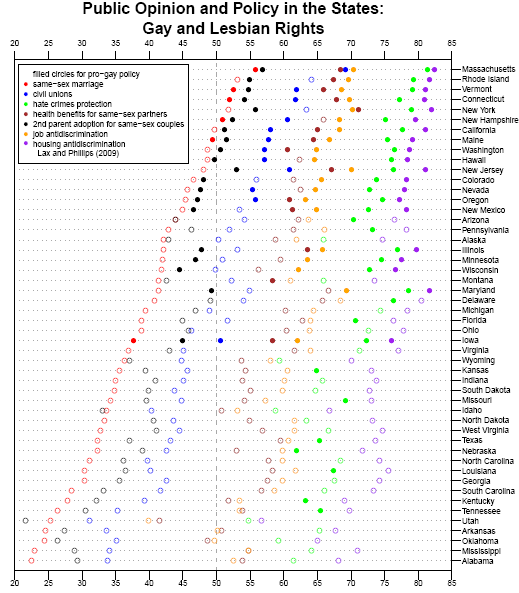
Andrew Gelman, over at FiveThirtyEight, presents a graph from data put together by Jeff Lax and Justin Phillips regarding opinions about various policies affecting gays and lesbians:

gay1

In another post, Nate Silver asks how public opinion about same-sex marriage might change if polls worded the question somewhat differently. Instead of asking “should the government allow same-sex couples to marry?”, we could just as well ask “should the government prevent same-sex couples from marrying?” He suggests that pro-gay-marriage groups might also frame the issue in this way–of keeping the government from taking away rights that people presumably already have rather than as the government giving new rights. It’s an interesting thought, and illustrates the role that question wording can play in affecting how survey respondents think about an issue.

UPDATE: Well, I was taken to task for not providing a better explanation of the graph. However, commenter Christopher explains it pretty well:

For each state, the status of seven public policies is listed as either pro- or anti-gay with seven colored circles which are either filled or empty with respect to the status. In addition, the position of the circle reflects the status of public opinion for each policy.

That is, each color represents one of the policies listed in the legend in the upper-left corner, so, for instance, red = public support for same-sex marriage. If the dot is filled in, it means gay-friendly legislation about the issue was actually passed in the state. If the dot is an empty circle, it means no gay-friendly legislation exists in the state. And the position of the circle tells you what percent of people in each state support each policy.

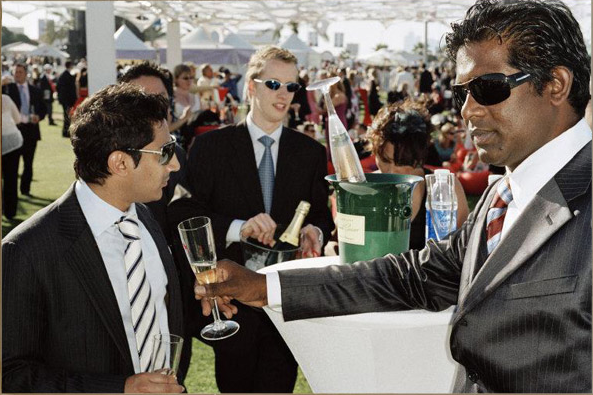
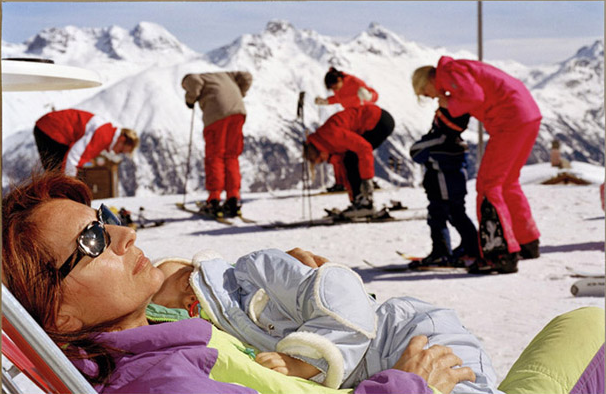
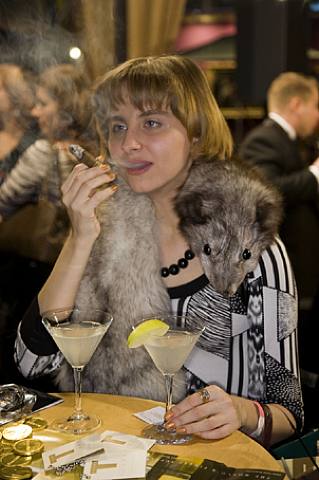
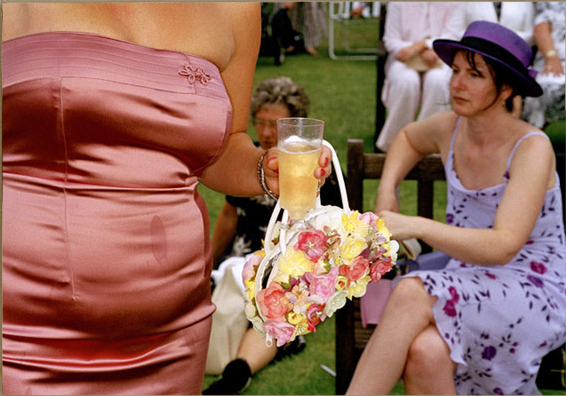
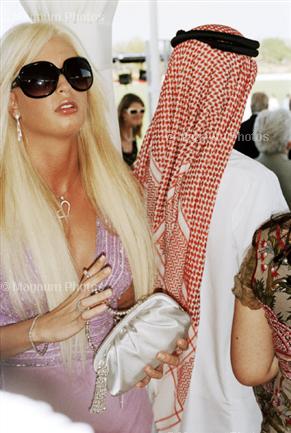
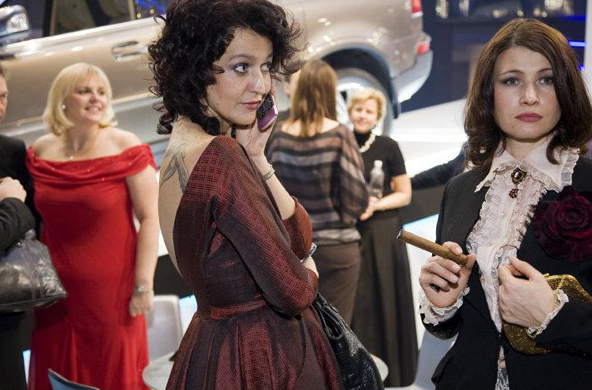
Photographer Martin Parr has decided to photograph the rich in their habitat, exposing an elite world for the rest of us.  He writes:

Shot in various locations, from art fairs to horse racing, and in many countries, I have selected situations where people are comfortable showing off their wealth. Designer clothes, champagne and parties are all part of this repertoire.

Traditionally the portrayal of poverty has been the domain of the “concerned photographer” [see, for example, here], but I photograph wealth in the same spirit.

What I like about his photographs is the realistic portrayal of the rich.  Unlike the way in which wealth is glamorized in popular culture (see, for example, here, here, here, here, and here), these are real people, with all of their imperfections, showing off all of their money.

The pictures are (as far as I’ve been able to determine) from the U.S., Moscow, and Dubai:

2martinluxury
3martinluxury
artwork_images_111979_464027_martin-parr
1martin_luxury
dubai1

picture14

russia12
picture23

(Images from here, here, here, here, here, here, and here.)

—————————

Lisa Wade is a professor of sociology at Occidental College. You can follow her on Twitter and Facebook.
In the opening essay to the book Shared Visions: Native American Painters and Sculptors in the Twentieth Century, Rennard Strickland and Margaret Archuleta write,

J.J. Brody in his classic study, Indian Painters & White Patrons, identified the colonial nature of a patronage system that narrowly defined and dictated what was “Indian art”…It seems almost as if definitionally…that paintings by Indians can be considered only in a primitive, aboriginal context. (p. 9)

They discuss Oscar Howe:

…[he was] thwarted in developing new directions in painting and striving to break away from the old stereotypes limiting Indian art…one of Howe’s Cubist style paintings was rejected from the 1959 Indian Artists Annual because it was “non-Indian” and embodied a “non-traditional Indian style.” (p. 9)

Strickland and Archuleta quote a letter from Howe to a friend:

“There is much more to Indian Art, than pretty, stylized pictures…Are we to be held back forever with one phase of Indian painting…?” (p. 10)

What Strickland, Archuleta, and Howe (as well as other contributors to Shared Visions) are discussing is the pressure American Indian artists have often faced to create a certain type of art. This pressure may come from other Indians or from non-Indians. Non-Indians have often had significant power over Indian artists because of their role as benefactors (providing money for artists to attend The Studio at the Santa Fe Indian School, for instance) and because non-Indians are the majority of buyers of art created by American Indian artists. And benefactors and art collectors often have a certain idea of what “Indian art” is, which includes assumptions about both themes and styles. Specifically, they want “traditional” images that depict Native Americans in a pre-modern world, often including images of animals.

I couldn’t help but think of that book when I recently picked up a tourist-oriented guide to Taos, New Mexico. Now, don’t get me wrong: I’m not saying there is anything necessarily wrong with any of the particular art pieces (or with “traditional” type Indian art more broadly). I’m also not claiming these particular artists feel their artistic expression is limited by preconceived notions of what counts as “Indian art.”

What struck me was just the homogeneity of the images found in the guide, which seemed to more or less fit the mold of the stereotypical idea of “Indian art.” It brings up the question: what is Indian art? Is it any art made by an American Indian? Or does it only count if it fits in with non-Indians’ preferences for what Indian art should look like? What if a White person, say, masters the “traditional” style–is it Indian art then? Over the years a number of American Indian artists have created art to intentionally challenge the idea of the romanticized 19th-century Indian as well as what Indian art can be. For instance, Fritz Scholder painted “Indian Wrapped in Flag” in 1976, in an attempt to deconstruct images of Native Americans (p. 16 of Shared Visions).

Both Indians and non-Indians picketed some of Scholder’s shows in protest.

Similarly, T.C. Cannon painted “Osage with Van Gogh” (I’ve also seen it titled “Collector #5“; from around 1980), which reverses our idea of who collects or appreciates which type of art by showing a Native American collecting a European artist’s work. Another great piece is “When Coyote Leaves the Reservation (a portrait of the artist as a young Coyote)” by Harry Fonseca (1980). See images here.

So are those pieces Indian art? Does it count as “Indian art” only if it contains specific styles and themes?  In which case, does it remain a sub-genre of art–part of “ethnic” art, as opposed to the neutral, non-marked mainstream art world?  Are Indians who paint or sculpt or play music in ways that don’t fit the existing idea of Indian art not “authentic” Indian artists?  If we accept that premise, “Indian art” is, as Howe said, “held back forever,” with themes and styles frozen in time and artists discouraged from experimenting or innovating in their work, as Howe learned so clearly. This tendency is apparent in other elements of U.S. culture, of course: movies like “Dances with Wolves,” books about “noble savages,” and conflicts over what types of technologies American Indians can use when spear fishing (with non-Indians arguing Indians should only be able to use the methods that their tribes used in the 1800s) all indicate a wider perception that “authentic” Indians should inhabit a time-warp universe in which their cultures and lifestyles have remained basically unchanged since the late 1800s or early 1900s, a requirement we don’t ask of other groups.

For more evidence that Indians are represented, and expected to represent themselves, anachronistically, see this post.

UPDATE: Commenter Camilla points out a documentary that asks similar questions about “African” art:

Christopher B. Steiner produced a fantastic anthropological documentary about the market for “African” art that addressed many of these same issues. It’s called “In and Out of Africa”…It explores the issue of how ideas such as “authenticity” and “tradition” are socially constructed phenomena. It also questions why particular types of “ethnic” art are successful in Western markets, while others are not.

Gwen Sharp is an associate professor of sociology at Nevada State College. You can follow her on Twitter at @gwensharpnv.

3615989327_e3474289ca

“Pregnant? Scared?”  They don’t mean hemorrhoids and contractions; they mean social opprobrium and economic ruin due to stingy social services.

Jill at I Blame the Patriarchy writes:

There is only one reason that pregnancy should “scare” you: your culture hates women and kids. It especially hates teenage women. It especially hates pregnant teenage women. It especially hates teenage pregnant women who get knocked up under unapproved circumstances.

It had never occurred to me before that a generalized fear of getting pregnant is a culturally and historically contingent state of mind.  But, of course, it is.

—————————

Lisa Wade is a professor of sociology at Occidental College. You can follow her on Twitter and Facebook.