Search results for The

As reported in the Associated Press, according to a report released today by the Trust for America’s Health and the Robert Wood Johnson Foundation, “Adult obesity rates increased in 23 states and did not decrease in a single state in the past year… In addition, the percentage of obese or overweight children is at or above 30 percent in 30 states.”
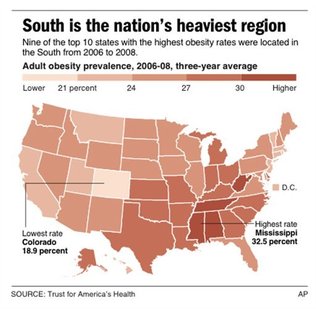
obesity_statesMore details, nifty flash graphics, and state specific information can be found online.
HAPPY BIRTHDAY TO SOCIOLOGICAL IMAGES!

Sociological Images is two years old this month.  In July of 2007, we had a whopping total of three (3) posts.

We have great fun with the blog and feel very lucky to have such passionate and intelligent readers.  Thank you all for reading, commenting, and submitting images!


FROM THE ARCHIVES:

While in Oklahoma this summer, Gwen and I saw a swastika design built into a brick chimney.  It reminded us of Wendy’s fascinating post on the history of the swastika symbol from June 2008.  Before WWII, it didn’t signify oppressive racist ideology at all.  The post features pictures of swastika jewelry, a swastika quilt, and more.


NEWLY ENRICHED POSTS (Look for what’s NEW!):

Race and Inequality

We updated our post about race and toxic release facilities by adding some maps showing high-poverty areas and air pollution in Toronto.

Racialicious had an interesting post about Microsoft’s Natal game initially having trouble recognizing people with “dark skin,” which we added to our post about Nikon’s blink-recognition software problems.


Sex and Sexual Orientation

Another zoo reports a pair of gay penguins raising a chick.  We added it to our post on gay animals.

A poster affixed to a tree outside my house was another excellent example of heteronormativity and the social construction of the family.  I added it to a previous example (featuring elephants!).

Christine B. sent us some images of sexualized animals used in Orangina ads, which we added to our earlier post about their insane commercial.

Joyous A. sent us a link to a photograph that we just had to add to our post on ejaculation imagery.


Doin’ Good

Also in boobs,we added another example of breast cancer marketing, this time a breast cancer-themed limousine sent in by Steve W., to our post on the topic.

We also added an anti-smoking advertisement threatening women with unattractiveness to a similar anti-drinking advertisement.


Hot Stuff

We added another example of the objectification of men to our post on the topic (NSFW). In this example a mascara wand involves a man who loses his clothes. Thanks to Jennifer C. for sending us the link!

Fiona D. sent in a Belfast Telegraph story on the Lingerie Football League that apparently warranted a slide show with fifty-nine (59) photos. We added some to our post asking “What warrants a slide show?” (scroll down).

Tiffani sent us an ad in which a woman with her head in a clothes washer is used to advertise a credit union in Georgia. See it here.

We also added a billboard, sent in by Sharon G., using sex with women to sell kitchen remodeling.  See it here, among our other examples of sex being used to sell homes and house stuff.

And Sarah N. sent us another example of women’s “curves” being used to sell products. We added it to our post on the topic here.

Taylor S. sent us another example of a boob-themed product and we added it to our products-shaped-like-boobs post.

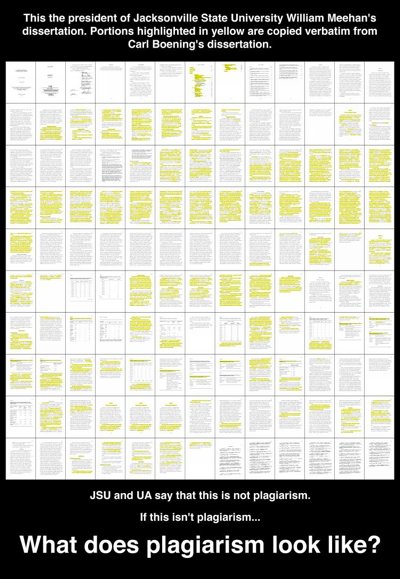
Nicole D. pointed out an interesting post on boingboing about plagiarism and status. Somehow or another someone noticed that large parts of the dissertation written by William Meehan, president of Jacksonville State University, were lifted word-for-word from an earlier dissertation by Carl Boehning; both men got their Ph.D.s from the University of Alabama. Here is an image indicating the extent of the copying–all the highlighted sections are exact replications of Boehning’s words (this does not include passages that were paraphrased without citation from his dissertation):

200906011029

You can get a look at the actual documents if you’d like: Boening’s work, Meehan’s dissertation, and an index of the plagiarized sections.

Michael Leddy of Orange Crate Art says,

Neither the University of Alabama (which granted Boening and Meehan their doctorates) nor Jacksonville State University, where Meehan is president, has chosen to take up the obvious questions about plagiarism that Meehan’s dissertation presents. As another recent story suggests, plagiarism seems to be governed by a sliding scale, with consequences lessening as the wrongdoer’s status rises.

The “recent story” he mentions is about how a paragraph from Talking Points Memo ended up in a Maureen Dowd column, uncited and without quotation marks.

I find this beyond infuriating. I am, admittedly, hardcore about plagiarizing. I check every paper for it and I immediately give a 0 on any assignment where I find plagiarizing for a first offense; if it’s a second offense, I fail them in the course (I’d really prefer to fail them for the first offense, but we aren’t allowed to do that). I also turn in every instance to the college student ethics committee so the record will be on file. But, as Leddy says, apparently if you can rise high enough, then later discovery of your plagiarism–of the document on which a person’s entire Ph.D. is based, no less–won’t be held against you (though it did dim Joe Biden’s career for a while when he, or his writers, plagiarized part of a speech years ago).

Given that universities increasingly make statements about the importance of academic honesty, it’s an interesting position for JSU to be in–how do you tell your students they can’t plagiarize but admit that the president’s dissertation was largely copied? Perhaps they are using it as an illustration to students of how status, power, and privilege combine to protect some people more than others.

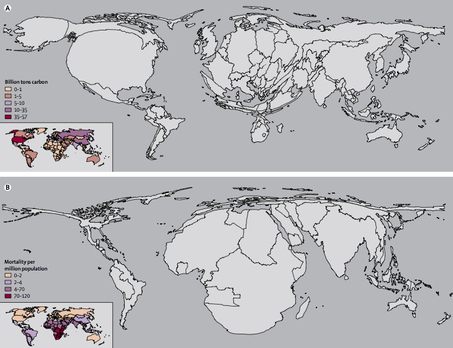
The two maps below are part of a series of maps that warp the size and shape of countries according to various international disproportions (see lots more here).

These two warp countries according to how much they are contributing to global warming and how much they are likely to suffer from global warming respectively.

globeadjustedclimate-thumb-453x348

Ezra Klein interprets:

The first shows the world in terms of carbon emissions. America, for instance, is huge. So is China. And Europe. Africa is hardly visible. The second map shows the world in terms of increased mortality — that is to say, deaths — from climate change. Suddenly, America virtually disappears. So does Europe. Africa, however, is grotesquely distended. South Asia inflates.

Kevin Drum summarizes:

Long story short, we spit out the carbon, but it’s people in Africa and South Asia who are mostly going to die because of it.

Thanks to Toban B. who linked to these maps in a comments thread.

—————————

Lisa Wade is a professor of sociology at Occidental College. You can follow her on Twitter and Facebook.

These Virginia Slims ads from 1969, sent in by Fred H., show how the idea of “progress” was as useful then as it is now (see also this post on the subject). The commercials suggests that the right to smoke is part and parcel of women’s liberation.

Fred also notes the suggestion that “petite things are meant for women.” Notice that the last commercial, on a different theme, uses not only the “slim” analogy, but also calls the cigarette “beautiful.”

[youtube]https://www.youtube.com/watch?v=vXUbkIkwn2Y[/youtube]

For other examples of co-optation, see these posts using feminism to sell guns (here and here), beauty products (here and here), botox, diamond rings, cars and credit cards, cars and bras, pornography, cleaning products, panties, and eyeglasses, washing machines, and, of course, cigarettes (here and here).

—————————

Lisa Wade is a professor of sociology at Occidental College. You can follow her on Twitter and Facebook.

Lisa Wade, PhD is an Associate Professor at Tulane University. She is the author of American Hookup, a book about college sexual culture; a textbook about gender; and a forthcoming introductory text: Terrible Magnificent Sociology. You can follow her on Twitter and Instagram.

Sociologist Yen Le Espiritu popularized the idea of a pan-ethnic identity.  “Asian American” is a pan-ethnic identity. It is an invented label applied to dozens of different groups with wildly different cultural traditions and languages. Most Americans (Asian and not), over time, came to accept the term as meaningful. American Indian is also a pan-ethnic term, as is African American and most other such labels.

On the one hand, pan-ethnic labels can be empowering. There is power in numbers. A large community identified across ethnic and national identities by race (however fake that racial designation is) can, for example, become a powerful voting bloc to which politicians must attend, or be mobilized to work together to fight for a common cause.

On the other hand, pan-ethnic labels can be disempowering. They tend to ignore the distinctions that make ethnic and national identities meaningful, and the rough categories erase differences among groups, thus making it more difficult to see and, thus, problematize disadvantage.

This latter problem motivated the Asian Pacific American Coalition (APAC) of the University of California campuses to run its “Count Me In” campaign. They notice that, though “Asian Americans” were well represented on University of California campuses (they make up 43% of incoming frosh in 2006), certain groups deemed “Asian” remain underrepresented. These include students of Cambodian, Hmong, and Laotian descent, among others.

The campaign asked the University of California system to disaggregate their “Asian” category.

In response the University of California added 23 new categories to their application.

For a much more extensive discussion of this issue, see Fatemeh Fakhraie’s post at Racialicious(where I stole this video clip).

—————————

Lisa Wade is a professor of sociology at Occidental College. You can follow her on Twitter and Facebook.

Feminist scholars argue that patriarchy relies not just on a hierarchy that places men above women, but a hierarchy of men that punishes men who don’t obey rules of masculinity.

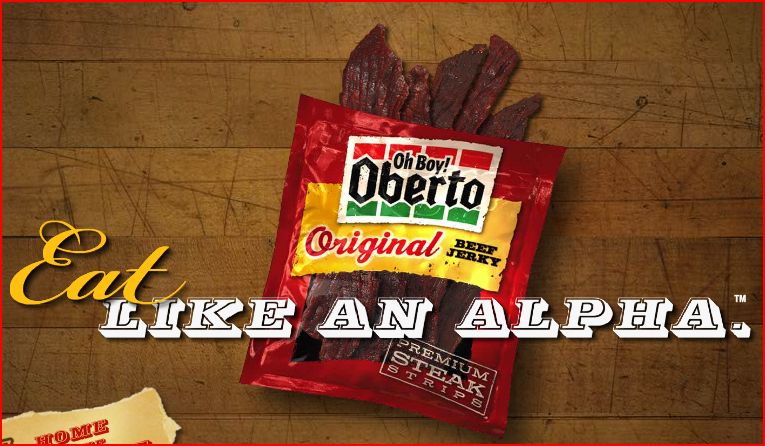
An advertising campaign for Oberto Beef Jerky, sent in by Kate S., nicely illustrates the threat to men if they don’t comply with patriarchy.

capturett

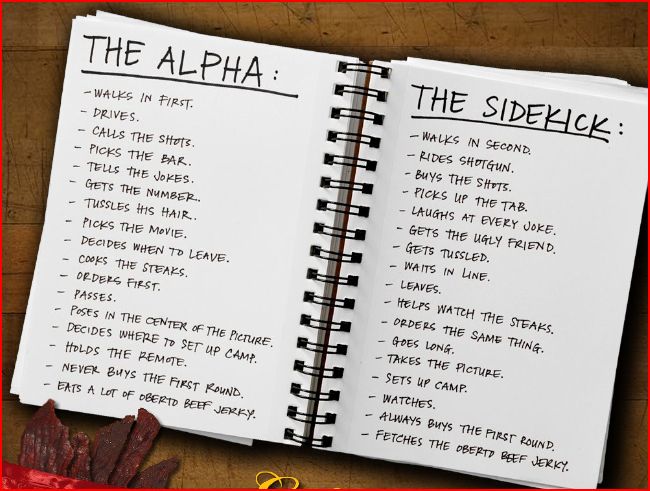
The threat is: If you’re not an “Alpha,” then you’re a “Sidekick.”

capturetv

The Alpha is first; the Sidekick is second. The Alpha gets served; the Sidekick serves. The Alpha gets the hot chick; the Sidekick gets the “ugly friend.” The Alpha makes the decisions; the Sidekick takes them.

In one part of the website, it actually encourages you to “establish your dominance.”   It features taunting emails and cards that you can send to your friends to trick them into looking like idiots/being your sidekick.

UPDATE: In the comments thread, Toban B. (T B) had a really nice observation:

As Murray Bookchin has written, language about ‘alpha males’ naturalizes hierarchy.

Bookchin highlights how people have conflated animal and insect interactions (e.g. ‘queen’ bees) with societal structures created by humans — as opposed to the far more instinctual of relations of non-human creatures.  (For Bookchin, there is a continuum between humans and other life forms, so these distinctions aren’t binaries.)  Basically, the point here is that if human hierarchies are the same as instinctual hierarchies (e.g. interactions with a lion ‘king’), then the human hierarchies must be just as natural and inevitable — which just isn’t the case.

Joanne suggests, further, that humans, invested in patriarchy and hierarchy, actually project it onto the natural world:

Using the terms “alpha” and “dominance” just reinforces the belief that nature exists within a patriarchal, hierarchical model.  It actually doesn’t.  I do a lot of work with horses, researching and observing the horse-human relationship, and this whole idea of “dominance” is one that has started with and is kept alive by the patriarchal worldview of Western culture.  Many observers of animal behavior are brought up in and continue to live in that worldview, so they impose it on animals and the natural world.  If you step outside of that worldview, what you find in the natural world is something entirely different.

—————————

Lisa Wade is a professor of sociology at Occidental College. You can follow her on Twitter and Facebook.

Lisa Wade, PhD is an Associate Professor at Tulane University. She is the author of American Hookup, a book about college sexual culture; a textbook about gender; and a forthcoming introductory text: Terrible Magnificent Sociology. You can follow her on Twitter and Instagram.

From ABC News, “Transformers: Revenge of the Fallen … is taking fire for its comic relief: a pair of slang-spewing, illiterate Chevy hatchbacks named Skids and Mudflap… the robot duo is being labeled a racist caricature.” According to Yahoo News, “They’re forced to acknowledge that they can’t read. One has a gold tooth.”

ADDITION Film Transformers-Jar Jar AgainI haven’t seen the movie, so it’s difficult to comment directly, but I wonder if this another example of the dehumanizing racial stereotypes. Michael Bay, the director, largely dismisses the concerns. “Listen, you’re going to have your naysayers on anything,” he said. “It’s like is everything going to be melba toast? It takes all forms and shapes and sizes.”