Search results for The

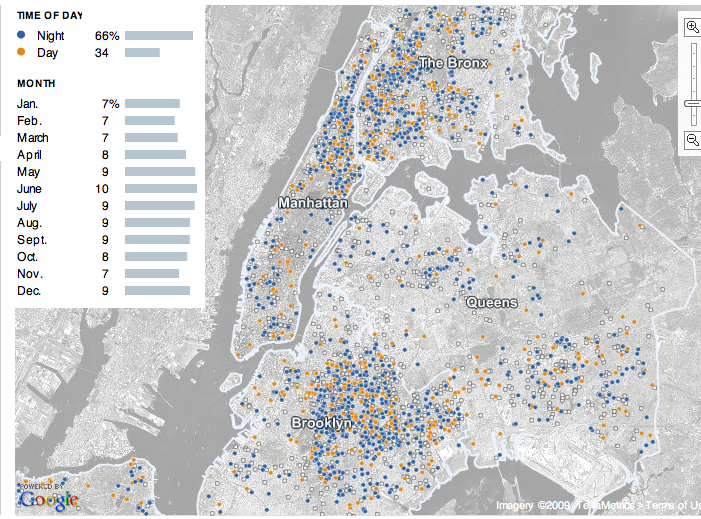
Miguel of El Forastero told us about an interactive map at the New York Times that presents data on murders in New York City from 2003 to today, broken down in various ways. The data come from NYPD reports, and of course there are definitely issues with taking police reports as a measure of actual crime, but my understanding is that while police reports on things like theft and rape are a poor measure of how often those crimes actually occur, they’re considered much more accurate regarding murder. In each map below, I include all murders from 2003 to 2009, but you can select particular years as well.

As many of us would suspect, the majority of murders occur at night (though the site didn’t specify exactly what hours are defined as “night” and “day”):
 picture_1

The racial breakdown of both victims and perpetrators are extremely similar:

picture_2

picture_3

The next two maps show that murder is an overwhelmingly male activity. When I discuss crime with my students, they usually assume most perpetrators are male, but because their ideas of assult and murder often relate to domestic violence or rape, they are always very surprised to find out that most victims of murder are also male. As we see, women are more likely to be victims than they are to be perpetrators, but still, the vast majority of murder victims are men:


picture_4

picture_5

Murder is also linked to age, with 18 to 34 year olds being most likely to be murdered or to murder someone else:


picture_6

picture_7

I found the accompaning article in the NYT rather interesting as an example of overemphasizing the likelihood of murder. Here are the first two paragraphs:

A young boxer was shot dead outside a Bronx bodega at 3:30 a.m. on a Saturday last August. Weeks later, a 59-year-old woman was beaten to death on a Saturday night on the side of a Queens highway. On the last Sunday in September, violence exploded as five men were killed in a spate of shootings and stabbings between midnight and 6 a.m.

Seven homicides in New York City. None connected in any way but this: They happened during the summer months, when the temperatures rise, people hit the streets, and New York becomes a more lethal place.

A few paragraphs down:

Still, the prime time for murder is clear: summertime. Indeed, it is close to a constant, one hammered home painfully from June to September across the decades. And the breakdown of deadly brutality can get even more specific.

Only in paragraph 6 do we get this information:

Of course, the dominant and most important trend involving murder in New York has been the enormous decline in killings over the last 15 years, to levels not seen since the early 1960s.

From reading the first several paragraphs, the impression is that NYC is awash in a “spate” of murders, making it a “lethal” place full of “deadly brutality.” Only in one small section do they acknowledge that, in fact, murders are down significantly. Now, of course, that doesn’t take away from the horror of the murders that do occur, but it feels like a bit of fear-mongering. This is a common trend in the mass media–newscasts often give a lot of coverage to crimes, particularly murders and assaults, for instance–and it gives the public the idea that crime is common (and increasing) and the world is a dangerous place.

The emphasis on how dangerous summer is also seemed a bit disproportionate. As the first map above illustrates, yes, a higher percentage of murders occur June through September, but given the language of the article, you’d expect a much bigger difference between those months and other times of year.

Stephen W. sent us a photograph of a billboard in Rock Valley, IA.  It suggests that keeping your baby, instead of having an abortion, is good for the economy:

cimg3590xxx

Sociologists talk about how nations are invested in reproduction.  Without babies, nations literally disappear; too many babies and nations collapse under the strain of a population they cannot support.  Because nations need babies (but not too many babies), states adopt pro- and anti-natal policies (e.g., the one child rule or medals for mothers) that encourage or discourage childbearing.  This billboard is an interesting example of a call to women to have children so as to help the nation (though it is sponsored by a pro-life organization, not the state).  Women, in this argument, have a responsibility to the nation (perhaps equivalent to military service?) that transcends their individual reproductive preferences.

(See this related post on making babies for the military.)

—————————

Lisa Wade is a professor of sociology at Occidental College. You can follow her on Twitter and Facebook.

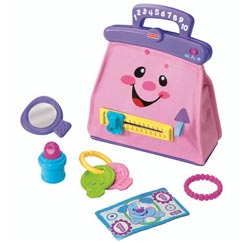
Andrea G. alerted us to a Fisher-Price toy, called My Pretty Learning Purse, for children aged 6 to 36 months. Behold:

fisher-price-laugh-learn-my-pretty-learning-purse1

The purse comes with a dollar bill, a bracelet, a mirror, and a set of keys.  It also sings songs about purple and pink.

Andrea writes:

With these props, a one year old can properly play “woman.”  I felt this is an example of how we do gender and teach it to children, as young as a year old.

At least they’re admitting that femininity must be “learn[ed]?”

UPDATE: Jane, in the comments, linked to a Fisher Price product for boys that is very similar:

m6221_b_2

Get it!  It’s a tool box and it includes keys, a screwdriver, a hammer, and a saw.

The play involved in each product is essentially identical (e.g., music, putting things in and taking them out), but the theme of the play is gendered.  Do you think this is to please the parents or the kids?

NEW (Dec. ’09)! Monica C. sent along this page from a Target catalog featuring a girl playing with a kitchen and a boy playing with a tool set:

target_cooking_and_tools

Also in teaching young children femininity and masculinity, see our posts here, here, here, here, here, here, here, here, here, here, here, here, here, here, here, here, here, here, and here.

—————————

Lisa Wade is a professor of sociology at Occidental College. You can follow her on Twitter and Facebook.

Christopher F. brought our attention to how the release of the four Chinese Uighurs from Guantanmo is being framed in the media. Uighurs are a minority group in China, often facing persecution for being Muslim. These three men had fled China as a result and were detained after the U.S. invaded Afghanistan. They were found innocent in 2003. Now, after years at Guantanamo, they were released and resettled in Bermuda, since there were fears that they could not safely be returned to China. Some images of them in their new home (from USA Today):

6a00d83451b46269e201157114d51b970b1

6a00d83451b46269e20115711526a2970b

What brought Christopher’s attention to the coverage of the Uighurs was a news segment he saw on MSNBC. The Huffington Post has a video of the segment (I can’t figure out how to embed it) and quotes part of the discussion by Tamron Hall:

But first from Gitmo to Bermuda, should former detainees, the ones you’re looking at there, be living what seems to be a pretty good life on one of the most beautiful islands some say in the world?

Another MSNBC host, Andrea Mitchell, said the following in a segment earlier in the day:

Let me talk about Guantanamo: you raised the point about the murky legal situation, one upshot of that is that we’ve got four Uighurs who are Muslim minority from China who are now basically getting ice cream and lolling about on the white sand beaches of Bermuda. It’s sort of incongruous! To see these four men in their polo shirts, from Guantanamo, eating ice cream in Bermuda…I mean, look at that picture! I’m not sure you can see it, but one of the Uighurs is swimming in the ocean. The first time, we’re told, that they had ever been to the ocean. Is this a good outcome?

Over on The Daily Show, Jon Stewart echoed some of these ideas:

The Daily Show With Jon Stewart Mon – Thurs 11p / 10c
Guantanamo Baywatch – Uighur, Please
thedailyshow.com
Daily Show
Full Episodes
Political Humor Jason Jones in Iran

Christopher says, about the photos above,

These images humanize something that has been, for the past 7 or so years, totally inhuman and alien. I find it highly disturbing that even the image of these former detainees enjoying their deserved freedom (we have know for a while now that these people were not complicit in any plot against the United States) is somehow anathema.

Indeed. These are men who were falsely imprisoned as a supposed threat and then remained at Guantamo for years since they were declared innocent and no threat to the U.S. Why are images of them enjoying themselves and living in a nice house and eating ice cream so problematic and offensive? You know, this is just my thought, but if you imprison someone for years for no good reason, really, the least you can do is give them a nice place to live where they won’t be persecuted. And it’s not like they chose Bermuda: when you imprison people for supposed links to terrorist groups, it turns out that when you release them, other countries aren’t eager to take them (and clearly, they can’t be released in the United States because…well, because people in the U.S. still consider them threatening, despite what the government might say). Bermuda was one of the few places that would agree to take them. How the particular house or luxurious ice cream was chosen, I don’t know.

There seems to be an underlying feeling here that the Uighurs simply don’t deserve such nice living conditions, even if we did arrest them, fly them around the world, and detain them for years. Instead of focusing on the fact that several innocent people were released, and that they remained in Guantanamo for six years after the U.S. said they weren’t actually a threat, there’s concern that they were released in a place so nice. If most American citizens don’t live like that, why should they get to? I can’t help but wonder how the coverage might have been different if they were resettled in a poor nation and were shown living in a run-down house.

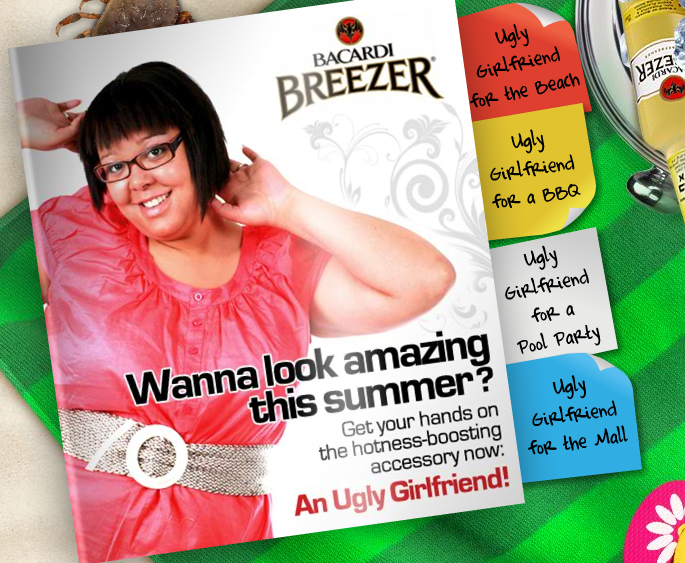
Kristin W., Brad W., and Deb G. sent us the Bacardi Breezers “Get an Ugly Girlfriend” ad campaign, discussed over at Jezebel. The message? Ladies, if you want to look better, get an ugly female friend to stand next to:

picture-12

There are profiles of the various ugly girlfriends you can get:

picture-21

picture-31

picture-41

picture-5

Of course this ad campaign suggests to women that the most important thing about them is how they look. But, more insidiously, as Sweet Machine points out, it places women “in competition with other women for male attention” in a world where “self-esteem is a zero-sum game.”

This is how patriarchy creates in-fighting among women: If men have the power, and the only way to get power is to get men, then women feel compelled to try to get (the attention of) a man (or men).  Other women are their competition.

Women are stereotyped as bitchy and catty as if it is an inherent feature of femininity when, in fact, women’s subordination to men creates the conditions that force them into competition.

We see it happen live in this horrendous clip from Battle of the Bods.

More examples of cultural endorsements of the idea that women and girls are always in competition with one another here, here, and here.

UPDATE: Commenter Joanne pointed out an update, via Shapely Prose:

Sean-Patrick Hillman of bacardi.com comments below:

June 21, 2009

Thank you for taking the time to post your story regarding Bacardi Breezer.

The campaign you are referring to ran in 2008 for two months in Israel. Even though Bacardi Breezer is not sold or distributed in the United States, we immediately notified the appropriate Bacardi affiliate and had this website shut down.

Bacardi proudly celebrates diversity and we do not endorse the views of this site.

We sincerely apologize to anyone who was offended by this site and thank you for bringing it to our attention.

I’m a bit confused, though–I did a quick google search, and Bacardi Breezer seems to be sold in a lot of places, including Canada and the U.S., but maybe they’re imported by a third party and not directly by Bacardi? I know I’d heard the name Bacardi Breezer before I saw these ads. Apparently I’m going to have to go on a tour of local liquor stores to see. What a horrible life I lead.

And I also agree with several of the other commenters–how awful must it be to be cast as an “ugly” person?

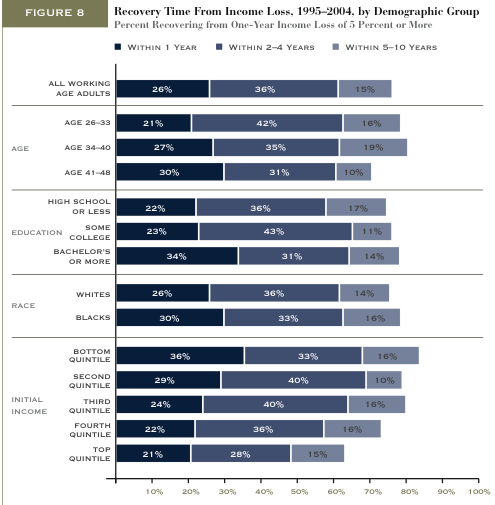
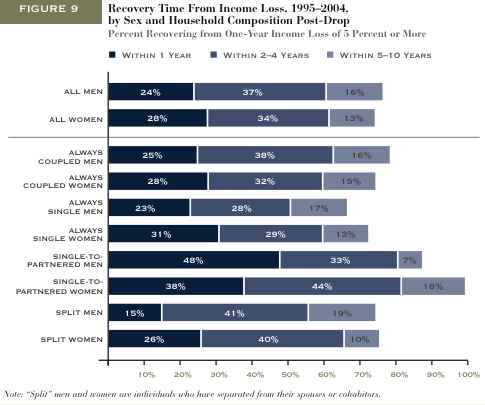
Matthew Yglesias featured two figures from the Pew Economic Mobility project.  They show how long different types of people tend to take to recover from income loss (within 1 year, 2-4 years, or 5-10 years).

This figure shows that people who are older, have more education, or are poor, working, or middle class have a harder time recovering from tough economic times:

recovery

This figure shows how marital status is related to recovery.  Most dramatically, people who get married before recovering financially (especially men), women who split with a partner, and women who are single have a more difficult time recovering.

recoverygender

Something to consider: As several commenters noted, I’m not sure how they defined “recovery” from income loss.  If you never made a lot of money to begin with, does recovery simply mean returning to a state of low income?  Then, does the income for an initially high income person need to return to its high state for it be counted as a “recovery”?

(Just FYI: I revised my interpretation of these figures.  Thanks to the early commenters who noticed I’d misinterpreted.  It was really late at night when I wrote this post!)

—————————

Lisa Wade is a professor of sociology at Occidental College. You can follow her on Twitter and Facebook.

Toban B. sent in a link to a clip of a 1935 Department of the Interior movie that includes a scene with African American conservation workers. I couldn’t find an embed code, so you have to click over, but the clip clearly illustrates the “happy-go-lucky,” dancing and singing stereotype of Blacks common to the era. The person who posted the clip says,

The racial stereotyping in this clip is appalling, but not surprising for a 1935 production. Hollywood films of that era also portrayed African-Americans purely for laughs. It was a rare film that showed black people as more than two-dimensional, and when they did – as Hattie McDaniel demonstrated in Gone With The Wind – Hollywood was ready to pat itself on the back.

Of course, Spike Lee’s movie “Bamboozled” implied that this type of stereotypical Black-man-as-happy-man-child-entertainer trope is still alive and well. He’s been criticized for his portrayal, of course, but it’s food for thought.

Genderkid sent in a link to a story in The Morning News about the Teen and Transgender Comparative Study, an art installation by Charlie White at the Hammer Museum in L.A. A description from the story:

The series is a correlation of two stages of transformation, pairing teen girls (12-14) with like adult [transgender] male-to-female…

More from The Morning News:

In the images in White’s series, both figures are blossoming into womanhood, though each along a different path. As observers, however, we have been taught to view the subjects in much the same way: with sheer terror.

For just as the original 1950s Invasion of the Body Snatchers warned of Communism’s impending doom, and stories of men with hooks were concocted to frighten young girls from riding in cars with boys, so often have Hollywood summer comedies acted as cautionary tales for the male who would cast his desire toward either the pubescent or transgendered woman. Because in the right skirt or the right application of makeup, each has proved alluring to our hero…

Indeed, both sexy underage girls and transgender women who “fool” unsuspecting men are often portrayed as threats to (straight, adult) men. The “Lolita” figure is long-standing, and portrayals such as the Ally McBeal plotline in which a man falls in love with a transgender woman without knowing she is trans present the possibility of men being “fooled” into having sexual or even long-term romantic relationships with a transgender woman. Both teen girls and trans women are threatening and can get a guy in trouble.

Of course, we’re more accepting of one of these types of trouble than the other, and we shouldn’t be surprised that trans individuals who are “discovered” may face dire consequences for “fooling” men who have an intense investment in a rigid type of heterosexual identity and fear ridicule by peers, such as the three men who killed a transgender teen in California. (And I don’t mean to imply here that women don’t ever feel uncomfortable with or attack trans individuals, but the murders I’m aware of all included male perpetrators.)

Anyway, it’s a pretty fascinating set of images. Thanks, genderkid!

UPDATE: Commenter EGhead says,

This analysis also neglects that society insistently refuses to acknowledge transgendered women as women, even though they are, while insistently acknowledging girls as women, even though they aren’t.

Fair enough–I think that’s a good point.

Gwen Sharp is an associate professor of sociology at Nevada State College. You can follow her on Twitter at @gwensharpnv.