Search results for The

Parker F. sent us a fun vintage ad that reminds us that chocolate wasn’t always seen as a woman’s indulgence.  The ad below, for Fry’s Chocolate Cream (found at the BBC) features a man delightfully, and conspiriatorally, popping a chocolate, with the copy “Go on– spoil yourself!”   The message (indulgence) is so familiar, but the subject (a man) less so.
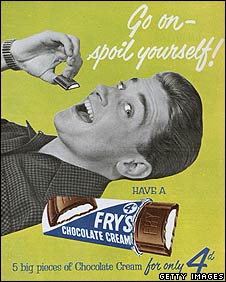
I think, if the ad ran today, it’d likely feature a woman and, instead of reading “5 big pieces… for only 4¢,” it’d read “5 big pieces… for only 40 calories.”

Today, it seems that efforts to sell chocolate to men involve hypermasculinization, as in the recent Snickers advertisements featuring Mr. T.the linking of Easter candy with professional wrestling, and Yorkie’s “Not For Girls” candy bars.

Lisa Wade, PhD is an Associate Professor at Tulane University. She is the author of American Hookup, a book about college sexual culture; a textbook about gender; and a forthcoming introductory text: Terrible Magnificent Sociology. You can follow her on Twitter and Instagram.
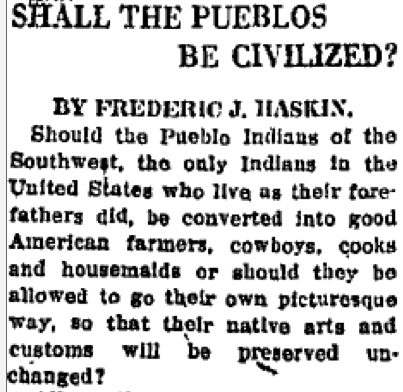
Larry of The Daily Mirror sent in an article that ran in the Los Angeles Times on January 26, 1920. Here are some screencaps of the most interesting sections:

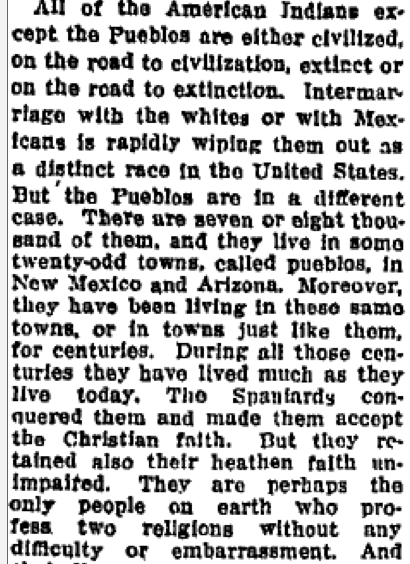
Not surprisingly, civilization means only one thing: assimilation into Anglo culture. The other option? Extinction. How do we know a tribe isn’t civilized? They still live like their “forefathers” did. It’s a theme we see a lot in terms of Native Americans: in order to be authentic (which in this case means “uncivilized”), they must not change any cultural practices. There is an expectation that “real” Indians are culturally frozen in time, as though their cultural practices and lifestyles had not changed throughout history just like every other group’s has.

And also, I’m pretty sure lots of groups have combined elements of two or more religions “without any difficulty or embarrassment,” but whatever. I’m sure they were, indeed, of immense interest to artists, scientists, and writers (also, physiognomists). And since they are of interest to them, that should definitely be taken into account when we decide what to do with them. Taos still loves Indian art.

Still, Native American cultural customs are acceptable only to the degree they are compatible with assimilation. And learning to read and write, use a stove or a sewing machine, mean giving up “the Indian life.” Again, modernity cannot be combined with existing cultural practices.

It’s a great example of how Whites felt entirely comfortable discussing what the future of American Indians should be, either romanticizing them as noble savages or insisting on their cultural backwardness, without any sense that Indians themselves might have any ideas on the issue worth paying attention to.

Gwen Sharp is an associate professor of sociology at Nevada State College. You can follow her on Twitter at @gwensharpnv.

This week the Supreme Court overturned a ban that “prevented corporations [and unions] from using their profits to buy political campaign ads” (source).  The ruling enhances the ability of these organizations to throw money behind candidates, potentially increasing their ability to influence political decision-making by shaping who ends up in, and out of, office.  The majority argued that the decision honored the First Amendment right to free speech.  And, since corporations, according to U.S. law, are persons, they have the same right to free speech as any of us.

They also, of course, happen to have a lot more money.

So much money, Senator Charles Schumer (D – New York) said, that “…the winners of next November’s election. It won’t be the Republican or the Democrats and it won’t be the American people; it will be corporate America” (source).

Matthew Yglesias puts this in perspective (source):

Bank of America, for example, dedicates $2.3 billion to marketing in 2008 so it’s clear that they’ve got the budget to mount a $100 million series of scathing attacks on a Senator who pisses them off and basically laugh that off (and note that in 2004 total spending on Senate campaigns was just $400 million). And if you can have it be the case that just one Senator goes down to defeat for having pissed off BofA then everyone else will learn the lesson and avoid pissing them off in the future. You don’t need to actually sustain that volume of campaign spending.

Others argue that the ruling doesn’t so much change the political landscape as make it more honest, since corporations have always found ways around the rules anyway (source):

“Whether there’s a vast increase in the amount of resources spent, it’s hard to say,” said Joseph Sandler, a former lawyer for the Democratic National Committee. “There’s already so much they can do.”

Republican consultants, in particular, argued that the decision would simply shift spending by political action committees and issue-based “front groups” to the corporations themselves.

“I don’t believe that the ruling will fundamentally change the outcome of the elections given the obscene amounts of money that was spent independently in the last two years by everyone,” said Jim Innocenzi, a GOP strategist in Alexandria, Va. “You could argue that since everyone has figured out a way to get around the rules, we’d be better off with full disclosures of who is really paying for this stuff and let everyone just promote whatever cause they want.”

The decision left unaddressed the question of whether this meant that multinational corporations, with non-U.S. roots and branches, were allowed to throw money to candidates (source).  Right now, the answer appears to be “yes.”  This, then, allows for an unprecedented “foreign” influence on U.S. elections.

So, with all  that said:  How do unions and corporations spend their money in elections?  What can we expect?

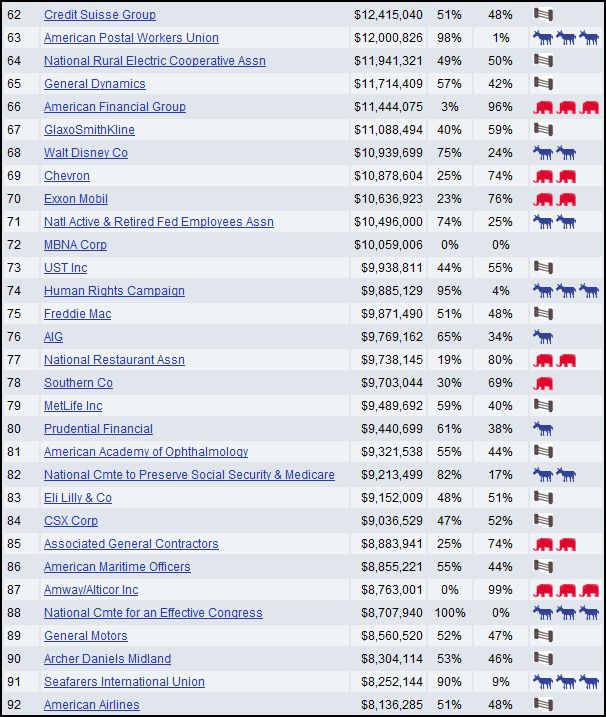
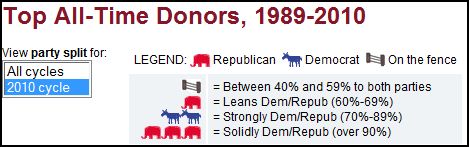
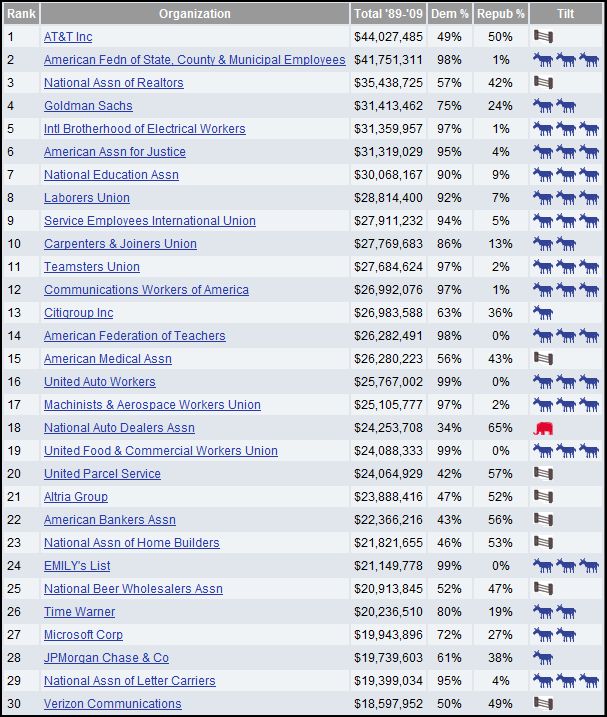
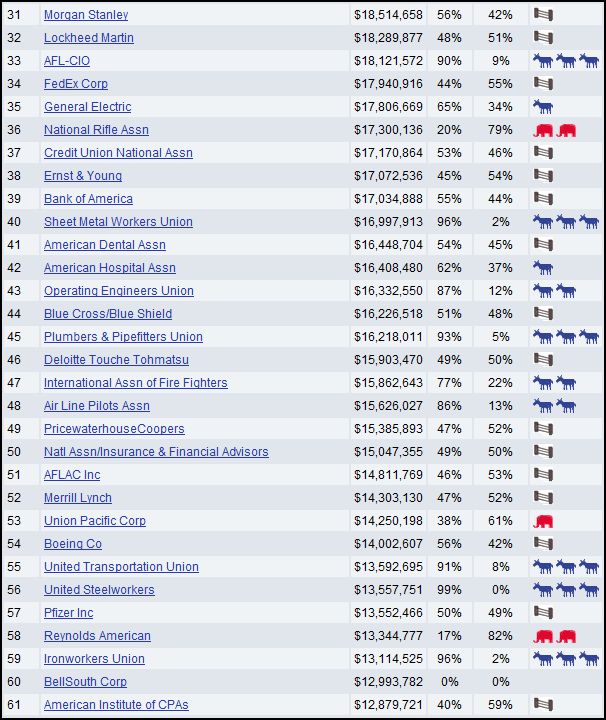
Dmitriy T.M. sent in a link to the Center for Responsive Politics listing the 100 corporations with the largest contributions to political campaigns between 1989 and 2009, as well as the direction of their donations (to the left or right).  Donations include:

Direct “soft money” contributions from the organization’s treasury. Under federal law, contributions from the treasuries of corporations, unions or other organizations may only be given to the parties’ “non-federal” (soft money) committees.

Contributions from the organization’s political action committee, or PAC. The money for these comes from individuals who work for or are connected with the organization, and it’s given on behalf of the organization.

Contributions by individuals connected with the organization. This includes employees, officers, and members of their immediate families.

Here are the results:

At last as far as these top 100 are concerned, it doesn’t appear that there is an overwhelming preference for Republicans, as one might expect.  Then again, a lot of these are unions.

But what does it mean when corporations and unions are sitting “on the fence”?  Basically it means that they’re covering their bases.  They win influence whether Republicans or Democrats end up in office.  Interestingly, 46 of the 100 are on the fence.  This doesn’t mean that things are somehow more fair or balanced, it means that, no matter who wins, corporations and unions win.

For another look at this type of information, see our post on partisan political contributions by U.S. companies.

Lisa Wade, PhD is an Associate Professor at Tulane University. She is the author of American Hookup, a book about college sexual culture; a textbook about gender; and a forthcoming introductory text: Terrible Magnificent Sociology. You can follow her on Twitter and Instagram.
We often talk about gender objectification on this blog, but we also try to talk about other types of objectification.  In this case, Literanista sent us a great example of racial/nationalist objectification.  The example comes from a tourism website for travelers to the Dominican Republic.  It offers, in one of its excursions, the chance to swim in a jungle river, enjoy a secluded beach, visit a “Rum Shack,” taste fresh sugarcane, see native animals and meet an honest-to-goodness-real-Dominican family.

Elsewhere, just to add some negative stereotyping, the website suggests that Dominican’s are drunk all the time:
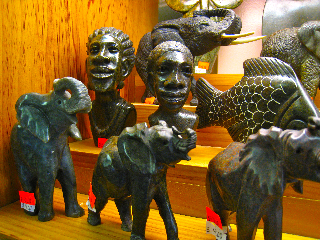
In a similar vein, Karole F. sent in a photograph of some “African” carvings for sale a Stones ‘n Stuff in Exeter, New Hampshire.  Human beings are included as objectified tokens alongside animals:


For more tourism-related objectification, see our posts on tourism in Hawaii, Brazil, and Thailand, and, related, these images of international adoption and onesies for internationally adopted babies.

Lisa Wade, PhD is an Associate Professor at Tulane University. She is the author of American Hookup, a book about college sexual culture; a textbook about gender; and a forthcoming introductory text: Terrible Magnificent Sociology. You can follow her on Twitter and Instagram.
Even the most cursory discussion of the history of women’s paid employment in the U.S. will include the importance of World War II, when the scarcity of men meant many jobs became available to women for the first time.

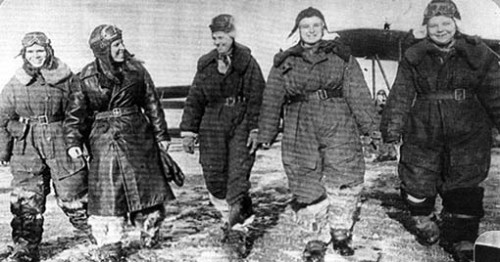
The U.S. wasn’t the only place this happened, of course. In the face of a massive attack by the Nazis, the Soviet Union allowed women to occupy combat positions, including setting up three regiments to fly night bombing raids (according to Wikipedia, it was the first nation to allow women to do so). The regiments became known as the Night Witches:

“We slept in anything we could find—holes in the ground, tents, caves—but the Germans had to have their barracks, you know. They are very precise. So their barracks were built, all in a neat row, and we would come at night, after they were asleep, and bomb them. Of course, they would have to run out into the night in their underwear, and they were probably saying,—Oh, those night witches!’ Or maybe they called us something worse. We, of course, would have preferred to have been called ‘night beauties,’ but, whichever, we did our job.”

Members of the 588th Night Bomber Regiment:

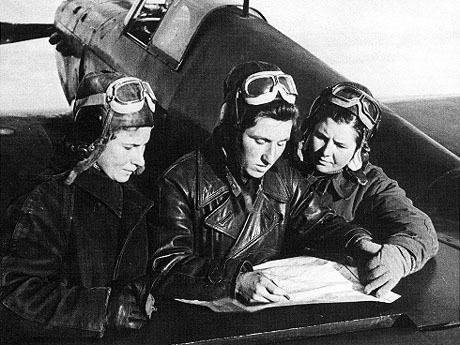
Lilya Litvyak:

In this video, Lidiya Gudovantseva recalls working as a sniper, including the first time she had to kill a German soldier and later being injured herself:

When the war ended, many women in the U.S. were pressured to leave their jobs; similarly, female Soviet soldiers found that opportunities for promotion dried up during peace time. They were apparently even barred from military colleges, closing off many positions to them altogether, though the military’s draft policies stipulated that women should be called up next time there was a war. Women served as a reserve labor force for the military, to be called up when needed (and praised on Soviet propaganda posters) but pushed out of the ranks to provide room for men the rest of the time.

In several posts, we have problematized past and present school mascots.  In this post, I discuss the University of Louisiana at Lafayette Ragin’ Cajuns.

ULL

Originally, UL Lafayette’s mascot was a Bulldog.  Then, according to the mascot history page,

…in the early 1960’s as an effort to “fire up” the football team, Coach Russ Faulkinberry called his team the Raging Cajuns since 95 percent of the football team was from the Acadiana area [i.e., ethnically Cajun].  It was then decided by the Sports Information Director, Bob Henderson, to honor the team and the Cajun heritage by calling them the Raging Cajuns.

The first Ragin’ Cajun mascot was Cajun Man:

cajun man

This was protested by African American activists who resented the association of the multi-racial and -ethnic University with a white ethnicity.  From another perspective, the mascot was questioned on the grounds that “Cajun” had once been a nasty racial slur.

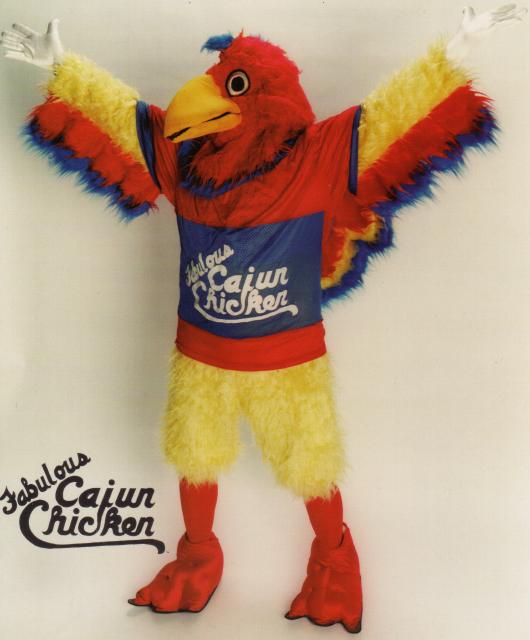
Apparently the University lost Cajun Man when he graduated, so he was replaced by Cajun Chicken:

GLAIBSRHCEWTCVC.20070413161145

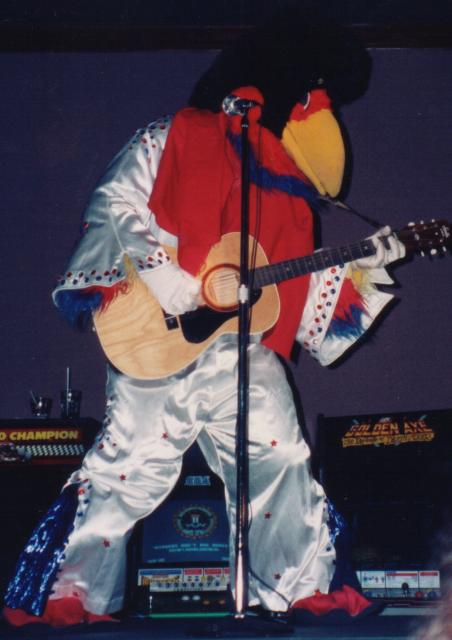
Cajun Chicken as Elvis (what, your mascot didn’t dress up like Elvis?):

JBAPCUWPAERAUQQ.20070413161210

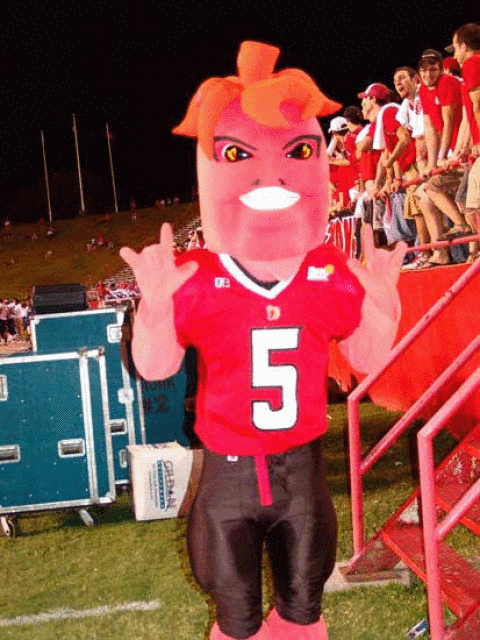
Cajun Chicken was later replaced by Cayenne, a chili pepper, the University’s current mascot:

JQOUKXVBITKMPNI.20070408033922

Still, the disappearance of the Cajun Man has not led to the disappearance of the controversy over the mascot, kept alive with the term “Ragin’ Cajuns.”  In Blue Collar Bayou, Jaques Henry and Carl Bankston III report that in 1997 Louis Farrakhan protested that the state funding of the University of Louisiana at Lafayette amounted to the state using “African American and Creole tax dollars… to promote a white culture.”

Consider the Ragin’ Cajun controversy in light of the other mascots we’ve covered: the Orientals, the Gauchos, the Jews, the Fighting Irish, and the Indians.

Lisa Wade, PhD is an Associate Professor at Tulane University. She is the author of American Hookup, a book about college sexual culture; a textbook about gender; and a forthcoming introductory text: Terrible Magnificent Sociology. You can follow her on Twitter and Instagram.
Is “princess” being redefined?

One of the compliments aimed at the new Disney movie, The Princess and the Frog, is that the heroine isn’t just a pretty face, but in fact an entrepreneur who wants to open her own restaurant and is uninterested in catching a man.  This observation was made to me, for example, when I was interviewed for a story by CNN reporter Breenana Hare, who suggested that this new princess was making a break with the old princesses in more than one way.

I replied that this “new” kind of princess had been on the scene for a while.  Belle, from Beauty and the Beast, according to imdb, was “a bookworm who dream[t] of life outside her provincial village,” not of a prince charming.  That was 20 years ago.  Both Pocohantas and Mulan were adventurous and brave.  Most princesses, these days, are not perfect embodiments of femininity, they balance their femininity with a bit of masculinity.  It’s ‘cess + sass as a rule.

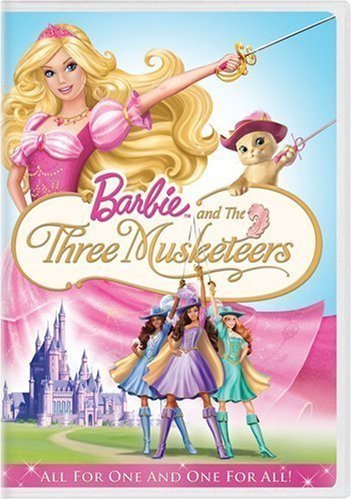
But, to be fair, these princesses aren’t radical.  They aren’t pushing the envelope of femininity.  They are only reflecting the fact that ideal femininity in the West has changed such that the perfect woman now incorporates some masculine character traits.  “Some” is the operative word here.  Today’s ideal woman is still feminine, but she works, wears pants, and plays sports.  She may even be a sports fan and drink beer.  But she also preserves her femininity, especially those aspects of femininity that mark her as “for” a (just barely and totally benevolently of course) dominant male.  She still doesn’t disagree too vigorously or laugh too loud.  She marries a man who is slightly older, more educated, larger, taller, and makes a bit more money at his job that is just slightly higher prestige.  And, no matter what, she looks, dresses, and moves in pretty, feminine ways.  Barbie and the Three Musketeers is another, non-Disney example of this phenomenon:

Barbie-and-the-Three-Musketeers-DVD-Case-barbie-movies-6758824-352-500

Not a man in sight!  But damn do they look good in those boots!

Simon O. also sent in a Barbie website that fits this theme nicely.  It asks “What Should Barbie Be Next?” and let’s us vote on her next profession: pet vet, race car driver, ballerina, baby sitter, “kid doctor,” rock star, pediatric dentist, or wedding stylist. Barbie can be anything she wants, as long as she looks great doing it.  Or maybe it’s that Barbie can be anything she wants because she looks good doing it.

The new rule is: a girl can be anything, as long as she’s hot (and deferent when push comes to shove).  Whether she likes it or not, she always gets the guy in the end because, well, she’s so damn sweet and adorable (and, yes, those words are totally coded with gendered meaning).  This fact, the fact that she always still ends up with the guy in the end, is a really important part of this story… it reminds us that getting the guy is still the happy ending… even the little girls in the bike commercial came away with a “prince.”

So, yeah, we can debate about whether these princesses are a qualitative and substantial break from previous princesses.  I’m not sure they are.  Or, if they are, I’m not sure the difference is all that fantastic, given that the ideal is still incredibly rigid and damn difficult to live up to.  And I’m not even sure I like this new (impossible) ideal any better than the old (impossible) ideal.  What we see today is a couple generations of women who are expected to be both masculine and feminine.  As if staying fit, looking lovely, smelling great, volunteering, and having a clean house, a sexually satiated husband, and behaved, brilliant, well-adjusted children wasn’t enough of a job… women now have to be go-getters at the law firm and ass-kickers on the court.   It’s called The Second Shift and women work more and relax less than men.

For more examples of the ideal balance of femininity and masculinity, see these posts on pinkifying masculine jobs, prints, and hobbies (sports and guns), the “girl” ranchhand, this ad suggesting that a girl’s razor should be “no girly man,” the social construction of female athletes (here and here), and the color blue.

Lisa Wade, PhD is an Associate Professor at Tulane University. She is the author of American Hookup, a book about college sexual culture; a textbook about gender; and a forthcoming introductory text: Terrible Magnificent Sociology. You can follow her on Twitter and Instagram.
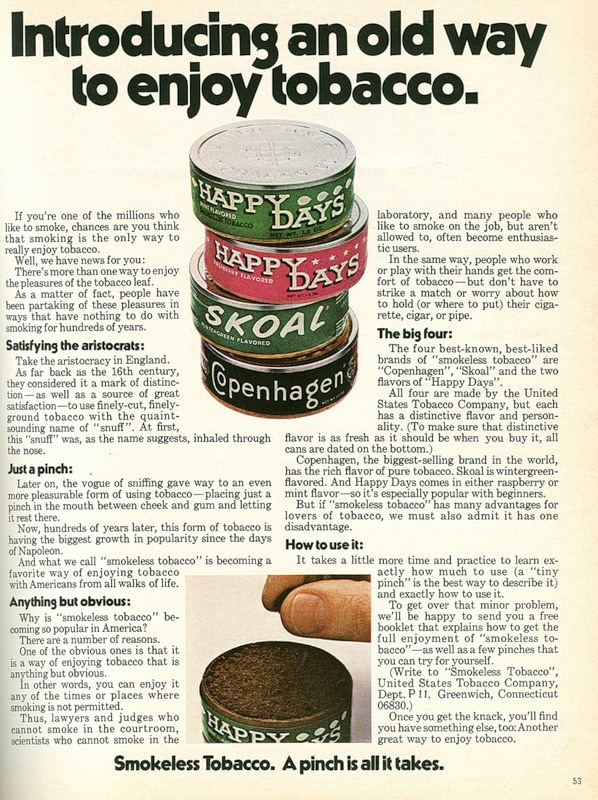
Vintage ads are an excellent way to illustrate how “the way things are” are not the way things have to be or always were.  In this post, I offer an ad for chewing tobacco.  Now, most Americans today associate chewing tobacco (eh em) “dip” with working class, rural, white men (hello family!) and, about ten years ago, baseball players (but I digress).

In contrast to this current social construction, this vintage ad suggests that dip is the province of the aristocracy (details after the ad):

1

Here are the parts that got my attention:

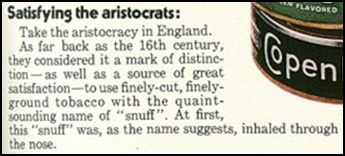
2

Text:

Take the aristocracy in England.  As far back as the 16th century, they considered it a mark of distinction — as well as a source of great satisfaction — to use finely-cut, finely-ground tobacco with the quaint-sounding name of “snuff.”  At first, this “snuff” was, as the name suggests, inhaled through the nose.

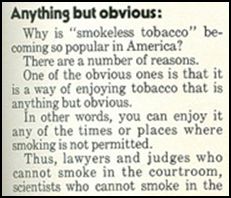
Then, the ad claims that “snuff” is enjoyed, today, by lawyers, judges, and scientists:

3

4

Selected text:

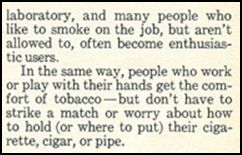
Why is “smokeless tobacco” becoming so popular in America?  There are a number of reasons.  One of the obvious ones is that it is a way of enjoying tobacco that is anything but obvious.  In other words, you can enjoy it any of the times or places where smoking is not permitted.  Thus, lawyers and judges who cannot smoke in the courtroom, scientists who cannot smoke in the laboratory, and many people who like to smoke on the job, but aren’t allowed to, often become enthusiastic users.

I just love the contrast between the current social construction and the attempt at social construction made in this ad.  I have no idea whether there was a time when dip wasactually enjoyed by the middle and upper classes.  Anyone?  Other comments welcome as well, of course.

Lisa Wade, PhD is an Associate Professor at Tulane University. She is the author of American Hookup, a book about college sexual culture; a textbook about gender; and a forthcoming introductory text: Terrible Magnificent Sociology. You can follow her on Twitter and Instagram.