Search results for The

The images below are aerial shots of a development in California City, a city about 100 miles northeast of L.A. The development was abandoned before being built, leaving a grid of empty streets now visible on Google maps:

4130760813_529b43a244_o

4131620736_a18fabe127_o

California City was planned in the late 1950s and early 1960s when L.A. was experiencing a major boom and houses were increasingly being built in large, pre-planned developments by a single construction firm. Instead of building houses as people requested them, the new business model was to buy a large section of property, build a lot of houses in more of an assembly-line fashion, and then find buyers for them and, with the post-World War II economic boom and subsequent suburban flight, it worked.

But as these maps testify, sometimes things go awry; a particular city doesn’t grow as much as the developers thought (California City was supposed to rival L.A. in size), or an economic downturn affects the real estate market in a more widespread manner (see the comments for several readers’ summaries of the many factors that have at times played into real estate booms and busts, including policy decisions in both the public and private sectors). And with the planned development housing model, we may be left not with a few unsold houses, but with bizarre ghost towns in varying stages of completion as evidence.

Related posts: the dilemma of the duplex, Michigan and the recession, and economic change hits the mall.

Gwen Sharp is an associate professor of sociology at Nevada State College. You can follow her on Twitter at @gwensharpnv.


Ricardo G. sent in a link to a British campaign encouraging citizens to ride the train.  The campaign features a Mexican wrestler named Loco Toledo.

Capture

The commercials basically feature him acting weird (“loco” means crazy), speaking broken English, and comparing the awesomeness of England’s train system with Mexico’s. An example:

How exactly is this different than the Frito Bandito and the Sleepy Sanka Mexican?

Other examples of contemporary advertising campaigns featuring demeaning racial and ethnic stereotypes: the U-Washee, KFC thinks Asians are ridiculous, Native American sports mascots, racism in identity theft ads, Indian, Chinese, and Italian stereotypes in superbowl ads, Asian kitchselling noodles with Asian enlightenment, and Mr. Wasabi.

Lisa Wade, PhD is an Associate Professor at Tulane University. She is the author of American Hookup, a book about college sexual culture; a textbook about gender; and a forthcoming introductory text: Terrible Magnificent Sociology. You can follow her on Twitter and Instagram.

The Adipositivity Project is a website featuring photographs by Substantia Jones.  The site features 324 beautiful pictures of fat women’s bodies.  Below are a few safe-for-work selections (click here to see them all [NSFW]).

1253426688

1253426371

1256619268

UPDATE: I just want to note that the commenters on this post are bringing up great questions!

Lisa Wade, PhD is an Associate Professor at Tulane University. She is the author of American Hookup, a book about college sexual culture; a textbook about gender; and a forthcoming introductory text: Terrible Magnificent Sociology. You can follow her on Twitter and Instagram.

Hank M. sent us a link to this image that shows the proportion of news coverage in 55 outlets for various items throughout the year (click here for a larger image; to read more about the methodology and the news outlets, see Journalism.org):

Picture 4

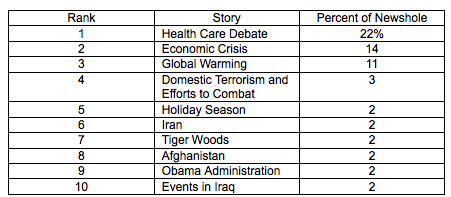
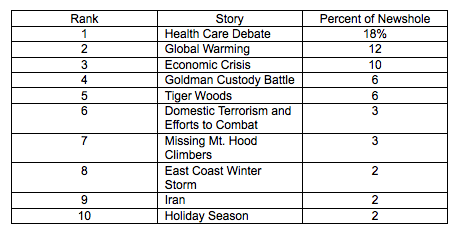
Journalism.org puts out a weekly index as well, broken down by type of source (network TV, newspaper, etc.). Some of the results for Dec. 14-20 show some interesting differences. Here are the top-10 lists for newspaper and network TV, respectively:

Picture 5

Picture 6

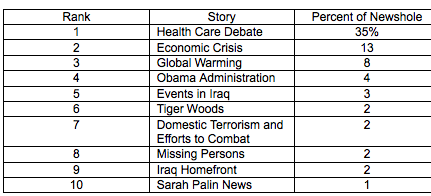
The top three stories are the same, and clearly dominate both types of media outlets. TV sources seem to do more “human interest” or “entertainment” coverage of things like Tiger Woods’s scandal, the Goldman custody battle, and the missing climbers. (My mom and grandma were both distressed that I wasn’t aware of the missing woman in Utah or the Goldman custody case and said that I need to keep myself more informed of the world around me by taking the time to watch the news on TV so I’d know what’s going on in the world.)

Cable TV outlets had the same top 3 stories, but actually emphasized them even more than newspapers and network TV did, with health care getting nearly twice as much coverage as it did on the networks (radio had the same pattern):

Picture 4

Their database is archived and searchable, and it provides a rather fascinating view of what is considered newsworthy each week and how that depends on the type of outlet.

Also check out our posts on google searches for information about Afghanistan and Tiger Woods, the “dithering” meme,

Missives from Marx sent in a link to this animated time line documenting the diffusion of various political-economic systems (e.g., fascism, democracy, and feudalism) over world history.  It can be read as a story about the triumph of democracy, but it’s also illustrates how political-economic systems are not natural, but invented during particular historical eras, and diffuse or disappear as a consequence of war, geography, and other geopolitical factors.

Lisa Wade, PhD is an Associate Professor at Tulane University. She is the author of American Hookup, a book about college sexual culture; a textbook about gender; and a forthcoming introductory text: Terrible Magnificent Sociology. You can follow her on Twitter and Instagram.

Robin H., Tomi L., and Kate McL. asked us to talk about the new movie, Avatar.   Tomi thought the gender politics were great, with men and women as equals fighting and ruling side-by-side.  I think she’s right.  It’s a great example of a cultural product that makes little of gender difference.  (UPDATE: Though commenters are disagreeing on this point quite insightfully.)

With that said, I want to comment on the race politics in the movie (I do so indebted to Annalee Newitz and Eric Repphun; you might also be interested in Meloukhia’s comments from a disability studies perspective).

First, a summary (super spoiler alert):

Avatar is a moral re-evaluation of colonization. In the movie, humans go about killing and displacing the indigenous population of another planet, the Na’vi, in order to extract a valuable mineral.

The Na’vi are a fantastical version of indigenous populations encountered by Europeans during colonization. They wear features, bones, and skins; they have a deep spirituality and a ritual-filled life; they are accomplished and principled warriors; they hunt and fight with bows and arrows; and they have an intense connection to nature (the end of the black braided ponytail of the Na’vi contains mysterious filaments that plug into the flora and fauna, allowing a sort of mind meld with the animals and the planet). They are, in short, the stereotypical “noble savage.”

Avatar

Capture4

In the movie, humans use technology to transport their consciousnesses into home-grown native bodies.

A character, Jake Sully, and his avatar:

Capture3

They use these bodies to infiltrate and befriend the Na’vi, all with the intention of furthering the goals of mineral extraction.  Through our hero, Sully, we discover the moral superiority of the Na’vi people.  His own exceptional nature is also revealed.

Sully being blessed by the Goddess, a sign that the Na’vi should accept him:

avatar_trailer1_017

Later, the chief’s daughter falls in love with him.

The anthropological effort to convince the Na’vi to give up their land fails and so the humans decide to take the land by force, wantonly destroying their home and killing any Na’vi that get in the way. A handful of humans, led now by Sully, defect and join the Na’vi.  During the battle, both the chief and the rightful inheritor of the role die.  After they win the battle, Sully assumes the role of chief, with the highest ranking female at his side.

In the end, Sully abandons his (disabled) human body and the Goddess transfers his consciousness into his avatar body. He has, literally, “gone native.”

Now, to the commentary:

Avatar is a fantasy in which the history of colonization is rewritten, but it a fantasy specifically for white people living with a heavy dose of liberal guilt. And it is one that, ultimately, marginalizes indigenous peoples and affirms white supremacy.

If it were a fantasy for, say, the American Indian population in the U.S., the story might go a little differently. In that fantasy there would be no Sully character. It’s that simple.

The Sully character is white redemption embodied; he “…is liberal guilt made flesh.”  His character redeems the human race (i.e., people of European descent) by proving that at least some of us (guilty liberals) are good. Whites can identify with Sully instead of the humans who orchestrate the genocide and displacement.

But Sully is not only a superior human being, he is also a superior Na’vi. After being briefly ostracized for his participation in the land grab, he tames the most violent creature in the sky, thereby proving himself to be the highest quality warrior imaginable per the Na’vi mythology.  He gives them hope, works out their strategy, and is their most-valuable-weapon in the war. In the end, with all Na’vi contenders for leadership conveniently dead, he assumes the role of chief… and gets the-most-valuable-girl for good measure. Throngs of Na’vi bow to him.

As Annalee Newitz summarized in her excellent commentary:

This is a classic scenario you’ve seen in non-scifi epics from Dances With Wolves to The Last Samurai, where a white guy manages to get himself accepted into a closed society of people of color and eventually becomes its most awesome member.

I’m going to speculate that, if this were a fantasy written for a colonized population, the hero would come from their own ranks and, at the end of the movie, they would continue life on their land, with their culture intact, under Na’vi leadership, without a human in sight.

But that would be a movie that alienated the colonizer. And since history is written, and rewritten, by the victor, Avatar is what we get.

And it is a safe fantasy because the fight is over. During most of the encounter between Europeans and the indigenous populations in the Americas, stereotypes were cruel and dehumanizing. The “noble savage” stereotype that we are familiar with emerged only after the threat of American Indian resistance was long gone. We re-cast our enemy in romantic terms only after we won the war. How nice for us. It turns out our foe was a worthy one, making us look all the more impressive for being the victor. We can now pretend that we had deep respect for them all along.

Europeans can enjoy Avatar precisely because there is no risk to admitting that colonization was wrong. We can wallow in guilt about it and, still, the likelihood that power dynamics will be reconfigured in any meaningful way is just about zero.

(Images borrowed from here, here, and here.)

Lisa Wade, PhD is an Associate Professor at Tulane University. She is the author of American Hookup, a book about college sexual culture; a textbook about gender; and a forthcoming introductory text: Terrible Magnificent Sociology. You can follow her on Twitter and Instagram.

Dmitriy T.M. sent in the clip below in which Senator Lindsey Graham (R – South Carolina) explains that health care reform will be bad because it will require his state to subsidize health care for poor people… and black people:

Graham’s mistake is a common one and one that contributes to penalizing and inhumane treatment of the poor in the U.S. He is conflating race and class. White people = not poor; black people = poor. Therefore, a high percentage of black people = a drain on society.

Here’s the reality: a higher percentage of the black population is poor, compared to whites. BUT, and this is a big “but,” most poor people are white because white people make up between 70 and 75% of the U.S. population.

However, a belief that that poor people tend to be black and black people tend to be poor is useful for those who want to stifle any redistribution of wealth. The conflation means that opposition to policies designed to alleviate the suffering of poverty can be based in both classism and racism.

Lisa Wade, PhD is an Associate Professor at Tulane University. She is the author of American Hookup, a book about college sexual culture; a textbook about gender; and a forthcoming introductory text: Terrible Magnificent Sociology. You can follow her on Twitter and Instagram.

In this clip from QI, the host and guests discuss the Roman God Mithras and his suspicious similarity to Jesus:

Thanks to Mytch P. for sharing this show with me!

Lisa Wade, PhD is an Associate Professor at Tulane University. She is the author of American Hookup, a book about college sexual culture; a textbook about gender; and a forthcoming introductory text: Terrible Magnificent Sociology. You can follow her on Twitter and Instagram.