Search results for The

Over Thanksgiving we posted a Bed, Bath, and Beyond ad that illustrated the fact that women, overwhelmingly, take responsibility for the work involved with holidays.  Victoria S. sent us a U.K. website illustrating the same idea.  The website, for a shopping center, is using the slogan, the 12 Mums of Christmas.

Victoria writes:

…it assumes that the mum of the family does EVERYTHING for the family/friends.  It also forgets about people who therefore don’t have children, or people who are on their own, or those that don’t have a mum-type figure in their lives etc…

The site even nicely describes the various tasks that “mums” are responsible for.

The shopper:

mums2

The planner:

mums1

The wrapper:

mums3

The party girl:

mums4

Mums!  Do all the work!  Look great!  And have a good time, too!  Or else you fail as a mother.  Just sayin’.

Lisa Wade, PhD is an Associate Professor at Tulane University. She is the author of American Hookup, a book about college sexual culture; a textbook about gender; and a forthcoming introductory text: Terrible Magnificent Sociology. You can follow her on Twitter and Instagram.

My besties gave me a copy of the target toy catalog for 2009 and pointed out the front cover.

At first i thought it was just your typical run of the mill gender socialization propaganda…

White girl on the cover? Check.
Is she wearing pink? Check.
Is she wearing a tiara? Check.
Is she wearing a tutu? Check.
Is the tutu pink? Check.
Is she smiling? Check.
Is she playing with barbie? Check.
Is there a little boy in the image? Check.
Is he doing one of the following: making a mess, eating something or expressing anger? Check.

Ok, the basics are covered.

But upon further inspection, I realize that the barbie is holding Lego flowers…. and… wait a minute… are those church bells I see?!  …

That little boy isn’t just upset because she is playing with his (read: a boy’s) toy… He is mad because she is marrying them!

So not only do we have an image of a smiling white girl wearing a pink tutu and tiara playing with barbie while a little boy is expressing anger… but we can add heteronormative relationships and male aversion to marriage to the list.  Yay!  The only things missing are caption bubbles:

As a silver lining I like to look at this image and imagine that the little boy is upset for other reasons…

Or maybe the little boy is a radical activist:


—————————–

Monica is teaches ethnic studies and works with survivors of interpersonal violence.  She blogs at The Woes of a Barren Lesbo and recently wrote an irreverent take-down of the cover of a Target holiday catalog.  We thought you’d enjoy her humor and creativity.

If you would like to write a post for Sociological Images, please see our Guidelines for Guest Bloggers.

So, what do you think:  Is this Gap ad featuring Black people dancing and singing about the “hood” using stereotypes to appeal to black people?  Or white people?  In the latter case, would you consider this a form of objectification?  (Unfortunately, I don’t know when or where it aired.)

For more, see my series of posts about how and why people of color are included in advertising aimed mainly at white people.

Via The Feminist Agenda.

Lisa Wade, PhD is an Associate Professor at Tulane University. She is the author of American Hookup, a book about college sexual culture; a textbook about gender; and a forthcoming introductory text: Terrible Magnificent Sociology. You can follow her on Twitter and Instagram.

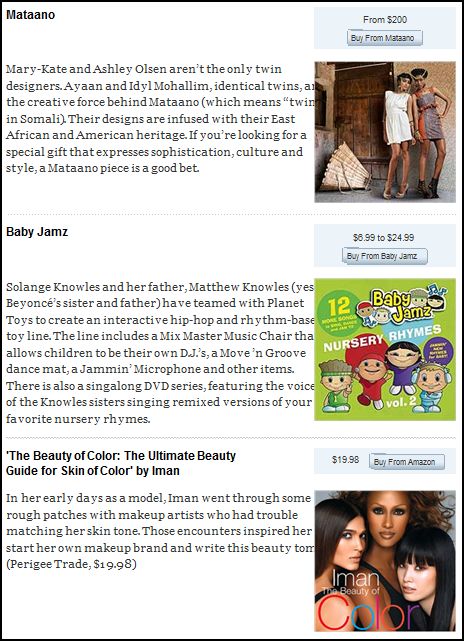
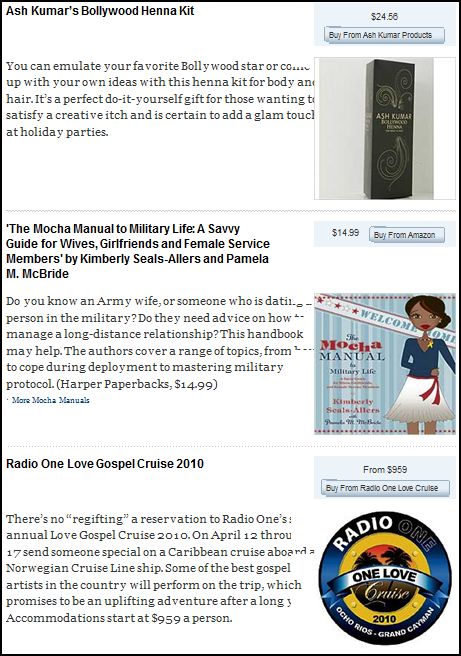
Cassidy P., Kailey V., Adèle G., and Allie L. sent in a gift guide put together by the New York Times specifically for people “Of Color” (center bottom):

color1

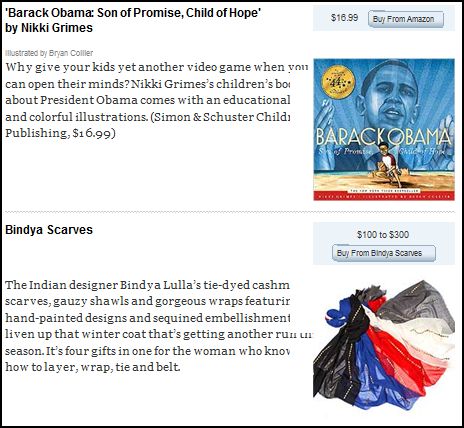
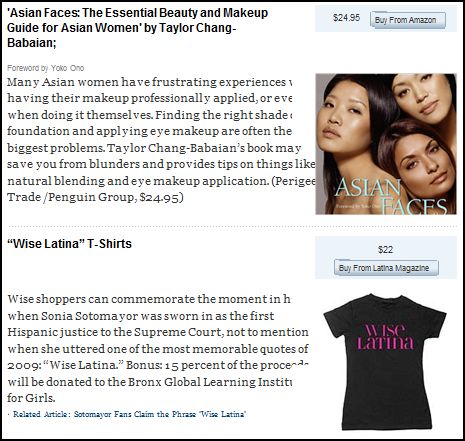
The guide lumps together all non-white groups, suggests that they are interested in race- and culture-specific products and implies that white people would NOT be interested in these things.  Some examples:

color2color3color4color5

The guide illustrates something we’ve discussed several times on this blog: the fact that there “needs” to be a guide specifically for people of color reveals that all the other products and guides, ostensibly for “people,” are really for white people.  Things that are marketed to non-white people are, supposedly, inherently uninteresting or irrelevant to white people.

Ultimately, this reinforces the idea that people of color are always outsiders in a white world.

Lisa Wade, PhD is an Associate Professor at Tulane University. She is the author of American Hookup, a book about college sexual culture; a textbook about gender; and a forthcoming introductory text: Terrible Magnificent Sociology. You can follow her on Twitter and Instagram.

Chris Uggen, fellow sociologist and editor of Contexts magazine, put together a graphic for Public Criminology comparing the current age of death row inmates in the US with their age at arrest (in the title, I assumed they were mostly men, but I don’t know):

deathrow3

So the median age at arrest is 27 and the median current age is 43.  This illustrates the lag time between arrest, conviction, sentencing, and  execution.  It also creates the conditions for what Uggen calls the “graying of prison populations.”   We are executing mostly middle-aged men and older, even as the young are disproportionately convicted for committing violent crimes.

I suppose whether or not we support executing a 50-year-old man for a crime he committed half a lifetime ago depends on what you think the death penalty is for.   Is it to satisfy the family of the victims?  Is it for revenge?  Is it for deterrence?  Is it to make the world outside the prison a safer place?

Executing people in their 40s, 50s, and beyond makes more sense if your goal is something like revenge, less sense if your goal is a safer world with less violent crime.  So, how we frame the death penalty (that is, how we answer the questions “what is it?” and “what is it for?”) shapes whether the graph above looks like social justice or social tragedy.

Lisa Wade, PhD is an Associate Professor at Tulane University. She is the author of American Hookup, a book about college sexual culture; a textbook about gender; and a forthcoming introductory text: Terrible Magnificent Sociology. You can follow her on Twitter and Instagram.

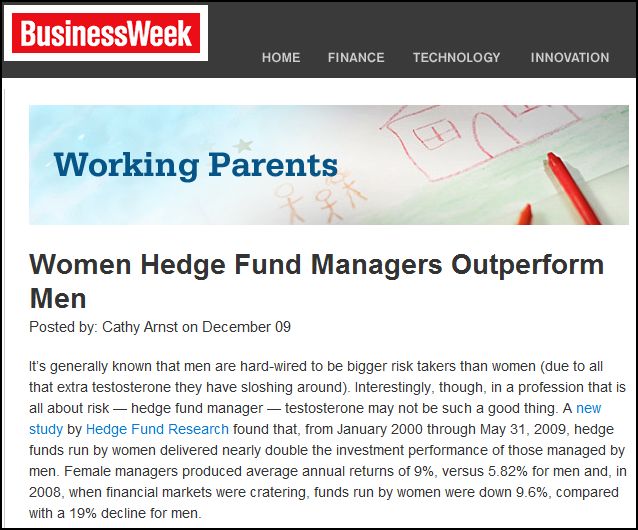
In a twist on the men are people and women are women theme, Catherine L. sent in this screen shot of a Business Week article about women hedge fund managers.  Notice that it’s placed in the “working parents” section of the website, even though the article does not say a single thing about kids or, even, work/life balance.

Capture

Also, women produce double the returns!?  Double!?  Damn!

Lisa Wade, PhD is an Associate Professor at Tulane University. She is the author of American Hookup, a book about college sexual culture; a textbook about gender; and a forthcoming introductory text: Terrible Magnificent Sociology. You can follow her on Twitter and Instagram.

Judy Z. H. sent in Kanye’s video for Love Lockdown for analysis.  My first thought was: they should have just went with Qwest Crew. But I digress.

The video contrasts Kanye, singing in a nearly empty apartment, with tribal imagery.

Here’s my thoughts:  The song is about a man who loves a woman but knows intellectually that the relationship is wrong.  So he has to leave her, even as his heart breaks to do it.  So the song is about a conflict between his heart and his mind or, alternatively, passion and rationality.

The passion/rationality binary is often layered onto a primitive/modern binary.  Primitives, we presume, are superstitious, driven by passions, more instinctual than intellectual, more closely connected to animals and nature more generally.  Moderns, by contrast, are assumed to be rational, in control of our emotions; modernity has brought us science and technology and taken us farther away from nature.

Accordingly, the primitives in the video express strong emotions and are dressed in skins and feathers, decorated with the earth, while Kanye calmly sings about a heart-wrenching decision, surrounded by a clean, white, even sterile, apartment, and lounging in the kitchen (the most technological room in the house); the only item other than furniture that we see is a telescope.  A telescope!  How very modern.

The video works because Kanye’s audience recognizes the modern/primitive binary and all that it implies.  But, of course, it’s false.   Psychological research (and, as far as I can tell, all of the research on voting behavior) demonstrates again and again that rationality is not our strong point as a species.  If anything, what is modern is the inferring of rationality (hello rational choice theorists!), something that we see clearly in this video.

Lisa Wade, PhD is an Associate Professor at Tulane University. She is the author of American Hookup, a book about college sexual culture; a textbook about gender; and a forthcoming introductory text: Terrible Magnificent Sociology. You can follow her on Twitter and Instagram.

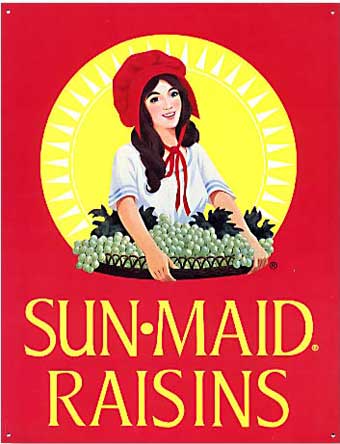
About a year ago, Gwen posted about the evolution of the Sun-Maid, the young spokeswoman for Sun-Maid raisins:

raisin1

In her post, she asked: “I wonder if Sun-Maid has stayed with the de-sexualized icon because raisins are associated with children?”

Well, Gwen, I’m afraid you spoke too soon.  Here, via Jezebel, is the new Sun Maid:

bb

Noticably slimmer and with more form-fitting clothes, this new Sun Maid is clearly not hyper-sexualized, but it’s a move in that direction.

Here’s a commercial in which, building on her increasing sexualization and objectification, she turns into a Hollywood celebrity for a sec:

I think–considering also the recent makeovers of Dora the Explorer, Holly Hobbie, and Strawberry Shortcake–we can officially call this a trend.

Lisa Wade, PhD is an Associate Professor at Tulane University. She is the author of American Hookup, a book about college sexual culture; a textbook about gender; and a forthcoming introductory text: Terrible Magnificent Sociology. You can follow her on Twitter and Instagram.