Search results for The

Religion is the sigh of the oppressed creature, the heart of a heartless world, and the soul of soulless conditions. It is the opium of the people. The abolition of religion as the illusory happiness of the people is the demand for their real happiness.

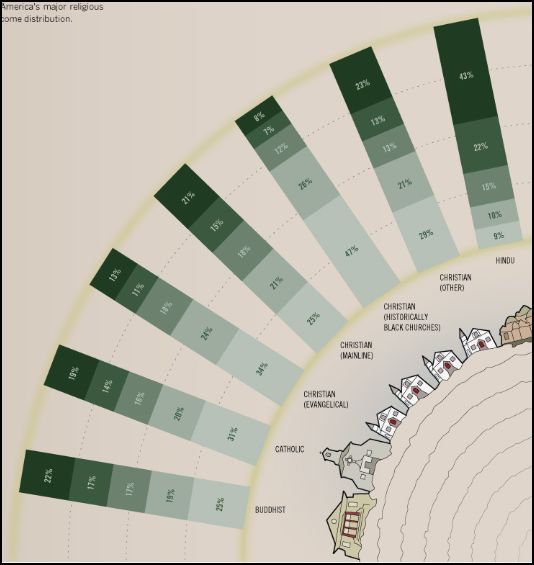
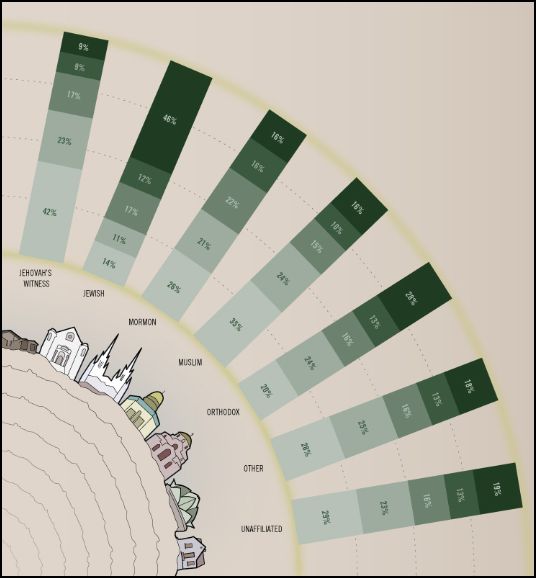
With these words Karl Marx condemned religion for making the class-disadvantaged masses complacent in the face of injustice. New data from the Pew Forum, sent in by Dmitriy T.M. and Allie B., suggests that this may be true for some religions more than others!

Visual at GOOD, shown here in three parts:

Allie was actually quite troubled by this figure, arguing that it affirmed stereotypes that Jews controlled all the money and encouraged people of different religions to see each other as competition.

Indeed, how we choose to present data is always a political decision.   Why correlate religion with income at all?  Maybe religion is somewhat spurious, compared to variables like geographic location, race, or immigration status.  That is, it may be that income correlates with geography, race, and immigration status and those variables correlate with religion.

It’s pretty tricky to figure these things out (and that’s why we force sociology graduate students to learn fancy statistical methods), but in the end we still can’t attribute causality, just correlation.  Figuring out why and how things correlate requires qualitative of research.

Lisa Wade, PhD is an Associate Professor at Tulane University. She is the author of American Hookup, a book about college sexual culture; a textbook about gender; and a forthcoming introductory text: Terrible Magnificent Sociology. You can follow her on Twitter and Instagram.

In “The Yellow Fever Pages” (full citation below), Karen Eng discusses a recurring problem she, as a Chinese-American woman, faces when dating: that many men, particularly White men, who express interest in her are not interested in her as an individual, but rather in a generalized Asian woman and the fantasies that are associated with them. Eng sums up the fantasies many men hold about Asian (particularly Japanese) women:

The fantasy Asian is intelligent yet pliable, mysterious yet ornamental…perpetually pre-pubescent–ageless and petite…high-pitched, girly–while simultaneously being exotic and wise…She comes from a culture where women traditionally serve men… (p. 68).

Thus, when men ask her out, Eng has to figure out whether they are asking her out because they think she specifically is interesting, or whether they’re asking her out because what they see is an Asian woman to whom they attach all kinds of expectations about exoticism, subservience, and so on. As she puts it, regardless of how she presents herself, the interests she expresses, the type of music and clothing she’s interested in, “…they still see a little Oriental flower.”

I could not help but think of Eng’s article when one of my students, Casandra L., let me know about the dating website ClassyAsianLadies:

The website specifically markets Asian American women to men in the U.S., drawing on all of the stereotypes Eng describes. Here are some images from the site; I highlighted some of the most blatant examples of the “Asian women as hot but also passive” stereotypes in red:

So they aren’t trying to use you to get to the U.S. (though, after stating these are women living in the U.S., they are always described as Asian, not Asian American). And the men who want to date them just love and respect “the Asian culture” (and, you know, there’s just one culture in all of Asia). And how do you show your appreciation for a culture? By marrying someone who personifies the elements of that culture you have romanticized.

Notice the guys using the site appear to expect quite a lot in a woman: she has to remain “a lady,” be “sweet, gentle, beautiful, loving, fun,” but also be “intelligent and independent.”

I don’t know to what degree the website specifically targets White men. There were three photos of Asian women with men on the site; two showed Asian women with White men, one showed an Asian woman with an Asian man.

In case you aren’t convinced yet, here’s some more information on why you should marry an Asian woman:

Unlike “the average woman” (which presumably means White women in the U.S., since we’re the majority of women and all), Asian women haven’t become too competitive (just intelligent and independent! But that’s different!) and certainly aren’t “masculine.” Again we see the romanticizing of a certain stereotype of “Asian culture,” with Asian women having a “well-known cultural attitude of gentle and caring support” and “Eastern values,” which apparently involves being sweet and supportive. Though they’ve also “learned Western values,” which here is associated with being “outgoing…independent and fun…”. Thus, the West = independent, fun women, while the East = supportive, submissive ones.

Notice the last line in that image:  “…that perfect Asian girlfriend or wife.” This is what Eng was getting at: this isn’t about finding the perfect girlfriend or wife; this is about a fantasy of the perfect Asian girlfriend/wife. “Yellow fever” refers to the fetishization of Asian women by men who have a specific idea of what Asian women are like and view them as particularly desirable mates based not on their unique personalities but because of the “Eastern values” they supposedly adhere to. The women thus become somewhat interchangeable. Eng’s frustration grew largely out of the difficulty of getting men to notice her, as opposed to her status as an Asian American woman.

Some other gems:

Asian women are exotic but also make a lot of money (no gold-diggers here!). Men find them “intoxicating.” They’re loyal, and “dedicated to their men.” An Asian woman “always thinks of her man first!” They’ll help with financial planning without being “intrusive”–that is, they’ll make suggestions, but it’s ultimately up to him to decide and she’ll accept whatever he decides on.

They’re “easy to be with…rarely complain…and constructive with their criticism.”  One of my students said the whole “Wonderfully easy to be with” section made her think of the way people describe breeds of dogs: “Get a Labrador! They’re smart, fun, and easy-going! They’ll make a nice addition to any family!”

The translation to all of this: Asian women will offer their wisdom and support, but will then step back and let their men decide. They aren’t bitches who will nag at you or criticize you in a nasty way, or complain that you aren’t doing half the housework, or expect to have an equal role in financial decisions. And she won’t let herself go and become a fatty, so be assured–what you see now is what you can expect she’ll stay like forever.

Aside from the objectification of Asian women (and “the Asian culture”) as having a predetermined set of characteristics you can count on, this says a lot about concerns surrounding changes in gender roles in the U.S. These women are being marketed as the antithesis of the “average” woman in the U.S., who is demanding, hard to get along with, too competitive, and doesn’t stay sufficiently attractive. Female assertiveness or insistence on gender equality is de-feminizing and unattractive; it turns us into masculinized women who won’t submit to men’s authority to take our ideas into consideration but make final decisions based on what they think is best.

For a certain group of men, then, dating an Asian woman is a way to reclaim a romanticized gender hierarchy in which women mix cultural elements associated with the “East” and the “West.” They’re independent and make money (the fun part of female empowerment, unless the independence goes to far and they get uppity), but they retain “Eastern” gender roles in which their independence is, ultimately, limited by their passivity and submissiveness to men, as well as appropriate displays of femininity (being thin, beautiful, and exotic). And, thus, this type of relationship allows men who believe they have been victimized and emasculated by the women’s movement to reclaim some of the overt patriarchal power the believe they’ve been robbed of.

NEW! (Mar. ’10): Rachel K. sent a link to this t-shirt, which ThinkGeek says translates as “now accepting applications for Japanese girlfriends.” It’s a great example of the fetishization of Japanese women:

Photobucket

(“The Yellow Fever Pages.” 2000. Bitch issue 12, p. 68-73.)

Also check out Lisa’s post on marketing Asian women to specifically anti-feminist men.

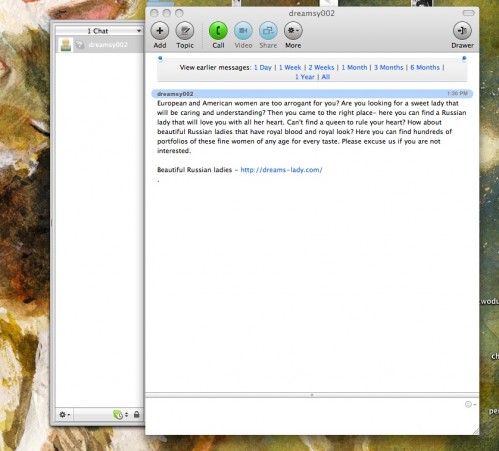
NEW! (May ’10): Sophie L. sent in this spam message she got on Skype, offering “a sweet lady that will be caring and understanding” in case ” European and American women are too arrogant for you.” In this case the source of of these nice, lovely women is Russia…which, yes, is part of Europe, but don’t get caught up on geographical details. You can find yourself a woman with “royal blood and royal look”!

In this video, sent in by Martha, Lindsay Ellis asks why it is that female characters in general-audience cartoons, if present at all, are always plot points for the male characters. Her point is clearly sound, but damn does she marshal the evidence!  She appears to have really done her homework… but I have no doubt that those of you who are experts in My Little Pony, Transformers, Scooby Do, and She-Ra will have something to add.

Here’s another video on the same topic:

For more on the phenomenon in which women are women and men are people, see our analysis of the “Human” Bodies exhibit, girls as an afterthought, dinosaurs are for boys (and girls), traffic lights with female figures, stick figures and stick figures who parent, and default avatars.

Lisa Wade, PhD is an Associate Professor at Tulane University. She is the author of American Hookup, a book about college sexual culture; a textbook about gender; and a forthcoming introductory text: Terrible Magnificent Sociology. You can follow her on Twitter and Instagram.

Members of PIKE fraternity at the University of California, San Diego came under fire this month for hosting a party, called” The Compton Cookout,” designed to mock black Americans and Black history month (less than 2% of UCSD students are black).  People are shocked and horrified, and rightly so, though it’s just one in what seems to be a constant stream of such parties.  Becca C. asked us to post about it.

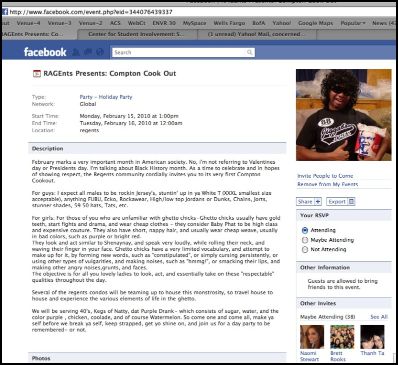
Its Facebook page shown below (which, interestingly, is part of what made the party visible enough to protest) explicitly describes how people are to dress and act (trigger warning; it’s quite upsetting):

February marks a very important month in American society. No, i’m not referring to Valentines day or Presidents day. I’m talking about Black History month. As a time to celebrate and in hopes of showing respect, the Regents community cordially invites you to its very first Compton Cookout.

For guys: I expect all males to be rockin Jersey’s, stuntin’ up in ya White T (XXXL smallest size acceptable), anything FUBU, Ecko, Rockawear, High/low top Jordans or Dunks, Chains, Jorts, stunner shades, 59 50 hats, Tats, etc.

For girls: For those of you who are unfamiliar with ghetto chicks-Ghetto chicks usually have gold teeth, start fights and drama, and wear cheap clothes – they consider Baby Phat to be high class and expensive couture. They also have short, nappy hair, and usually wear cheap weave, usually in bad colors, such as purple or bright red. They look and act similar to Shenaynay, and speak very loudly, while rolling their neck, and waving their finger in your face. Ghetto chicks have a very limited vocabulary, and attempt to make up for it, by forming new words, such as “constipulated”, or simply cursing persistently, or using other types of vulgarities, and making noises, such as “hmmg!”, or smacking their lips, and making other angry noises, grunts, and faces. The objective is for all you lovely ladies to look, act, and essentially take on these “respectable” qualities throughout the day (transcription borrowed from Threadbared).

The page:

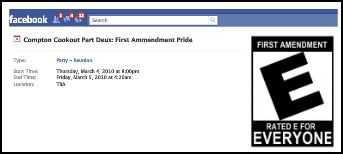
When the first Facebook page was taken down, a student put up a second page in objection (Compton Cookout Part Deux: First Amendment Pride):

A diverse group of students, with the support of many faculty, protested the administration’s slow response to the event (chronicled at Stop Racism UCSD). But the vocal resistance to the overt prejudice and hateful stereotyping created a counter-resistance.  A student-run TV station defended the party with racial epithets and, then, a student hung a noose in the library:

UPDATE (Mar. ’10): This was followed by a KKK hood, made from a pillow case, found on a campus statue’s head (hap tip to Becca).

This is sociologically interesting because it illustrates the backlash phenomenon.  Backlash is a common response to any effort to point out or undermine prejudice, discrimination, and inequality.  We’ve posted about it in response to racist products (Mr. Wasabi, the Black “Lil’ Monkey” doll, and the Obama sock monkey) as well as anti-rape campaigns.  As I wrote in a previous post:

…resistance to oppression is met with counter-resistance.  Until inequality is challenged, things often seem to be just fine; when groups stand up and demand equality, we suddenly see how fiercely people will defend their privilege.

Remember, the Klu Klux Klan emerged only after slaves had been emancipated; whites didn’t need to put black people in their place when they were in their place.  Those who are protesting the Compton Cookout, by not standing by and letting the (largely white) administration address (or fail to address) the party as it pleases, are refusing to stay in their place.  The backlash is proof that they are actually perceived to be a threat.

NOTE: A commenter claims that the party was organized by the PIKE, SIGMA CHI and SIGMA NU fraternities, not just the PIKE fraternity.  I read in a news report that it was PIKE, but it could be wrong.

Lisa Wade, PhD is an Associate Professor at Tulane University. She is the author of American Hookup, a book about college sexual culture; a textbook about gender; and a forthcoming introductory text: Terrible Magnificent Sociology. You can follow her on Twitter and Instagram.

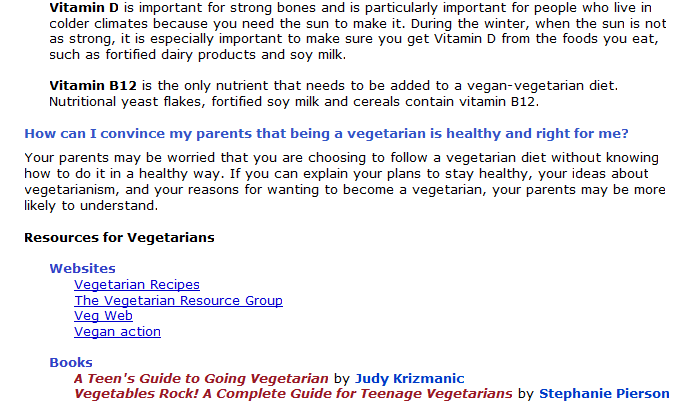
Christopher R. noticed that the sibling sites www.youngwomenshealth.org and www.youngmenshealthsite.org had nearly identical advice for being vegetarian or vegan, except for one small detail.  He writes:

Both pages are generally the same (pretty much word for word), except for the last section on convincing parents to let you be vegetarian. The female version includes the suggestion “read vegetarian cookbooks or nutritional information with your parents and offer to help with the shopping and cooking,” as well as an extra article titled “What are some healthy meals that I can prepare?” I guess the difference between male and female vegetarians is their ability to cook and shop.

Screen shot of the male version:

Screen shot of the female version:

Also, pink and blue!  Of course!

Lisa Wade, PhD is an Associate Professor at Tulane University. She is the author of American Hookup, a book about college sexual culture; a textbook about gender; and a forthcoming introductory text: Terrible Magnificent Sociology. You can follow her on Twitter and Instagram.

Mihai L. sent in a Romanian commercial for wafers that suggests that women have been slowing down progress and re-writing history since the cavewoman days!

With subtitles:

Lisa Wade, PhD is an Associate Professor at Tulane University. She is the author of American Hookup, a book about college sexual culture; a textbook about gender; and a forthcoming introductory text: Terrible Magnificent Sociology. You can follow her on Twitter and Instagram.

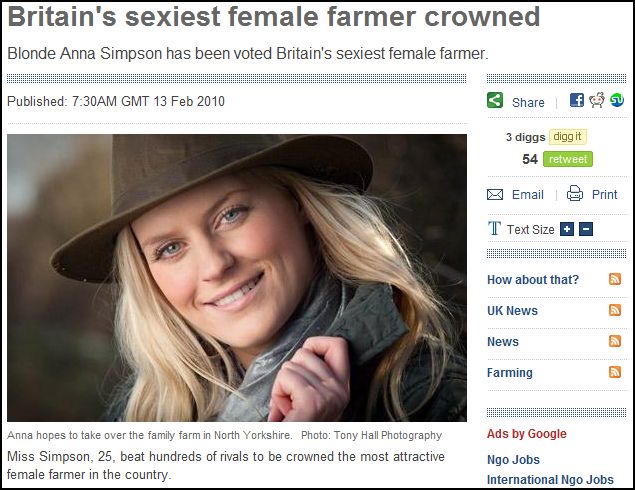
Katrin noticed something interesting about the coverage of the Farmer’s Weekly competition for Britain’s sexist male and female farmer, Pete Mortimore and Anna Simpson.

The coverage focused almost exclusively on Simpson.

She writes:

Of the (so far) 12 newspapers mentioning this, 11 focus solely on Anna Simpson: She’s the only one mentioned in the article’s title, there are huge pictures of her, videos of her and there is NO picture of Pete Mortimore, he is barely mentioned at all, never in the title (in some of the texts there is a half sentence in the middle of the article mentioning him: “Pete Mortimore, 25, has been voted Britain’s sexiest male farmer”, but that’s ALL).

For example, the Telegraph:

More examples of the focus on Simpson include the following headlines:

Blonde is UK’s Sexiest Farmer (the Sun)

Blonde Named Sexiest Female Farmer (UPI)

Welly-Wearing Blonde Named UK’s Hottest Farmer (GardenXL)

The Barnyard Beauty… UK’s Sexiest Farmer (Express)

Katrin continues:

The single exception, which has a tiny picture of him, is his own local newspaper.

Katrin thinks this is a great example of the way that the straight, male gaze shapes news coverage.  The coverage in these newspapers, ostensibly for both male and female, gay and straight readers, nevertheless covered the competition as if all of the readers are primarily, or only, interested in the hot chick.

Lisa Wade, PhD is an Associate Professor at Tulane University. She is the author of American Hookup, a book about college sexual culture; a textbook about gender; and a forthcoming introductory text: Terrible Magnificent Sociology. You can follow her on Twitter and Instagram.

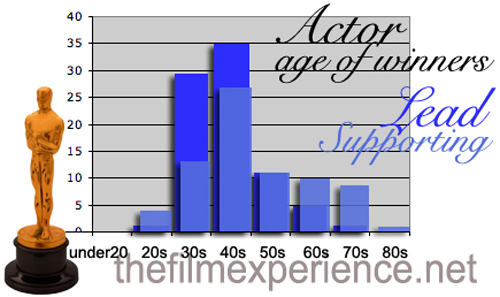
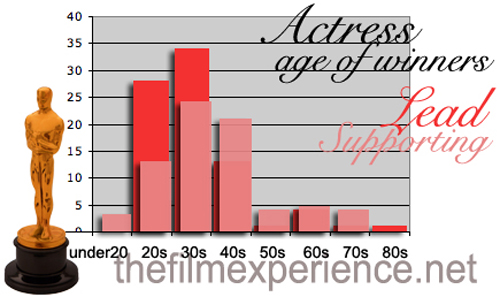
Nathaniel Rogers of The Film Experience tracked down the age at which all Oscar winners in the Academy’s 82 year history won their awards.  He found that men who won Best Actor and Best Supporting Actor were typically in their 30s and 40s.  In contrast, women who won were typically in their 20s or 30s.

Men:

Women:

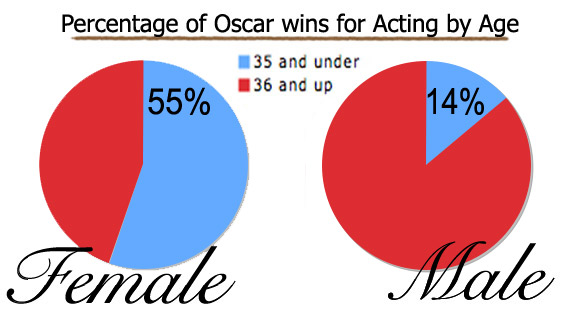
Looking at it another way, 55% of the women who have been awarded Oscars were 35 and under, whereas only 14% of men were the same:

Perhaps we’re seeing an age bias in award nomination and granting.  It’s reasonable to expect that older actors would be much more likely to win awards, given all their years of experience acting.  But this is not what we see for women or men.  Alternatively, there is an age bias in casting such that the only men and women available for an award are in these age groups.  Disaggregating the data by decade might also reveal some interesting patterns or trends that are invisible in this data.  There is, then, much room for speculation.

Lisa Wade, PhD is an Associate Professor at Tulane University. She is the author of American Hookup, a book about college sexual culture; a textbook about gender; and a forthcoming introductory text: Terrible Magnificent Sociology. You can follow her on Twitter and Instagram.