Search results for The

Martin M. pointed out some ironic happenings in Peru that illustrate the complexities of trying to deal with long-term stereotypes and prejudice. Back in November 2009, the Peruvian government officially apologized for discrimination against AfroPeruvians. So far so good–a step toward acknowledging that AfroPeruvians have suffered both economically and socially because of social attitudes and government policies.

But, of course, long-held stereotypes aren’t that easy to change. Peruvians of African descent have often been portrayed as backward, uncivilized, and possibly cannibalistic.

Just a few days after the government’s apology and declaration that poor treatment and negative stereotypes of this ethnic group needed to end, the newspaper El Comercio began advertising their new section on healthy eating with a TV commercial that draws on all the old stereotypes. The video is in Spanish, but I’m pretty sure you’ll get the gist of it, and I describe it below:

El comercio- Los canibales from Pao Ugaz on Vimeo.

What’s going on here? The mother is mad, not because her younger son ate someone, but because he ate someone who was too fat, and thus not good for them to eat. They need to eat less fattening people to improve their health. She warns him about his cholesterol. The caption says, “You eat healthy, you are healthy.”

According to Reportaje al Perú, the newspaper pulled the spot after receiving complaints and apologized for it.

As with any society with a history of widespread, blatantly racist stereotypes and discrimination, attempting to heal racial wounds will be a very long, painful, and difficult process. It’s one thing to officially apologize. It’s another to convince citizens that prejudice and discrimination are unacceptable and that everyone must play a part in ending them.

See also: El Correo ridicules Quechua speakers in government.
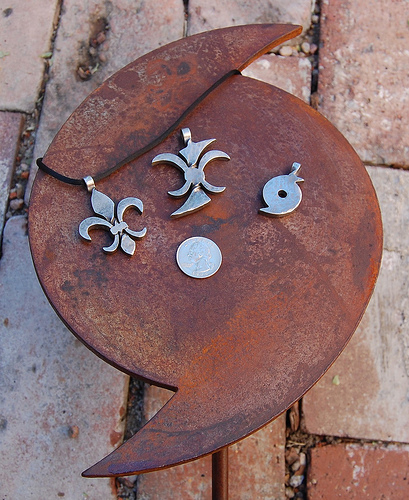
On August 29th, 2005, Hurricane Katrina sideswiped New Orleans.  The storm surge broke its levees, flooded 80% of the city, and killed almost 2,000 people.

The city is in recovery and it is emerging with a new identity tied tightly to that hurricane.  Though the storms have always played a role in the mythology of the city (consider its most famous drink), hurricane imagery increasingly has part of what defines New Orleans.  I’ve spent quite a lot of time there recently, and I can attest that the hurricane is everywhere: in jewelry, in art, and on bodies, for example.

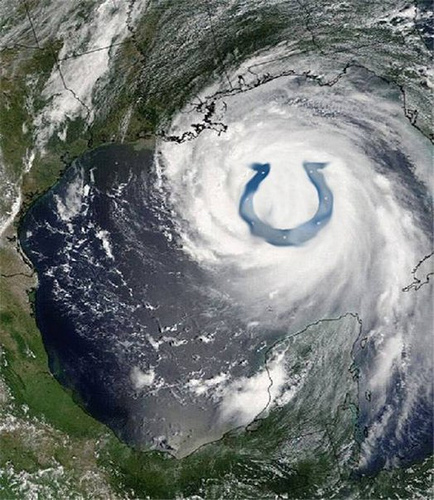
In light of this, Casey F. thought it would be interesting to think about who gets to use hurricane humor?  Case in point:  A flickr stream by Editor B includes the following two images.  The first uses hurricane imagery to suggest that the New Orleans Saints is going to “attack” the Indianapolis, Colts at the Superbowl (in Miami, FL):

The second also uses hurricane imagery, but this time it’s an Indianapolis Colts fan using it against New Orleans:

Casey feels that those who suffered from the hurricane, including New Orleans, “…have reclaimed hurricane imagery for ourselves, because we survived it.”  But, she says, “That doesn’t make it acceptable for others to do so yet.”

For Casey, the use of hurricane imagery to suggest that a team is going to crush its opponent is like the use of the n-word or “queer.”  It was a hurtful term that has been reclaimed by those it most  hurt.  Thus, blacks and gays can use the words (respectively).  But, still, when others use them, they still carry a sting.

For someone who was harmed by a hurricane, using the imagery is a way of reclaiming the hurt they suffered, even appropriating the strength of the force that hurt them.  But, for others to use it, it is trivializing that same hurt, re-imagining the destruction they suffered.  It is not funny, from this perspective, to imagine that New Orleans could be hit again.

I sympathize with Casey on this, but think it’s also an interesting topic for conversation.

Lisa Wade, PhD is an Associate Professor at Tulane University. She is the author of American Hookup, a book about college sexual culture; a textbook about gender; and a forthcoming introductory text: Terrible Magnificent Sociology. You can follow her on Twitter and Instagram.


The clip below is the trailer for a movie, The Code of the West: Alive and Well in Wyoming, that appears to be part documentary, part travel/tourism advertising, and part morality play. It emphasizes the moral superiority of a simple, truly “American” life lived in the great outdoors:

The clip is a great example of the way we socially construct both places and times.  Wyoming, a stand in here for “The Old West,” is mythologized as a place where people haven’t changed much.  Just as they were in the old days, they are steadfast, hard-working, and follow an impeccable honor code.

This isn’t to say that there aren’t great people in Wyoming, but it’s always wrong to say that something is always true (see what I did there?).  Further, today it is likely that many people work indoors in blue and white collar jobs and have little time to soak in the big sky that supposedly inspires such wholehearted goodness.  But the “idea” of Wyoming nonetheless privileges the cowboys (however many are left) over the office jocks.

Further, as Rachel at The Feminist Agenda writes “omit[s] a huge chunk of history”:

In cowboy country, there was one group of people with whom we never honored our word or felt bound by a firm handshake. If your skin was brown, all bets were off. We would make agreements with you, sealed by a handshake and a written contract, which we would disregard the minute it became convenient for us. Our word was worthless if your skin was brown and your culture didn’t look like ours.

Of course Rachel makes the same mistake here that the film makes:  There were (white) cowboys who would honor a handshaking with an American Indian.  We shouldn’t demonize the past/a people any more than should romanticize it/them.  Still, Rachel’s point stands: in the big scheme of things, the new Americans were not honorable by any measure.

The fact that the romanticization of The Old West wins out over its demonization is part of the larger revisionist history that the United States encourages (in school, in politics, and in popular culture).  There is what power looks like: to the victors go control over the narrative.

Lisa Wade, PhD is an Associate Professor at Tulane University. She is the author of American Hookup, a book about college sexual culture; a textbook about gender; and a forthcoming introductory text: Terrible Magnificent Sociology. You can follow her on Twitter and Instagram.


Kelly V. sent in a video by Alisa Miller of Public Radio International about the impact of news coverage on what we know about. In particular, she argues that changes in the U.S. news media, such as shutting down expensive foreign bureaus, have led to less coverage of events or issues in other countries:

For other examples of the role of media outlets in signaling what’s worth talking about, check out our posts on media outlets covering celebrity stories while chastising us for caring, presenting polls in the media, what stories get covered?, people are more interested in Tiger Woods than Afghanistan, meaningless statistics, U.S. and international versions of magazine covers, “us and them,” which missing kids get news coverage?, covering Obama and McCain, covering Obama and Clinton, and what’s worth covering in a slideshow?

Tilly R. sent in the clip below of Bill Maher attempting to illustrate the oppressiveness of the burqa by staging a fake fashion show in which every model comes out in an identical burqa. You only need to watch the first couple models to get the idea (starts at about .20 sec.):

The comedy is tasteless, at best. And it brings out two interesting assumptions: that measures of women’s liberation include (1) the right to show skin and/or your body’s shape and (2) the choice to express your individuality through your clothes.

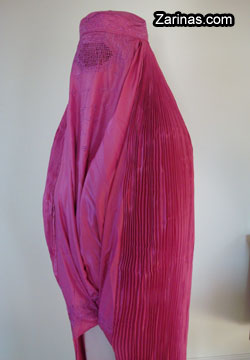
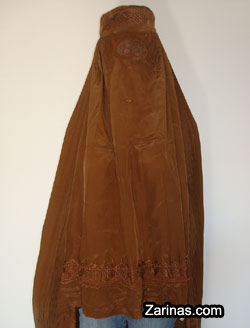
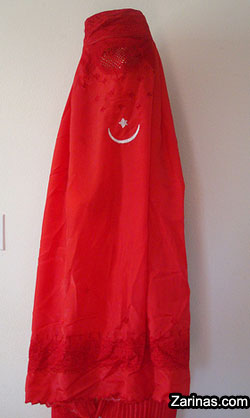
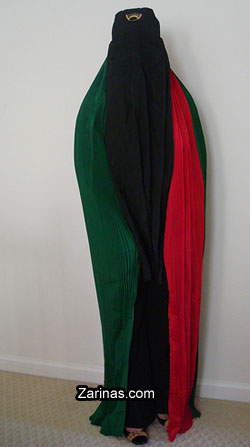
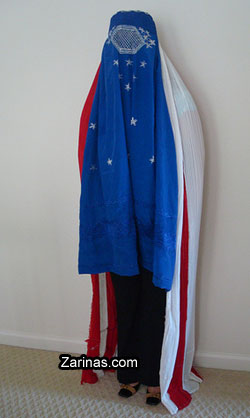
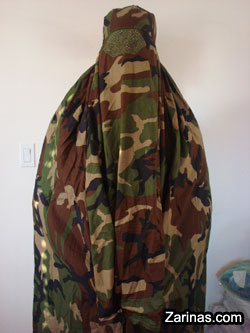
It is with a focus on the latter that I introduce a website submitted by K.L. The website, Zarina, sells burqas. While most of the burqas we see in Western media are blue or black, this website sells burqas of all stripes.

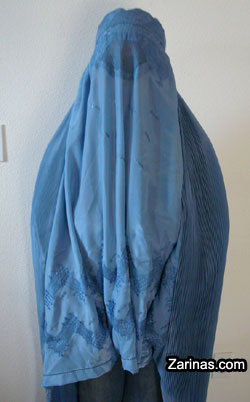
A blue, embroidered burqa:

A “hot pink” burqa:

A saddle brown burqa:

A Turkish flag burqa:

An Afghan flag burqa:

An American flag burqa:

A camouflage burqa:

I have no idea if this website is legitimate (though it seems to be) and I have no idea whether women in (which) different burqa-requiring/encouraging societies can actually choose to wear these. I really have no idea.

But I do think it prompts us to interrogate our own assumptions about what women’s liberation looks like and if being able to choose your own style really is a good measure of it.

I’d bet that most Western women feel like being able to choose her clothes is a central part of her sense of freedom. Does that translate in this context? That is, if women were required to wear burqas, but could wear any burqa they like, does this mediate how oppressive the burqa seems to you? Conversely, does the seeming freedom that comes with choosing your clothes become less convincing once you think about it in this context?  I know this is tough to think about, but I think it’s an interesting thought experiment.

For related posts asking us to think about the relative freedoms represented by the burqa and the power of the male gaze, see here, here, and here.

Lisa Wade, PhD is an Associate Professor at Tulane University. She is the author of American Hookup, a book about college sexual culture; a textbook about gender; and a forthcoming introductory text: Terrible Magnificent Sociology. You can follow her on Twitter and Instagram.

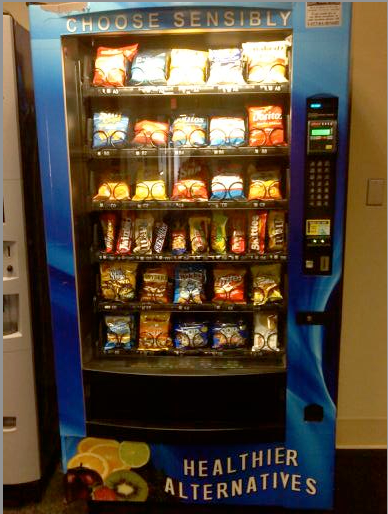
The vending machine below is a great example of the folly of relying on individual will in the absence of supportive institutional change.  “Choose sensibly,” the vending machine, exhorts… as it tempts you with fresh fruit, but offers you nothing but snack foods that are high in calories and low in nutritional value:

This makes me think of the many iterations of public service campaigns that tell people to have a good attitude and work on their character.  Yes, those are lovely things, but if people are going to make good choices, the options need to be there.

Found at Doctor Grumpy in the House, an amusing blog in which a doctor complains about doctoring.

Lisa Wade, PhD is an Associate Professor at Tulane University. She is the author of American Hookup, a book about college sexual culture; a textbook about gender; and a forthcoming introductory text: Terrible Magnificent Sociology. You can follow her on Twitter and Instagram.

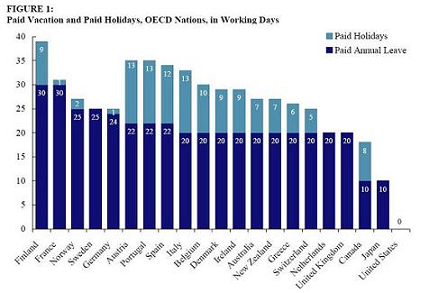
Sociologists have noted that race and gender have been more politicized in the U.S. than class.  In contrast, class is highly politicized in Europe, leading to a much stronger labor movement.   The weak labor movement in the U.S. is partly to blame for the stingy federal policies around vacation and holidays.  The U.S. federal government dictates that employees are given exactly zero paid holiday and vacation days a year (that means, if you get such things, it is because your employer is being generous/in a benefits arms race with other employers).  This is in stark contrast to most other OECD countries:

vacation_time_chart

Yep, that’s right.  In every country included except Canada and Japan (and the U.S.), workers get at least 20 paid vacation days.  In France and Finland, they get 30… an entire month off, paid, every year.

When I show figures like these (and there are many of them, parental leave, work hoursmilitary spending, class inequality, etc) to my students, they are STUNNED.  Most Americans are woefully ignorant of how pro-business U.S. policies are compared to the policies of like countries.  I think this ignorance contributes to the resistance many Americans display when politicians and activists talk about improving protections for workers.

Gin and Tacos:

We’re a nation of people working harder and harder for less and less, and the merest suggestion that we should do anything other than work 9 hour days without pause until we drop dead is met with cries of socialism…

The quality of life of a typical American certainly suffers from our ignorance of life in other nations.  If we were more aware of what a strong labor movement could offer, we might be more supportive of those movements.

I’ve always loved this bumper sticker:

weekend_bumper_800

Lisa Wade, PhD is an Associate Professor at Tulane University. She is the author of American Hookup, a book about college sexual culture; a textbook about gender; and a forthcoming introductory text: Terrible Magnificent Sociology. You can follow her on Twitter and Instagram.

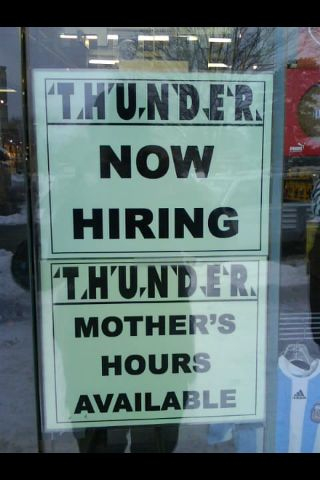
Catherine L. sent in the following picture of a (gramatically incorrect?) ad in the window of a sportings good store in Wellesly, MA:

“Mothers’ hours” refers to those hours during which kids are in school.  The term reveals the assumption, or prescription, that it is women who take care of kids after school.

Of course, that a company is offering work to primary caretakers is actually quite nice and supportive of families.  But it would be entirely easy to instead say “parents’ hours” instead.  Still, it’s possible that employers would be suspicious of any man who wanted to work only part time and assume they were both bad fathers and bad workers.  Employers are known to discriminate against men who do not put their job before their family.

Lisa Wade, PhD is an Associate Professor at Tulane University. She is the author of American Hookup, a book about college sexual culture; a textbook about gender; and a forthcoming introductory text: Terrible Magnificent Sociology. You can follow her on Twitter and Instagram.