Search results for The


The 30-second video below powerfully illustrates the spread of high joblessness rates from January 2007 to January 2010 (map by Latoya Egwuekwe; data from the U.S. Bureau of Labor Statistics).

Lisa Wade, PhD is an Associate Professor at Tulane University. She is the author of American Hookup, a book about college sexual culture; a textbook about gender; and a forthcoming introductory text: Terrible Magnificent Sociology. You can follow her on Twitter and Instagram.
Facebook ad from Ryan R.

Lisa Wade, PhD is an Associate Professor at Tulane University. She is the author of American Hookup, a book about college sexual culture; a textbook about gender; and a forthcoming introductory text: Terrible Magnificent Sociology. You can follow her on Twitter and Instagram.
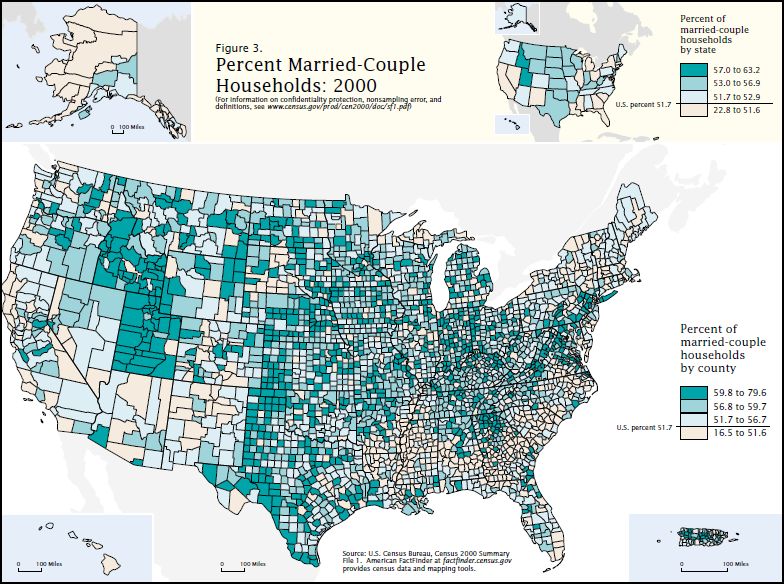
The US Census Bureau put together the map below.  It shows what percentage of households in any given county include a married couple.  In the counties colored with the darkest turquoise, between 59.6 and 79.6% of households consist of a married couple.  In the counties colored white, less than 51.6 do.

I think it’s interesting to speculate as to how the reasons why there are more or less married couple households might vary by place. For example, some places may have disproportionate numbers of gay and lesbian residents who cannot, legally, get married. Others may have higher rates of poverty, which has been shown to decrease relationship stability, leading to less marriage and more divorce.  Still others may have normative or religious pressures in favor of marriage (Utah strongly stands out as the most marriage-prone state).  The racial/ethnic make-up of counties may contribute to marriage rates; we know, for instance, that black women marry at a lesser rate than white women for a whole host of reasons.  Racial/ethnic homogeneity may play a factor too, since interracial marriage is still uncommon and asymmetrical when it does occur.  Some counties have more disproportionate ratios of males and females, which may also shape marriage rates. What do you think?  More hypotheses?  Arguments one way or another?

Lisa Wade, PhD is an Associate Professor at Tulane University. She is the author of American Hookup, a book about college sexual culture; a textbook about gender; and a forthcoming introductory text: Terrible Magnificent Sociology. You can follow her on Twitter and Instagram.
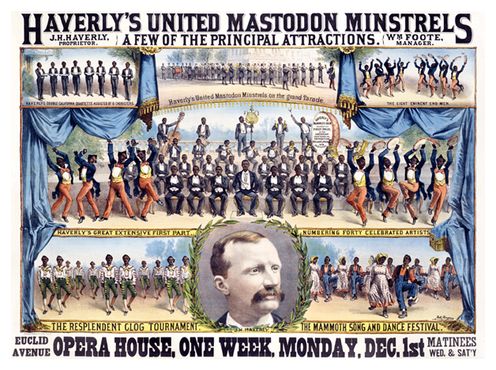
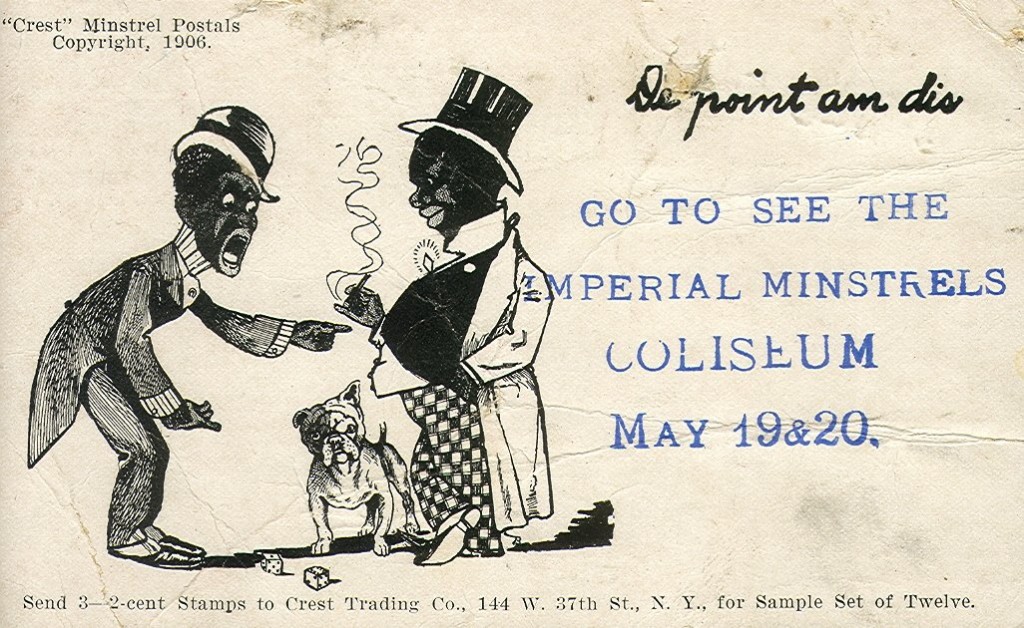
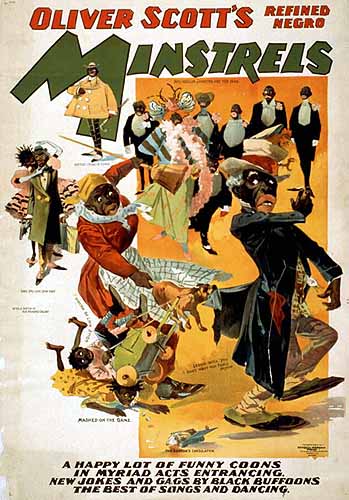
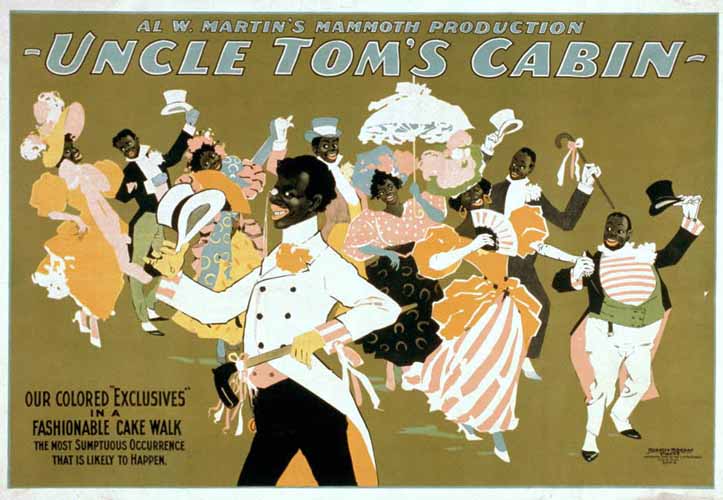
Minstrelsy is a form of entertainment, popular from the 1830s till the early 1900s in which white, and later black, people painted their face black and performed a caricature of blackness.  The images below (borrowed from Jim Crow History and Wikipedia) are original advertisements for minstrel shows.

Haverly’s United Mastodon Minstrels (circa 1877):

Haverly's_United_Mastodon_Minstrels

Oliver Scott’s Refined Negro (1898):

a_26082

Al W. Martin’s Uncle Tom’s cabin (1898):

a_2425

Wm. H. West’s Big Minstrel Jubilee (1900):

800px-Minstrel_PosterBillyVanWare_edit

Postcard (1906):

ImperialMinstrelsPostcard

For more caricatures of black people in U.S. history, see these posts: one, twp, three, four, five, six, seven, eight, nine, ten, eleven, thirteen, fourteen, fifteen, sixteen, seventeen, eighteen, nineteen, and twenty.

And for examples of modern reproductions of these stereotypes (literally), see these: one, two, three, four, and five.

For examples and discussion of contemporary “blackface,” see one, two, three, four, five, and six.  Also, bugs bunny.

Lisa Wade, PhD is an Associate Professor at Tulane University. She is the author of American Hookup, a book about college sexual culture; a textbook about gender; and a forthcoming introductory text: Terrible Magnificent Sociology. You can follow her on Twitter and Instagram.
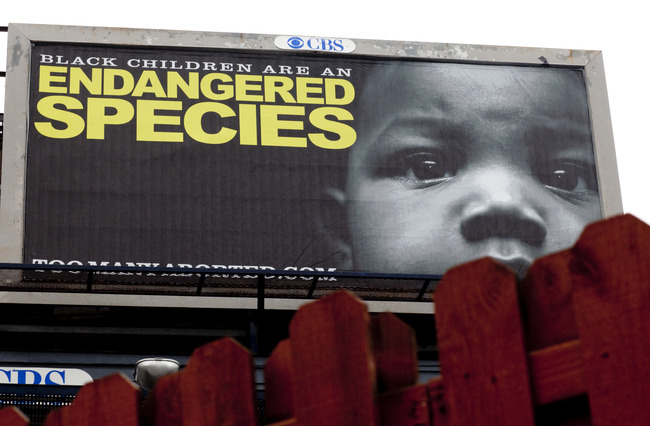
Emily D., Jeff S., and Dmitriy T.M. have all sent in links to a series of billboards, recently put up in Atlanta, that suggest that abortion is a form of genocide against African Americans:

We’ve posted before on the argument that abortion should be made illegal because it is used disproportionately against the children of Black mothers.  There are good reasons to both credit and discredit this argument, but I’d like to point out something a bit different.

The fact that abortion is highly politicized in the United States, deeply connected to feminism (but not race or class movements), and framed as a contest between “life” and “choice” seems natural to most Americans. Indeed, it’s hard for many Americans to imagine a world in which the procedure is less politicized or debated differently.  But the politics of abortion in the U.S. is not the only kind of abortion politics that could exist.  Myra Marx Ferree‘s award-winning book comparing abortion politics in the U.S. and Germany, Shaping Abortion Discourse, is a great example (with Gamson, Gerhards, and Rucht).

So, whether you agree or disagree with the claims in these billboards, they nicely jolt us out of our acceptance of abortion politics as is.  How might thinking about abortion as a race issue or a class issue change the debate?

NEW! (Mar. ’10): Dmitriy T.M. let us know about this billboard in Poland, sponsored by the Center for Bio-Ethical Reform, that connects abortion to Hitler (found at Opposing Views). The text reads, “Abortion for Polish women introduced by Hitler on March 9, 1943.” It was put up in time for International Women’s Day on March 8th.

I’m putting it after the jump–it has images of bloody fetuses and might not be safe for some workplaces.

more...

The BBC TV show Newswipe makes hilarious fun of common, trite elements of news reports in this video, which has replaced the tickle kitten as my current favorite video:

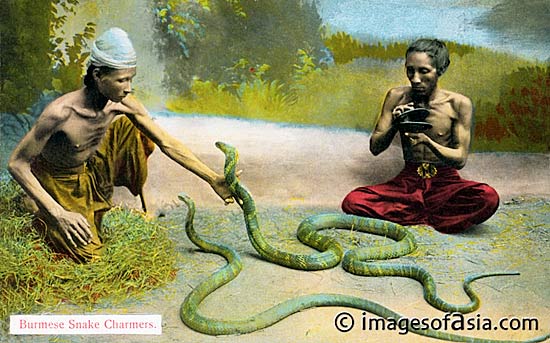
These days, if you live in the West, thinking about Asia–whether it be Chinese labor, Japanese inventions, Indian demographics, or Korean politics–is taken-for-granted as part of knowing about the world.  During the colonial era, however, when “mass media” was largely limited to print, Americans and Europeans experienced being more-or-less newly introduced to different cultures.  This spurred an entire industry in which “Africa,” “the Orient,” and the “Middle East” were presented to curious Westerners.  These presentations, more often than not, were objectifying.  Westerners were able to enjoy reveling in the seemingly bizarre and unfamiliar people and customs of these Other places (with a capital “O”), as if Other kinds of people were new species of animals over which to fawn.  This accumulation of documents with which the average Westerner could try to understand their “foreign” counterparts were produced not only by travel writers, but anthropologists, artists, imperial employees, novelists, and others.

Edward Said, in his powerfully influential book, Orientalism, first articulated the way that efforts of these actors coalesced into a mythology about “the Orient.”  A mythology in which the East and the West were set in opposition and the East was used by the West to define its own, superior identity.

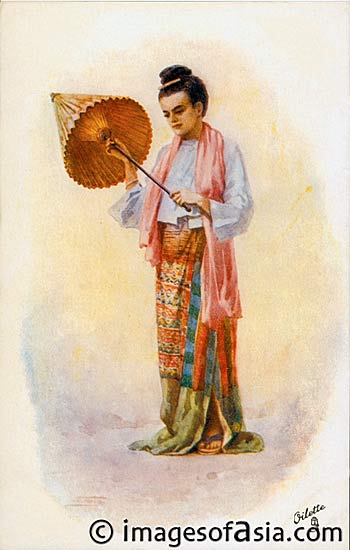
Katrin sent in one example of this traffic in Orientalism.  It’s a postcard from the early 1900s that depicts a “Burmese Beauty.”  It was painted by Robert Talbot Kelly and originally published in his book, Burma (1905).  The caption reads:

A Burmese Beauty. The Burmese women are generally attractive, much more so than the men, and present a pretty picture as they walk about attired in their gaily coloured skirts and shaded by their quaint umbrellas. All the ladies smoke in Burma, large cigars being the favourite ‘weed.’

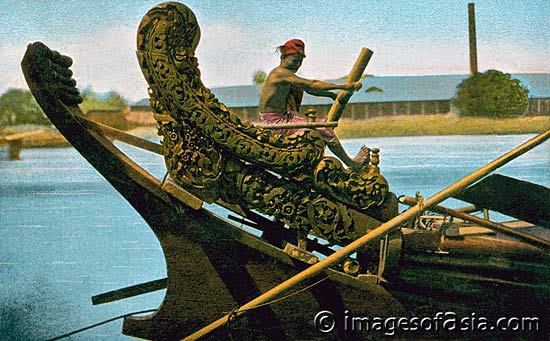
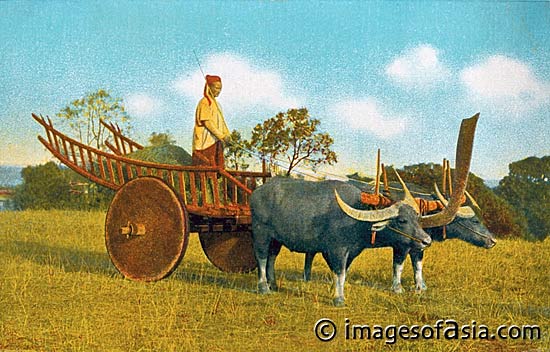
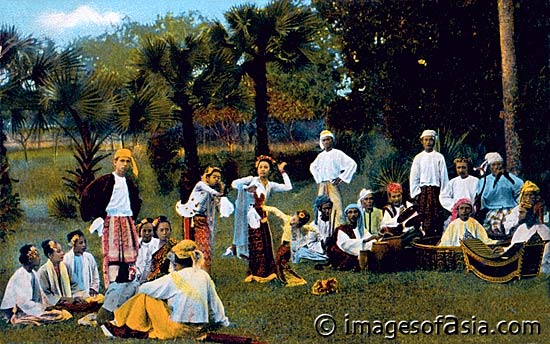
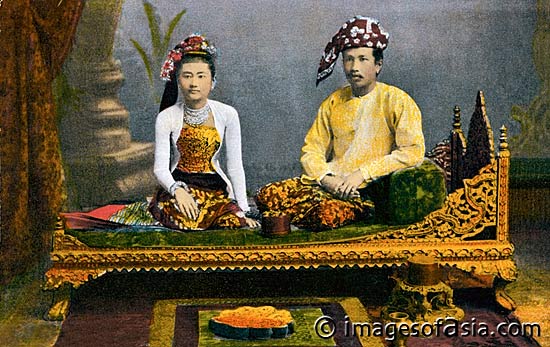
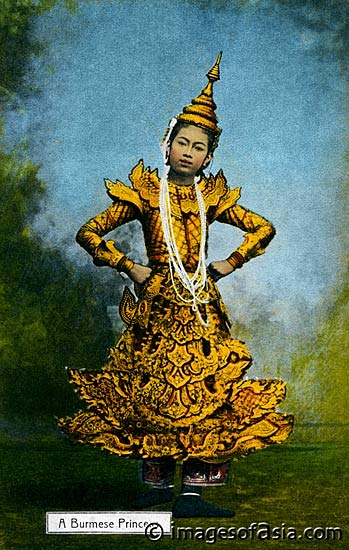
Here, the people themselves are seen as objects for a (distant) touristic gaze, kind of like the generic mostly-naked-woman-in-tropical-paradise postcard that we still see today.  More examples of colonial era Orientalist postcards depicting Burma (from Images of Asia):

1908:

1910:

1905:
1910:

1905:

1912:

Lisa Wade, PhD is an Associate Professor at Tulane University. She is the author of American Hookup, a book about college sexual culture; a textbook about gender; and a forthcoming introductory text: Terrible Magnificent Sociology. You can follow her on Twitter and Instagram.
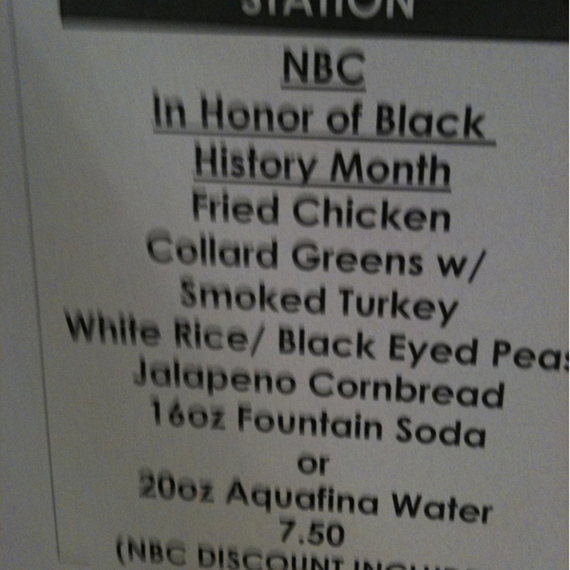
Dmitriy T.M. and Claire C. sent in a link to a photo of an NBC cafeteria menu in honor of Black History Month (that’d be February) that featured stereotypical African-American foods:

It’s not the first time.

Many argued that the menu was offensive because it reproduced stereotypes, but I think an interview (no longer available) with the chef who devised the menu complicated the story a bit.

Honestly, I think the main problem here is that Americans live in a racist society and so we have no idea how to celebrate Black History Month (how about with relaxer?).   The rest of the year, we make fun of black people for eating fried chicken. And yet, these are traditional Black southern dishes. So how exactly do we celebrate the holiday?   Do we pretend to valorize the same traditions that we make fun of during the rest of the year?  It makes no sense!  But it makes no sense because we’re still racist.  And we need a Black History Month because we’re still racist.  So, what to do!?

Perhaps the lesson to take from all of this is:  Undermining racism is hard work.   A month dedicated to Black history is a (flesh-colored) band aid, at best.  If we don’t do the other stuff (e.g., challenging the web of racist institutions that preserve class and race privilege), then no amount of fried chicken will make the difference.

Lisa Wade, PhD is an Associate Professor at Tulane University. She is the author of American Hookup, a book about college sexual culture; a textbook about gender; and a forthcoming introductory text: Terrible Magnificent Sociology. You can follow her on Twitter and Instagram.