Search results for The

In the article “In Pursuit of the Perfect Penis: The Medicalization of Male Sexuality” (available for free if you search for the title and Tiefer’s name), Leonore Tiefer discusses the way that the increasing attention paid by the medical community to conditions defined as “impotence,” and the way it has become medicalized, requiring any number of surgical, psychological, and/or pharmacological interventions. While some men have undoubtedly benefited, the largest beneficiary is the medical community itself. The broadened definition of what counts as “erectile dysfunction,” for instance, has created a larger market for drugs such as Viagra and Cialis.

Dmitriy T.M. sent in a trailer for the documentary Orgasm Inc., which documents efforts to medicalize “sexual dysfunction” among women. In the 3-minute trailer, we see cultural commentators and doctors discussing the shocking prevalence of sexual problems among women (43%! 83%! It’s an epidemic!) and some potential medical solutions. It’s a fantastic example of the medicalization of sexuality (and pretty safe for work). Enjoy!


Eight readers — Christine B., Hermes, Yvette, Hope H., Tyler D., Pris S., John G., and Dmitrity T.M. — alerted us to a photo spread in the December issue of French Vogue. The series of photographs is another piece of evidence of the adultification of young girls, an adultification that looks suspiciously like child porn, given the sexualization of adult women.  New York Magazine reports that the girls are 6 years old.  Don’t miss the lipstick, high heels, and disinterested pouts.

The thing is: the adultification/sexualization of young girls is paralleled by a infantilization of adult women.  This adds up to a conflation of women and children which serves to uphold prejudice against adult women and the exploitation of girls.


More at Gawker.

For more on the infantilization of adult women, see our posts on lady spanking, Glee, this collection of examples, a vintage example, and the Halloween edition.

For more on the adultification/sexualization of young girls, see our posts on sexually suggestive teen brandsadultifying children of color, “trucker girl” baby booties“future trophy wife” kids’ tee, House of Dereón’s girls’ collection, “is modesty making a comeback?“, more sexualized clothes and toyssexist kids’ tees, a trifecta of sexualizing girls, a zebra-striped string bikini for infants, a nipple tassle t-shirt, even more icky kids’ t-shirts, “are you tighter than a 5th grader?” t-shirt, the totally gross “I’m tight like spandex” girls’ t-shirt, a Halloween costume post, and girls in the World of Dance tour.

And, yes, it happens to boys too.  For examples of the sexualization of young boys, see our posts on Lil’ Wayne’s virginity loss, the depiction of a 13-year-old boy having a relationship with his teacher, the sexy marketing of both Jaden Smith and Justin Bieber, with a follow up here.

Lisa Wade, PhD is an Associate Professor at Tulane University. She is the author of American Hookup, a book about college sexual culture; a textbook about gender; and a forthcoming introductory text: Terrible Magnificent Sociology. You can follow her on Twitter and Instagram.

Justin G., an adjunct instructor in the Department of Sociology at Marymount University, recently received a gender lesson from his local Target. I’ll let him tell the story:

I grabbed the pack of eight depicted in the photo because they match our towels and bathroom wall colors and, to my surprise, when I scanned them for the price, I was told by the machine that they were “feminine casual” washcloths! I stood there and wondered how much darker the shades of blue and green would need to be for them to be “masculine”? Even when it comes to washcloths, it seems that Target and/or the manufacturer feels we need to be told what color we should be comfortable scrubbing our naked bodies with in the privacy of our own showers.

Lisa Wade, PhD is an Associate Professor at Tulane University. She is the author of American Hookup, a book about college sexual culture; a textbook about gender; and a forthcoming introductory text: Terrible Magnificent Sociology. You can follow her on Twitter and Instagram.

A set of stock photos on Hairpin must have hit a nerve because eight people — Renée Y., R. Walker, Amy E., Duff McDuffee, Lauren McG., Patricia P., Amy H., and Dmitriy T.M. — have sent it in.  The images appear, titled “Women Laughing Alone with Salad,” without comment.  Here’s a sampling:


These images resonate with readers, I think, because they are so damn familiar.  They are a good example of advertising in general.  They practically beg: “Please please please think it is fun to eat salad!”  And they insist: “Eating salad will make you haaaaappppppyyyyy!”  Much advertising today needs to convince you that the product will make you happy because we don’t need almost anything we buy.  Necessity lost out to desire in marketing a long time ago.

Lisa Wade, PhD is an Associate Professor at Tulane University. She is the author of American Hookup, a book about college sexual culture; a textbook about gender; and a forthcoming introductory text: Terrible Magnificent Sociology. You can follow her on Twitter and Instagram.

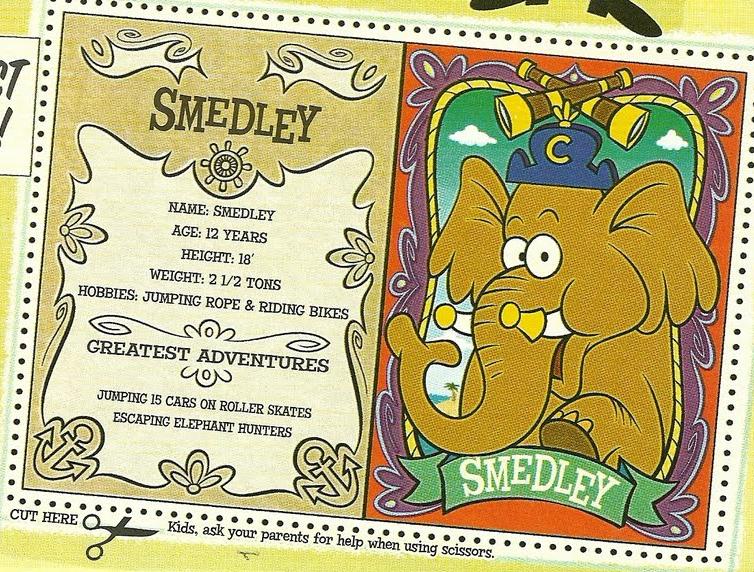
Mab R. sent in a nice example of how children are socialized into gendered expectations. Chunky Monkey Mind has a post about the cut-out trading cards that appeared on the back of Cap’n Crunch cereal boxes a while back. Each card features a Cap’n Crunch character. Here’s the card for Smedley:

Ok, so for the male character we get basic stats, and he’s clearly an active guy who has thrilling adventures.

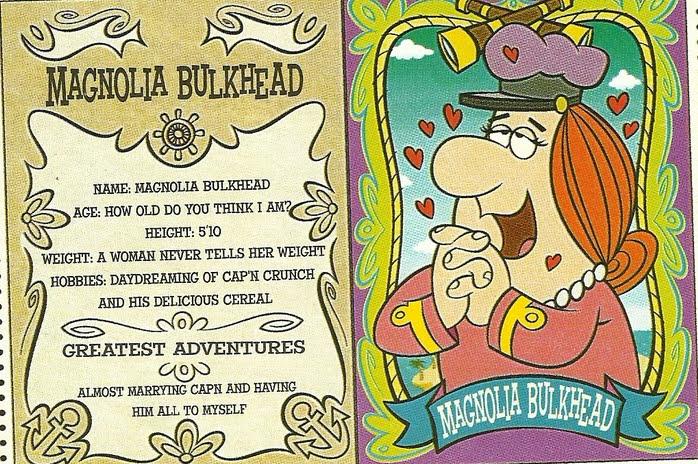
On the same box that featured the Smedley card was a card for Magnolia Bulkhead, who is shown with hearts hovering around her face as she clasps her hands together in rapture:

But of course, being female, she isn’t going to give us all of her vital statistics — in particular, age and weight are secrets women should guard carefully. Also notice the reinforcement of the idea that women are obsessed with romance. While Smedley’s hobbies involve action, Magnolia’s only listed hobby is daydreaming about a man (and his cereal). And her greatest adventure? Why, almost getting married, of course. Yes, the most amazing adventure of her life is something she failed at, but since it held out at least the possibility of romance, and she’s female, it was still the highlight of her life.

Ah, gender stereotypes! Fun for kids of all ages!

In an earlier post we reviewed research by epidemiologists Richard Wilkinson and Kate Pickett showing that income inequality contributes to a whole host of negative outcomes, including higher rates of mental illness, drug use, obesity, infant death, imprisonment, and interpersonal trust.

In the 3 1/2-minute video below, Kate Pickett argues that social inequality causes violence by creating status inequalities that those on the bottom respond to with violence.

Pickett and Wilkinson’s data is striking, but I’m not sure I buy that low status combined with status-sensitivity instigates violence.  Sociologists have made this argument; but others have questioned these conclusions.

Villanova University’s Lance Hannon, for example, tested this “subculture of violence” thesis as applied to poor African Americans. Using police department homicide data, he found no evidence that Black people were more likely than White people to react to an insult with violence.  This is swapping race for class, of course (and Hannon doesn’t control for class because the data was limited), but it does suggest that we should think carefully about the kind of argument Pickett is making.

See Dr. Pickett making similar arguments as to why raising the average national income in developed countries doesn’t make people happier or enable them to live longer and how status inequality increases stress.  And see more about income inequality and national well-being at Equality Trust.

Lisa Wade, PhD is an Associate Professor at Tulane University. She is the author of American Hookup, a book about college sexual culture; a textbook about gender; and a forthcoming introductory text: Terrible Magnificent Sociology. You can follow her on Twitter and Instagram.

“It is big, it is strange, it is unexpected.”

Schell spends the first six-and-a-half minutes of the lecture below talking about the surprising wins in technology this year.

Club Penguin, a flash game for kids, being bought by Disney for 350 million dollars.

Guitar Hero.

Webkins. “What?” “Really?”

He spends next 22 minutes trying to explain why these games have been so successful. Including:

Anything you spend time on, you start to believe, “This must be worthwhile. Why?  Because I’ve spent time on it.  And therefore it must be worth me kickin’ in 20 bucks because look at the I’ve spent time on it.  And now that I’ve kicked in 20 bucks, it MUST be valuable, because only an idiot would kick in 20 bucks if it wasn’t!”

What these all have in common is that these are all busting through to reality… We live in a bubble of fake bullshit and we have this hunger to get to anything that’s real.

Pockets turn the law of divergence inside out… remember the swiss army knife! …and this is why everyone hates the ipad.

And then, from about 21 minutes forward, he gives an account of what he thinks the future will look like. It’s, um, chilling.

Enjoy!

See also: Do We Play Farmville Because We’re Polite?

And also, he makes the same point we made in a previous post about how the new Ford Hybrid has made driving green into a game.

Via Text Relations.

Lisa Wade, PhD is an Associate Professor at Tulane University. She is the author of American Hookup, a book about college sexual culture; a textbook about gender; and a forthcoming introductory text: Terrible Magnificent Sociology. You can follow her on Twitter and Instagram.

Cross-posted at Jezebel.


Most of us are clear on the idea that patriarchies are defined by sexism: the valuing of men over women.  In our American patriarchy, however, this is matched and perhaps even superseded by something called androcentrism: the valuing of all-things-masculine over all-things-feminine.  We know we live in an androcentric society because masculinized things (playing sports, being a doctor, being self-sufficient) are imagined to be good for everyone (we encourage both our sons and daughters to do these things), but feminized things (playing with dolls, being a nurse, and staying at home to raise children) are considered to be good only for women.

This means that men are teased and ostracized for doing feminized things, as we have demonstrated in advertising for McCoy CrispsHungry ManSoloChevydog foodMiller beerbeef jerkycell phones, Dockers, the VW Beetle, and alcohol (see hereherehere and here).

This tendency towards androcentrism means, also, that companies can count on both women and men buying masculinized products, but only women buying feminized products.  It’s smart business, then, to masculinize everything.  In a New York Times article, for example, Patton reports that Mercedes masculinized its SLK in response to a finding that “too many” women were buying it, something that threatened to feminize the car:

Mercedes says that 52 percent of the registered owners of first-generation SLK’s are women and 48 percent are men; the company would prefer the figures to be more on the order of 60 percent men and 40 percent women…

The standard thinking in the industry is that lots of women will buy a car that appeals to men, but many men — certainly those who wish to avoid the girlie-men label — won’t buy one associated with women.

This logic helps explain the, admittedly tongue-in-cheek (I think), hyper-masculinization of the Honda Odyssey in this commercial, sent in by Nancy N. She writes:

The choice of the black car, the music, and lighting all direct the viewer to think, “this isn’t just a mini-van, this is a man-van, and you aren’t a pansy if you buy it.”   …[It is] “technology packed “… with distinctly harder edges. Overall, Honda is trying very hard to override the notion of a “mom car” to sell to a broader audience.

See also: “how to give the perfect man hug” and “how I sit on the bus”.  And for more examples of androcentrism, see our posts on the phenomenon in  sports (see here and here), cartoons, schools (see here and here), and Cosmo.

Lisa Wade, PhD is an Associate Professor at Tulane University. She is the author of American Hookup, a book about college sexual culture; a textbook about gender; and a forthcoming introductory text: Terrible Magnificent Sociology. You can follow her on Twitter and Instagram.