Search results for The

Cross-posted at Love Isn’t Enough.

Brandy B. let us know about an interesting article by Isis the Scientist at Science Blogs on the apparent whitening of a children’s cartoon character for the Christmas toy market. PBS’s cartoon, “Super Why!”, includes a female character, Princess Presto, who has the power to spell. Here’s what she looks like:
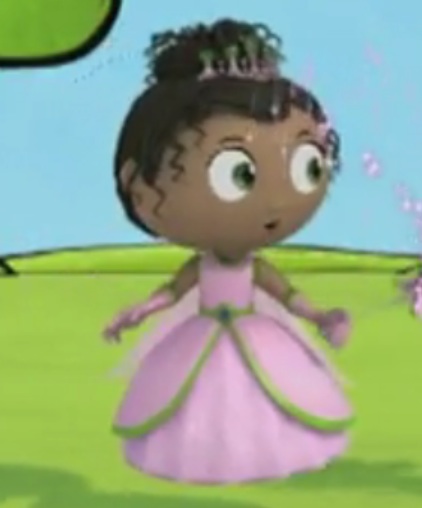
Yet the plush doll version of Princess Presto (who is supposed to have one White and one African American parent) looks significantly different:
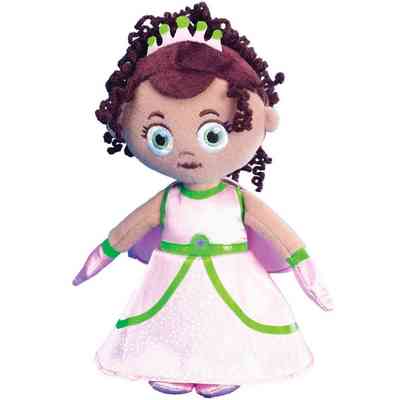
I found another Princess Presto doll online as well:

I did find one set where she looks more like the original:
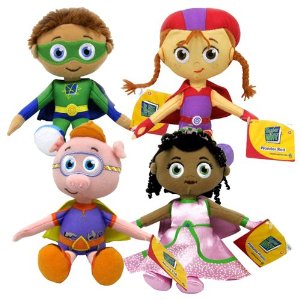
Isis the Scientists says that in comments to an article on the topic at the Orlando Sentinel, someone claiming to represent the company says the plush doll looks more like the original in person than the pictures online and says the following:

…The hair on the doll is more purple than black and this was an aesthetic choice…The placement of the facial features was intentionally tweaked to make the embroidered beanies look cute, so there is a slight difference from the onscreen character. The alterations were similarly made across all characters in the line, not just Princess Presto. There are almost always slight differences when translating the onscreen characters to off-air product especially with regard to colors because we have to use PMS or CMYK color choices for products.

Isis says BS — that having seen an actual version of the plush toy, it looks like it does in the photo, with very light skin, and that aside from that, other manufacturers seem to be able to make African American dolls just fine. And saying you changed things for “aesthetic” purposes doesn’t explain why you thought her existing characteristics were insufficiently aesthetically pleasing. Of course, we also don’t know for sure the person writing the comment was from PBS.

I tend to side with Isis here: the idea that technical limitations prevent making a more accurate representation of a dark-skinned doll is…sketchy, to say the least, and makes me think PBS needs to partner with a better toy design firm. And the choices about what the Princess Presto doll should look like in doll form put PBS in the position of appearing to think that a mixed-race character needs to be whitened to sell. PBS’s dolls exist in a marketplace where we’ve seen controversies about African American dolls being literally valued less than White dolls, and whatever their supposed reasons, it’s hard to get around the fact that all of the choices made in the name of aesthetics added up to a doll that looks awfully White.

Many Americans are familiar with “female genital mutilation.”  The term is typically applied to practices occurring in some parts of Africa, Asia, and the Middle East, but not to genital cutting practices that happen in the U.S. and other Western societies (including cosmetic surgeries on the genitals, surgeries on children with ambiguous genitalia, and transsexual surgery) and, by definition, not to genital cutting practices that happen to men in both Western and non-Western countries (male circumcision and other rare but more extreme practices).  “Female genital mutilation” elsewhere, then, is widely condemned by Americans, but rarely condemned in light of these other genital cutting practices, nor America’s own history of genital cutting.  In fact, it was not unusual to subject women in the U.S. to proper circumcision (removal of the clitoral prepuce, or foreskin) until the 1960s and these procedures remained legal until 1996 (though, as far as I’m concerned, their legality is still up in the air).

In any case, RabbitWrite gives us a glimpse into this era in American history. Reading from a Playgirl published in 1973, she recounts the confessions of a woman who chose to be circumcised and offers a short critique.

Lisa Wade, PhD is an Associate Professor at Tulane University. She is the author of American Hookup, a book about college sexual culture; a textbook about gender; and a forthcoming introductory text: Terrible Magnificent Sociology. You can follow her on Twitter and Instagram.

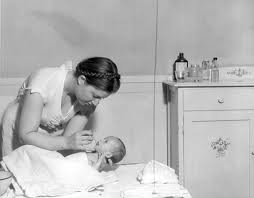
Nils G. drew my attention to a fascinating now-abandoned America educational practice that nicely illustrates how ideas about ideal parenting shift over time.  Between 1919 and 1969, the Home Economics departments of about 50 colleges and universities served as foster homes for orphans. Writes Emily Anthes at Wonderland:

During this time, homemaking… was considered to be something that could be conquered by science. Running a home based on instinct was considered to be woefully old-fashioned; the idea that raising a child and maintaining a home could be optimized by following a set of scientific rules was gaining currency.

Accordingly, getting a degree in Home Economics included a labratory set up exactly like a home: “practice apartments.”  And what better to fill these homes with than “practice babies!”  Students would practice applying the latest science-endorsed parenting techniques on orphans.  An article published in the Journal of Home Economics in 1920, by Elizabeth Vermilye, explained the rotation of care:

Each girl, in rotation, carried the work of “baby manager” for one week… The “baby manager” assumed the entire responsibility for the care of the child during her period. She herself did the actual work of caring for him between the hours of 6.00 to 8.00 a.m. and from 4.30 to 6.00 p.m. During the day the child was in the care of three or four other students during the time they were not in class, the manager making the program for this care, giving instructions regarding food and other matters needing attention. The baby manager did the baby’s laundry work.

A student taking care of a practice baby:

Far from being exploited, it was believed that these babies would get not just excellent, attentive care, but the best, most scientifically-valid care.  Vermilye claims that the examining physician was highly impressed with the children’s development during their stay with the students.  She quotes him saying, “The improvement in the condition of these children speaks highly for your cooperative motherhood.”

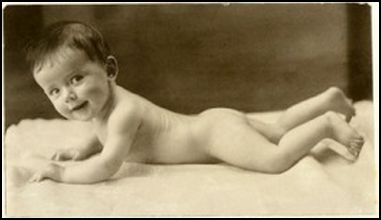
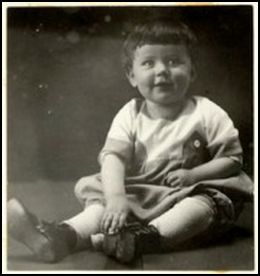
These pictures of orphan and practice baby Bobby Domecon (surnamed after his role in the Domestic Economics department) reveal his chubbification.

A skinny 6 pounds at 2 months old:

Perking up at age 10 months:

Nice and chubby 5 months later:

Because these children were believed to be benefiting from the latest science of parenting, they were highly adoptable; many couples were eager to get their hands on a child that had such a good start in life (source).

Eventually, however, ideas about mothering began to change.  In particular, scholars began to talk about Attachment Disorder and argue that a child’s development required that it strongly bond to one unique person.  In 1954, a short Time magazine article on the subject included experts suggesting that the program was harmful.  Starting with the Superintendent of the Illinois State Child Welfare Division, the author writes:

“It is not a normal family setting,” said he. “There are just too many persons involved in the handling of that child.”  Heaven only knows, added the superintendent, how many neuroses little David might develop. Other officials seemed to agree. “Imagine.” cried Mrs. Babette Penner, director of the Women’s Services Division of United Charities, “what anxieties there are in a child who is given a bottle in twelve or more pairs of arms.”

The scientific consensus eventually changed and, as a result, by 1969, then, “practice babies” were a thing of the past.

In this video from ABC Doris Mitchell, Cornell University graduate and Home Economics major, sweetly remembers her experience helping raise a practice baby at Cornell University:

For another fantastic example of historic management of children without parents, see our post on the Orphan Trains.

Lisa Wade, PhD is an Associate Professor at Tulane University. She is the author of American Hookup, a book about college sexual culture; a textbook about gender; and a forthcoming introductory text: Terrible Magnificent Sociology. You can follow her on Twitter and Instagram.

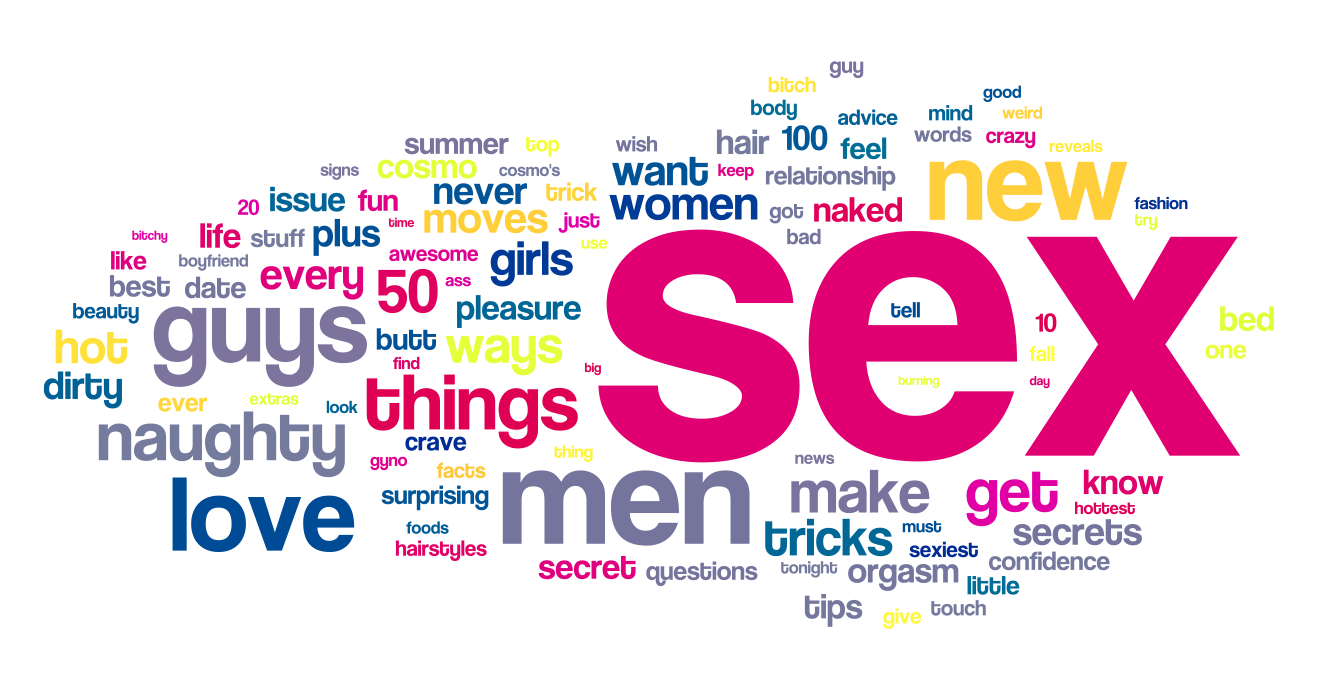
Jacqueline S. told us about a post at DarrenBarefoot comparing the words that appears most frequently on the covers of Cosmo and Maxim. Darren typed a list of every word that appeared on the covers for three years (2007-2010 for Cosmo, 2005-2008 for Maxim; he doesn’t explain why he chose different time periods) and then made word clouds to illustrate frequency. The results for Maxim:

And Cosmo:

So in both cases, sex rules, followed by a reference to the category of people you’re supposedly interested in having sex with (since both magazines pretty much exclusively assume heterosexual relationships). The word “sex” or “sexy” appeared at least once on ever single Cosmo cover in the 3-year span, and most Maxim covers as well.

But notice how much more the language on Cosmo covers focuses on sex and relationships than Maxim‘s does, with more frequent use of words that explicitly refer to men and/or sex. Of course, those familiar with Cosmo, or most other women’s magazines, know that its headlines about sex make it clear what the point is: various ways to please your man, which translates into increasing your own pleasure. Maxim, on the other hand, focuses less attention on relationships (or health/fitness) and more on money, travel, and pop culture (sports, TV, movies).

To highlight how dominant sex is on Cosmo covers, Darren made a 15-second video of them in rapid succession, back and forth:

I doubt any of you are shocked by his findings, but it’s a nice illustration of the way magazines aimed at women reinforce the idea that our primary goal should be finding, pleasing, and keeping a heterosexual partner to a degree not usually found in men’s magazines.

A while back Kale let us know that the New York Public Library had made their images collection available online.The collection has images on a huge array of topics, from fashion to the military to slavery to insects to a whole category for stilts, and including political cartoons, illustrations from publications, photographs, and so on.

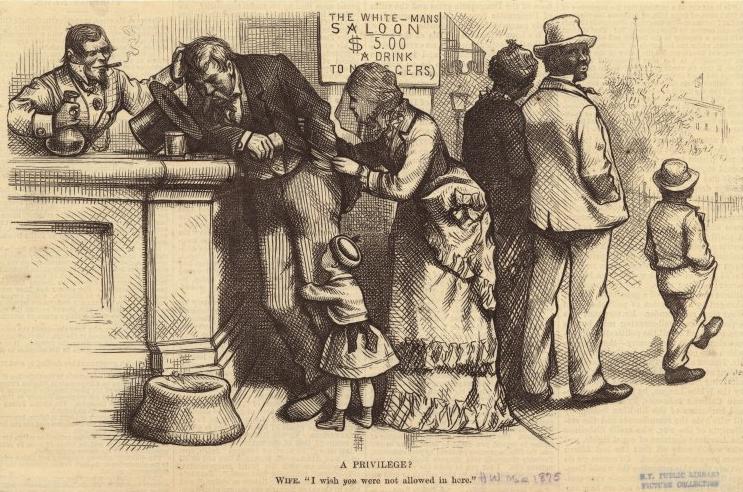
Kale found the collection particularly interesting as a way to look at historical racism and rhetoric about race relations in publications aimed at White readers. This 1875 cartoon, titled “A Privilege?”, presents segregation as actually protecting African Americans from the scourge of alcohol:

Text:

A PRIVILEGE?

Wife, “I wish you were not allowed in here.”

It’s a fascinating example of the use of institutionalized racial inequalities that hurt African Americans to, instead, garner sympathy for White women and children and present African Americans as, really, better off.

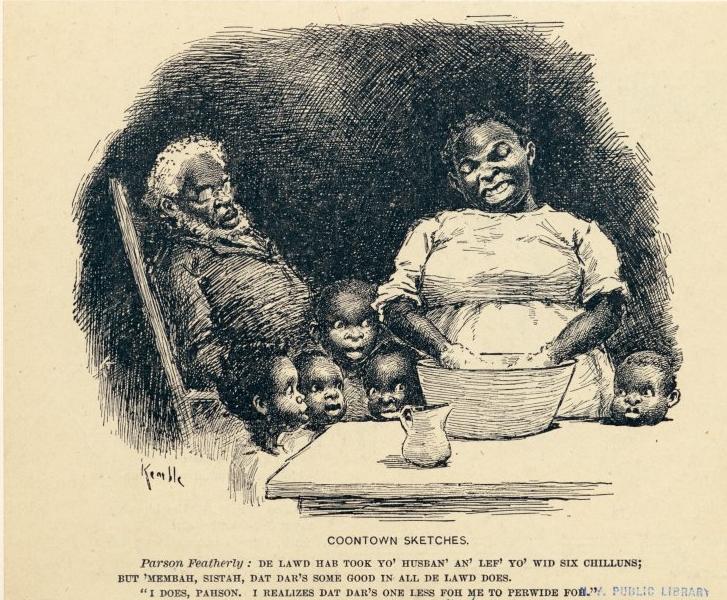
Another, published in Life in 1899, implies African American men are burdens on their families, making their wives take on the role of providing for everyone:

Text:

Parson Featherly: De Lawd hab took yo’ husban’ an’ lef’ yo’ wid six chilluns; but ‘membah, Sistah, dat dar’s some good in all de Lawd does.

“I does, Parson. I realizes dat dar’s one less for me to perwide foh.”

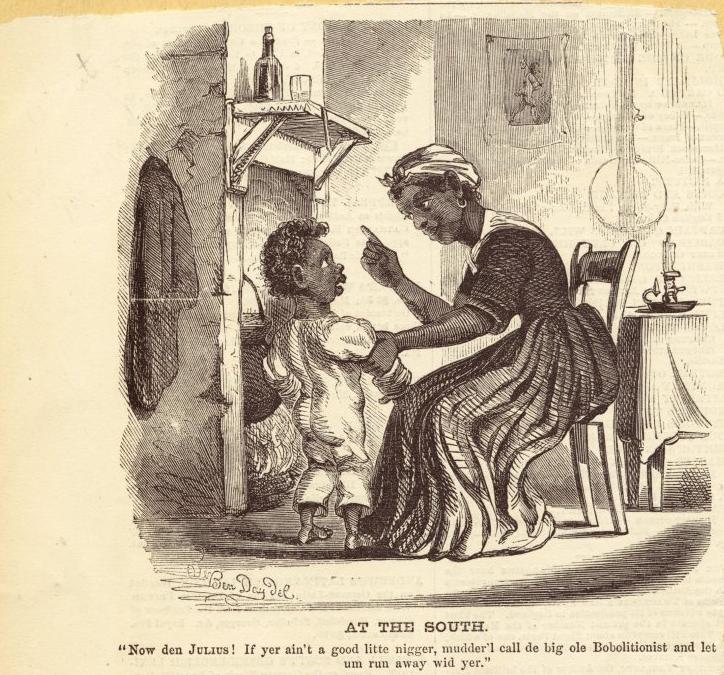
This 1860 cartoon from Harper’s Weekly shows an African American woman (presumably a slave) in the South using the “Bobolitionists” — that is, abolitionists, who wanted to outlaw slavery — as a threat, a type of monster that will come steal him if he’s not good:

Text:

“Now den Julius! If yer ain’t a good litte nigger, mudder’l call de big old Bobolitionist and let um run away wid yer.”

I’m sure it must have been very comforting to some readers to think of slaves viewing abolitionists as threats rather than potential allies.

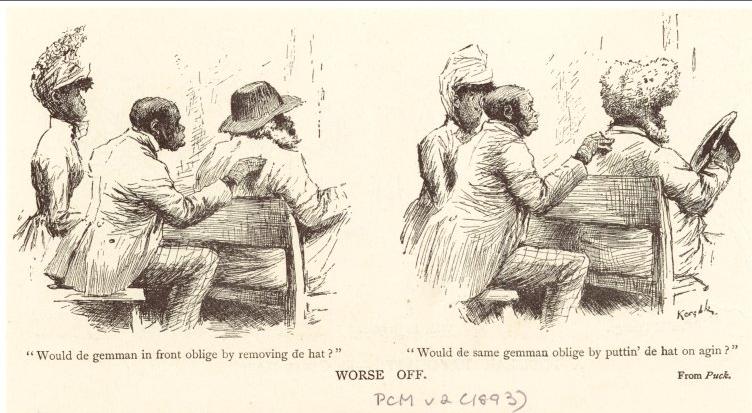
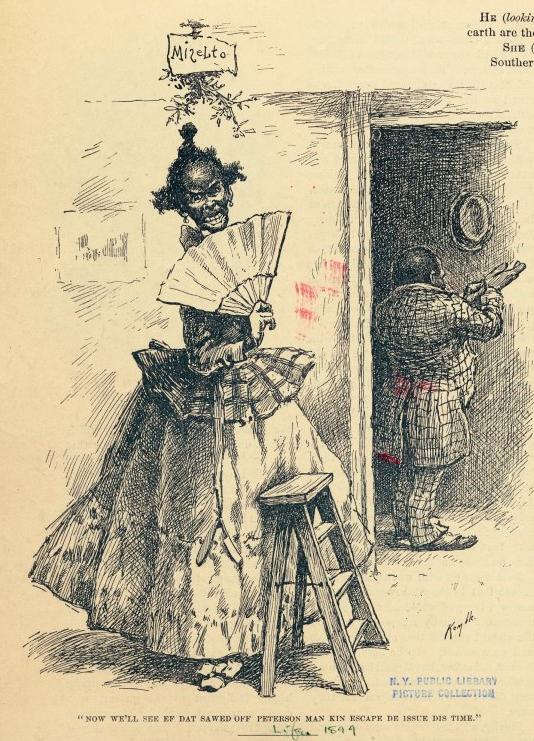
Other cartoons mock African Americans’ physical attributes, marking them as laughable or even grotesque:

Text:

“Would de gemman in front oblige by removing de hat?”

“Would de same gemman oblige by puttin’ de hat on agin?”

(Details.)

Text:

“Now we’ll see ef dat sawed off Peterson man kin escape de issue dis time.”

(Details.)

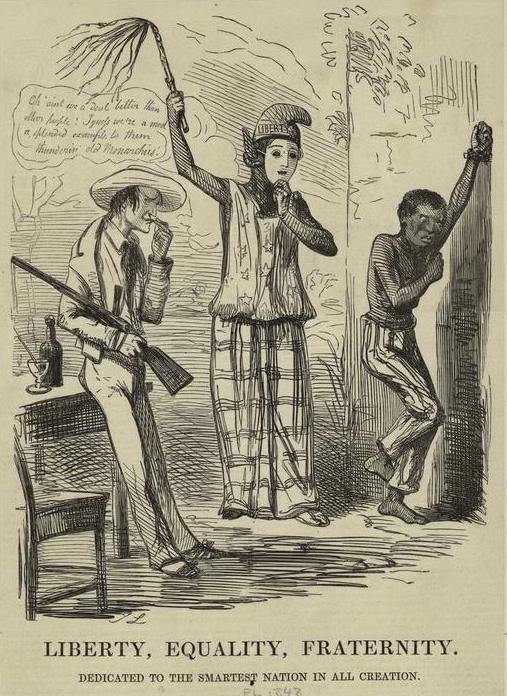
There are also examples that criticized U.S. race relations, such as this 1848 cartoon from Punch [Note: a reader thinks this might be about France, which banned slavery in 1848, but the NYPL has it listed as relevant to U.S. slavery, so there may be so lost context here]:

Enjoy!

[Note: A commenter has expressed concern that I ended this post with “Enjoy!” I apologize for my insensitivity. I meant it in terms of “Enjoy browsing this fascinating archive,” of which racist imagery is only a small part, not, I hope it would be clear, “Enjoy looking at racist cartoons!” I wasn’t thinking about how it might appear immediately after those set of images, and I should have been more careful.]


Sam J. and Elizabeth H. sent in these commercials for the Toyota Highlander.  In both an (ungrateful brat of a) son explains that parents who don’t drive the Highlander — all of which, inexplicably, drive wooden-sided station wagons or minivans — are “lame” “geek[s]” who ooze “dorkiness” and are “utterly humiliat[ed].”  Somehow the words seem to distract from the real message: if you’re too poor to buy a brand new mid-range SUV, you suck.

Lisa Wade, PhD is an Associate Professor at Tulane University. She is the author of American Hookup, a book about college sexual culture; a textbook about gender; and a forthcoming introductory text: Terrible Magnificent Sociology. You can follow her on Twitter and Instagram.

Sometimes we save up submissions on a particular topic so we can show several examples at once. And today, ladies and gents, I thought I’d present a few items that, to greater or lesser extent, glamorize brutality toward women or use images of dead women as props. Yes, I know — happy day!

On the less graphic end of the scale, way back in June 2010, Rei sent in these two trailers for the A&E show The Glades, where women exist just as props who manage to remain sexy, despite the deadness:

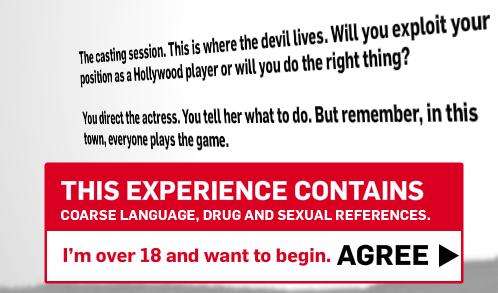
And some time ago Stefan Mesch, who writes for Die Zeit, let us know about the promotional website for Bret Easton Ellis’s new novel, Imperial Bedrooms. The website includes an interactive game where you’re a casting director and interact with a young woman who wants a part. From the homepage:

So theoretically, you have a choice — you can “exploit your position” or “do the right thing,” which presumably means not degrading or using a woman just because you can. But as Stefan explains, the options in the game are actually quite limited:

The game gives you options to talk to (and “encourage”) her, but they all lead to abuse, sexual harassment…The game rewards you for harassing the girl, and you’re supposed to drive up your personal score of “evil” by making her submit as much as possible.

Here are your first set of options:

I selected “encourage her.” The game then plays out a few seconds of dialogue and then leads to a second decision point, where I have these choices:

At least the first time I had one option to be a decent human being, other than not hiring her at all. I suppose that, in theory, giving someone booze might be a nice thing to do, but I think in this situation, probably nothing good can come of it. I selected that option; the director encourages her to drink when she doesn’t want to, and to drink more than she wants to. And then…

The “make her strip” option isn’t quite as bad as it might seem; when I chose it, she takes off her cardigan, but nothing else. At that point I felt like I’d pretty much gotten the point of the game, and wasn’t particularly interested in exploring how much of an asshole I could theoretically be, so I quit.

But both of those pale in comparison to our finale, readers. Dmitriy T.M. and Hope H. told us to check out Kanye West’s video for “Monster,” in which, among other things, Kanye casually rearranges the lifeless bodies of two women in bed with him:

Images of dead-looking women’s bodies appear throughout the video (which also features Jay Z and Nicki Minaj). I’m putting the rest of the images after the jump, as they might be particularly upsetting to some readers:
more...

We’ve posted before on the tendency for female, but not male, athletes to be featured in glamorous or sexualized ways that highlight their femininity instead of their athleticism.  See, for example, our posts on WNBA player Candace Parker and the Florida State University’s women’s basketball team.  Kirsten W. sent in another nice example.  In this case, it’s two tennis players at the height of their careers: Roger Federer and Anna Kournikova.

Federer is pictured as we might expect, doing what he is famous for doing, playing tennis:

(source)

In contrast, Kournikova is pictured like this:

(source)

Kirsten writes:

[Kournikova]… is presented in a very typical “female” way, with her long hair down (it would generally be pulled during a game), flowing over a pink frilly nightgown that suggests she’s in bed, and potentially waiting for company.

In 2000 when this issue of Sports Illustrated was released, Kournikova was on fire.   She was ranked 8th in singles and 4th in doubles… in the world.  Yet, Sports Illustrated decided to portray her not as an amazing athlete, but softly: as a beautiful, perhaps receptive woman.

Later Kournikova would abandon tennis for modeling.  Many argue that she did so because she failed as a tennis player, I wonder if she went into modeling, in part, because her appearance made people take her less seriously as an athlete.

Lisa Wade, PhD is an Associate Professor at Tulane University. She is the author of American Hookup, a book about college sexual culture; a textbook about gender; and a forthcoming introductory text: Terrible Magnificent Sociology. You can follow her on Twitter and Instagram.