Search results for The

Heather Downs, an Assistant Professor at Jacksonville University, pointed out a post by Sadie Stein at Jezebel about a recent graphic from the USA Today Snapshots feature; we’re pleased to repost it here, with some additional comments from me below.

———-

Women just love, love, love housework! Says a survey. Conducted by cleaning product.
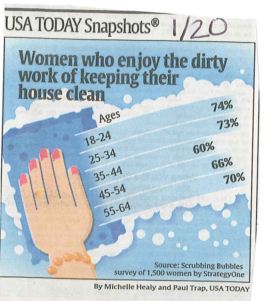
Apparently under the impression that we also believe cigarettes are soothing to the throat and little kids love laxatives, Scrubbing Bubbles (or rather, the impartial survey they commissioned) informs us (via USA Today) that an overwhelming percentage of women in every age group “enjoy the dirty work of keeping their house clean.”

Now, I know there are indeed women — and men, for that matter — who do indeed find satisfaction in the tangible rewards of cleaning (although I can’t pretend to be one of them.) But…why is this survey for and about women exclusively? Maybe because it comes from the same universe in which women — exclusively — scrub and sweep and swiffer with expressions of cheerful serenity in pastel-hued V-necks.

That said, in their defense, at least as of 1978, the bubbles themselves seem to have been masculine. And do not appear to be perverts:

[Via: Scrubbing Bubbles Says: All women are cleaning ladies (Mislabeled)]

Send an email to Sadie Stein, the author of this post, at Sadie@jezebel.com.

———-

Aside from the gendered element, it’s also a great example of the conflation of marketing-type materials with the surrounding, presumably non-advertising, material. Without having to buy advertising space, Scrubbing Bubbles gets a mention next to an item that says women think cleaning is awesome!

Also see how excited Kelly Ripa is to do laundry and product placement on Days of Our Lives.
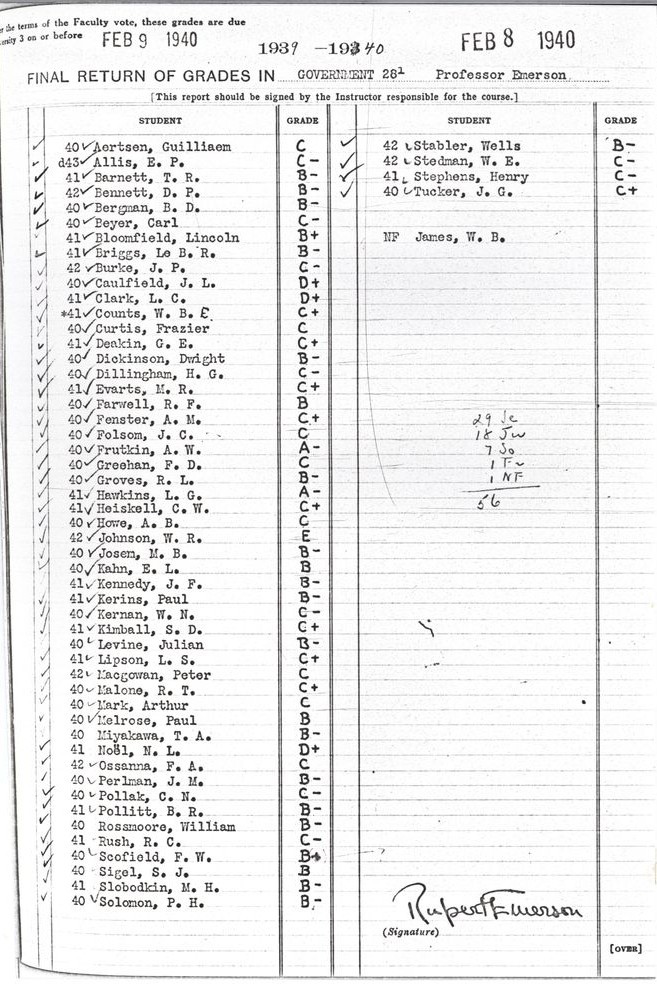
He got a B-minus. Which wasn’t so bad! He was only out-performed by 15% of his class: 5 B-pluses, 2 A-minuses, and exactly zero As.  In contrast, a whopping 33% got a C or worse.

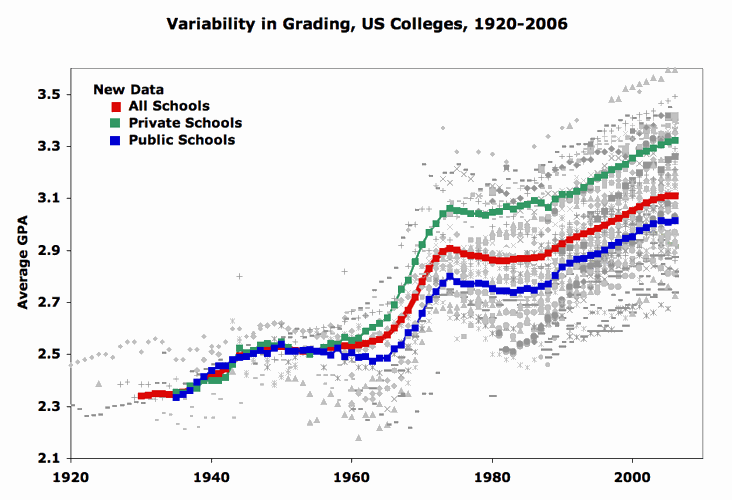
It turns out, JFK was already benefitting from grade inflation — the slow shift in the average grade point average in higher education — even in 1940. The chart below, borrowed from gradeinflation.com, shows that the average grade had gone up by 0.1 on  a 4.0 scale between 1935 and Kennedy’s not-so-fateful grade report.  Since then, however, has gone up another 0.7 points.

I’m well-known ’round campus for being a hard grader, but I’m no Professor Emerson.

Thanks to Matthew Beckmann for helping Kennedy’s paltry performance (I kid) see the light of day.  And to Jay Livingston for bringing it to my attention.  See also our post on pants inflation.

Lisa Wade, PhD is an Associate Professor at Tulane University. She is the author of American Hookup, a book about college sexual culture; a textbook about gender; and a forthcoming introductory text: Terrible Magnificent Sociology. You can follow her on Twitter and Instagram.

Alys sent in a photograph of the packaging at her local McDonald’s. It included pictures, not of Chicken Clubs and Big Macs, but of the raw ingredients that these foods are (theoretically) made of… with the notable exception of realistic images of animals. The materials, Alys writes, were…

…adorned with pictures of healthy whole foods, such as a tomato or a head of lettuce. That in itself is interesting — they are clearly attempting to cash in on the whole-foods-are-good-for-you mentality despite the fact that there is hardly anything more processed than fast food — but what I found particularly fascinating was the animals, or rather the lack thereof. My chicken club sandwich package featured not a live chicken, but two little origami chickens. Similarly, the bag the food came in had a tin chicken knick-knack thing. My husband’s hamburger package was even more ambiguous. It’s a little hard to read in the picture, but “two all beef patties” is represented not with a cow, or a picture of the patties, or even an origami cow, but with a spatula. Clearly MacDonalds realizes that while Americans want to be reminded that the ketchup on their sandwich originally came from a tomato — and that means it’s healthy! — they do not want to look into eyes of the live animal that sacrificed its life to provide the main focus of the meal.

Lisa Wade, PhD is an Associate Professor at Tulane University. She is the author of American Hookup, a book about college sexual culture; a textbook about gender; and a forthcoming introductory text: Terrible Magnificent Sociology. You can follow her on Twitter and Instagram.

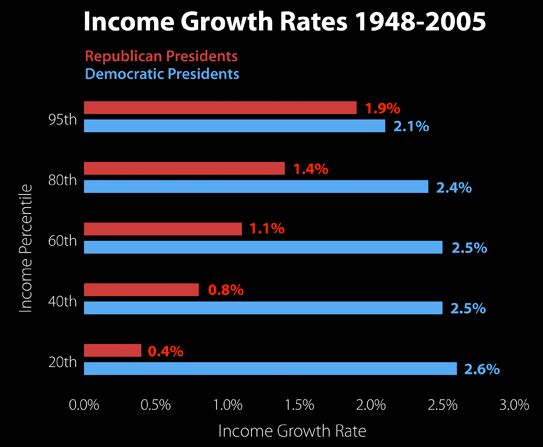
Tipped off by Dmitriy T.M., I enjoyed a Slate slideshow depicting and contextualizing the shrinking of the middle class and the growing advantage of the very top earners in the U.S. over time.  We’ve highlighted this slideshow before, but I thought this image deserved its own post.  Drawing on data from 1948 to 2005, put together by Larry Bartels, Slate shows that all income brackets prosper under both Democratic and Republican leadership, despite the idea that Republicans are fiscally responsible and Democrats irresponsible.  Under Democrats, however, nearly everyone is much more prosperous.  The highest income brackets are, given the margin of error, equally prosperous and all other brackets are significantly more so.

The figure reminds us that stereotypes about Republicans and Democrats don’t reflect reality and economic prosperity isn’t a zero sum game.

More slides at Slate.

Lisa Wade, PhD is an Associate Professor at Tulane University. She is the author of American Hookup, a book about college sexual culture; a textbook about gender; and a forthcoming introductory text: Terrible Magnificent Sociology. You can follow her on Twitter and Instagram.


Sociologists have noted that wives of men with very high-paying, high-status job often serve as a non-official, auxiliary employee to the company for which their husbands work. They do so not only by ensuring that his house is clean, his clothes washed, his belly full, and his kids are raised, but by supporting his actual work. For example, they may act as a second secretary in the evenings: typing or editing his writing, keeping his calendar, and screening his calls.

The commercial for Kraft Mac ‘n Cheese is a great example of this kind of relationship. In the video, a man surprises his wife by bringing a “client” home for dinner. The wife is pissed off at the lack of notice, but the idea that women should be entertaining men to lubricate their husbands’ work relationships is taken-for-granted. This dinner is work, for both the husband and the wife, but only the husband is on the payroll.

Thanks to my good friend Nils for sending along this video.

Lisa Wade, PhD is an Associate Professor at Tulane University. She is the author of American Hookup, a book about college sexual culture; a textbook about gender; and a forthcoming introductory text: Terrible Magnificent Sociology. You can follow her on Twitter and Instagram.

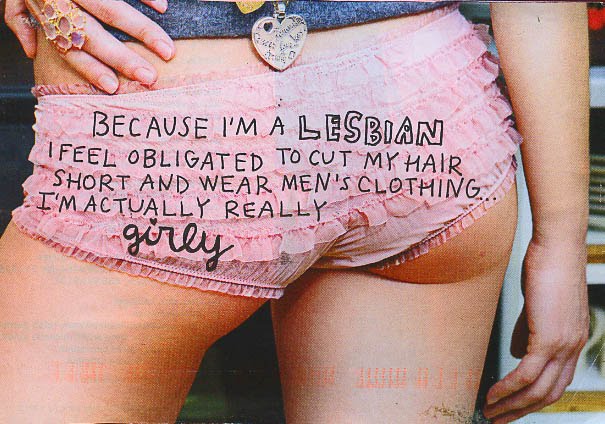
Suzy S. sent in an illuminating confession from PostSecret in which a woman confesses to being girly, but feels like she has to look more masculine because she’s a lesbian.  It reads: “Because I’m a LESBIAN I feel obligated to cut my hair short and wear men’s clothing… I’m actually really girly”:

This woman says she feel “obligated” to tone down her girliness.  In fact, adopting a masculinized appearance is one way that women signal to other people that they are gay, something they need to do because heterosexuality is normative and, therefore, generally assumed of everyone in the absence of signs otherwise.  There are lots of reasons why lesbians may want to be visible.

They may want to be a symbol of the very existence of gay people and thereby fight the assumption that everyone is straight.  They may want to find other gay women with which to build community or to find a girlfriend.  Or they may simply want to ward off the unwanted attention of men.  The style choices made by lesbians, then, aren’t simply about fashion or some internal inclination towards the masculine, as our confessor neatly illustrates. In some cases, at least a little bit, they’re strategic communication.

Related, see our fun post titled Revisioning Aspirational Hair.

Lisa Wade, PhD is an Associate Professor at Tulane University. She is the author of American Hookup, a book about college sexual culture; a textbook about gender; and a forthcoming introductory text: Terrible Magnificent Sociology. You can follow her on Twitter and Instagram.

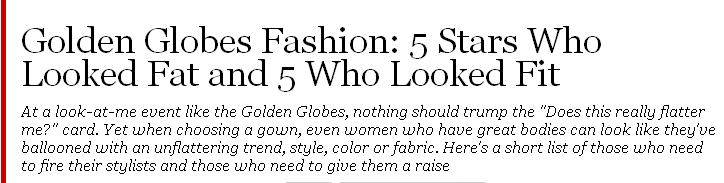
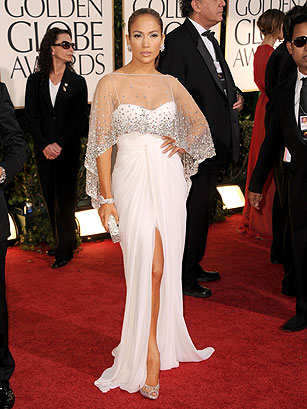
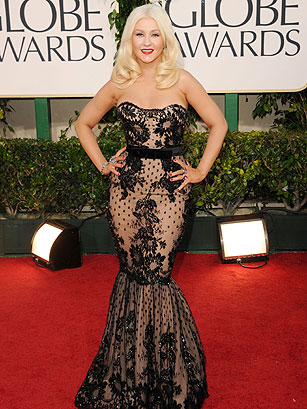
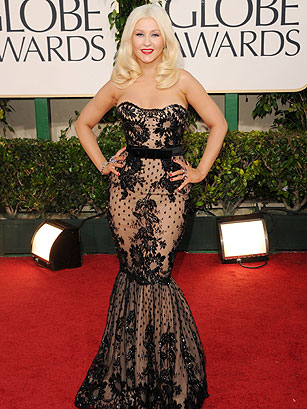
G.M. Cairney pointed out a set of photos at Time that highlights the scrutiny women’s bodies are under, the expectation that we constantly work to make our bodies look smaller, and a general cultural fat phobia, while making me wonder, again, why does this merit a slideshow? The article (which features only women) focuses on celebrities’ outfits at the Golden Globes on Sunday and makes it very clear what the main criterion for success is: could it possibly, in any way, from any angle, make these celebrities, most of whom are tiny, look even slightly larger than they are?

Here’s one of the offending garments, on Jennifer Lopez:


I don’t know that I particularly like the dress, but does it make her look fat? The author assures us, though, that this is a disaster: “White is a fright on an ample derriere, or on anyone who is not a size 0.” That’s right: if you’re over a size 0, the entire color white is off-limits to you.

Christina Aguilera’s dress commits the sin of making her look “buxom” and “hippy,” and she is rather oddly compared to Mae West as though that’s a bad thing:

Jennifer Love Hewitt’s dress is described as a “high-calorie confection,” reinforcing the association with fat.

All of these criticisms rest on the central assumption that there is an ideal body type that we should all be aspiring to, and that the role of fashion is to “camouflage” any areas that don’t conform. Any outfit that doesn’t do this has, by definition, failed, no matter how it actually looks on the person. Yes, the specific dress is supposed to be unique, individual, unlike anything else there, but the body inside it isn’t.

As Lisa once asked, wouldn’t it be something if instead we thought the point of fashion was to emphasize whatever shape we have, to  make our bodies look different from one another? Crazy thought, I know.

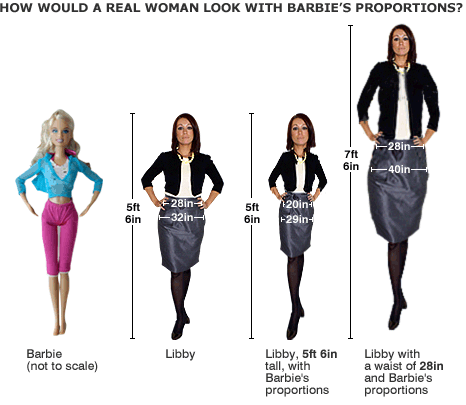
Everyone says that Barbie has unrealistic proportions, but have you seen them? Denise Winterman at the BBC decided to make a visual, borrowing one Barbie doll, one real human woman, Libby, and the wonders of photoshop.

First, Barbie’s measurements:

  • bust 4.6ins (11.6cm)
  • waist 3.5ins (8.9cm)
  • hips 5ins (12.7cm)

Second, the transformation:

Writes Winterman:

If Libby’s waist size of 28ins (71.1cm) were to remain unchanged, then applying Barbie’s proportions to her would mean Libby shoots up in height, to an Amazonian at 7ft 6ins (2.28m) tall. That’s just two inches shorter than the world’s tallest woman, Yao Defen. She would also have hips measuring 40ins (101.6cm) and a bust of 37ins (83.9cm).

But what if, instead, Libby’s height of 5ft 6ins (1.68m) was to remain unchanged. Doing the maths, Libby would have an extraordinarily tight waist of just 20ins (50.8cm), while her bust would be 27ins (68.5cm) and her hips 29ins (73.6cm).  Even the famously slight Victoria Beckham reportedly only has a 23ins (58.4cm) waist. But neither are they unheard of — Brigitte Bardot was famous for her 20ins (50.8cm) waist.

Citing scholarship, Winterman reports that “the likelihood of a woman having Barbie’s body shape is one in 100,000. So not impossible, but extremely rare.”

Via Jezebel.

Lisa Wade, PhD is an Associate Professor at Tulane University. She is the author of American Hookup, a book about college sexual culture; a textbook about gender; and a forthcoming introductory text: Terrible Magnificent Sociology. You can follow her on Twitter and Instagram.