Search results for The

Laura Heron sent in a article from the Economist about changes in union membership. The article, which takes a fairly negative view of the effects of unionization, includes a graph, titled “Where trouble lies,” that illustrates how much union membership has shifted from the private to the public sector in the U.S. Today, 36% of public employees (7.6 million) are members of a union, while only about 7% of employees of private companies (7.1 million) are:

Such a change, from primarily private-sector and often blue-collar workers to government employees, many of whom will be white-collar, middle-class, and relatively highly educated, has significant consequences for employers, governments, employees, and the issues likely to be of primary concern to the labor movement more broadly.

I used the data given in the article to create a chart comparing the percent of private- and public-sector employees in unions in Canada, the U.S., and Britain “today” (by which I assume they mean 2010, though they don’t specify, so be cautious there; also, they didn’t provide the private-sector rate for Canada, so I just used the data I had):

Aside from that, Laura’s attention was drawn to the post partially by the way labor was represented. To make sure we don’t miss the fact that unions are “trouble,” they illustrate the story with this image depicting labor as a fat, ravenous, naked figure devouring resources from the trim man in business attire:
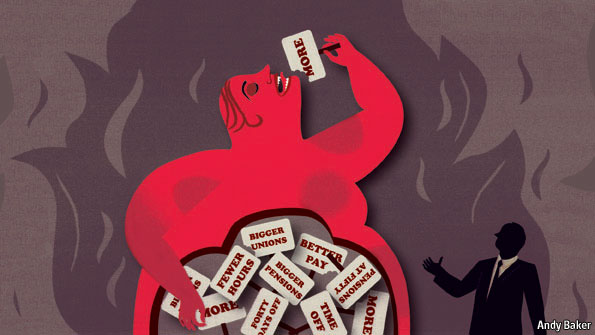
A subsection of the article is also titled “Fattening the Leviathan,” and as the image at the end of the article makes clear, we need to cut this monster down to size:

It’s sort of the mirror image of the “fat cat” rhetoric often used to depict the wealthy as greedy individuals who gorge themselves on profits at the expense of workers. In either case, the central element that makes such rhetoric work is the perception of fat people as lazy, ravenous, greedy individuals who take more than their fair share of available resources.
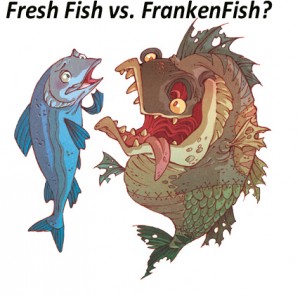
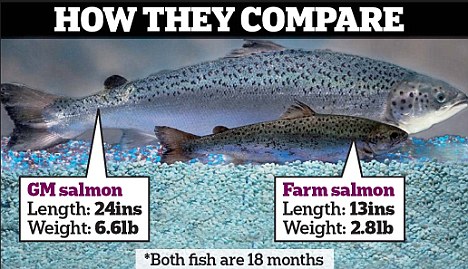
All social movements try to frame issues in ways that benefit their cause. Controlling the discourse is an important step towards getting the outcome they want.  Previously, we’ve posted about the way that activists against the genetic modification of food have nicknamed these foods, “frankenfoods.” Recently, Steven Foster, a student at Rensselaer Polytechnic Institute, sent us a pair of images questioning this rhetoric by comparing the imagery with the animals in question.

Frankenfish cartoon:

Images of genetically- and non-genetically-modified salmon:

While we don’t know whether anti-“frankenfood” activists are right about their concerns and it’s certainly true that these animals are genetically modified; it’s also clear that the visuals distort the facts (that is, the modified animals are not nearly as distorted as the cartoon implies).  Thinking through how the tactics by which social movement actors try to influence discourse is a fun and useful application of the sociological imagination.

Lisa Wade, PhD is an Associate Professor at Tulane University. She is the author of American Hookup, a book about college sexual culture; a textbook about gender; and a forthcoming introductory text: Terrible Magnificent Sociology. You can follow her on Twitter and Instagram.

In a previous post I embedded a video of a small child worshipping, arguing that it illustrated how children learn “the culturally-specific rules guiding the performance of devotion.”  The video below is a similar case, showing how a young child of about the same age, who has yet to learn to speak, has nonetheless absorbed the rhythms, emotional expression, and gestures customary among preachers in the particular faith in which he is being raised:

Discovered thanks to Dmitriy T.M.

Lisa Wade, PhD is an Associate Professor at Tulane University. She is the author of American Hookup, a book about college sexual culture; a textbook about gender; and a forthcoming introductory text: Terrible Magnificent Sociology. You can follow her on Twitter and Instagram.

Cosmo's Fake Cover Hides Orgasms From Advertisers

The cover of January Cosmo is as sexed-up as ever — on newsstands at least. But we got a copy of the version the mag sends to advertisers, and it’s significantly more chaste. What’s going on here?

Note the miraculous disappearance of “60 Sex Tips” and “Orgasm Virgins” — suddenly, Cosmo‘s appropriate for your grandma! Or your grandma’s favorite retailer — a tipster suggests that the cleaned-up cover is meant to be “more appropriate for conservative [advertising] clients, which the ad sales team is hoping to fool.” If so, they’re not doing a very good job — the table of contents in the ad-friendly version still lists both the sex tips and the orgasm piece as cover stories.

Cosmo's Fake Cover Hides Orgasms From Advertisers

A spokesperson for Cosmo offered this terse comment in response to our queries: “It is common for magazines to have different versions of the cover.”  We decided to see if this was indeed common at other publications. Caroline Nuckolls at Teen Vogue told us the magazine usually has just one version of the cover — but of course, Teen Vogue has a cleaner image to start out with, and less to hide. So we called Maxim, known for its lad-mag raunch — a source there told us they too produce just one cover, which goes out to newsstands, subscribers, and advertisers alike. This isn’t to say that no magazine does what Cosmo‘s done, but it’s not an industry-wide standard.

Of course, it’s not a surprise that a publication feels it needs to put its best foot forward to attract ad dollars — still, creating whole new cover lines is a pretty big step. Which coveted advertising account merited such a drastic cleanup? Some high-fashion brand? (Current Cosmo advertisers include Dior and Chanel.) Mainstream car or consumer products companies? (January’s issue includes an ad for Chevrolet.) Maybe they’re gunning for that Candie’s account? Whatever the brand, Cosmo assumes the ad buyers don’t read very carefully, and don’t know that the mag’s been providing sex advice and orgasm pointers to eager middle-schoolers for decades.

Send an email to Anna North at annanorth@jezebel.com.

A couple of days ago, Lisa posted about the sexualization of young girls, specifically in a fashion spread in French Vogue. Erica B. found another striking example on the reality show Toddlers & Tiaras, a show about young girls entered in beauty pageants. In this case, 2-year-old Mia’s mother has her perform wearing a tiny version of Madonna’s famous cone-bra bustier from her Blond Ambition tour:

The whole performance (and note the video is titled “Mia Living Doll”):

M/p>

For another video of her doing the routine, watch the 2nd video at this Jezebel post.

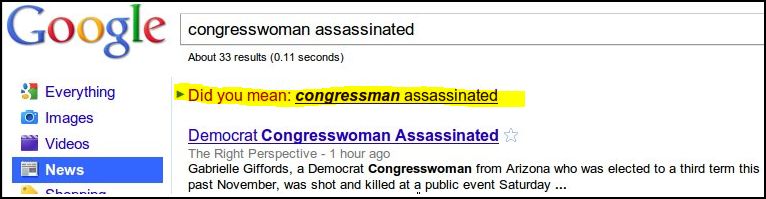
George Wiman, in searching for news about the shooting of Gabrielle Giffords’ and others, typed into Google the phrase “congresswoman assassinated.”  Google, it turns out, isn’t sure that “congresswoman” is a word.  I tried it again at midnight last night with the same result.

UPDATE: Readers discovered that Google doesn’t say “Did you mean congressman?” if you type only “congresswoman.”   The algorithm is based on language that already exists on the net and apparently “congresswoman assassinated” is not a phrase we find out there.  It’s so interesting how neutral tools — like algorithms — can nevertheless reproduce existing biases.  Because there have been so few congresswomen (too bad), and so few targeted with violence (thank goodness), typing in “congresswoman assassinated” makes it seem as if women are strangers to congress.  To sum, I’m not saying that this is some evil plan or oversight by Google, it’s an interaction between our real, unequal social world and a neutral algorithm.

Lisa Wade, PhD is an Associate Professor at Tulane University. She is the author of American Hookup, a book about college sexual culture; a textbook about gender; and a forthcoming introductory text: Terrible Magnificent Sociology. You can follow her on Twitter and Instagram.

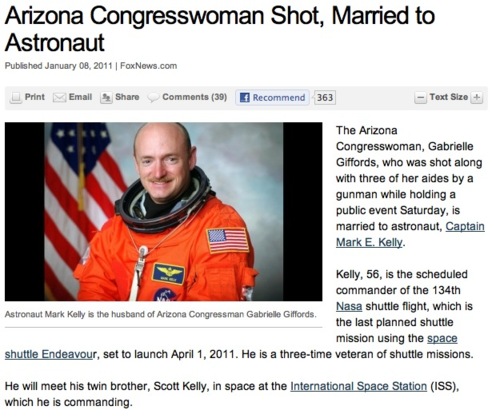
As most of you probably know, yesterday Representative Gabrielle Giffords, of Arizona, was one of 18 people shot at a public event yesterday. Elliott J. went online to find more information and came across this piece from Fox News:

The piece has now been expanded somewhat, with a photo of Giffords added, the photo of her husband pushed to the bottom of the page, and the title changed.

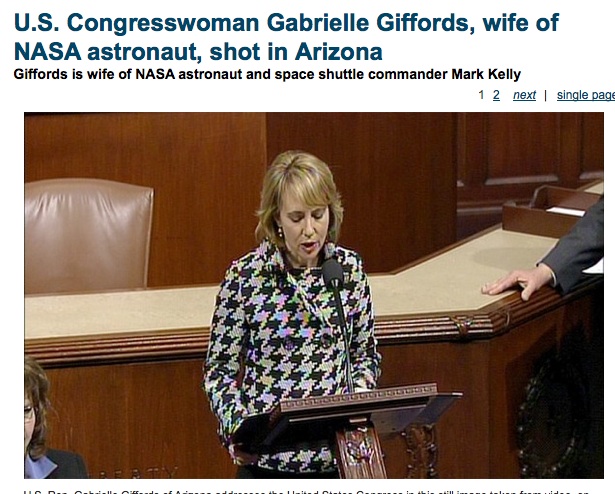
When I was googling looking for the Fox story, I came upon this from the website of the Orlando Sentinel:

I get that the point of a title is to draw people in and give them information that might make the topic seem interesting or relevant to them. And I guess NASA has a center in Florida, so maybe being married to an astronaut has special resonance there.

But really: a woman had a person walk up to her in a crowd and shoot her in the head, also shooting other people and killing some of them. I would hope that, even if she weren’t a member of Congress, that in and of itself would be sufficient material for a headline, regardless of who the victim’s husband was.

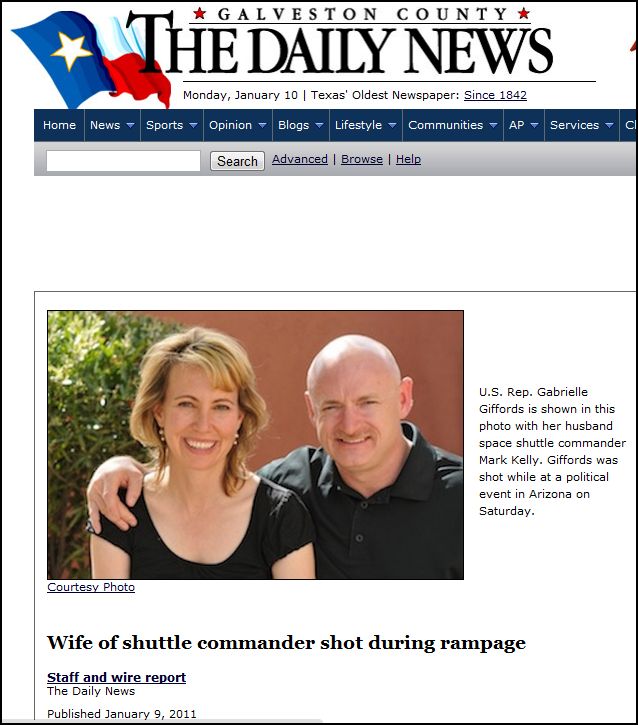
UPDATE: Kat P. sent in another example from the Galveston County Daily News. The headline reads: “Wife of shuttle commander shot during rampage.”

Meant to reveal the unbearable whiteness of the TV show Friends, this video by The DocFuture Show, is a pretty hilarious account of all of the black characters to ever grace the screen alongside the cast. It’s, um, funny:

Via BoingBoing.

Lisa Wade, PhD is an Associate Professor at Tulane University. She is the author of American Hookup, a book about college sexual culture; a textbook about gender; and a forthcoming introductory text: Terrible Magnificent Sociology. You can follow her on Twitter and Instagram.