Search results for The

Camille S. sent along a characteristic example of advertising for kids’ toys.  From KMart, the catalog specifies very different ideas for boys versus girls:

In contrast to the KMart advertising, Shannon H. sent a link to the advertising at Bazoongi. Their website, featuring slumber bags and play structures, is both multiracial and breaks down gender stereotypes. Notice that the boys and girls are both modeling boy-ish (blue, sciency) bags and girl-ish (pink, pony, butterfly) bags:


And this “dollhouse,” for example, shows mixed-sex play:

As does this “superhero hut”:

Lisa Wade, PhD is an Associate Professor at Tulane University. She is the author of American Hookup, a book about college sexual culture; a textbook about gender; and a forthcoming introductory text: Terrible Magnificent Sociology. You can follow her on Twitter and Instagram.
In the tradition of highlighting different Christmas characters (e.g., Krampus and Black Pete), we bring you Santa’s granddaughter Snegurochka, the “Snow Maiden.”  Snegurochka was brought to my attention by my Dmitriy T.M.

In Russia, Santa is frequently accompanied by Snegurochka. This allows female high school and college students to get in on the Christmas gig that, in the U.S., is restricted to guys with (fake) beards. Apparently lots of students get holiday work playing her.


Lisa Wade, PhD is an Associate Professor at Tulane University. She is the author of American Hookup, a book about college sexual culture; a textbook about gender; and a forthcoming introductory text: Terrible Magnificent Sociology. You can follow her on Twitter and Instagram.

E.C.S. sent along this clip from Keeping Up with the Kardashians in which the world is introduced to Kim’s wax figure, to be installed at the famous Hollywood wax museum, Madame Tussauds. E.C. asks, and suggests and answer to, the question: What has Kim Kardashian done to earn a spot beside historic presidents and renown musicians?  Kardashian, she explains, is being honored for her capitulation to patriarchy.  She explains:

Using her attractiveness, and her sexual and social capital as tools, Kim has made herself both a career and fame by winning the attention of men…

E.C. is referring, here, to Kardashian’s patriarchal bargain.   A patriarchal bargain is a decision to accept gender rules that disadvantage women in exchange for whatever power one can wrest from the system. It is an individual strategy designed to manipulate the system to one’s best advantage, but one that leaves the system itself intact.

Indeed, this is what Kardashian has done, and very successfully. So, for what is she famous? For making this bargain and getting such a good deal for herself. “Congratulations, Kim,” E.C. writes, “for being patriarchy’s perfect woman.”

Clip:

See also our post on how Tila Tequila’s patriarchal bargain ultimately backfired.

Lisa Wade, PhD is an Associate Professor at Tulane University. She is the author of American Hookup, a book about college sexual culture; a textbook about gender; and a forthcoming introductory text: Terrible Magnificent Sociology. You can follow her on Twitter and Instagram.
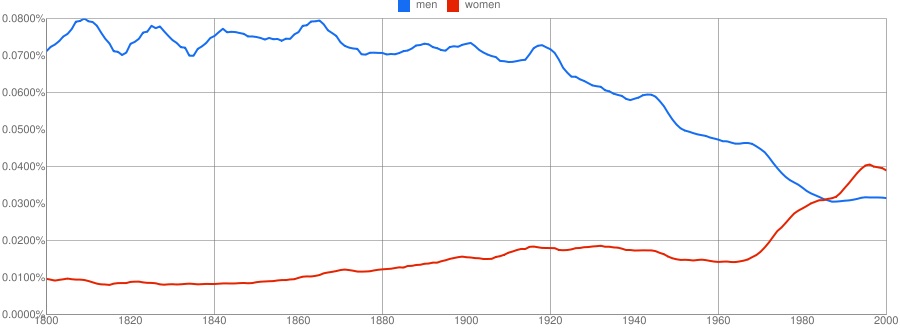
A  number of readers, including Mickey C., Lu Fong (writer and editor at The Good Men Project and Good Feed), Cheryl S., and Kelly V., let us know about Google Ngram. The program includes a database of a little over 5 million books and allows you to graph the frequency with which various words or phrases show up in books published in various languages over time (English can also be broken down into British or American English). Mickey and Lu each graphed the words “men” and “women” (see Lu’s discussion here):

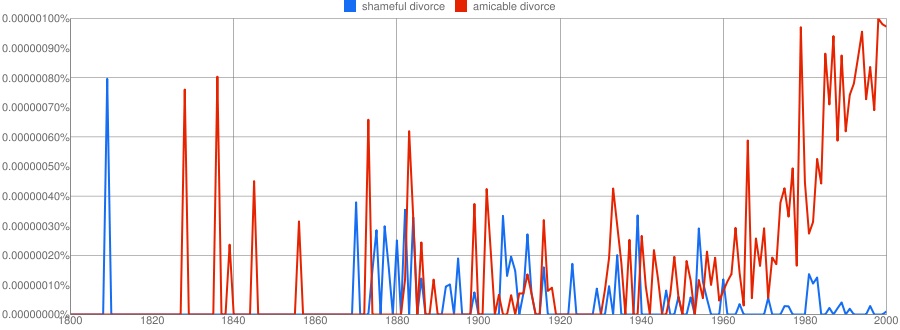
Cheryl S. tried “shameful divorce” vs. “amicable divorce”:

The plateaus are due to smoothing, which presents the data as 3-year averages to reduce huge spikes and valleys from individual data points to make overall trends more apparent. You can change the level of smoothing. Here’s the graph with no smoothing at all:

Overall, the tool provides a way to track changes in language as well as social trends. Google provides some info on their methodology, though not as much as I’d like. Some key points:

1. They “normalize” the results based on the number of books published each year, to account for the fact that many more books are published each year now than in, say, 1800, so 100 occurrences of a phrase today means less than 100 occurrences then — that’s why results are presented as percentages, not as raw numbers.

2. Phrases have to appear in at least 40 books total to be included in the database.

3. Keep in mind, the dataset is not based on all books published, but of a subset of books digitized by Google Books. The database includes about 4% of all published books, according to a journal article just published in Science.

I suspect it will be an amazing time-killer.


Stephen Colbert reports, and mocks, some pretty stunning product placement on Days of Our Lives:

Thanks to Dmitriy T.M. for the tip!

Lisa Wade, PhD is an Associate Professor at Tulane University. She is the author of American Hookup, a book about college sexual culture; a textbook about gender; and a forthcoming introductory text: Terrible Magnificent Sociology. You can follow her on Twitter and Instagram.

Abbotsford, Wisconsin’s Mark Prior posted a sign reading “NO NEGRO’S ALLOWED” sign [sic] at the entrance to his strip club.  From the story at NBC (via Racialicious):

“Our mistake is sometimes we look for logic in something that is just plain stupid,” says Dr. Selika Ducksworth-Lawton, an African American historian at the University of Wisconsin-Eau Claire.

Meanwhile, in Hayden, Idaho, Mark Eliseuson celebrated the first snow with a KKK snowman, complete with noose.  According to KTLA News, Eliseuson took down the snowman after being told that he could be charged with a “nuisance”:

(Thanks to Dmitriy T.M. for the tip off.)

See also our post on race-themed parties at colleges and universities and our post on The Compton Cookout.

Lisa Wade, PhD is an Associate Professor at Tulane University. She is the author of American Hookup, a book about college sexual culture; a textbook about gender; and a forthcoming introductory text: Terrible Magnificent Sociology. You can follow her on Twitter and Instagram.

To commemorate the last weekend before Christmas, when many will be out trying desperately to complete holiday shopping, I thought I’d post this image, designed and sent in by Joseph Moriarty in response to the craziness of all the holiday-season shopping frenzies (including the now-predictable tramplings):

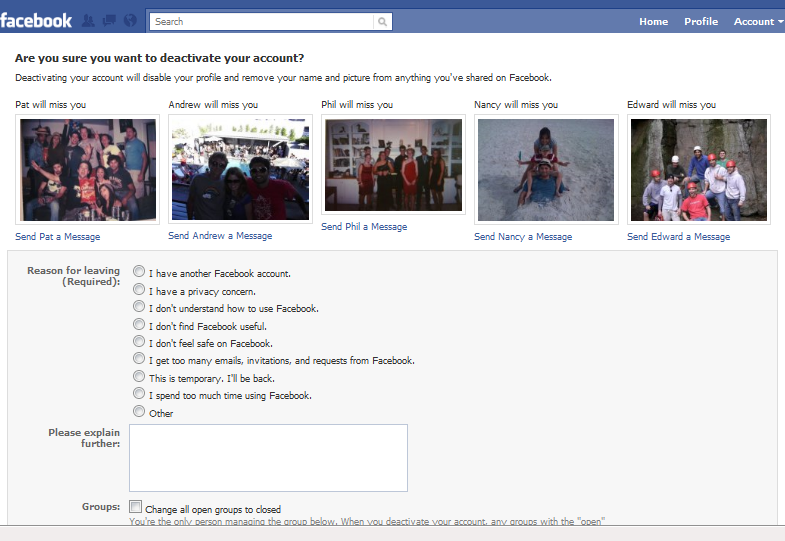
Genesis C. smartly decided to deactivate her Facebook account, and thus its distractions, during her final exams. “It felt as if Facebook was doing all it could to convince me to stay.”  First Genesis sought to delete her account altogether, but finding a delete button took quite a bit of digging (and some googling).  She set about to delete, but the site insists on a 14 day waiting period.  A deleted account in two weeks wasn’t going to help her study now, so she decided to deactivate instead.  She continues:

After I selected the “deactivate” button under “account settings” Facebook asked me “Are you sure you want to deactivate your account?” and under that it displayed pictures of a few friends, captioned with the lines “[Friend’s name here] will miss you.”

The images they included weren’t profile pictures, but pictures in which Genesis had been tagged, so Facebook deliberately included people that she knew personally.


Genesis concludes:

I just thought it was very interesting to find out how manipulative a social network like Facebook can be by trying their best to make you feel that you really need Facebook in your life. First of all by making it very hard to finalize your deletion request and by making you feel that by deleting/deactivating your account you lose connection with your closest friends, as if it were the only form of communicating with these people.

See also an ABC News story on deleting/deactivating your Facebook account.

Lisa Wade, PhD is an Associate Professor at Tulane University. She is the author of American Hookup, a book about college sexual culture; a textbook about gender; and a forthcoming introductory text: Terrible Magnificent Sociology. You can follow her on Twitter and Instagram.