Search results for The

If you are a bit of a linguistics geek, then Jeff H. sent in a treat for you. He found a detailed map of accents/dialects among English speakers in the U.S.:

The creator, Rick Aschmann, is a professional linguist, though the map is described as a hobby not related to his work. It appears to be based primarily on data from the Atlas of North American English (ANAE).

A caution: Aschmann says, “I have not included AAVE [African American Vernacular English] in this study, since its geographical distribution tends to be independent of ‘white’ dialects.” That’s an important omission to keep in mind. I went to the ANAE website and also did a general search for a map of AAVE prevalence, but I haven’t been able to find one

And there is one area in the continental U.S. where the majority of people do not speak English: the parts of Arizona and New Mexico, shaded a sort of coral color, where indigenous languages are still more prevalent than English.

If you go to Aschmann’s page, you can click on sections of the map and go to a list of representative recordings of people who represent the dominant speech patterns there. You can also get a very thorough explanation of all kinds of linguistic differences that are beyond my level of interest/comprehension.
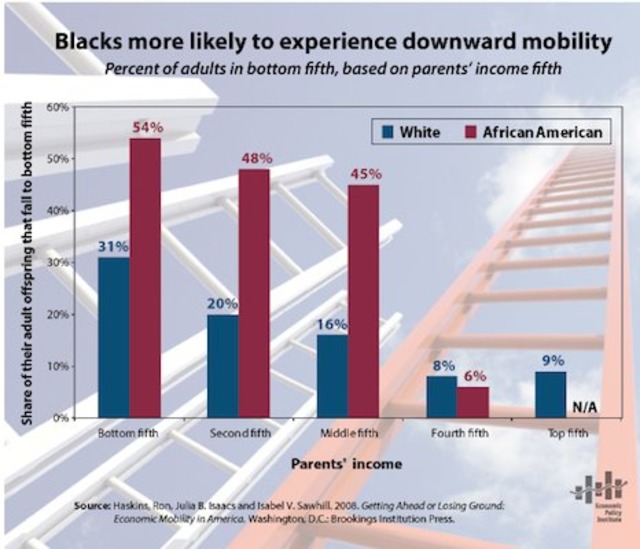
Kai Wright at Colorlines discusses an “arresting” graph demonstrating downward class mobility among black and whites.  The bars represent the proportion of parents’ children that end up in the bottom fifth of income earners by race and income of the parent.  On the far left, you see that 31% of whites and 54% of blacks born into the bottom fifth remain the bottom fifth.  Poor black children, then, are more likely than poor white children to stay poor.

The remainder of the bars represent downward mobility.  You can see that, in every case, black children are more likely to be poor as adults than white children, no matter what class they were born into.  Among those born into the middle fifth, the statistically middle class, 16% of whites and 45% of blacks end up in the bottom fifth of income earners.  For the richest white Americans, the chance of ending up poor is statistically zero; while nearly one in ten of black children born rich will end up poor.

Wright summarizes:

…economic mobility is not the same for everybody in America, and to the degree we can talk about a genuine black middle class, it’s not a terribly secure one.

Lisa Wade, PhD is an Associate Professor at Tulane University. She is the author of American Hookup, a book about college sexual culture; a textbook about gender; and a forthcoming introductory text: Terrible Magnificent Sociology. You can follow her on Twitter and Instagram.

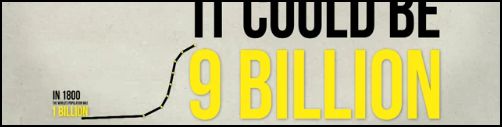
Well, it’s 2011. Sometime this year, the global population will pass the 7 billion mark. Jessica B. sent in this video, from National Geographic, that puts that into some perspective, showing the rapid increase in the pace of population growth over time:

This time of year Americans are incited to eat, eat, eat as much delicious holiday-themed food as possible, and then to lose, lose, lose the weight we gained with diet plans, gym memberships, appetite suppressing pills, and tummy tucks.  Somehow I don’t think it’s random that I received a coupon for a scale designed to measure the weight of my person as I exited Target this holiday season.

Lisa Wade, PhD is an Associate Professor at Tulane University. She is the author of American Hookup, a book about college sexual culture; a textbook about gender; and a forthcoming introductory text: Terrible Magnificent Sociology. You can follow her on Twitter and Instagram.

NEWS:

We would like to express our gratitude to Michael Kimmel and Abby Kinchy for nominating us for the American Sociological Association’s Distinguished Contributions to Teaching Award.  We’re grateful, also, to Chris Uggen, Doug Hartmann, Philip Cohen, Myra Marx Ferree, who wrote supporting letters, and to all of our Readers who submitted supporting anecdotes and words of praise.    We are committed to continuing the work we’ve been doing thus far and hope to make the website increasingly easy to use and helpful to instructors.

An original essay by Gwen, Family Movies: Where Are All the Girls (based on a post here at SocImages), was featured at BlogHer.  There she talks about the data on who produces these films alongside analyses of Bee Movie and the new Disney adaptation of Rapunzel, Tangled.

Always a fun treat, two of our posts — the baby worshipper and Target trampling — were featured on BoingBoing this month (here and here).

Finally, this is your monthly reminder that we’re on Twitter and Facebook.

In other news…

FEATURED READER:

This month we received an email from Robin who inquired:

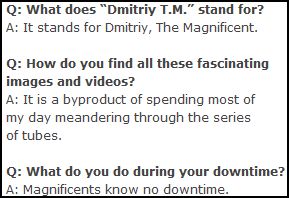
I was just reading your blog, and for the 100th time probably, asked myself “Who is Dmitriy T.M.? What do they do for a living/for pleasure that they come across so many interesting and varied images??”

I would love to see an interview with Dmitriy on your blog. For real, I want to know who this mysterious person is!

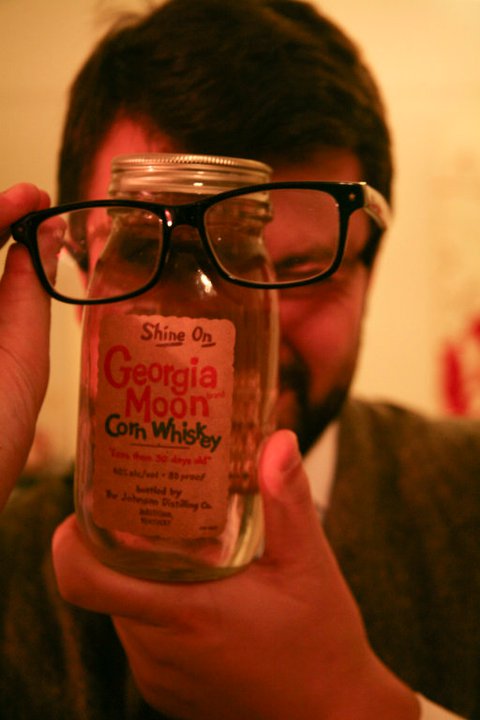
Well Robin, the mysterious Dmitriy submitted to an interview and sent along a revealing self-portrait!  Enjoy!  :)

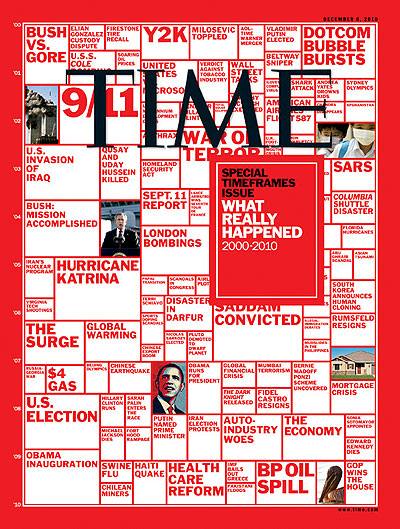
Time magazine has an end-of-the-decade issue with a cover, sent in by Dmitriy T.M., that summarizes what they consider major events between 2000 and 2010:

The stories illustrate the way that, as ESPN puts it, “only bad news counts as news.” Of the 118 items chosen by the editors as “what really happened” over the last ten years, a few are what most people would probably see as relatively positive or benign (such as achievements in sports and the rescue of the Chilean miners) and others would probably fall into the “neutral” category (“U.S. Election” doesn’t say anything about the election — or, for that matter, even indicate which of the various elections that occurred during that time frame it refers to). And a few are just…odd. “AOL-Time Warner Merger” is one of the most important events of the decade? And “The Dark Knight Release” was selected as the most significant pop-culture-related event? Um…okay.

But the majority of items are clearly negative/scary, or at least I think the editors assume they’d be seen that way: BP oil spill, a space shuttle disaster, various diseases, several bombings, “Disaster in Darfur,” the Haiti earthquake, a tire recall, and various topics related to economic problems. According to the ESPN post,

The Time selection says nothing about major positive trends such as declining international military spending (rising U.S. spending is the exception to the rule), declining teen pregnancy rates, declining crime, declining accidental deaths. “U.K. foot and mouth crisis” [a livestock disease]…was cited, but nothing said about declining cancer rates. “Shark attack” was cited, but nothing was said about the dramatic rise in living standards in most of the developing world. (“Overall, poor countries are catching up with rich countries” on nearly all central measures, according to this important new [United Nations] report.)

The post continues, “Yes, journalists have always loved bad news, and have long pretended good news doesn’t exist.” That’s going a bit far. For instance, local newspapers often take part in what Harvey Molotch described as the “growth machine,” a collection of organizations, institutions, businesses, political leaders, and influential community members that support economic growth. Media outlets may contribute to such boosterism by running positive stories and providing space (in op-eds, etc.) for predominantly rosy depictions of the community.

That said, media scholars do criticize news outlets for focusing so much attention on stories that are sensationalistic or that imply the world is an incredibly dangerous, scary place, and leading the public to have quite unrealistic perceptions of actual sources of risk. And Time‘s editors play into this with their selection of the most significant stories of the past decade.

I recently saw a great example of greenwashing — that is, marketing a product as eco-friendly based on questionable or rather superficial characteristics of the production process. This decal was on the front of a calendar, touting it as “eco-positive”:

What was eco-positive (a term that has no real meaning or standards) about it? Was it made from recycled paper? No. Maybe some statement about non-toxic ink? Nope. It’s eco-positive because they used the scraps from producing the calendar to make you a very special gift…two bookmarks tucked inside the calendar.

I’m all for using scrap material, but that alone seems to be a pretty minor detail upon which to then market the entire product as an  “eco-positive” one, especially given that paper scraps from manufacturing processes are often reused already (notice how often paper products say they’re recycled from “pre-consumer” waste).


This Tide commercial with Kelly Ripa, sent in by Joyce L., is an excellent example of one of the common themes in the marketing of cleaning products. Of course, cleaning products are almost entirely marketed towards women but, more, women are often portrayed as being absolutely OVERJOYED at the prospect of cleaning.

Indeed, Ripa is thrilled at the fact that a man spilled red wine on her white table cloth.  She is so pumped that he has given her an opportunity to use her washing machine, that she cannot wait. She literally sweeps the table cloth out from under the party so that she can wash it immediately.  And she is so excited that she invites the entire dinner party to partake, managing to communicate, in the process, her absolute adoration for Tide.  I don’t know about you, but this is what it’s like at my house.

Lisa Wade, PhD is an Associate Professor at Tulane University. She is the author of American Hookup, a book about college sexual culture; a textbook about gender; and a forthcoming introductory text: Terrible Magnificent Sociology. You can follow her on Twitter and Instagram.