Search results for The

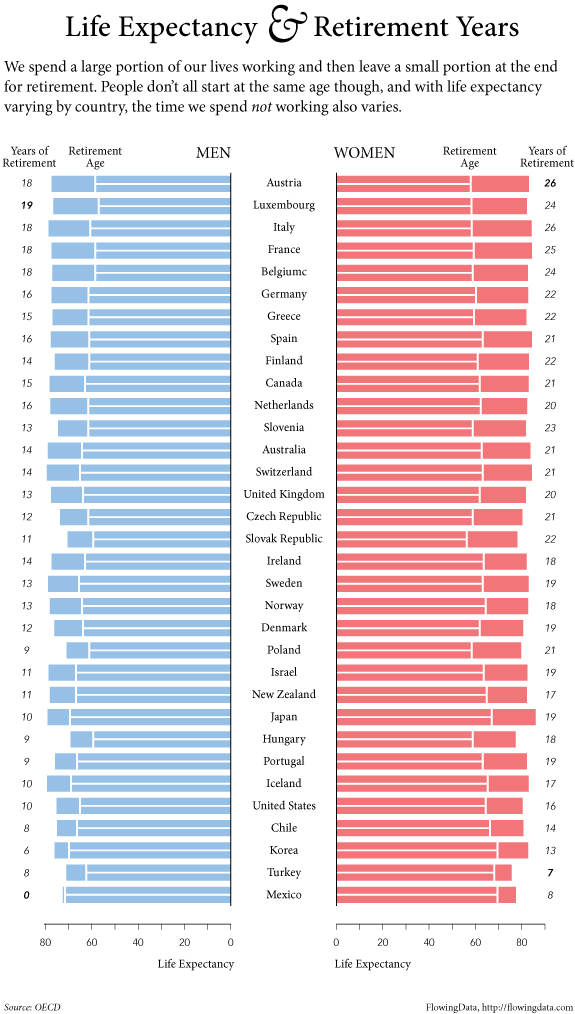
Does American prosperity translate into long retirements?  Not compared to other developed countries in the world.  Flowing Data borrowed OECD numbers on life expectancy and age of retirement to calculate the average number of years in retirement for men and women across many different countries.  The portion of each bar with the line is the average number of years working, while the non-lined portion represents years in retirement.

Largely because of life expectancy, women enjoy more years than men in all states except Turkey, but the number of years varies quite tremendously, from an average of zero years for men in Mexico, to an average of 26 years for women in Austria and Italy.  The United States is way down on this list, not doing so well relatively after all.
Lisa Wade, PhD is an Associate Professor at Tulane University. She is the author of American Hookup, a book about college sexual culture; a textbook about gender; and a forthcoming introductory text: Terrible Magnificent Sociology. You can follow her on Twitter and Instagram.


Leigh S. sent in a link to a story at The Week about a new Budweiser ad depicting a soldier returning home from deployment. It has gotten attention because some viewers interpret it as at least potentially presenting a gay soldier. See for yourself:

So…what do you make of it? I certainly don’t think it’s unambiguously a gay couple — it could be a friend or brother just as well. But it does show him calling that guy instead of, say, his parents (or the woman he hugs when he gets home), and that guy being the first to greet him.

For that matter, is the fact that a beer company would make an ad where they didn’t go to great lengths to make it 100% clear that he’s not gay itself a step forward?

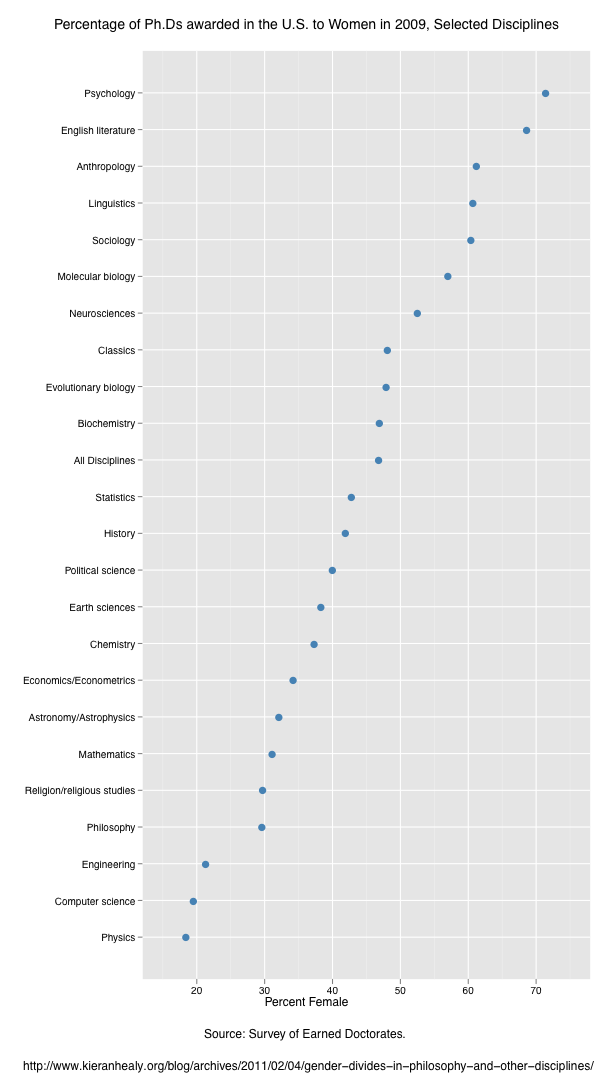
From Abi, Kieran Healy, and the Survey of Earned Doctorates: 2009 data on the gender divide among doctorate-level graduates in academic disciplines (from most to least female by percentage).   View the full pdf for even more detail.

Lisa Wade, PhD is an Associate Professor at Tulane University. She is the author of American Hookup, a book about college sexual culture; a textbook about gender; and a forthcoming introductory text: Terrible Magnificent Sociology. You can follow her on Twitter and Instagram.
Abby W. let us know about a disturbing scene in this week’s episode of the TV show Gossip Girl. The scene depicts an interaction between two individuals, Chuck Bass and Blair Waldorf, who have turned into one of the show’s anchor couples that fans root for, always ending up together again despite their on-again off-again nature. In this episode, they’re off again and Blair has been dating someone else (a prince, of course). According to Zap 2 It, earlier in the episode, Chuck apparently humiliated Blair by talking about their prior sexual escapades in front of her boyfriend’s mother. She then goes to Chuck’s penthouse to tell him that her boyfriend has proposed to her, leading to this scene (warning: though he doesn’t hit her, if you’re sensitive to images of violence, you may want to skip the video):

So after publicly humiliating her by referring to her sexual past, Chuck tells Blair “you’re mine” and that she can’t be with anyone else, grabs her and throws her onto the sofa, and when she reiterates that it’s over, he ends up punching a window and injuring her with flying glass. And yet, in an interview with E!, one of Gossip Girl‘s executive producers says that this shouldn’t been seen as abusive behavior. In fact, if there’s anyone to be worried about, it’s Chuck:

I think it’s very clear that Blair is not afraid in those moments, for herself. They have a volatile relationship, they always have, but I do not believe—or I should say we do not believe—that it is abuse when it’s the two of them. Chuck does not try to hurt Blair. He punches the glass because he has rage, but he has never, and will never, hurt Blair. He knows it and she knows it, and I feel it’s very important to know that she is not scared—if anything, she is scared for Chuck—and what he might do to himself, but she is never afraid of what he might do to her.

I don’t know how they intended the audience to interpret the scene, but watching it, I think it’s hard to make an argument that Blair is clearly not in any danger and is at no point scared for her safety. Her face in the screenshot I put at the top looks frightened, and she cowers after he punches the window, then runs away.

More importantly, whether or not Blair supposedly feels frightened is irrelevant to whether this behavior is, in fact, abusive. But disturbingly, after discussing this scene, the interviewer goes on to say:

Ah, Chuck…He’s such a classic romantic hero, like Rhett Butler, sort of strong enough that you can stretch him pretty far.

He’s always had that Gothic thing, and those guys are always imbued with a dark side in addition to their vulnerability about their girlfriends.

It’s a disturbing example of the way that controlling and violent behavior by men toward the women in their lives is often depicted as evidence of passion that the female character totally accepts (they just “have a volatile relationship,” so it’s “not abuse when it’s the two of them”). Chuck’s repeated mistreatment of Blair (apparently last season he promised his uncle he could have sex with Blair as part of a business deal) is excused (he’s drunk, and really upset about whatever he learned about his family!), and in fact, his inappropriate behavior is romanticized by the executive producer and the interviewer. A man who publicly humiliates his girlfriend, uses her sexuality as a pawn in business deals, and leaves her injured from flying glass when he finds out he’s losing control over her (not to mention tried to force a 14-year-old girl to have sex with him in the very first episode of the show, back before we were supposed to find him lovable) is still referred to as a “classic romantic hero” who should not be seen as abusive or scary.

In fact, the promo for next week’s episode reinforces the message that Chuck is acting like this because he needs Blair so much that he falls apart without her, and individuals with nefarious plans are intentionally using this knowledge to get to him. So Chuck isn’t abusive; he’s a fragile victim who just loves Blair too much for his own good:

This is particularly disturbing given that the show is popular among teens, many of whom experience abuse in their relationships but are unsure how to deal with it or whether it “counts” as abuse. These types of representations of normalize such behavior, excusing the men who engage in it and giving the message to women that being treated in such a way isn’t a major warning sign but, rather, evidence of a man’s deep passion and vulnerability.

Gwen says that y’all are gonna think I’m going too far, but I can’t resist posting this. More, readers often think we post things because they make us mad grrrr, but we usually post stuff just because we think it’s interesting or illustrative. This is a case of the latter.

Jordan G. sent me this clip of a young bobcat captured on a balcony near his house in Irvine (LA Times). They released it into the wild, but not before a news crew came by and filmed the intrepid hunters with their catch. Enter my amusement: I just love how two of them at some point feel the need to place their foot on the cage, like in a victory pose. This is recognizably masculine body language, a dominance gesture, and kind of silly. Maybe you’ll think I’m silly too, but there it is:

Also posing with your kill: Taming Nature (a personal favorite).

And, in body language, Whoopi sitssitting like a man, and gendered anatomy.

Lisa Wade, PhD is an Associate Professor at Tulane University. She is the author of American Hookup, a book about college sexual culture; a textbook about gender; and a forthcoming introductory text: Terrible Magnificent Sociology. You can follow her on Twitter and Instagram.

The phrase “environmental racism” was coined to draw attention to the ways in which exposure to environmental toxins like air pollution and lead is not even across cities and states, but tends to be higher in low income neighborhoods — especially those that are disproportionately Black and Latino — ones that are also more likely than others to be home to garbage dumps, sewage treatment plants, and power plants.  As a result, poor children and children of color are more likely to suffer the consequences of environmental pollution, like asthma and lead poisoning.

Prevention efforts, however, tend to focus on parents’ responsibility for protecting their children from these threats instead of the state or city’s failure to keep all neighborhoods equally safe. For example, even though it’s illegal for landlords to rent out a house or apartment with lead paint, poisoning prevention efforts tend to focus on educating parents.  I thought of this tendency to blame the victim when I noticed a set of billboards going up in my neighborhood in Los Angeles, Highland Park.  Meant to encourage parents not to smoke, they read (in English and in Spanish): “I gave you love, you gave me asthma.”

(source)

Highland Park is a low-income neighborhood.  And given what we know about the inclination for cities to tolerate environmentally harmful conditions in low income neighborhoods, this seems to me a particularly nasty message to send.  It erases the role of the city in protecting children and places 100% of the blame on parents (“you gave me asthma”), and then it twists the knife (“I gave you love”). Even if they are smokers, poor parents can only do so much to protect their children from things that the city is all-to-comfortable letting slide.

Lisa Wade, PhD is an Associate Professor at Tulane University. She is the author of American Hookup, a book about college sexual culture; a textbook about gender; and a forthcoming introductory text: Terrible Magnificent Sociology. You can follow her on Twitter and Instagram.

Dolores sent us a link to a post at Feministing about Klondike’s new “5 Seconds to Glory” ad campaign for their ice cream bars. The ads revolve around men trying to endure 5 full seconds of unimaginable horror; if they succeed, they are rewarded with Klondike bars (provided by hot chicks).

For instance, in this particularly brutal segment, a man must listen to his wife speak:

A man must listen to his wife talk out loud for 5 whole seconds, about fixing up the house, no less.

In a second video, found ad AdWeek (the embedded clip at Feministing isn’t working), two bikers must hold hands:

So guys, don’t ever forget: wives are annoying burdens you should try to avoid interacting with (much less listening to), and touching or being even superficially intimate with other guys is gross. If, through super-human effort, you are able to bear doing one of these things, you deserve a reward. Brought by women in mini dresses.

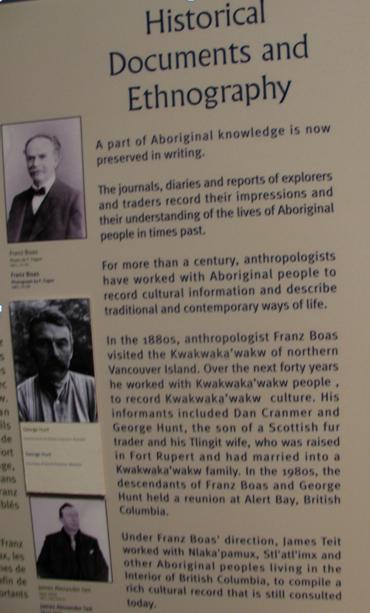
A recent Soc Images post on cultural appropriation highlighted issues of control over the production and representation of images of Indigenous peoples. On a related note, an image I captured during a recent visit to the Canadian Museum of Civilization (or as one of my professors has called it, the “Canadian Museum of Colonization”) highlights similar issues regarding the representation of Indigenous knowledges. This poster was displayed in the “First Peoples’ Hall” of the museum in a section dedicated to “Ways of Knowing”:

Two points are particularly striking. Firstly, the poster portrays the “preservation” of Indigenous knowledges as a project of colonizers and non-Indigenous anthropologists. Rather than attributing control over the production and representation of Indigenous knowledges to Indigenous peoples themselves, the poster depicts colonial “explorers” and anthropologists as the primary agents in these endeavors. Indigenous peoples themselves are merely portrayed as informants, leaving interpretation and presentation to colonizers and anthropologists. In recent years, numerous Indigenous scholars have written about the oppressive nature of this type of approach to Indigenous peoples and knowledges, pointing out how academic disciplines such as anthropology have been essential tools in the study and subjugation of Indigenous peoples as “primitive Others.”

Secondly, the poster presents Indigenous knowledges as static and unchanging, ignoring their dynamic nature and the ongoing experiences of Canada’s Indigenous communities. Canadian Indigenous scholar Andrea Smith* has argued that in settler societies such as Canada, false notions of the disappearance or threat of extinction of Indigenous peoples and their knowledges are at the foundation of cultural imaginations and serve as justifications for the appropriation of Indigenous lands and cultures. In this case, the threat of extinction is implied in the need for Indigenous knowledges to be “preserved in writing.”

This poster provides an entry point for questioning power relations inherent in the production and presentation of knowledge at the Canadian Museum of Civilization and similar institutions. This example demonstrates how the museum portrays a particular view of Canada and its relationship with Indigenous communities, one which ignores the historical and continuing reality of colonialism and its implications.

* Smith, A. (2006). Heteropatriarchy and the three pillars of white supremacy: Rethinking women of color organizing. In A. Smith (Ed.), Color of Violence: The Incite! Anthology (66-73). Cambridge, MA: South End Press.

—————————

Hayley Price has a background in sociology, international development studies, and education. She recently completed her Masters degree in Sociology and Equity Studies in Education at the University of Toronto with a thesis on Indigenous knowledges in development studies.

If you would like to write a post for Sociological Images, please see our Guidelines for Guest Bloggers.