Search results for The

When I teach Sociology of Race and Ethnicity, one thing I have to balance is disclosure of the horrendous history of racism in the U.S. and the risk of further traumatizing students in my classroom for whom these tragedies are not pure abstractions.  One of the these tragedies is lynching.

Lynching, or the killing of individuals targeted by non-police mobs, usually by hanging, became frighteningly common after slavery was ended.  It was a form of terrorism, designed to teach black people, and their white allies, that the end of slavery would not be the end of their subordination. Because a lynching need not be based on evidence that could stand up in court, all anti-racists were at risk of death. Thousands of people — most, but not all of them black — were violently hanged, their bodies often set afire.

Despite the importance of this chapter of American history, I do not show pictures of lynchings in my classroom.  These images are surprisingly easy to come by because the events were often gleefully public and photographs of the murders were sold as postcards. Sometimes, though, I think about showing Billie Holiday singing what is, perhaps, one of the most deeply troubling songs ever written, “Strange Fruit.”  Written by Abel Meeropol and Laura Duncan, it was first performed by Holiday in 1939, almost 30 years before lynching could be called “history.”

Strange Fruit:

Via BoingBoing.

Lisa Wade, PhD is an Associate Professor at Tulane University. She is the author of American Hookup, a book about college sexual culture; a textbook about gender; and a forthcoming introductory text: Terrible Magnificent Sociology. You can follow her on Twitter and Instagram.
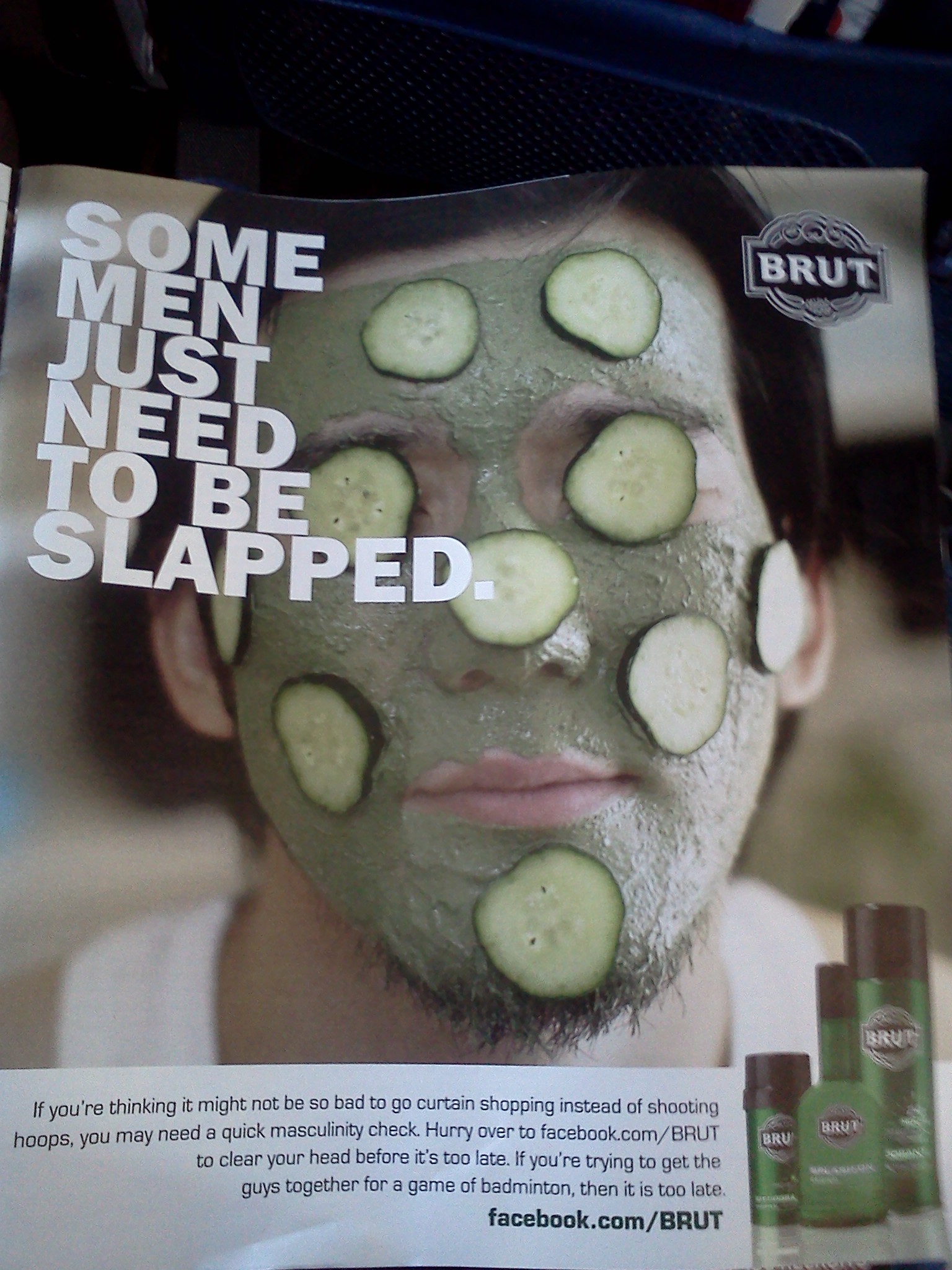
Mimi S.-L. sent in a Brut ad that is a particularly non-subtle example of the policing of masculinity and denigration of things associated with women:

The text:

If you’re thinking it might not be so bad to go curtain shopping instead of shooting hoops, you may need a quick masculinity check. Hurry over to facebook.com/BRUT to clear your head before it’s too late. If you’re trying to get the guys together for a game of badminton, then it is too late.

I had no idea badminton was so feminized that playing it is a sign a man is truly beyond repair. Learn something every day.

For more on this ad campaign, see our earlier post on Brut’s “Slap Me” game on their website, white allows you to slap men who don’t meet masculine norms (their Facebook page lets you slap everyone from a hippie to a Star Trek fan to guys meant to represent Kelsey Grammar and Tiger Woods.

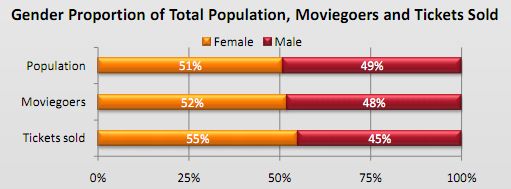
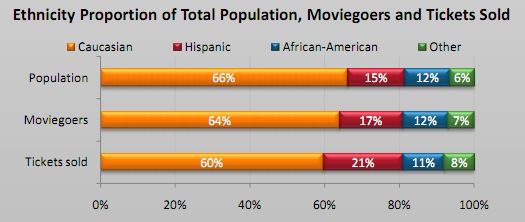
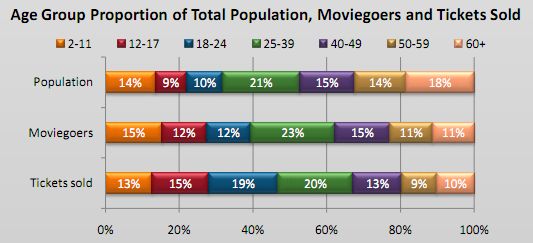
It must be a cliché that American movies are, overwhelmingly, made for 17-year-old white boys.  Goodness knows that there is plenty of evidence on this website to back up the cliché.  In light of this, I am surprising floored by the actual data showing who goes to movies.  It’s not that I didn’t know that women, people of color, and grown-ups went to movies.  It’s just that seeing it in technicolor just drills home the fact that the making of movies to please white male kids is ideological, not capitalist.  And that’s always an interesting observation to make.

55% of tickets sold are sold to not-men:


40% of tickets sold are sold to non-white people:


72% of tickets sold are sold to legal adults (i.e., not-kids, though they may be buying tickets for kids):

Data from the Motion Picture Association of America (via Racialicious).

See also our post on how about 1/3rd of ESPN’s audience are women.

Lisa Wade, PhD is an Associate Professor at Tulane University. She is the author of American Hookup, a book about college sexual culture; a textbook about gender; and a forthcoming introductory text: Terrible Magnificent Sociology. You can follow her on Twitter and Instagram.
Way back in 2008 Gwen wrote a great post using data showing the ways in which social context influences average age of menstruation.  The average age is, it turns out, different across countries, across different groups within countries, and has been changing throughout history.  In the U.S., it has been dropping and the average age (note: average, not earliest) is now about 12-years-old.

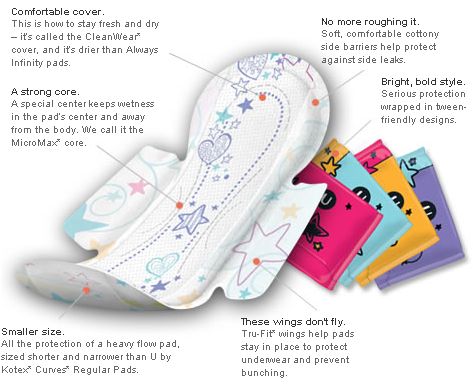
In response, Kotex has now introduced a website and a line of pads and panty liners for girls 8-years-old and up.  Leigh, from Wherapy, sent us a link.

Meant to appeal to tweens, the product is packaged with bright colors, stars, and hearts. It’s decidedly cute and girly:

And also a bit smaller than “regular” products:

I’m not exactly sure what to make of the whole thing.  The age of menarche (first menstruation) is going down.  And girls need (as we called it in my family) “personal products.”  And I’ll give it to Kotex that tweenifying the products with sparkles, stars, and hearts doesn’t just sell them, but may help girls feel better about getting their periods (on the assumption that some have mixed or negative feelings about it).

All that said.  This is a fascinating moment in U.S. history reflecting, simultaneously, capitalism, the social construction of youth, and the circular relationship between biology and society.

Via Jezebel.

Lisa Wade, PhD is an Associate Professor at Tulane University. She is the author of American Hookup, a book about college sexual culture; a textbook about gender; and a forthcoming introductory text: Terrible Magnificent Sociology. You can follow her on Twitter and Instagram.
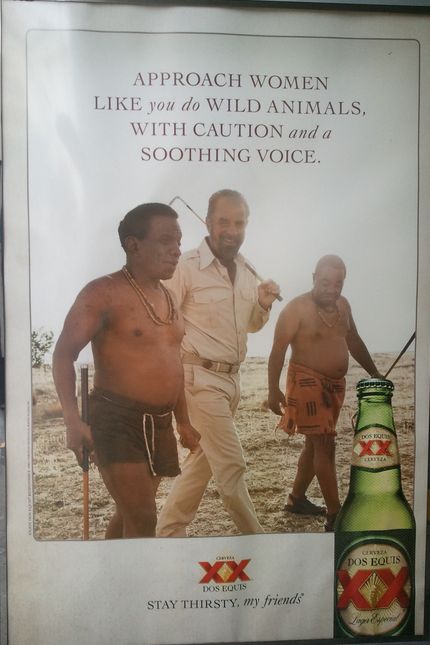
Dmitriy T.M. sent in another example, via Jezebel, of the use of hunting as a metaphor for dating/attaining sex with women.  The metaphor portrays men as predators and women as prey,  suggesting that women are inherently unwilling and men inherently deceitful, coercive, and aggressive.  This sets the stage, discursively, for sexual assault.

Throw in a couple men representing a non-specifically “primitive” culture to remind us that such a relationships is “natural,” and you’ve got this Dos Equis ad:

For more of this metaphor, see Sex and Dating as a Hunt, Beer, Sex, and the Hunt, Taxidermied Girl Parts, and Hunting for Bambi.

Lisa Wade, PhD is an Associate Professor at Tulane University. She is the author of American Hookup, a book about college sexual culture; a textbook about gender; and a forthcoming introductory text: Terrible Magnificent Sociology. You can follow her on Twitter and Instagram.
Katrin sent us another in the long line of fashion shoots that exoticize the cultures and residents of non-Western countries. The article, titled “Indian Summer,” appeared in the British version of Vogue in September 2007, along with the tagline, “Eclectic, colourful, crazy…The modern gipsy’s style is every bit as exotic as her travels.” So the model is being presented as “exotic” herself (she’s a “gipsy,” after all), but her exoticism is proven by her travels to places that are themselves marked as exotic and extremely different from the UK.

It includes several elements common to these types of photo shoots, including a model who is clearly differentiated from the local population not just in terms of fashion, but by skin tone, as well as the use of locals as props surrounding or in the background of the blond model.

While a video Vogue posted about the photo shoot clearly shows cars, motorcycles, and paved roads, the photos tend to erase signs of modernity, focusing instead on items that present India as somehow stuck in pre-modern times, such as images with animals:

Also see Lisa’s post on the Anthropologie catalog set in India.

Gwen Sharp is an associate professor of sociology at Nevada State College. You can follow her on Twitter at @gwensharpnv.

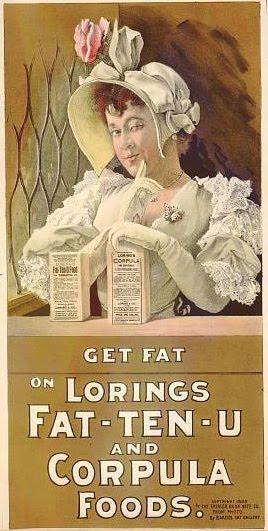
Cassie C. sent us a vintage ad that illustrates the way that beauty standards can change dramatically over time. The ad, for products called Fat-ten-u and Corpula, promises to help you get fat, a clearly desirable state:

Available at the Library of Congress.

Of course, it’s also worth noting that the woman in the photo likely wouldn’t be considered fat by current standards, partially because of a small waist that probably resulted from corseting.

Side note: The link Cassie sent us, at Whole Health Source, has two black and white ads as well, but I haven’t been able to verify them as authentic or find any info on where they were found or originally appeared, and I’ve found some questions about their authenticity.

We’ve posted a number of posts about cultural appropriation in fashion, particularly when it comes to Native Americans. Kristyn G. sent in a link to a story at the Huffington Post about a recent fashion show in Moscow that brings up questions about cultural appropriation of another group. The show, from St. Bessarion, included female models in hats, sidecurls, and some articles of clothing inspired by things worn by Orthodox Jews, combined with distinctly non-Orthodox items.

It’s not the first time Orthodox-inspired clothing has appeared on the runway. For instance, in 1993 Jean Paul Gaultier put together a men’s line he called Chosen People, which the New York Times says it was the first Judaism-inspired clothing line from a well-known designer. According to an article I found at Racked, “the collection ruffled quite a few feathers in the religious community, many of whom felt that Gaultier had misappropriated elements of religion in a disrespectful, frivolous manner.” It was quite the production:

Thoughts?

UPDATE: Just a quick note, since I see some confusion in the comments — the designer who recently made some horrid anti-Semitic remarks was John Galliano, not Jean Paul Gaultier.

Gwen Sharp is an associate professor of sociology at Nevada State College. You can follow her on Twitter at @gwensharpnv.