Search results for The

I suspect most Soc Images readers will, by now, be familiar with the Bechdel Test — the set of criteria for evaluating whether female characters are included in movies in even minimally non-male-centered ways, made popular by Alison Bechdel of Dykes to Watch Out For. To pass, a movie has to have at least two female characters who have at least one conversation with one another about something other than a man. For a quick overview, see our repost of Anita Sarkeesian discussing the Bechdel Test.

Leah B. let us know that there’s a website, Bechdel Test Movie List, entirely devoted to rating movies based on the criteria (with the stipulation that female characters have to actually be named to count). It consists of a list of movies that have been added and rated by readers; there are currently over 2,000 movies produced between 1900 and 2011 rated on the website. This is, obviously, nowhere near a random sample; as you’d expect, it’s highly weighted toward more recent movies, and of course not everyone agrees on the ratings (you can add a symbol to show you disagree and leave a comment on a movie’s rating page).

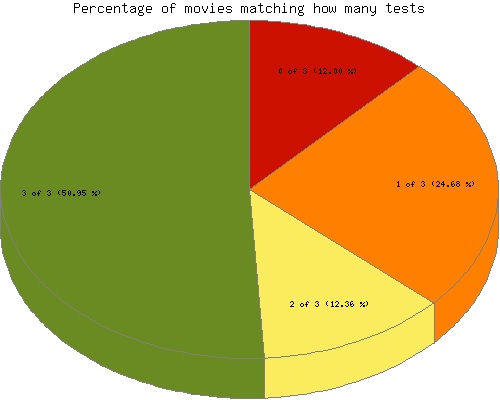
That said, the site includes a stats page that is interesting to look through just for a snapshot of the inclusion of women in these movies. Here’s a breakdown of the entire list; green indicates movies that passed all three tests, yellow passed 2, orange passed 1, and red didn’t pass any of the three:
It’s fun to browse through, for entertainment value and a starting place for thinking about the Bechdel Test and pop culture.

We have posted in the past about the controversy surrounding the casting of the movie The Last Airbender. Many fans of the original series were upset that Asian characters were recast as White, with the main cast initially containing no non-White characters at all. This fits in with a more general lack of Asian main characters in Hollywood.

More recently, a different controversy about race and casting emerged when African American British actor Idris Elba was cast as the Norse god Heimdall in Thor, though this character was always White in the comic book series.

Anthony N. sent in a video by MovieBob at The Escapist that discusses concerns over race in casting Thor and why recasting a White character with a non-White actor doesn’t have the same implications as recasting a non-White character with a White actor does:

,/p>

We’re trying to get our inbox under control, so I decided it was time for another of my occasional round-ups of gendered kids’ items, so here you go. My favorite example was an ad from a flyer for Save On Foods in Victoria, Canada, sent in by Joanna M. The advertised products are boysz and girlsz inhalers, for all your gendered breathing needs. The boyz’ version is in green and gray with a graphic of a skateboarder, while the girlz’ inhaler is, of course pink, with a flower:

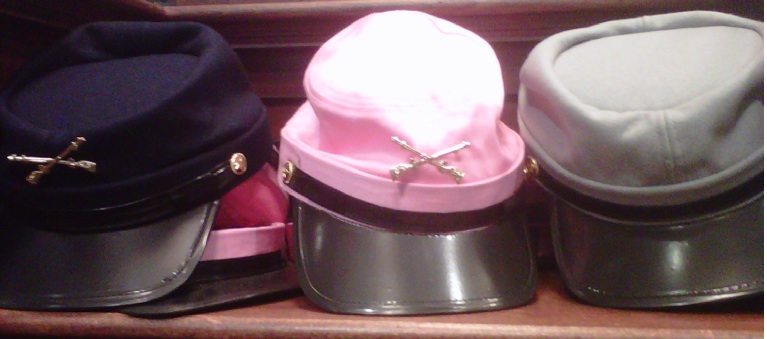
Amanda K.H. took this photo of 3 kid-sized Civil War hats for sale at the Abraham Lincoln Presidential Museum in Springfield, IL. In addition to the Union blue and the Confederate gray, there was a pink version:

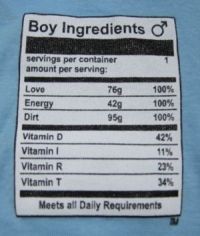
The Pragmatist let us know about onesies for sale at Mommy and Kids Allure Boutique. The onesies include lists of “ingredients” for boys and girls. What are boys made of? Love, energy, and dirt:

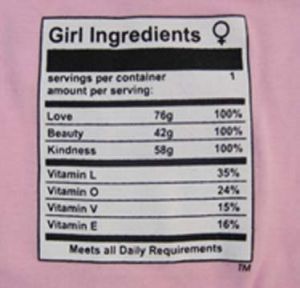
For girls, it’s love, beauty, and kindness:

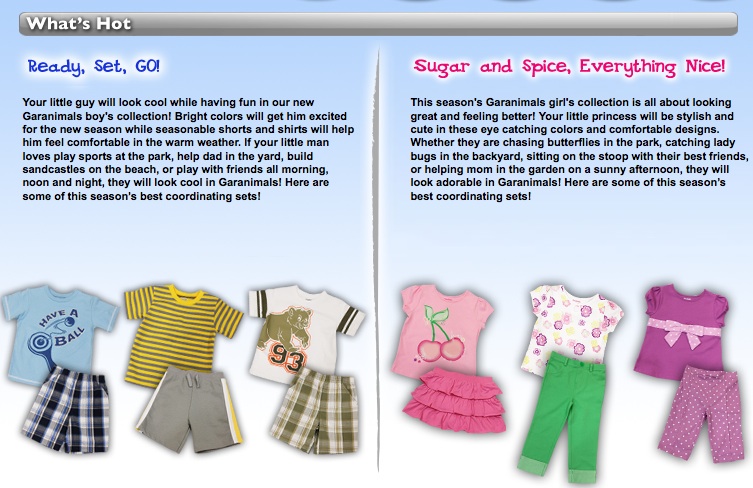
Elliott M. noticed that the Garanimals website doesn’t just just divide the clothing into boys’ and girls’ sections, but uses gendered language to describe them. The boys’ clothing is described with active language (“ready, set, go!”), and they’ll look “cool”. Girls, on the other hand, are “sugar and spice, everything nice” and a “princess,” and they’ll be “looking great and feeling better,” “cute,” “eye catching,” and “adorable”:

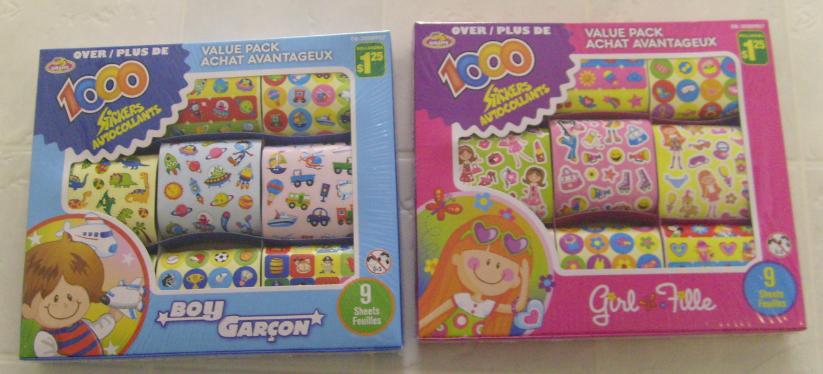
An anonymous reader saw these sets of stickers, divided into themes for boys and girls:

What are boy themes? Space, travel/transportation, dinosaurs, sports, and pirates, among others. Girls, on the other hand, are associated with stars, flowers, butterflies, clothes, makeup, personal hygiene, cheerleading, and shopping. Since the reader was buying them to give out to a Girl Guide group (equivalent to Girl Scouts in the U.S.) for badges about science, being active, and personal hygiene, she had to buy both sets.

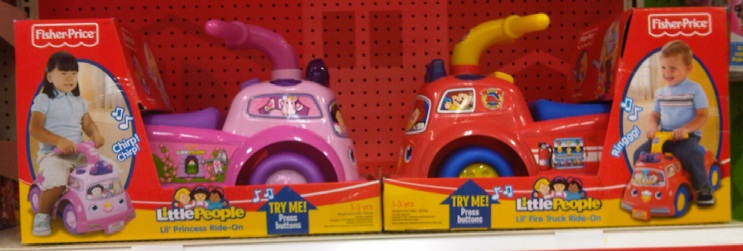
Finally, Sarah M. sent in a photo she took at Target of two toys that define boys by what they do and girls by what they are. The toys are those types of little sit-and-scoot toy cars kids push around with their feet. The boys’ version is red and is, appropriately, called a Lil’ Fire Truck Ride-On. The pink version, on the other hand, is the Lil’ Princess Ride-On — because apparently there’s no appropriate vehicle to define as “girly,” so the easiest way to gender the toy was just to call it a thing for princesses and be done with it:

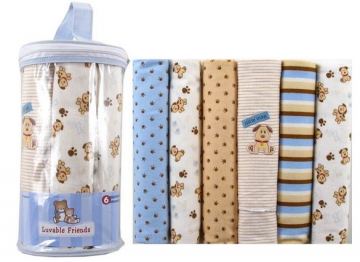
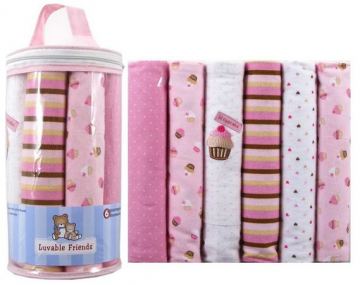
UPDATE: Philip Cohen pointed out another example on his blog, Family Inequality. Baby blankets at Amazon were available in blue for the “little man” and pink for the “little cupcake,” in case your baked goods are cold:

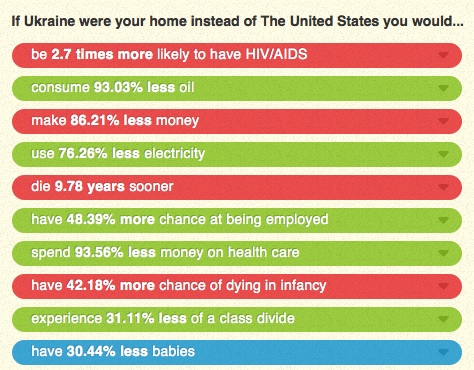
Dmitriy T.M. sent in a link to the website If It Were My Home. The site allows you to select two nations and then explains how your life would compare if you lived in each one in terms of rates of HIV/AIDS, employment, energy consumption, infant mortality, class inequality, and other factors (based on CIA data). As an example, Dmitriy chose to compare the U.S. and Ukraine, “the 2 greatest countries in the world, as determined by the poll conducted in my head”:

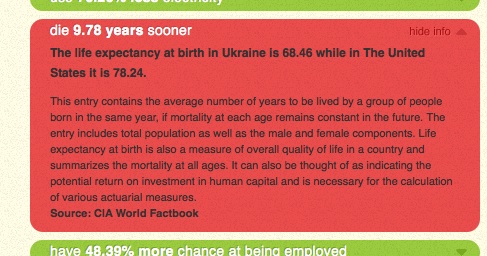
You can then choose one of the items for more details; I selected life expectancy:

The site is set up with the U.S. as one of the default comparisons, but at the top there’s a button that lets you select a non-U.S. comparison. (Note: Reader Parodie says it appears to detect whatever country you’re accessing the site from and set that as one of the default comparisons.) It’s a fun site that you can spend quite a bit of time playing around with.

UPDATE: Just a caution–a couple of readers seem to have found situations where the math doesn’t add up in the comparisons of some countries. And other readers noted that this does an enormous amount of averaging, which definitely hides the differences in quality of life in various countries, which are so extreme in some nations that “averages” might be nearly meaningless.

A number of celebrities, including Meghan McCain — daughter of Senator John McCain of Arizona — recently posed naked (visible from the shoulders up) in a skin cancer prevention awareness ad. Meghan’s father had to have melanoma removed from his face, prompting her interest in the issue. Here’s the ad:

Christie W. sent in a segment (via The Pragmatic Progressive Forum) from Glenn Beck’s radio show in which he reacts to the video, and particularly to the image of Meghan McCain in it…by pretending to throw up violently. In this 8-minute clip from his show (audio only), Beck repeatedly pretends to puke, and someone says, at about 5:28, “Has she thought about, like, a burqa, so she’s extra safe?” and “I’m not sure that covers enough, because you can get skin cancer of the eyeballs” (I can’t distinguish all the voices, so I’m not sure who is speaking). They say she looks like “John McCain with long blonde hair” and, at 6:35, mockingly refer to her as “luscious” repeatedly:

Criticizing Glenn Beck for being mean-spirited is really a pointless task — I might as well go yell at the tree in my yard for shedding leaves — so I’m not going to expend much energy on it. But it’s a good example of policing of women’s bodies and fat-shaming (when McCain is described as “luscious,” it clearly isn’t a compliment). Who cares about the message? Never mind about skin cancer! Those women are so gross they make me sick!

Sigh.

Over the weekend I came across an interesting video of Mike Rowe, creator and host of Dirty Jobs. Rowe recently testified before the U.S. Senate’s Commerce, Science, and Transportation Committee. He made an impassioned case for the type of difficult but essential jobs he highlights on his show, as well as the vocational and other training programs that prepare workers for them — programs facing tremendous cuts due to state budget crises. While we hear a lot about the need to increase the level of 4-year college degree completion in the U.S., Rowe argues that skilled plumbers and welders are every bit as essential to our economic development, and that such jobs are worthy of respect and public support:


Nico G. sent along a sweet seven-minute film short about a little girl who wants to win the heart of a boy, and does so by his equal instead of his object. It’s cute.

Directed by Michelle Lehman, 2008 award winner Tropfest Australia

Lisa Wade, PhD is an Associate Professor at Tulane University. She is the author of American Hookup, a book about college sexual culture; a textbook about gender; and a forthcoming introductory text: Terrible Magnificent Sociology. You can follow her on Twitter and Instagram.

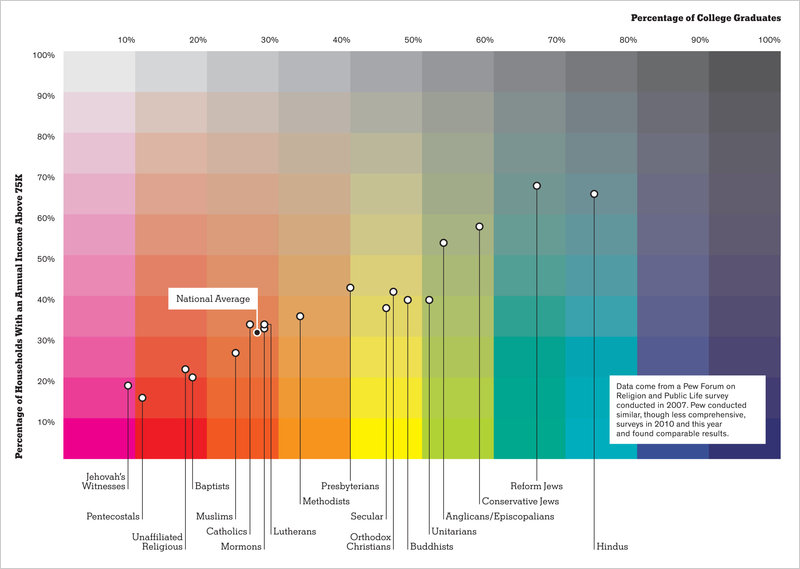
Dmitriy T.M. sent in a link to an article by David Leonhardt in the New York Times about differences in income between various religious groups in the U.S. This graph shows the percent of households earning more than $75,000 a year (the numbers along the side; and note that, somewhat counterintuitively, the shade of each color gets lighter as the percentage gets higher), as well as the percent of each group with a college degree (along the top). In order from least to most educated, we have Jehovah’s Witnesses, Pentecostals, the unaffiliated, Baptists, Muslims, Catholics, Mormons, Lutherans, Methodists, Presbyterians, those who identify as secular, Orthodox Christians, Buddhists, Unitarians, Episcopalians, Conservative Jews, Reform Jews, and Hindus. Not surprisingly, income is pretty strongly correlated with education:

The data come from a 2007 Pew Forum on Religion and Public Life survey (which we’ve posted on before), though the NYT reports that they did smaller surveys in 2010 and 2011 and found similar patterns.

Also see our posts on the demographics of the non-religious and religion, income, and 2008 Presidential voting behavior.