Search results for The

Emma M.H. sent us a commercial for Cougar Life, a dating site that promotes itself as a place to meet older (but still sexy!) women interested in dating younger men. Despite the name, the site actually welcomes women of all ages. When you go to the website, you specify whether you’re looking for a “cub” (women aged 18-35) or a “cougar” (aged 35-65). Similarly, Emma was struck by how young the women in the ad look:

So though the company brands itself as a site about cougars — which would imply an emphasis on middle-aged and older women — here it markets itself almost entirely with women who would fall into no more than into the “cub” category or the very lowest end of 35-65 age range that defines cougars on the site, while the song declares they’re “all cougars.” It’s possible the company thought that women who look older than 40 would be unacceptable even to potential customers of a dating website specifically promising the ability to meet such women. But it also seems like the term “cougar” is being used to apply to a wider array of women than when it first entered pop culture — not just older women who date younger men, but practically any woman past her early 20s who has a voracious sexual appetite. Cougar Life draws on this, assuring us it was recently voted the “wildest dating service in America.” The defining feature may be less age than the idea that a woman is not just sexually available, but almost predatory in her search for sex — that is, that she seeks sex in a way we generally find acceptable only for men.

UPDATE: Reader Anna caught a mistake I made. The “cub” category was for the men seeking women on the site, not for younger women. She explains,

If you look at the site carefully, the “cubs” category means men the ages of 18-35, not women of these ages. Choose “looking for a cub” and the pictures are all male, and that term is often used for the younger male partner of an older women. The only women “available” on the site are 36 years old and over, so the site in effect bans both middle aged men and young-ish women from participating.

Thanks, Anna!
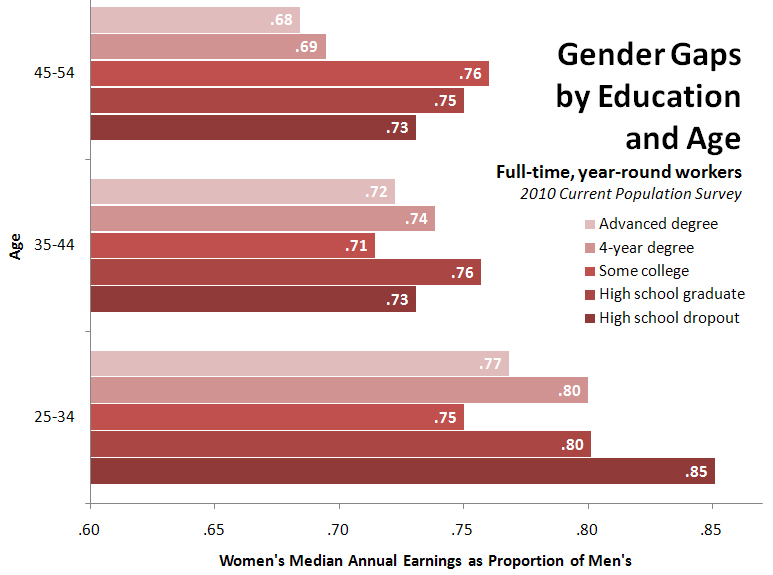
Philip Cohen posted some interesting data at his blog, Family Inequality, that I think will look at first blush, counterintuitive to many.  The figure below shows the percent of men’s income that women bring home, organized by age bracket and level of education.  The top bar, for example, tell us that, among 45-50 year olds with advanced degrees, women make 68% of what men do.

Two observations:

First, notice that women with more education (the lighter bars in each age bracket) do worse compared to men than women with less education.  That is, the gender inequity is worse in the upper classes than it is in the lower classes.   Why?  Well, people tend to marry other with similar class and education backgrounds.  Accordingly, women with more education may be married to men with higher earning potential than women with less education. Those women are more able to make work-related choices that don’t foreground economics, since their income is less central to the financial health of the couple.  They are also more likely to take substantial amounts of time out of the workforce when they have kids (working class women can’t afford to do so as easily), and we know that doing so makes a real dent in career advancement.  So, perhaps ironically, women who are “richer” educationally may marry economically richer men who then allow them to deprioritize their careers.

Second, notice that the most equal incomes (where women make 85% of men’s salaries) occurs among the youngest and least educated group: 25-34 year old high school drop outs.  Why would younger women do better relative to men than older women?  Some of this may be due to a decrease in gender-based discrimination.  But it also likely has something to do with the devaluation and disappearance of traditionally working-class men’s work.  Most of the narrowing of the gender wage gap, in fact, has to do with the lowering of men’s earning power to meet women’s, not vice versa.  As the industrial base in the U.S. has been collapsing, the number of historically-male blue collar jobs have been shrinking.  Meanwhile, our industrial economy has been replaced by one split between (well compensated) information/technology and (poorly compensated) service jobs.  Those service jobs are going disproportionately to women.  So, while men still dominate (especially the most well-regarded and well-compensated) upper class professions, their dominance in the lower rungs of the economic ladder is waning.

Thanks again to Philip Cohen for the data!

Lisa Wade, PhD is an Associate Professor at Tulane University. She is the author of American Hookup, a book about college sexual culture; a textbook about gender; and a forthcoming introductory text: Terrible Magnificent Sociology. You can follow her on Twitter and Instagram.

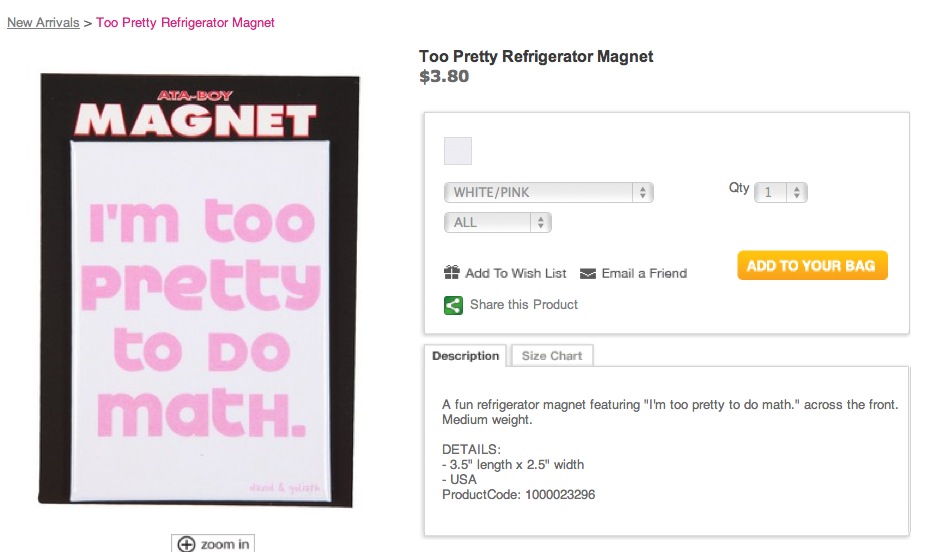
A year ago we posted a photo of a children’s t-shirt, found at Goodwill, that claimed the wearer is “Too pretty to do math.” We were relieved to know the shirt had been destroyed, in the interests of children and appreciators of the fine field of mathematics.

But sadly, Ingrid P. informs us that a magnet with the same slogan is now for sale at youth-oriented clothing store Forever 21:

So the message to girls is that, first, math is something to be avoided if possible; only girls who aren’t pretty enough to get out of it would bother to take it seriously. And, second, being attractive should get you out of doing things you might find difficult or unpleasant.

There do not appear to be “I’m too handsome to do math” or, say, “I’m too pretty to do English literature” versions, because the magnet relies on two notions that preclude those options: that girls, specifically, either can’t or don’t want to master difficult academic subjects, and that math is inherently, and almost uniquely, difficult to learn — a cultural trope my friends who teach math often find exasperating, as it means they have to battle years of socialization that teaches students to be intimidated and convinced they’re likely to fail before they even start.

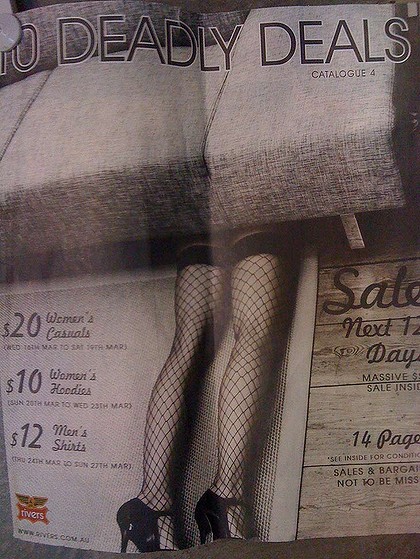
Kelebek and Laurie L. both let us know about a recent example of the use of images of dead or brutalized women in fashion advertising. A recent catalog, titled “Deadly Deals,” from the Australian clothing chain Rivers, included this image (via The Age):

And way back in July of last year, Caroline submitted an article from Amazing Women Rock about an ad for Beymen Blender, an upscale clothing boutique in Istanbul. The ad shows a woman’s dismembered body hanging from meat hooks; it and the rest of the photos below may be triggering for those sensitive to images of violence toward people, so I’m putting it after the jump.

However, Dmitriy T.M., Melissa F., and Noelle S. found an example from the October 2010 issue of Interview magazine that inverts the usual gender pattern by showing a woman with brutalized men. The photo shoot was apparently supposed to evoke the types of torture and murder used by organized crime in Russia.

In this case, Naomi Campbell is shown in positions of dominance over an extremely pale-skinned, and clearly badly injured, man. So those images reverse not just the usual gender dynamic in images of violence and brutality in fashion photos, but also the frequent pattern of seeing naked or partially-naked Black bodies displayed as props around more fully-clothed White bodies (though Campbell is certainly scantily clad and sexualized). I suppose you could see this as undermining or commenting on the images we often see of violence toward women in fashion. Yet we could also argue that it does so by reinforcing the association of Blackness, in particular, with violence and aggression. And the photo shoot includes the same sexualization of violence seen so often in the fashion industry.

Thoughts?

Gwen Sharp is an associate professor of sociology at Nevada State College. You can follow her on Twitter at @gwensharpnv.

Cross-posted at Jezebel.

Way back in September of last year, Baxter sent us this Star Trek promotional poster, which showed the main cast staring straight out at the viewer, with the exception of the one female character, who was turned to the side, glancing sideways at the viewer with her mouth slightly open:

We didn’t get around to posting about it at the time, but I thought of it when I saw the image from the Hulu site for the U.S. version of The Office, sent in by Jessica F. Similarly to the Star Trek poster, all of the male characters are looking straight out at the viewer, mouths closed, while the one female character has her head turned to the side, mouth slightly open; in this case, she’s looking at one of the male characters, not the viewer:

In both these posters, the men meet the viewer head-on, if you will.  Their bodies are aimed straight at the viewer, they make eye contact, and that contact is confident. In contrast, the women avert themselves.  Their body language is less self-assured.  The woman in the Star Trek poster is alluring, a passive sexiness; the woman in the Office poster is referential, using her eyes to draw attention to the show’s star.

After initially posting those, I asked for more examples and readers sent them in. Jessica T. pointed out this banner ad for Thor:

She also found an ad for the TV show Bones, which has the women smiling at the camera much more openly (well, except for Bones):

d

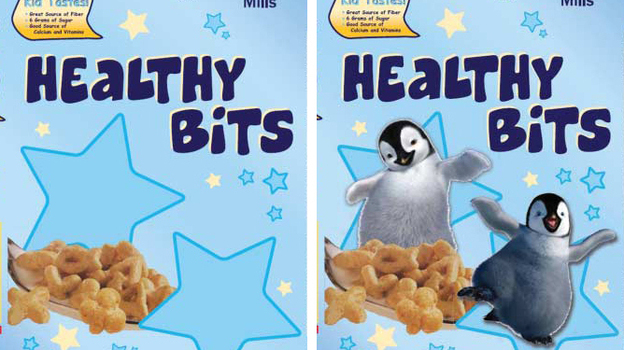
Bryan L. sent us a link to an NPR story about the effects of using cartoon characters to market food to kids. The study, conducted by researchers at Yale University’s Rudd Center for Food Policy and Obesity, had 80 children between the ages of 4 and 6 eat what they were told was a “new” cereal. The cereal was either called Sugar Bits or Healthy Bits, and in each case, half of the boxes included cartoon penguins and half didn’t. Here’s are the two options for Healthy Bits:

Kids were  then asked to rate the taste of the cereal, using a 5-point smiley face scale. Interestingly, kids rated the taste of Healthy Bits more highly than that of Sugar Bits (overall mean rating of 4.65 vs. 4.22). Less surprisingly, the presence of a cartoon character on the box led kids to think the cereal taste better (overall mean rating of 4.70 with a character, vs. 4.16 without).

You can read an overview of the article, “Influence of Licensed Spokescharacters and Health Cues on Children’s Ratings of Cereal Taste, which was published in the Archives of Pediatrics & Adolescent Medicine.

So it appears that kids are getting some of the message about nutrition and healthy eating, and that describing something as having lots of sugar leads them to evaluate it more negatively than they might have otherwise. (I couldn’t help but wonder if there might be a contrast effect, also. Maybe kids expect something  called Healthy Bits to be really gross and, if it doesn’t, evaluate it more positively than they would have, while they expect Sugar Bits to be super awesome and rate it particularly harshly if it doesn’t live up to their hopes. I know that type of comparative priming effect occurs with adults, where our initial expectations influence our later subjective assessment, but I have no idea to what degree that occurs with kids. Anybody know enough about childhood development to comment?)

However, cartoon characters have a strong influence on how kids evaluate the taste of cereal, enough to override their nutritional concerns. Put a cute penguin on Sugar Bits, and it suddenly tastes as good as a box of Healthy Bits without the penguin. Another study from researchers at the Rudd Center found that kids preferred to eat graham crackers, gummy snacks, and even carrots more if they were in a package with a popular cartoon character.

So the good news here is that kids may be willing to make better eating choices than we often give them credit for, and describing something as “healthy” isn’t the kiss of death we might expect. But the use of cartoon characters, such as tie-ins from TV shows and movies, is a powerful form of marketing. If such characters — especially, I assume, highly recognizable and popular ones — appear more often on less healthy options, they undermine efforts to guide children to develop healthy eating habits.

UPDATE: Reader qwirkle was able to get a copy of the entire article, which does make clear that the kids rating Sugar Bits lower than Healthy Bits wasn’t just an “expectations effect”:

Another explanation for the difference in children’s assessments of the cereal involves their expectations of the cereal taste based on the name. Specifically, the cereal used for this study had only a moderately sweet taste. Consequently, children may have been disappointed by the lack of sugary flavor in the cereal named Sugar Bits and pleasantly surprised by the sugary flavor in the cereal named Healthy Bits. At 6 g of sugar per serving, however, the sugar content was comparable to that of other commonly available sweet cereals (eg, 6 g in Honey Kix and 9 g in Honey Nut Cheerios). Nevertheless, whether the children were reacting to their expectations of the cereal’s taste or expressing their skepticism of the merits of sugary products, when the character was present on the box, children reported a more favorable subjective experience with the product.”

This month’s celebrity gossip included a scandal over a photo Serena Williams tweeted of herself that was quickly taken down.  The photo was of Williams in a bra and panties behind what appears to be a curtain; you can see her silhouette and some fuzzy details of what she is wearing.  It was timed to correlate with the release of the World Tennis Association’s Strong is Beautiful campaign, featuring Williams of course.

Williams took the photo down because of criticism.  A man had recently been arrested on charges of stalking her and the image, critics claimed, was exactly the kind of thing that triggered men to stalk her.  She shouldn’t encourage the creeps, said the blogosphere.  Sports columnist Greg Couch, for example, called her a hypocrite for daring to release such a photo and still wishing to avoid being stalked, and then went on to discuss her appearance and clothing choices at length.

Of course, selling one’s own sex appeal is more or less required for any female athlete who wants to reach the pinnacle of her career without being called a “dog” and a “dyke” at every turn.  So Williams isn’t breaking the rules, she’s playing the game.  And, yet, when she plays the game she gets, in return, not only stalkers, but criticism that suggests that, were she to be stalked again, she was asking for it.  This is an excellent example of the ugly truth about the patriarchal bargain.

A patriarchal bargain is a decision to accept gender rules that disadvantage women in exchange for whatever power one can wrest from the system. It is an individual strategy designed to manipulate the system to one’s best advantage, but one that leaves the system itself intact.  Williams is making a patriarchal bargain, exchanging her sex appeal for the heightened degree of fame and greater earning power we give to women who play by these rules (e.g., Kim Kardashian).  Don’t be too quick to judge; nearly 100% of women do this to some degree.

But once women appear to have acquiesced to the idea that their bodies are public property, their bodies are treated as public property.  Others, then, feel that they have the right to comment on, evaluate, and even control their bodies.  Williams made her body public, the logic goes, therefore anything that happens to it is her fault.  This is why the bargain is patriarchal.  Williams will be excoriated for her unwillingness to defer to the male gaze if she refuses to trade on her sex appeal. But if she does make this trade, she’ll be the first against the wall if anything bad happens to her.

Lisa Wade, PhD is an Associate Professor at Tulane University. She is the author of American Hookup, a book about college sexual culture; a textbook about gender; and a forthcoming introductory text: Terrible Magnificent Sociology. You can follow her on Twitter and Instagram.

M.H. thought we might like to get to post about the sexualization of food again, so she sent us a link to a post at Redbook that is one of the more bizarre and blatant examples I’ve seen in a while. The article, titled “Blow Him Away in Bed: Oral Sex Tips” (an excerpt from Redbook’s 500 Sex Tips), is illustrated with various foods.

Here’s an example of one of their helpful hints:

Other tips are illustrated with images of a pickle, popsicle, mushroom, banana, a baguette, and a butternut squash, among others.

I cannot help but feel that if you write something that requires you to type “keywords: squash, tomato, vegetable, phallic, fellatio, oral sex, blow job, penis,” you may want to reconsider the topic, but that’s just me.

UPDATE: Readers are correctly pointing out that this example differs significantly from most of our other examples of sexualization of food by not being degrading in the way many of the others were. I think this is more just a curious example of the wide array of foods we sexualize, as well as how silly a lot of sex tips in women’s magazines are.

Gwen Sharp is an associate professor of sociology at Nevada State College. You can follow her on Twitter at @gwensharpnv.