Search results for The

Kristie V. let us know about a new item in Skechers’ Shape-Ups line of shoes. If you aren’t familiar with Shape-Ups, they’re the sneakers with the specially-shaped soles that supposedly firm your butt as you walk. Now Skechers has introduced a line of Shape-Ups targeted at tween girls (via Shine):

I was particularly struck by the scene at 23 seconds in, where the girl confidently bounces along in her Shape-Up, trailed by exhausted-looking boys dressed up as food:

Apparently Shape-Ups not only firm your butt, they give you the ability to reject food as well.

Though Skechers apparently claims to be targeting childhood obesity, at least two independent studies found that these types of shoes have no benefit in terms of fitness, whether measured by calories burned or level of muscle toning. But as Morning Gloria at Jezebel points out, girls are never too young to be socialized into buying products of questionable effectiveness — and avoiding food — in the hopes of “looking good and having fun,” as the ad put it.


In discussing sex work in my Power and Sexuality Course, I often ask students whether sexuality is really absent in work that is not deemed “sex work” (e.g., stripping, prostitution, and pornography).  Students can quickly think of ways in which sex appeal and sexy performances play a role in many, many jobs.  This is obviously true for singers, actresses, models, and dancers.  But it is also true, to some degree, in sales and bar-tending, or working as a lawyer, a flight attendant, or a teaching assistant.  These workers are sometimes called upon to dress to accentuate their sex appeal, move in ways that incite desire, and flirt with customers, clients, or co-workers.  Sex plays a role in most of our jobs, even when they aren’t explicitly called “sex work.”

I thought of this conversation when checking out a submission by artist Costanza Knight. (I’m a fan, especially, of her paintings about slavery and freedom based on the beautiful poem, The People Could Fly.)  Knight’s submission was in regard to a story about a Chinese tea producer hiring busty virgins to pick tea with their mouths.  The method of harvest is in reference to a traditional folktale and is designed to titillate and intrigue buyers willing to pay handsomely for the virgin-kissed, bosom-cradles leaves.

I can’t confirm the veracity of the story, but whether or not it’s true, it helpfully points to the need to deconstruct the notion that some jobs are “sex work” and other jobs are “just work.”  We sell our sexualities in many types of jobs; much of the time, it’s simply a matter of degree.

Lisa Wade, PhD is an Associate Professor at Tulane University. She is the author of American Hookup, a book about college sexual culture; a textbook about gender; and a forthcoming introductory text: Terrible Magnificent Sociology. You can follow her on Twitter and Instagram.


When we talk about beauty standards on Soc Images, we’re usually discussing attempts to meet them, and impacts on those who can’t. But what about people who are considered quite attractive by other people? Katherine K. sent in the trailer for the documentary The Art of Seduction: Not Pretty, Really. In it, the director interviews men and women about the impacts of being generally defined as attractive. There are the perks, such as sometimes getting free stuff, but there are downsides, too: jealousy from others, the stereotype that attractive people (especially women) are dumb, and questioning the motives of friends:


I graduated from high school in 1992.  I was born 9 months to the day my dad returned from the Navy; what were my parents to do?

Anyhow, I couldn’t help but chuckle watching this slideshow of photographs taken by Michael Galinsky of people, in malls, in 1989. I had that big hair. And, damn it, it was cool then. Well, sorta.

Anyhow 2, the slideshow is a fun reminder that aesthetics change. We all thought we looked hella good. Shut up, like totally.

Via BoingBoing, which never disappoints.

Lisa Wade, PhD is an Associate Professor at Tulane University. She is the author of American Hookup, a book about college sexual culture; a textbook about gender; and a forthcoming introductory text: Terrible Magnificent Sociology. You can follow her on Twitter and Instagram.

Gregory S. sent in a video that highlights the way that social institutions, including the legal system, are often based on assumptions about gender that make it difficult for men and women who break gender norms. Five years ago, a couple in Nebraska got married and the husband chose to take the wife’s name. He wasn’t trying to make a feminist statement; he just didn’t want her son from a previous relationship to be the only member of the family to have a different last name, and the simplest solution was for the husband to change his instead.

This doesn’t appear to be a difficult change. They weren’t blending their last names to invent a new one; they weren’t even hyphenating both their names. This is exactly the type of change that the legal system allows when women get married and decide to take their husband’s name. But five years after their marriage, the state suddenly seems incapable of dealing with a reversal of the usual gender pattern in name changing.

[Ugh. You’ll have to watch it at KETV or YouTube because they’ve disabled the YouTube embedding. Sorry!]

What strikes me is that officials are pretty openly stating that the problem here is his gender. They admit that women who change their names after marriage are given an exception to the normal name-changing procedures. They don’t appear to dispute that this couple got married. Instead, they seem to be arguing that as a man, he doesn’t qualify for the spousal name-change loophole, and thus allowing him to take his wife’s name using that method was a “mistake.”

Yet it is a “mistake” only because he is a man. The system is set up to facilitate conforming to gender norms: there is (an apparently unofficial) loophole to make it easy for women, and only women, to assume their husbands’ names. That exception to procedure is now being denied, retroactively, to a couple whose use of it defies gender norms. And the fact that five years ago some government official apparently applied the name-change loophole in a gender-neutral manner and allowed Josh to change his name is seen as an incomprehensible error.

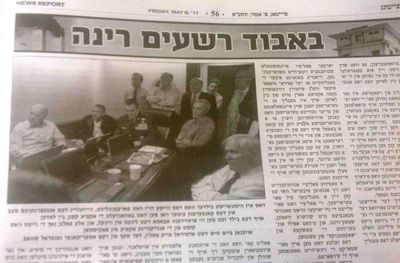
Tim, Cindy S., and Kenny V. sent in an interesting story. The Brooklyn-based newspaper Der Tzitung, which targets the Ultra Orthodox Jewish community, published copies of the now-famous photo of President Obama and his staff in the Situation Room during the Navy SEALs operation that killed Osama bin Laden. Here’s the original (via the New York Daily News):

However, the version of the photo that ran in Der Tzitung had been photoshopped to remove the two women in the room, including Secretary of State Hillary Clinton (initially posted at Failed Messiah):

We’ve seen this before. Usually the argument for deleting women or girls from photos is that they are sexually suggestive or show women interacting with men in ways that are considered inappropriate by the Ultra Orthodox. Whether that’s the case here, or whether it was discomfort showing a woman in a position of significant political power, the effect is to rewrite history to erase the role of women in political decision-making.

UPDATE: While this post led to a lot of interesting discussions, some individuals also posted problematic and offensive comments about the Orthodox community. Due to a family emergency I was overwhelmed and distracted and did not monitor the comments closely at the time, and thus those comments have remained up for the past week. I am going to delete some offensive or inappropriate comments, but I apologize that they were left up for so long without any response from me.

That said, a lot of readers made really great comments, both about how we go about being culturally respectful/sensitive but also thinking through issues such as public representation, and that the Orthodox Jewish community is quite diverse and that this newspaper, and the policies it espouses, shouldn’t be taken as indicative of the behavior or attitudes of Orthodox Jews more broadly.

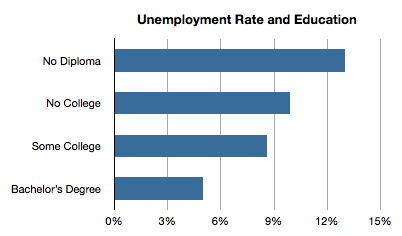
People with a college degree are less likely to be unemployed than people without one (source: Andrew Sullivan):

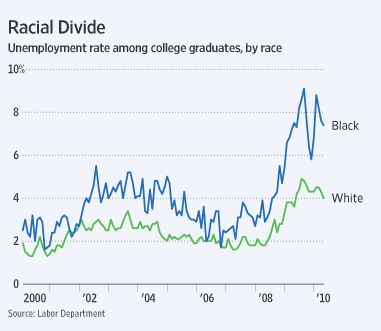
But a college degree helps blacks less than it  helps whites, especially in this recession (source: Andrew Sullivan):

See also Devah Pager’s stunning data on race, drug convictions, and employment prospects (in text or video).  (Hint: it’s better to be a white felon than a black person with no felony record).

Lisa Wade, PhD is an Associate Professor at Tulane University. She is the author of American Hookup, a book about college sexual culture; a textbook about gender; and a forthcoming introductory text: Terrible Magnificent Sociology. You can follow her on Twitter and Instagram.

Cross-posted at Jezebel.

gabrielleabelle sent in an online ad for Minute Maid orange juice that reinforces gender stereotypes, particularly that women are desperate to get married and feel competitive with one another regarding their progress toward this all-important goal. The ad is part of Minute Maid’s “Mmojo” campaign, which consists of ads showing people drinking Minute Maid and then instantly being more successful, desirable, and generally awesome. This ad included images of two people who clearly have lots of mmojo and asks how you compare. How could we tell? Well, the guy is covered in lipstick kisses and looks a little overwhelmed by the attention:

Now, how would we know a woman was magically charmed? Oh, that’s right — she’d have managed to get herself an engagement ring:

Because there would be no better proof of a woman’s magical powers than her ability to get a man to propose to her. I can’t even imagine how much mmojo another woman would have to have to top this.