Search results for The

Photographer Peter Menzel has a habit of displaying people’s lives in illuminating ways.  Previously we highlighted a project in which he went around the world asking families to pose in front of their house with all of their stuff.  He now has a book, Hungry Planet, featuring photographs of families posting with a week’s worth of food.  It tells a fascinating qualitative and quantitative story of cultural gastronomical difference.

Go to Menzel’s website for more information.


Lisa Wade, PhD is an Associate Professor at Tulane University. She is the author of American Hookup, a book about college sexual culture; a textbook about gender; and a forthcoming introductory text: Terrible Magnificent Sociology. You can follow her on Twitter and Instagram.

Sometimes you just have to laugh.  Sex is used to sell the most ridiculous things, like organ donation.  It’s like marketers think we’ve Pavlov’s dogs.  Show a sexy woman (’cause sexy women = sex) and, rumor has it, people will buy.

When Renée sent in this photograph of a storefront display aiming at selling ovens, I felt compelled to share its ridiculousness with you.  Begin snark:

Ovens are hot.  Get it.  They’re “hot.”  LOL.  Put her in lingerie, sit her ass on the oven door, add a fire-red wig, and surround her with thermometers.  Add the words, “HOT! HOT! HOT!”  Maybe if we really overdo it with the metaphor, no one will notice how stupid this is.

Enjoy:

Lisa Wade, PhD is an Associate Professor at Tulane University. She is the author of American Hookup, a book about college sexual culture; a textbook about gender; and a forthcoming introductory text: Terrible Magnificent Sociology. You can follow her on Twitter and Instagram.

NEWS:

Gwen and I are finishing up our semesters and looking back at a wonderful year with all of you!

Some highlights:

We were granted an innovation in teaching award from the Pacific Sociological Association and have been nominated for awards from the American Sociological Association and the Pop Culture / American Culture Association.  Plus David Mayeda was kind enough to review us for Teaching Sociology.

We started accepting proposals for guest posts.

We broke the 10,000 friend barrier on Facebook.  (And we think over 3,500 on Twitter is nothing to shake a stick at.)

We just barely almost didn’t quite reach 750,000 visits in one month.  But darn were we close!

We entered a partial syndication agreement with the historic Ms. magazine.

We broke a story that ended with Abercrombie Kids pulling their push-up bikini top for kids.  Read the original post and our summary.

We managed to fool a few of you on April Fool’s Day (scroll to bottom).

And we let you all in on the mystery that is Dmitriy T.M.

Sociologists, Gwen and I will be at ASA, SWS, and SSSP this August. So please say “hello” if you see us or look us up in the programs. We’ll be giving a talk or two.

KUDOS:

Special thanks to Jon Smadja, Velanie Williams, Norma Morella for all their hard work on the blog.  We couldn’t do it without you.

And thanks for reading everyone!  We’re looking forward to a productive summer and another record-breaking year!

We’ve featured posts before on how chocolate is often marketed by linking it to sexual pleasure or presenting it as a substitute for love and romance, especially for women. And we’ve written about ejaculation imagery in ads.

John from Facile Gestures and YetAnotherGirl sent us an Australian commercial for Zokoko chocolates that dispenses with any subtlety when connecting their product to sex and ejaculation. It’s…something:

From Copyranter, via Gawker.

Andrew Slater sent in an interesting example of the mocking of rap music.  The mocking occurs in a re-make of Rebecca Black’s “Friday,” about the excitement of going on out Friday night.  Black’s low-budget music video went viral, shooting her into stardom, or at least celebrity.  The song is a standard teeny-bop pop song, complete with rap interlude.

The re-make, produced by the Community Christian Church, features a so-called “Sadie Black” singing about “Sunday” instead of Friday, and extolling the pleasures of worship. Slater noticed, however, that the entire re-make is more-or-less truthful to the original, except for the rap section. In the re-make, “BP” and “Master E” appear to make fun of rappers.  It’s a very different effect when compared to the straightforward mimickry of Sadie B.

Screen shots (original and re-make respectively):

Videos (rap sections starts at 2:30 and, um, 2:30 respectively):

Lisa Wade, PhD is an Associate Professor at Tulane University. She is the author of American Hookup, a book about college sexual culture; a textbook about gender; and a forthcoming introductory text: Terrible Magnificent Sociology. You can follow her on Twitter and Instagram.

Back in December, Carly S. sent in an ESPN video about NFL player Bart Scott, nicknamed the “Mad Backer.” The video illustrates a number of noteworthy themes:

  • The glorification of violence, with Scott reveling in the chance to dish it out.
  • Equating being able to play through pain caused by this violence as proof of masculinity — particularly disturbing given concerns about the long-term effects the physical punishment players take has on their health.
  • Through the “Mad Backer” persona and the presence of a straight jacket and stretcher, Scott associates mental illness with violence and danger as a way to prove his own superiority on the field. Not only is he “mad,” he depicts himself as a villain who enjoys brutality.

See for yourself:

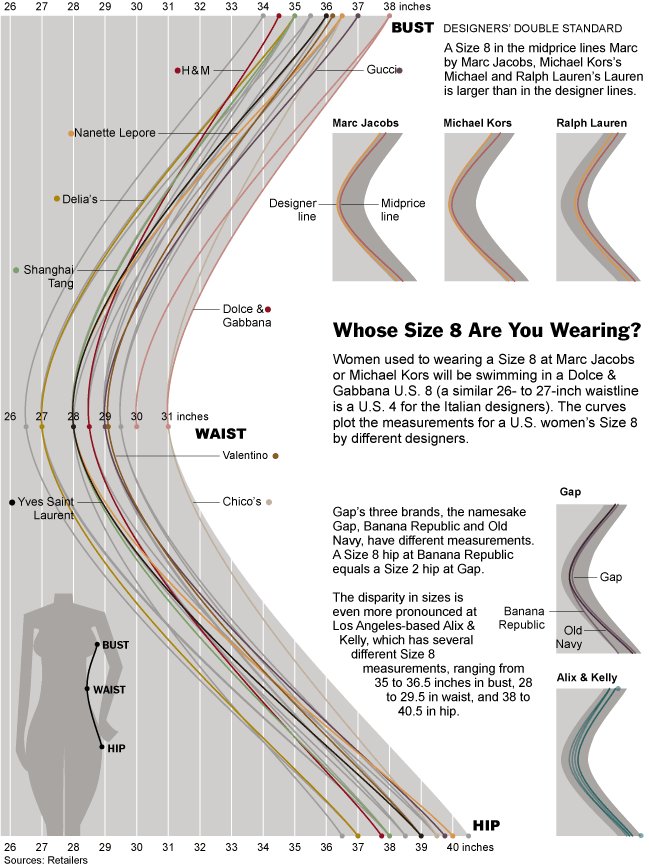
In one store, you’re a Size 4, in another a Size 8, and in another a Size 10 — all without gaining an ounce.

So starts a New York Times article, forwarded along by Kristin, Valerie, and Dolores.  It features this handy graphic illustrating just how much both sizes and proportions vary from store to store:

It’s interesting that this article is specific to women, as if the sizes and proportions in men’s clothes don’t vary. Hint: they do.

Lisa Wade, PhD is an Associate Professor at Tulane University. She is the author of American Hookup, a book about college sexual culture; a textbook about gender; and a forthcoming introductory text: Terrible Magnificent Sociology. You can follow her on Twitter and Instagram.

How does “culture” control us?  In her book Talk of Love, Ann Swidler argues that culture has the power to shape our behavior even when we do not internalize the cultural narratives to which we are exposed.  She uses Secretary’s Day, or Administrative Professional’s Day if you’re being politically correct, as an example.

Secretary’s Day is a rather recent faux-holiday that conveniently (for florists, card makers, and candy and cookie bakers) falls between Easter and Mother’s day and mostly serves to bolster capitalist cashflow.  Need a product to show your appreciation?  We’ve got ’em! From cakes to gift baskets to greeting cards.

Like Mother’s Day cards suggest that families would fall apart without mothers to do EVERYTHING, Secretary’s Day cards suggest that an office would be helpless without its administrative assistants:

The holiday is meaningful, of course, only because (like with mothers) we take-for-granted and devalue what adminstrative assistants do everyday every day.  In that sense, the holiday is disingenous and actually exposes that which it claims to resolve.  So there are good reasons for administrative assistants to think it’s bunk, too.

Let’s say that you had a secretary, but you thought that Secretary’s Day was stupid.  Would you still mark the day?

Swidler says you would.

You would if Secretary’s Day was being so ubiquitously advertised and promoted that everyone knew it was Secretary’s Day.  And, if everyone knew that it was, including your administrative assistant, then it makes a statement NOT to mark the day.  Marking the day is the path of least resistance.  Not “showing your appreciation” tells a story about you (you’re not a very nice person) or your adminstrative assistant (who must suck and be a crappy employee).  And there’s nothing you can do about that.

Here’s how Swidler tells it:

…the difficulty is that even the most skeptical, who recognize the trumped up, commercial origins of the occasion, may find themselves trapped by the wide publicity of the code.  If one’s boss won’t even spend a few dollars, does that signal that he or she doesn’t ‘care?  Both bosses and secretaries, however distasteful they may find the holiday, may nonetheless worry about the signal their actions will send.  Indeed, that is the key to semiotic constraints on action.  One is constrained not by internal motives but by knowledge of how one’s actions may be interpreted by others (p. 163).

We don’t just get to act according to what we think and feel.  We have to make decisions about how to act based on how others will interpret our behaviors.  And, often, it’s easier to go along and make the right moves than it is to buck the system that gives our choices meaning.

Lisa Wade, PhD is an Associate Professor at Tulane University. She is the author of American Hookup, a book about college sexual culture; a textbook about gender; and a forthcoming introductory text: Terrible Magnificent Sociology. You can follow her on Twitter and Instagram.