Search results for The

Cross-posted at Jezebel.

Oh how I love a good example of our tendency to gender cats and dogs.  See, for example, my cat person/dog person rant and our post about an adoption campaign arguing that it can be manly to own a cat.

Josh Pearson sent in another colorful example from The Blue Buffalo Trading Co., a company that makes pet foods.  The company subtly genders dogs and cats with blue and pink, respectively:

More, the language on the site sexes the animals themselves. They consistently refer to cats as “she” and “her” and dogs as “he” and “him.”  For example, the text reads:

I hope everyone recognizes this as bizarre.  Dogs and cats come in both hes and shes (that how there are more cats and dogs every year).  And notice that we tend to stereotype dogs as more like the stereotypical woman (dependent, passive, and happily subordinated) and cats like stereotypical men (independent, self-serving hunters), even as we masculinize dogs and feminize cats.  So there is some serious contradiction going on here.  We gender everythingthough, so why not dogs and cats!

Lisa Wade, PhD is an Associate Professor at Tulane University. She is the author of American Hookup, a book about college sexual culture; a textbook about gender; and a forthcoming introductory text: Terrible Magnificent Sociology. You can follow her on Twitter and Instagram.

History and women’s studies professor Keri Manning, along with Aydrea at The Oreo Experience, Sully R., and Dmitriy T.M., sent a link to a series of illustrations of pin-up girls (from the ’50s, I’m estimating) alongside the original photograph on which they were modeled (Buzzfeed).  Today we bemoan photoshopping, and here we have pre-photoshop examples of the kind of free-reign that artists had in idealizing their subject.  Dr. Manning notes, for example, that overall:

Bellies become flatter. Breasts become perkier.  Cleavage appears that wasn’t there before.  Waistlines shrink; the difference between the bustline and waistline gets more pronounced.  Hair gets longer.  Hair goes from brunette to blonde.  Inner thighs emerge from the shadows.  Cheeks become flushed, lips are quite red.

An interesting look at a photoshop forerunner. See the images at Buzzfeed and Pristina.

Lisa Wade, PhD is an Associate Professor at Tulane University. She is the author of American Hookup, a book about college sexual culture; a textbook about gender; and a forthcoming introductory text: Terrible Magnificent Sociology. You can follow her on Twitter and Instagram.
Following up on a post I put up last month about World War II internment camps for Japanese Americans, reader Eduardo let us know about a short film distributed by the federal Office of War Information explaining why the camps were necessary and trying to portray them in a positive light. It’s a great example of propaganda. Notice at about 2:45 the narrator explains the change from voluntarily to required relocation of Japanese Americans in terms of their own protection, and at 3:20 mentions that those forced to relocate “cheerfully” took part in the process. It was such a happy, smooth process, with the federal government helping out!

The implication starting at about 4:00 that “loyal” Japanese Americans were happy to relocate as part of their patriotic duty is particularly striking. Presumably, then, if you objected to the violation of your civil rights and treatment as a potential enemy of your country, you proved exactly why you needed to be relocated.

But don’t worry. “We are protecting ourselves without violating the principles of Christian decency.”

Cross-posted at Jezebel.

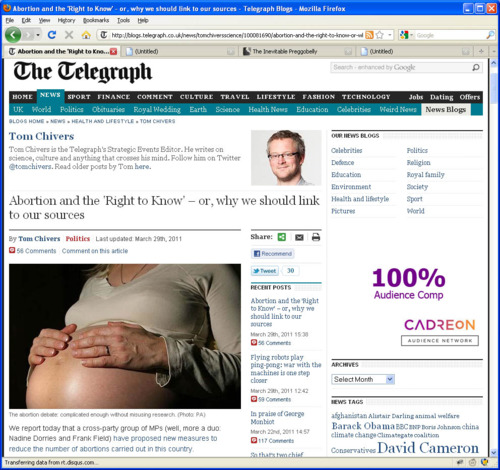
According to The Guttmacher institute, 90% of all abortions occur in the first trimester. According to WebMD, a 12-week old fetus is 2.5 inches long and the typical woman will have gained three to five pounds. Most of these women’s pregnancies are essentially undetectable to an observer.

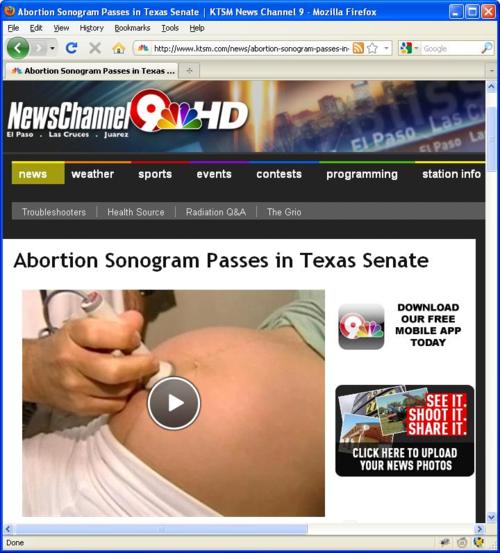
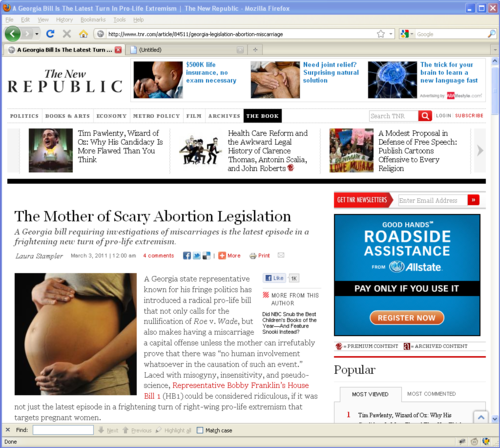
Most news stories about abortion, however, illustrate their article with an image of a woman with an unambiguously pregnant belly.  The disconnect between the reality (90% of abortions occur in the 1st trimester) and the imagery (of women who are in their 3rd) implies that many abortions are occurring much later than they are.

A reader, Richard, brought our attention to a tumblr blog highlighting this mis-illustration. Preggobelly collects screenshots of abortion stories illustrated by heavily pregnant bellies. Here is a sample:

For another fascinating post on imagery and abortion, see our post on the initiation of fetus imagery.

Lisa Wade, PhD is an Associate Professor at Tulane University. She is the author of American Hookup, a book about college sexual culture; a textbook about gender; and a forthcoming introductory text: Terrible Magnificent Sociology. You can follow her on Twitter and Instagram.
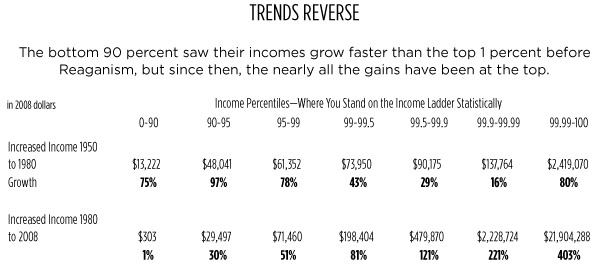
Captain Crab sent us an article by David Johnston in the Willamette Week that looks at changes in income inequality in the U.S. since 1950.Based on an analysis of research by Saez and Piketty (2007, with updated 2008 data available at Saez’s website–the first entry under “Income and Wealth Inequality”), Johnston calculated changes in income for various income percentiles in the U.S. Between 1950 and 1980, the bottom 90% of income earners saw their incomes increase by 75% (a gain of $13,222), a rate higher than or comparable to the highest income groups. However, between 1980 and 2008, incomes of the bottom 90% has largely stagnated, while the incomes of the super rich have soared (all data in constant 2008 dollars, adjusted for inflation):

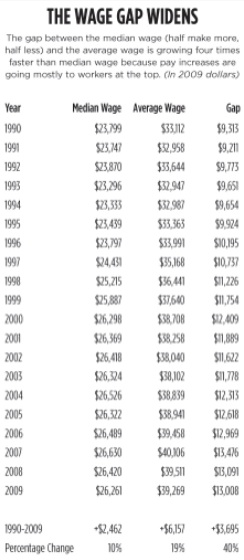
As a result the difference between the median wage and the mean wage has widened (data from the Social Security Medicare Database):

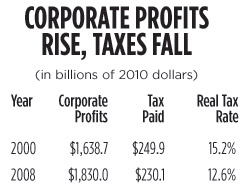
Johnston also includes data on changes in corporate income tax rates, based on IRS data. The actual tax rate — how much corporations pay after various loopholes and tax breaks — fell between 2000 and 2008:

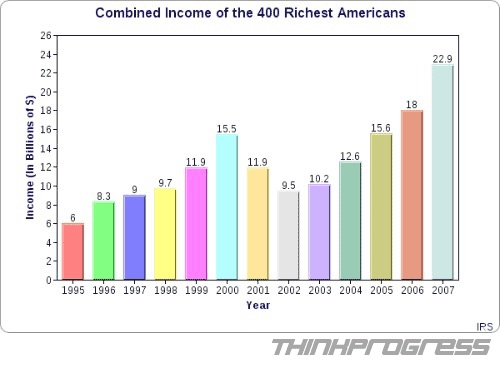
On a similar topic, Deeb K. sent in a link to images at Think Progress showing the actual tax rate of the 400 richest Americans between 1995 and 2007, based on IRS data. During that period, the effective tax rate of this group fell by 13 percentage points:

Their incomes, on the other hand, jumped significantly:

Also see my recent post on various illustrations of inequality in the U.S.

Said Mary Wollstonecraft:

Taught from infancy that beauty is woman’s sceptre, the mind shapes itself to the body, and roaming round its gilt cage, only seeks to adorn its prison.

Inspired, perhaps, by Wollstonecraft’s words, Katie Makkai fights back against the word “pretty.”  After a childhood subject to its tyranny, she imagines telling her own daughter to reject its pull, beginning with “The word pretty is unworthy of everything you will be!”  Thanks to Jake Lundwall for the tip.

(Transcript after the jump.)

more...

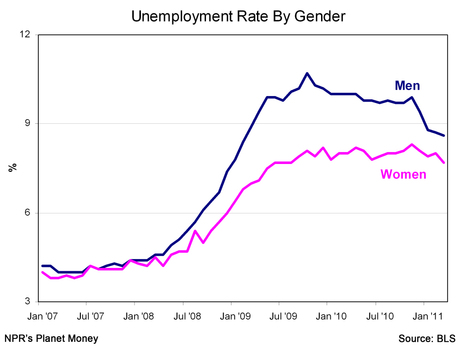
Sangyoub Park, who teaches sociology at Washburn University, sent us an interesting article posted by NPR on various aspects of unemployment. The overall official unemployment rate of 8.8 percent (as of March 2011) hides a lot of variation. For instance, the unemployment rate during this recession has been consistently worse for men than for women:

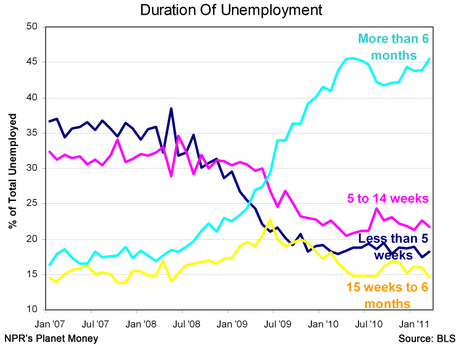
Nearly half of people have been out of work for at least 6 months:

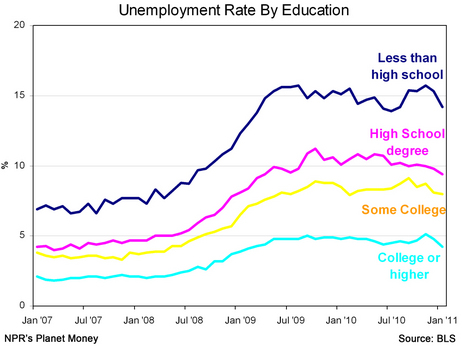
The unemployment rate for those with a college education is under 5%, while for those who didn’t graduate high school, it’s nearly 10 percentage points higher:

Check out the NPR story for more discussion and a few more graphs.

The NPR article doesn’t include data on race, but Sangyoub found some racial data at the BLS website. As of March 2011, the unemployment rate for Whites was 7.9%, while for Blacks it was 15.5%.

Racialicious and Hermes’ Journeys featured a clip of stand-up comedian Gary Owens comparing black and white churches, joking about how long and loud black services are compared to white services.  Two things are happening in the clip.  First, Owens is commenting on two different styles of worship.  This is really interesting sociologically because it shows that how one worships is a cultural phenomenon that varies.  We’ve seen this powerfully illustrated by children recently in the viral videos Baby Preacher and Baby Worshipper.

Second, though, Owens is racializing these different forms of worship.  In consultation with Gwen, she reminded me that what he’s really talking about is “the difference between more mainline churches vs. the charismatic evangelical ones.”  At the latter churches yelling out and hours-long services are common, no matter the racial makeup of the congregation.

So, the clip is a good example of both a sociological principle (socialization) and a sociological mistake (racialization):

Lisa Wade, PhD is an Associate Professor at Tulane University. She is the author of American Hookup, a book about college sexual culture; a textbook about gender; and a forthcoming introductory text: Terrible Magnificent Sociology. You can follow her on Twitter and Instagram.