Search results for The

Flashback Friday.

I recently came upon the Jewish greeting card section at Target, way down on the bottom row. I could tell it was the Jewish section because all of the dividers that tell you what kind of card is in that slot (birthday, anniversary, etc.) had a Star of David on them.

I was interested in what a specifically Jewish birthday card might look like, so I picked this one up. It draws on the idea that Jewish people are particularly prone to feeling guilty.
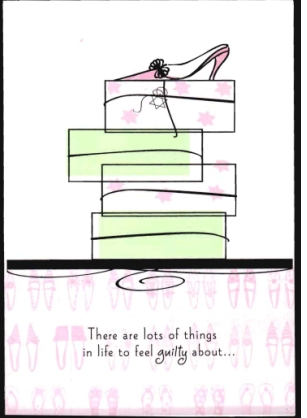
 

The inside said:

…but is cake and ice cream mentioned anywhere? I think NOT! It’s your day! Enjoy! Enjoy!

Mary Waters found that people often believe that ethnicity explains all types of behaviors that are in fact very widespread. She interviewed White ethnics in the U.S.; they often attributed their families’ characteristics to their ethnicity. Take the idea of the loud, boisterous family, often including a mother who is constantly trying to get the kids to eat more of her homecooked meals and worrying if they aren’t married. Many individuals described their family this way and claimed that their ethnicity was the reason.

People who identified their background as Italian, Greek, Jewish, Polish, and others all believed that the way their family interacted was a unique custom of their ethnic group. Yet they all described pretty much the same characteristics. The cardmakers’ (and others’) allusion to guilt to signify Jewishness seems to me to fall into this category: take out the Stars of David and I bet a range of religious/ethnic groups would think it was tailored to them specifically.

So you take a card, say guilt in it, add a Star of David, and you’ve got a Jewish card. Take out the Star of David, maybe it’s a Catholic card, especially if you added a cross, since they’re often portrayed as feeling a lot of guilt. I’ve had friends who grew up Southern Baptist or Pentecostal joke about having felt guilty about everything, so you could market the card to them, too! I think it’s a good example of how we often treat characteristics or behaviors as somehow meaningfully connected to a specific ethnic background rather than being a pretty common way that people in general, across ethnic lines, behave.

Originally published in 2010.

Gwen Sharp is an associate professor of sociology at Nevada State College. You can follow her on Twitter at @gwensharpnv.

Flashback Friday.

Sociologist Max Weber argued that the nation-state can be defined by its monopoly on violence. For most of us, most of the time, violence exercised by the state is assumed to be legitimate (unless shown otherwise). For example, police walk around with guns and can shoot you legally. Soldiers kill as part of their jobs. This is simply “keeping the peace” or “following orders.”

But violence exercised by individuals and other entities is (unless shown otherwise) illegitimate. In fact, when individuals or other entities do violence, it is often called “criminality” or “terrorism.” A powerful cartoon by Andy Singer illustrates the phenomenon well.

Words are powerful. Calling something “terrorism” is a way to make it seem illegitimate.  And, often, what makes violence illegitimate is not something inherent in the violence itself, but your perspective on it.

Thanks to Perry H.for the submission. Originally posted in 2009.

Lisa Wade, PhD is an Associate Professor at Tulane University. She is the author of American Hookup, a book about college sexual culture; a textbook about gender; and a forthcoming introductory text: Terrible Magnificent Sociology. You can follow her on Twitter and Instagram.

Most women in the U.S. go to considerable lengths to consistently protect the majority of men from their unmasked faces (it’s a “disguise,” remember?). Comedian Amy Schumer wonders what might happen if men saw the real us…

Lisa Wade, PhD is an Associate Professor at Tulane University. She is the author of American Hookup, a book about college sexual culture; a textbook about gender; and a forthcoming introductory text: Terrible Magnificent Sociology. You can follow her on Twitter and Instagram.

SocImages in the News:

You like!  Here are our most appreciated posts this month:

Thanks everybody!

Editor’s picks:

Top post on Tumblr this month:

Follow us!

Finally…

To all the students, faculty, and staff out there, I found this mossy, wooden-eyed, 100-year-old teddy bear inside the walls of my (shotgun) house. It wishes you good luck for the end of the semester. Tell it “thank you”… OR ELSE.2

Lisa Wade, PhD is an Associate Professor at Tulane University. She is the author of American Hookup, a book about college sexual culture; a textbook about gender; and a forthcoming introductory text: Terrible Magnificent Sociology. You can follow her on Twitter and Instagram.

African Americans are less healthy than their white counterparts. There are lots of causes for this: food deserts, lack of access to healthcare, an absence of recreational opportunities in low income neighborhoods, and more. Arguably, these are indirect effects of racist individuals and institutions, leading to the disinvestment in predominantly black neighborhoods and the economic disempowerment of black people.

This post, though, is about a direct relationship between racism and health mediated by stress. Experiencing discrimination has been shown to have both acute and long-term effects on the body. Being discriminated against changes the biometrics that indicate stress and personal reports of stress (anxiety, depression, and anger). Bad health outcomes are the result.

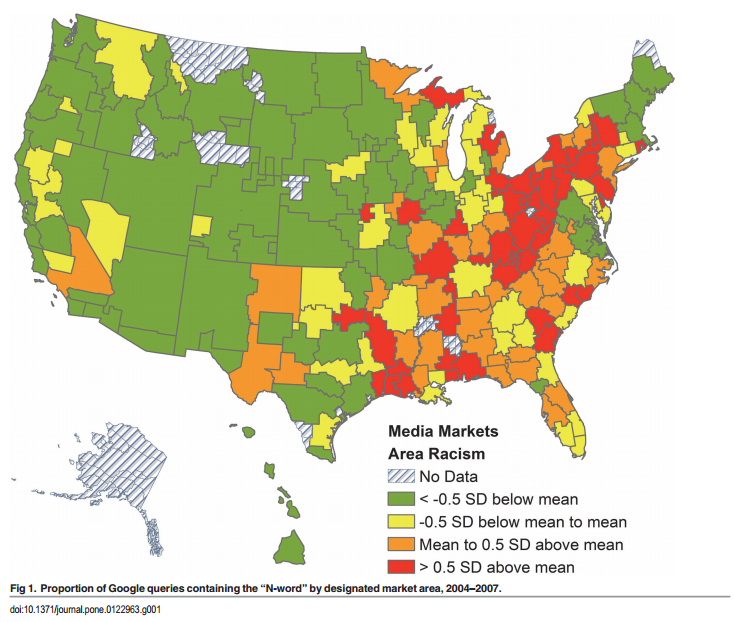
A new study, published in PLOS One, adds another layer to the accumulating evidence. To get a strong measure of “area racism” — the prevalence of racist beliefs in a specific geographic area — epidemiologist David Chae and his colleagues counted how often internet users searched for the “n-word” on Google (ending in -er or -ers, but not -a or -as). This, they argued, is a good measure of the likelihood that an African American will experience discrimination. Here are their findings for area racism:

2

They then measured the rate at which black people over 25 in those areas die and the death rate from the four most common causes of death for that population: heart disease, cancer, stroke, and diabetes. They also included a series of control variables to attempt to isolate the predictive power of area racism.

The resulting data offer support for the idea that area racism increases mortality among African Americans. Chae and his colleagues summarize, saying that areas in which Google searches for the n-word are one standard deviation above the mean have an 8.2% increase in mortality among Blacks. The searches were related, also, to an increase in the rates of cancer, heart disease, and stroke. “This,” they explain, “amounts to over 30,000 [early] deaths among Blacks annually nationwide.”

When they controlled for area level demographics and socioeconomic variables, the magnitude of the effect dropped from 8.2% to 5.7%. But these factors, they argued, “are also influenced by racial prejudice and discrimination and therefore could be on the causal pathway.” In other words, it’s not NOT racism that’s making up that 2.5% difference.

Directly and indirectly, racism kills.

H/t to Philip Cohen for the link. Cross-posted at Pacific Standard.

Lisa Wade, PhD is an Associate Professor at Tulane University. She is the author of American Hookup, a book about college sexual culture; a textbook about gender; and a forthcoming introductory text: Terrible Magnificent Sociology. You can follow her on Twitter and Instagram.

I’m going to start this post even though I don’t have an ending.

About a year ago I was asked to start writing for Playboy. The editor said that he was helping to transform the magazine’s website into one that “was a destination for smart writing on sex.” I said that I’d keep the offer in mind but, between you and me, the answer was no.

Around the same time, I heard of some other high-profile feminist writers being invited as well. “Huh,” I thought, “they may actually be serious about this.”

Since then, I’ve ended up on the Playboy website a couple of times, following links by like-minded people who found material they thought was valuable. I’ve been surprised and tentatively impressed. Then, this week there was a flurry of links to a piece by Noah Berlatsky, deftly and smartly analyzing feminist responses to trans woman Laverne Cox’s decision to pose nude for Allure.

The article began with a cropped screenshot of Cox’s photograph featuring her face and de-emphasizing her body and a quote from Cox about the widespread belief that black women and trans women, and especially black trans women, can’t be beautiful.

Berlatsky then goes on to discuss the challenges intersectionality poses to feminism, conflicts within feminism about whether trans women count as women, debates over cosmetic surgery and the problem with trying to live up to patriarchal standards of beauty, and whether Cox’s decision to pose naked is degrading. You don’t have to agree with all Berlatsky says to notice that he is no stranger to feminist theory.

Moreover, he seems to look upon Cox’s photograph with a delicate and sensitive gaze, describing what he sees like this:

Cox is not fashion-model-thin. She’s not fashion-model-petite or willowy, either. She has very large hands, which are not hidden, boldly displayed. In the photo, Cox lies on a blanket; her body taut rather than relaxed, her head in one big, strong hand, eyes closed, a slight smile on her face — like she’s a little embarrassed and amused at being embarrassed. She’s voluptuous and awkward and sweet all at once. In her simultaneous enjoyment of and discomfort before the camera, she seems, in the frankly staged pose, startlingly natural — and beautiful.

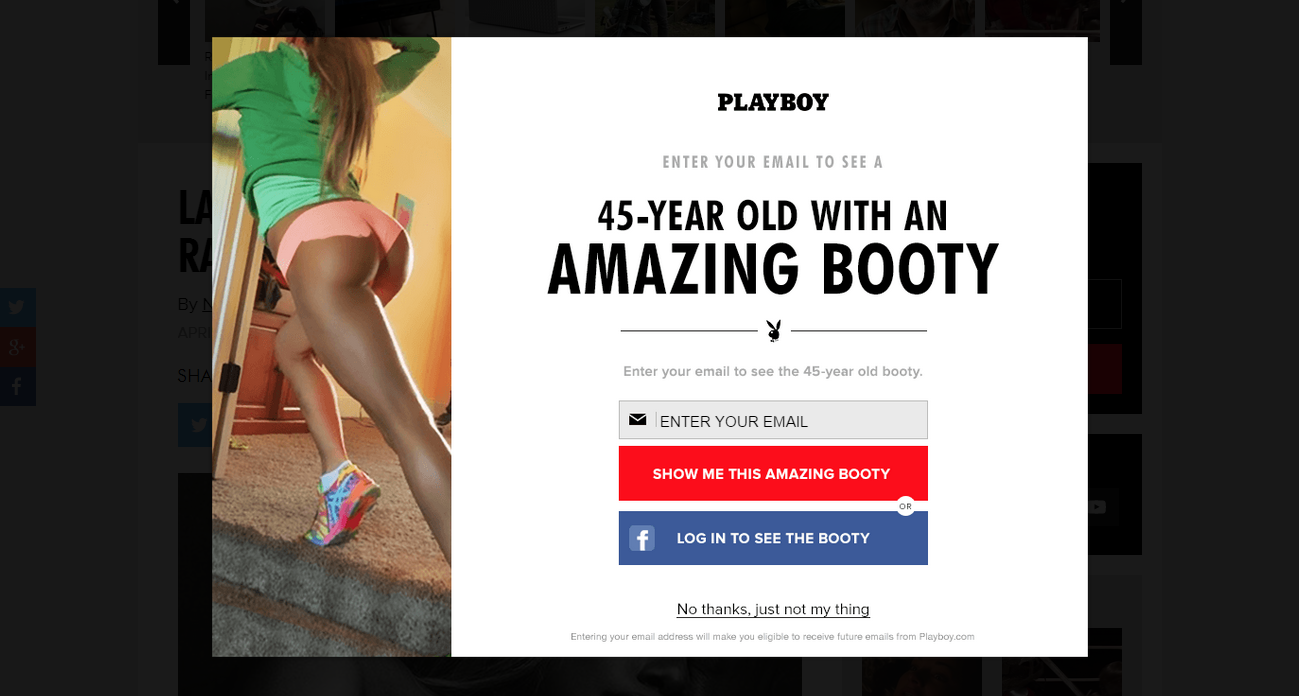
As I reached the end of the article, I was considering sharing a post from Playboy for the very first time. Then, this happened:

11

That’s a screenshot of a pop-up that arrived on my screen when I reached the end of Berlatsky’s thoughtful, feminist essay. It says: “Enter your email to see a 45-year-old with an amazing booty.” In other words, “Click right now to see a woman still fuckable after 40!” (And here I’m going to just go with the idea that this is sexist, but not engage with the extensive feminist theorizing about pornography.)

This is where I’m at a loss.

Is this what change looks like? Is this what change looks like, specifically, when it comes from inside of an organization? A slow, stuttering shift from misogyny to feminism, replete with missteps and contradictions?

Who’s in charge over there? What is their strategic plan? Are they trying to appropriate feminism? It’s not like they haven’t done it before. What role do they see this feminist discourse playing in a space that’s still so misogynist?

Or is the right hand just not paying attention to what the left hand is doing? Maybe Berlatsky was as surprised by the pop-up as I was, thinking “Come on, guys!” Or do they not think that their pop-up was sexist at all?

And, from a feminist perspective, does this do anyone any good? I don’t mean this rhetorically. I honestly don’t know how to answer that question. And, on the flipside, could this hurt feminist activism?

What say you?

Lisa Wade, PhD is an Associate Professor at Tulane University. She is the author of American Hookup, a book about college sexual culture; a textbook about gender; and a forthcoming introductory text: Terrible Magnificent Sociology. You can follow her on Twitter and Instagram.

Thanks to Stuff Mom Never Told You for this fantastic satire!

Thanks to Meredith E. for the tip!

Lisa Wade, PhD is an Associate Professor at Tulane University. She is the author of American Hookup, a book about college sexual culture; a textbook about gender; and a forthcoming introductory text: Terrible Magnificent Sociology. You can follow her on Twitter and Instagram.

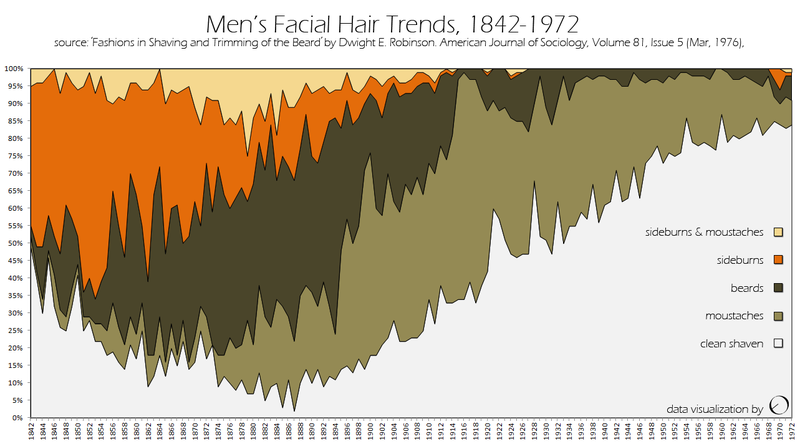
At Vox, Phil Edwards dug up and revived an article from the American Journal of Sociology published in 1976. It tracks facial hair trends — or what the author whimsically calls “frequencies in whisker forms” — from 1842 to 1972. He notes, in particular, the overwhelming dominance of the clean face at the time of publication.

This is your image of the week:

8

The original author uses the data to make an argument about the existence of fashion trends. He’s interested, too, in why fashions change and, in like any good sociologist, recommends further research. He does speculate, though, about one possible driver of change: old people. He writes:

…as long as any considerable number of people who have stuck to a superseded form of personal appearance are still living, the young may tend to avoid such a mode as old hat. These distasteful associations seem to be safely overcome only after the passage of a century or more.

His theory holds. If his data is correct, beards disappeared right around 1915. It’s been a hundred years and beards are back!

Lisa Wade, PhD is an Associate Professor at Tulane University. She is the author of American Hookup, a book about college sexual culture; a textbook about gender; and a forthcoming introductory text: Terrible Magnificent Sociology. You can follow her on Twitter and Instagram.