Search results for The

Welcome Guest Poster Brady Potts, who just put together this post about online communities and collective mourning of Alex Chilton’s death. Brady is a PhD student in sociology at the University of Southern California who studies discourse in the public sphere. He is also the co-editor of The Civic Life of American Religion, and an inveterate music junkie.

——————–

Flags are at half-mast today mourning the death of Alex Chilton, former Box Top, Big Star, producer of The Cramps and Tav Falco’s Panther Burns, and truly eclectic solo artist. It got me thinking about the way people use the internet to collectively mourn the passing of public figures, and how online spaces have developed cultures of their own.

In the comments to a New York Times story about Chilton’s death, you’ll find a variety of comments ranging from brief RIPs to lengthy statements about what Chilton’s music has meant to them. Over at the Onion AV Club, which has a robust-yet-often-snarky commenting culture, you find lengthier, more thoughtful comments that are more like a dialogue between members of the site, as members trade stories, recommend songs to each other, and post links to Chilton’s work.  The comments also reveal a shared knowledge of “what kind of place this is and what kind of discussions we tend to have here,” as is the case with “PB,” who writes:

“Seriously, folks……the first person to make a snarky “Who?” comment gets a punch in the mouth.
Not just because this guy was a legend and your ignorance of him should be viewed with pity and disgust. But also because it’s obnoxious and ghoulish.Remember, just because you’re on the internet doesn’t meet you have to say something.”

“PB” acknowledges the speech norms of the site (“Who?” is a frequent, if contentious, comment regarding cult artists on the site) and, given the occasion, suggests that the usual sarcasm would be inappropriate.

On the other hand, if you click over to this Chilton tribute song by the Replacements and poke around the comments, you find mostly one or two lines of “RIP” and “You’ll be missed”. This is about par for the course with YouTube, whose commenters seem to favor mostly brief remarks (and, it should be said, often veer into speech that many would find wholly objectionable).

So are the differences in these patterns of commenting evidence of a shared collective identity (“AV Clubber”), as opposed to the more anonymous “anything goes” posting style of YouTube? I think that many observers would agree that it is, but looking at the different sites, there also appears to be a “group style,” what Nina Eliasoph and Paul Lichterman describe as “recurrent patterns of interaction that arise from a group’s shared assumptions about what constitutes good or adequate participation in the group setting.”* Some online spaces we implicitly understand as places for anonymous commentary (with all that entails) while others we recognize as places where one should comment in a certain way, regardless of the identity we may or may not share as visitors to the site. This would suggest that visitors to web sites draw on collective understandings of what it means to be a good commenter in certain kinds of online spaces and post accordingly.

In any case, discussions like these are a starting point for all manner of interesting conversations about how we negotiate interaction online, and for that matter, how we use spaces like these to collectively mourn the passing of public figures whose life’s work is deeply meaningful to many people. And to that end, here are a few of my favorite of Chilton’s tunes, so feel free to use the comments to commemorate his work, wonder what the big deal is, lament the fact that they’ve been missing from your life thus far, or otherwise muse on the uses of the internet.

* Nina Eliasoph & Paul Lichterman, 2003, “Culture in Interaction,” American Journal of Sociology 108(4):737.

——————–

So there’s your late-night Alex Chilton memorial post and rumination on the creation and maintenance of online communal identities. For a somewhat different example, see Jay Smooth’s discussion of people mourning Michael Jackson’s death.
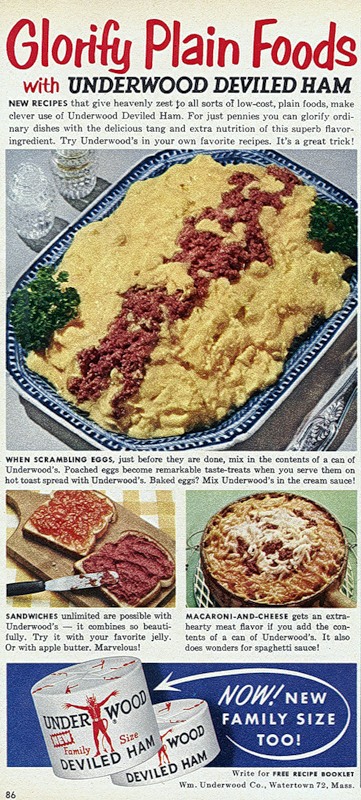
The vintage ad below is another great example of how “tasty” is socially constructed (i.e., culturally- and historically-contingent). If I’m not mistaken, this ad for canned deviled ham is suggesting that it makes a great sandwich when combined with jelly:

For more fun food-related examples of social construction, see our posts on meat-flavored gelatin, savory veggie jell-o, vitamin beer, cucumber flavored soda, soup for breakfast, and 7Up milk.

Source: Vintage Ads.

Lisa Wade, PhD is an Associate Professor at Tulane University. She is the author of American Hookup, a book about college sexual culture; a textbook about gender; and a forthcoming introductory text: Terrible Magnificent Sociology. You can follow her on Twitter and Instagram.

Crossposted at Jezebel.

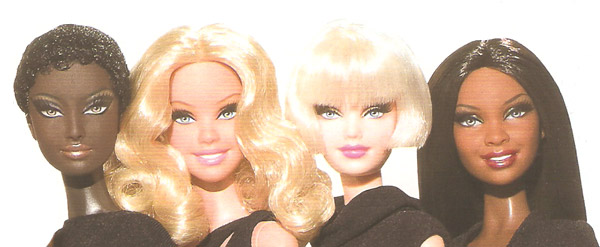
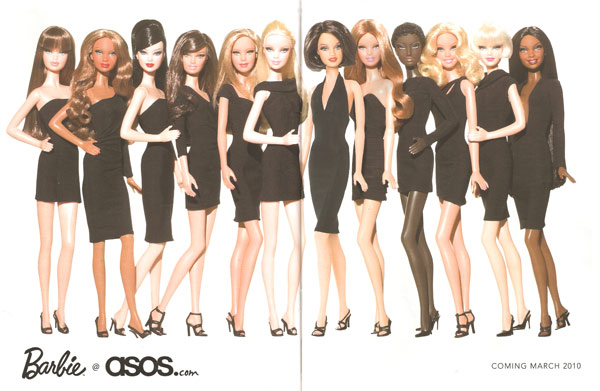
Sarah Barnes, who blogs at Uplift, expressed surprise at seeing the ad below in Grazia magazine:

She found herself surprised, she explains, because it took a minute for it to sink in that the dolls weren’t real people…

She explains:

In a time when everything is photoshopped to such disastrous levels, there really isn’t that much difference between a Ralph Lauren advert using a real model and an ASOS ad using Barbies. When fashion just has to be seen on ‘perfect’ women, we are becoming used to seeing a Barbie-like cookie cutter version of what women look like in our magazines.

So, this is why I screamed. Because, for a second there, I thought the Barbies were real women.

Do they freak you out a bit?

Lisa Wade, PhD is an Associate Professor at Tulane University. She is the author of American Hookup, a book about college sexual culture; a textbook about gender; and a forthcoming introductory text: Terrible Magnificent Sociology. You can follow her on Twitter and Instagram.

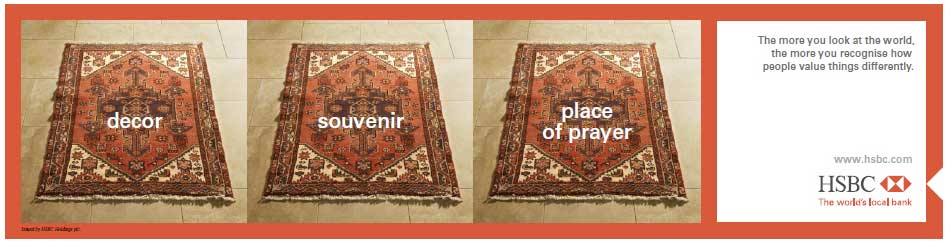
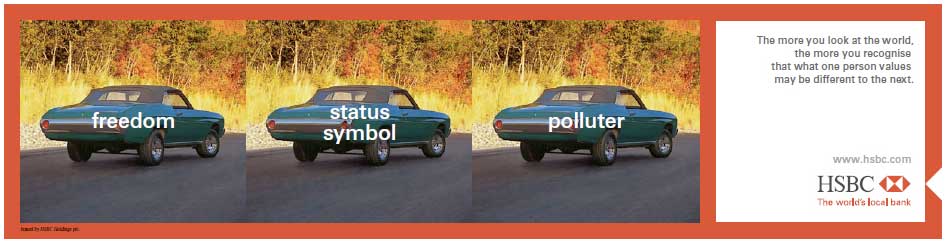
Jay Livingston, who blogs at MontClair SocioBlog, put up a set of ads for a bank that illustrate a basic sociological insight. The message in the ads is “Different values make the world a richer place” and they each feature the same image triply labeled.

Privilege.  Sacrifice.  Role model.

Decor.  Souvenir.  Place of prayer.

Freedom.  Status symbol.  Polluter.

Style.  Soldier.  Survivor.

Glorified.  Vilified.  Gentrified.

They say that a photograph is worth a thousand words, but this exercise reminds us how much words, even one word, can shape our interpretation of an image. The world doesn’t just exist, it must always be interpreted. Those immediately around us have a great ability to influence how we see the world, but the people with power over media do also… and their power is vast.

Lisa Wade, PhD is an Associate Professor at Tulane University. She is the author of American Hookup, a book about college sexual culture; a textbook about gender; and a forthcoming introductory text: Terrible Magnificent Sociology. You can follow her on Twitter and Instagram.

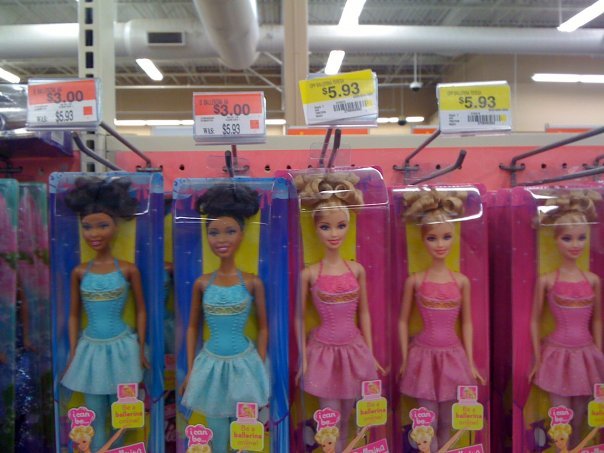
db, Lindsey B., and ABC News asked us to talk about the recent scandal over Walmart pricing a darker-skinned version of the Ballerina Theresa doll less than its white counterpart.  The evidence (from FunnyJunk):

Walmart claimed that the doll was priced less because they were trying to move inventory (ABC News).  It’s possible that the doll wasn’t selling (low demand) or they had ordered more than they could sell (high supply) and so the doll went on sale.  In fact, we know that people of all colors tend to absorb a color hierarchy in which whiteness is nicer, more beautiful, and more valuable (test your unconscious preferences here), so maybe the white doll WAS outselling the non-white doll because both white and non-white people were buying it, but not the darker-skinned doll.  Walmart, in this case, would only be following the market so as to maximize profits.

Walmart, however, could have chosen, in this case, to opt out of profit maximization.  The market isn’t physics; a company doesn’t have to follow its laws.  Walmart could have said, “You know, putting the dark-skinned doll on sale symbolically values whiteness higher than blackness.  Perpetuating that stereotype isn’t worth the money.”  That is, they could have decided that anti-racism trumped profits.

But they didn’t.

It’s important to say that I know of no study showing that, as a rule, white dolls are priced higher or are less likely to go on sale than other dolls.  It may be true that, if we were paying attention, we’d see all kinds of disparate pricing and it wouldn’t pattern itself on race.  Even in this case, I still think that companies need to be cognizant of the context in which they price their products.  In fact, I will go so far as to say that I think it is perfectly fine to discount white dolls while other dolls are left undiscounted, but not vice versa.  Why?  Because we live in a world where discounting dark-skinned dolls resonates with a discourse the symbolically devalues dark-skinned human beings.  Discounting white dolls simply does not carry the same problematic message.

Costco faced this kind of problem when it’s black Lil’ Monkey doll was pulled from shelves.  It turned out that the Lil’ Monkey doll came in three different races, but the black doll carried connotations that the others did not because black people have been compared to primates for centuries in an effort to dehumanize them.  A black Lil’ Monkey is wholly inappropriate in a way that a white Lil’ Monkey is not.

Companies make and sell products in a context.  Following market demands is not opting out; often, it reproduces the status quo.

NEW (Mar. ’10)! Sarah G., after seeing a different post on a multicultural cast of Barbies, looked them up on Target only to discover that the light-skinned Barbies were all priced at $19.99 and the dark-skinned Barbies were all priced at $19.95.  Here are all of the Barbies:

I don’t know, people.  I just don’t know.

See another example here.

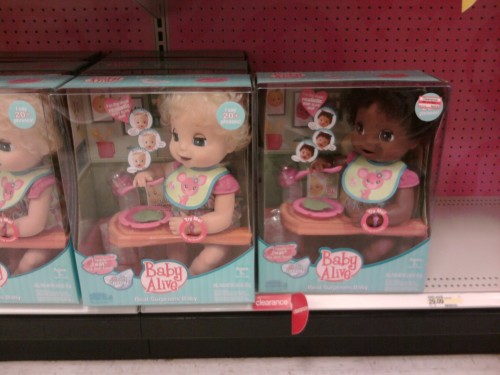
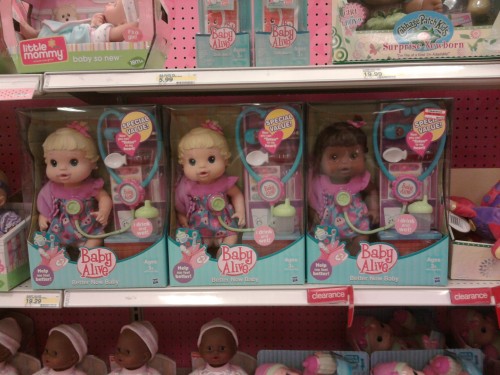
NEW! (July ’10): Christine B. sent in images from Target that show Black Baby Alive dolls (two different types) on clearance (down from $19.29 to $13.50) while the White versions aren’t; the Black dolls are clearly marked on the shelf and with individual stickers:

Lisa Wade, PhD is an Associate Professor at Tulane University. She is the author of American Hookup, a book about college sexual culture; a textbook about gender; and a forthcoming introductory text: Terrible Magnificent Sociology. You can follow her on Twitter and Instagram.

Prolific sender-inner Dmitriy T.M. sent in some maps found at F.A.D. that illustrate where various agricultural items are produced. This one shows the population density of cows (pink), pigs (yellow), sheep/goats (turquoise), chickens (blue), and turkeys (green); the darker the shade of each color, the higher the density. Note that the data is broken down at the county level:

You can see a larger image here, where it’s easier to read the info at the bottom about the highest population density for each animal, per square mile: Cows = 700, pigs = 2,800, sheep/goats = 85, chickens = 75,000, turkeys = 5,500. I suspect the highest density for cattle is based on a county with a lot of feedlots, which put many more cattle in a small space than you’d see on grazing lands.

Notice the high levels of production of chickens throughout the southeast. This is a relatively new occurrence; poultry producers moved into the region due to lower wages and fewer environmental regulations compared to other areas, making it less likely their huge containment facilities would lead to a lot of opposition.

The low densities of sheep/goats are due to a few things. Most obviously, there isn’t nearly as much of a market for sheep or goat meat in the U.S. as for other meats, so they aren’t produced in large numbers. Beyond that, they’re more likely to be raised by people with a small amount of land, or even in a back yard, because they don’t need a lot of space, so you don’t have to have a lot of grazing land devoted just to them the way you do with cattle (though in the western states there certainly are very large herds).

Random bit of info: in the U.S., wool production is just a by-product of sheep meat production in most cases. I worked on a sheep ranch for a few months; they sheared their sheep just to reduce the weight the sheep had to carry around and the chance of overheating. The amount they got for the fleeces just barely covered the cost of hiring a shearing crew. The real profit was in selling the lambs for meat.

Also: you think lambs are super cute, with the jumping and baa-ing and all, but when you have to bottle-feed 40 of them twice a day, they quickly lose their allure. [Note: since commenters are already getting worked up about this being my way of justifying my brutality toward animals, I’ll just state that I’m a vegetarian, so that line of reasoning isn’t going to get you far. That is entirely irrelevant to how exhausting it got to feed lambs.]

Here we have % of land in each county devoted to corn (gold), wheat (green), soybeans (pink), cotton (blue), hay (yellow), and fruits/nuts/veggies (red):

Larger version here.

Dmitriy also sent in an image from GOOD that shows where the various elements that go into a taco in the U.S. come from, and how far they travel on average. I can’t get it large enough here to read the info on the various ingredients, but there’s a larger version here.

From the article on GOOD:

The various spices in the Adobo seasoning, for instance, had traveled a combined 15,000 miles. The avocados had traveled from Chile, home of the world’s largest avocado grower (a company that was said to produce 300 million fruit per year). The rice was imported from Thailand, despite an abundance of California-grown rice, and was packaged under an array of brand names.

Related posts: feeding a city, Unilever encourages local eating, and the global distribution of Starbucks and McDonald’s, ownership of organic brands.

Our online host, Contexts magazine, is offering some free content, a selection of essays on aging, now through March 15th.  I borrowed the material below from the essay, “Facts and Fictions About an Aging America.”

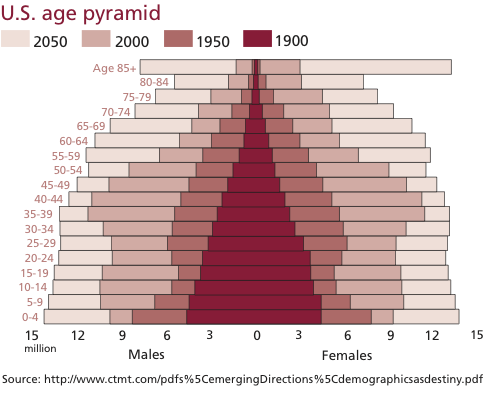
The average American is aging… and fast.  Advances in public health — especially related to childbirth, infant mortality, and infectious disease — have led to longer lives.   “The result is that death has been permanently shifted from a phenomenon among the young to one of the old.”  This means that the age distribution in the U.S. has shifted from one shaped like a neat pyramid (in 1900), to one shaped kind of like a house (in 2000), to whatever shape that is they’re predicting in 2050:

The great news is that “active life span is increasing faster than total life span.”  That is, even though we live longer, we spend fewer of our years sick or disabled than ever before.  This is called (so you can impress your friends) the “compression of morbidity.”

Lisa Wade, PhD is an Associate Professor at Tulane University. She is the author of American Hookup, a book about college sexual culture; a textbook about gender; and a forthcoming introductory text: Terrible Magnificent Sociology. You can follow her on Twitter and Instagram.

Tennille N. sent in this Australian commercial for NutriGrain cereal:

Transcription:

Boys need protein for growth and muscle development.
NutriGrain is one of the highest protein cereals, so as part of a balanced diet and regular exercise, NutriGrain has what it takes to help build your son into an Ironman.
Thanks Mum.
NutriGrain, Ironman food.

As Tennille noted, I guess she doesn’t need NutriGrain, since she’s a girl and, accordingly, does not need muscles, nor athletic aspirations.

Lisa Wade, PhD is an Associate Professor at Tulane University. She is the author of American Hookup, a book about college sexual culture; a textbook about gender; and a forthcoming introductory text: Terrible Magnificent Sociology. You can follow her on Twitter and Instagram.